

2026 Peak Season Shipping Surcharges: How to Reduce Q4 Fulfillment Costs
In September, surcharges remained elevated: FedEx 47.75%, UPS 48.25%, DHL 43.25%, while USPS introduced a 6% peak season surcharge effective October 4. These figures mark the highest sustained surcharge environment since 2020, reshaping cost structures for exporters and e‑commerce sellers alike.
Table of Contents
- Peak Season Surcharge Timeline (2026)
- 2026 Peak Season Surcharges: What Has Changed?
- Impact on Export Enterprises
- Impact on Cross‑Border E‑Commerce Sellers
- Six Ways to Reduce Peak-Season Shipping Costs Without Sacrificing Delivery
- A Practical Q4 Fulfillment Strategy for Cross-Border Sellers
- How ChinaDivision Can Help Reduce Peak-Season Logistics Costs
- FAQ: 2026 Peak Season Surcharges
Peak Season Surcharge Timeline (2026)
| Carrier | Period | Surcharge Range | Key Notes |
|---|---|---|---|
| DHL | Sept 2 – Nov 30 | +$3.00 – $8.50/kg | Tight capacity after Sept 20 |
| FedEx | Sept 1 – Dec 15 | +$2.50 – $7.00/kg | Residential surcharges apply |
| UPS | Sept 8 – Dec 1 | +$2.00 – $6.50/kg | Remote area fees up to $61 |
| USPS | Oct 4 – Jan 17 (2027) | +6% | Priority Mail, Ground Advantage, Parcel Select |
Capacity Alert: DHL and FedEx cargo space to the U.S. will tighten after Sept 20—book shipments by mid‑September to secure space.
2026 Peak Season Surcharges: What Has Changed?
| Cost Layer | What It Covers | How It Can Affect Sellers |
|---|---|---|
| Base transportation rate | Normal transportation | Starting point for shipping cost |
| Fuel surcharge | Fuel-price volatility | Changes according to carrier index |
| Peak/demand surcharge | Holiday capacity and operating pressure | Adds seasonal cost |
| Residential surcharge | Residential delivery | Particularly important for DTC |
| Remote-area surcharge | Difficult-to-reach destinations | Can materially increase individual shipments |
| Additional handling | Oversized, irregular or difficult parcels | Common for bulky products |
| Customs/disbursement fees | Import processing and payment services | Can increase landed cost |
| Storage/fulfillment | Inventory positioning | More important when using overseas warehouses |
This distinction is one of the most important points for sellers planning Q4 logistics.
A product that appears profitable under a base freight quote can become marginally profitable—or unprofitable—after all applicable surcharges are included.
Impact on Export Enterprises
1. Explicit Cost Modeling
With surcharges exceeding 40%, total express cost = base rate × 1.4 + peak surcharge.
Enterprises should treat surcharges as a separate budget line item.
2. Channel Mix Optimization
Use express for urgent samples; shift bulk cargo to dedicated air freight or ocean freight.
This hybrid model can cut logistics costs by 20–35%.
3. Front‑Load Shipments
Complete non‑urgent Q4 shipments by September 15 to bypass surcharge windows.
4. Contractual Pass‑Through Clauses
Under DDP or freight‑collect terms, include surcharge pass‑through clauses to protect margins.
5. Annual Negotiation Leverage
High‑volume exporters can negotiate surcharge caps or rebate tiers during Q4 contract renewals.
Impact on Cross‑Border E‑Commerce Sellers
1. Recalculate Direct‑Ship Costs
Fuel + peak + residential surcharges raise per‑parcel cost by 30–40%.
Reassess pricing for low‑margin SKUs.
2. Build Pricing Buffers
Add a 2–3% logistics buffer to Q4 pricing to absorb surcharge volatility.
3. Ship Before Surcharges Hit
September is the final cost‑saving window—early restocking can preserve up to $1.50–$3.00 per parcel.
4. Diversify Last‑Mile Channels
Use multi‑carrier rate comparison tools to select optimal carriers by destination.
5. Increase Overseas Warehouse Inventory
Local fulfillment avoids last‑mile surcharges and stabilizes delivery times.
Chinadivision’s overseas warehouse network helps sellers hold Q4 inventory closer to customers.
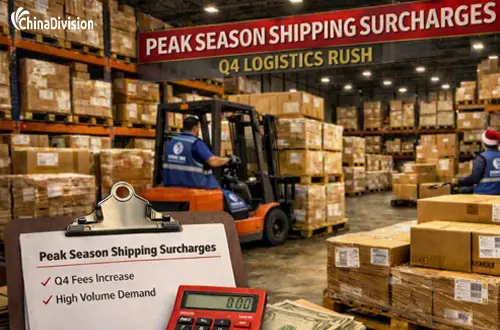
Six Ways to Reduce Peak-Season Shipping Costs Without Sacrificing Delivery
1. Bring Forward Inventory, Not Every Parcel
The best way to avoid expensive Q4 express shipments is to move core inventory earlier.
For high-velocity US or European SKUs, ship bulk stock to an overseas warehouse before late-September capacity constraints intensify. Then use local parcel delivery for final orders.
This converts repeated cross-border parcel shipments into one planned inbound move plus lower-cost domestic last-mile delivery.
2. Segment Inventory by Velocity and Margin
Do not use the same logistics method for every SKU.
| SKU Profile | Recommended Inventory Model |
|---|---|
| High-velocity, high-margin | Overseas warehouse + fast local delivery |
| High-velocity, low-margin | Overseas warehouse + economy domestic service |
| Low-velocity, high-margin | Direct shipping or limited overseas buffer |
| Low-velocity, low-margin | Review viability; avoid expensive express fulfillment |
| Bulky/heavy | Local stock where demand is proven; optimize carton size |
| Seasonal/Q4 SKU | Pre-position baseline stock, retain controlled replenishment buffer |
3. Reduce Dimensional Weight Before Rates Rise
Right-size cartons, reduce void fill, use protective packaging that fits product shape, and check whether packaging triggers carrier handling thresholds.
A package may be physically lightweight but billed as a much heavier parcel because of volume.
Before Q4, review the top 20 SKUs by:
- Dimensional-weight ratio.
- Damage rate.
- Additional Handling trigger.
- Large Package/oversize trigger.
- Freight cost per unit.
- Freight cost as a percentage of selling price.
4. Use Multi-Carrier Rate Shopping
No carrier is cheapest for every zone, package profile, or service level.
A multi-carrier strategy may include:
- USPS Ground Advantage or Parcel Select for qualified domestic US parcels.
- UPS/FedEx for specific zones, weights, and service levels.
- DHL Express for time-sensitive international documents or parcels.
- Regional carriers where coverage and service are appropriate.
- Dedicated cross-border lines for lower-cost direct shipping.
- Air/sea/rail freight for upstream replenishment.
The key is not simply having multiple carrier accounts; it is having routing rules that choose the lowest-cost service that still meets the delivery promise.
5. Use a 3PL Warehouse as a Q4 Buffer
Sending all inventory directly to marketplaces or FBA can create inflexibility. A 3PL buffer warehouse provides a controlled place to:
- Hold inventory before final fulfillment.
- Replenish marketplace stock.
- Split B2B, DTC, and marketplace inventory.
- Relabel or repackage products.
- Process returns.
- Switch carriers or shipping methods when rates change.
- Reduce emergency air freight.
6. Audit Carrier Invoices Weekly During Peak
Peak charges can change by date, service, package category, and volume tier. A monthly invoice review is often too late.
Track:
- Base freight.
- Fuel surcharge percentage.
- Peak/demand surcharge.
- Residential delivery fee.
- Additional Handling.
- Oversize/large package fee.
- Address correction.
- Remote-area fee.
- Dimensional-weight adjustments.
- Failed-delivery and return costs.
The fastest savings during Q4 often come from correcting preventable billing triggers—wrong dimensions, weak packaging design, incorrect address data, and unnecessary express upgrades.
A Practical Q4 Fulfillment Strategy for Cross-Border Sellers
The most effective strategy is usually not to eliminate express shipping. It is to reserve express capacity for orders that genuinely require it.
| Shipment Type | Recommended Channel | Why |
|---|---|---|
| Samples, prototypes, urgent replacement parts | DHL/FedEx/UPS express | Speed and tracking justify cost |
| High-margin, fast-moving small parcels | Express or priority dedicated line | Faster delivery supports conversion and customer experience |
| Planned replenishment to US/EU warehouse | Sea freight, rail, multimodal, or consolidated air freight | Lower cost per unit and better capacity planning |
| Large B2B shipment | FCL/LCL ocean, air cargo, or scheduled freight | Better economics than parcel express |
| Low-value, non-urgent DTC orders | Economy direct line or postal/hybrid service | Cost control where transit time is flexible |
| Heavy or oversized parcels | Specialized freight/3PL solution | Avoid parcel-carrier oversize and handling charges |
This approach creates channel elasticity.
When one carrier becomes expensive or capacity becomes constrained, order volume can be shifted to another logistics channel.
How ChinaDivision Can Help Reduce Peak-Season Logistics Costs

For cross-border sellers, the objective should not be simply to find the cheapest carrier.
It should be to build a flexible fulfillment architecture that can respond to changing transportation costs.
ChinaDivision can support this through a combination of:
Multi-Channel Fulfillment
Select different transportation channels according to product characteristics, destination, urgency and order economics.
Warehouse Inventory Management
Position high-volume products closer to customers while keeping long-tail products in China where appropriate.
Pick & Pack Optimization
Review packaging dimensions and packing methods to reduce unnecessary billable weight and avoid package-related surcharges.
Consolidated Replenishment
Combine inventory into larger international shipments rather than sending every customer order independently from China.
Carrier and Route Flexibility
Maintain multiple transportation options so that sellers are less dependent on one carrier's pricing and peak-season capacity.
Real-Time Fulfillment Data
Monitor order volume, inventory levels, shipping costs and destination patterns to identify when a product should move from cross-border fulfillment to overseas inventory.
The operational advantage is not simply a lower shipping quote.
It is the ability to change the fulfillment method when the economics change.
FAQ: 2026 Peak Season Surcharges
What is the difference between fuel surcharges and peak season surcharges?
A fuel surcharge responds to fuel-cost changes and is typically updated regularly. A peak or demand surcharge is a temporary fee applied during high-volume periods or to specific package profiles, such as residential, large, oversize, or additional-handling shipments.
How can I avoid UPS and FedEx peak season surcharges?
You cannot always avoid them, but you can reduce exposure by shipping planned inventory before peak periods, using local fulfillment, right-sizing packaging, avoiding oversized parcels, comparing carriers, and routing non-urgent shipments through lower-cost services.


About the Author: Limi

Limi is a content marketing expert at ChinaDivision, helping businesses and e-commerce sellers navigate the complexities of international shipping by providing actionable tips and comprehensive guides on logistics, shipping, and cargo transportation.