

Chinadivision Adds Automatic Sorting Machine, Boosting Warehouse Efficiency by 30%
As e-commerce order volumes continue to grow, warehouse efficiency is no longer determined by storage capacity alone. How quickly and accurately products can move from receiving to sorting, packing, and shipping has become equally important.
Table of Contents
- What Is an Automatic Sorting Machine?
- Why Chinadivision Added Automatic Sorting Equipment
- Automatic Sorting Machine vs. Manual Sorting
- Automation Is Only as Good as the Data Behind It
- From Warehouse Upgrade to Better Customer Experience
- What Makes Chinadivision's Approach Different?
- What This Warehouse Upgrade Means for Chinadivision Customers
- Building a More Intelligent Fulfillment Warehouse
- Frequently Asked Questions (FAQ)
To strengthen its warehouse automation capabilities, Chinadivision has introduced a new automatic sorting machine as part of its ongoing warehouse equipment upgrade.
The upgrade is designed to address one of the most labor-intensive stages of fulfillment: parcel identification and destination sorting.
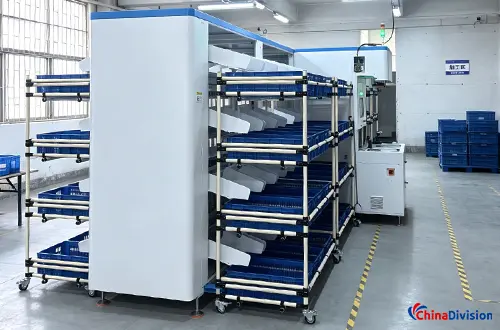
According to Chinadivision's operational results, the new sorting equipment has helped achieve:
- 30% increase in sorting efficiency
- 99.9% sorting accuracy
- Faster parcel routing to the correct processing or shipping area
- Reduced dependence on repetitive manual sorting
- Better scalability during high-volume periods
This is not simply an equipment purchase. The objective is to connect physical automation with warehouse management and fulfillment processes so that inventory can move through the warehouse with fewer manual intervention points.
What Is an Automatic Sorting Machine?
An automatic sorting machine is warehouse automation equipment that uses technologies such as barcode scanning, RFID, cameras, control software, and mechanical divert mechanisms to identify and route parcels according to predefined criteria.
Unlike a conventional conveyor, which primarily moves products from one location to another, an automatic sorting system can identify an item, determine where it needs to go, and physically divert it to the appropriate destination.
A typical automated sorting workflow includes:
- Induction – Parcels enter the sorting system.
- Identification – Barcodes, RFID, cameras, or other sensors identify the parcel.
- Data processing – The system communicates with the WMS or sorting controller.
- Routing decision – The system determines the appropriate destination.
- Automatic diverting – A mechanical mechanism moves the parcel to the correct lane.
- Verification – Sensors confirm the sorting result and flag exceptions.
This integration between hardware, software, scanning, and warehouse data is what makes automated sorting valuable for modern fulfillment operations. The value of automation is not simply moving more parcels. It is reducing the number of parcels that require human recovery after an incorrect routing decision.
Why Chinadivision Added Automatic Sorting Equipment
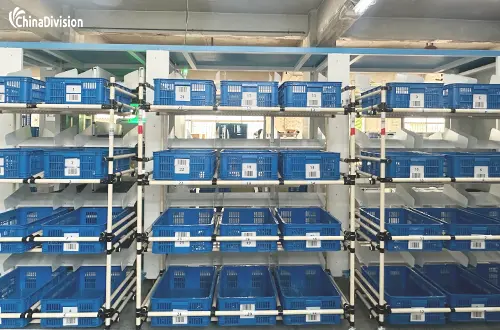
For a 3PL fulfillment provider, sorting is not an isolated warehouse activity. A sorting error can create a chain reaction:
Incorrect identification → wrong destination → additional handling → shipping delay → customer service issue.
At higher order volumes, even a small percentage of sorting errors can create substantial manual recovery work.
Chinadivision's equipment upgrade therefore focuses on two measurable outcomes:
1. Increase Processing Efficiency
Automated sorting reduces repetitive manual routing work and allows parcels to move through the warehouse more consistently.
The new system has increased sorting efficiency by 30%, giving the warehouse additional processing capacity without relying solely on proportional increases in manual labor.
2. Improve Sorting Accuracy
The system combines parcel identification and automated routing to reduce manual sorting errors.
The upgraded operation has achieved a 99.9% sorting accuracy rate, making accuracy a measurable operational KPI rather than simply a qualitative promise.
Automatic Sorting Machine vs. Manual Sorting
|
Factor |
Manual Sorting |
Automatic Sorting |
|---|---|---|
|
Parcel identification |
Primarily manual |
Automated scanning/sensing |
|
Destination routing |
Employee decision |
System-driven |
|
Processing speed |
Labor dependent |
Equipment dependent |
|
Accuracy |
Operator dependent |
System + scanning dependent |
|
Peak scalability |
Requires additional labor |
Higher throughput capacity |
|
Repetitive work |
High |
Reduced |
|
Data visibility |
More limited |
Better integration potential |
|
Exception handling |
Manual investigation |
Automated flagging + intervention |
The key point is that automation does not eliminate human involvement. Instead, it moves employees away from repetitive sorting tasks and toward exception handling, quality control, inventory management, and other higher-value activities.
Automation Is Only as Good as the Data Behind It
One of the most important lessons from warehouse automation is that buying a faster machine does not automatically create a faster fulfillment operation.
The sorting equipment needs accurate information about:
- SKU or parcel identity
- Destination
- Shipping method
- Order status
- Carrier requirements
- Warehouse location
- Exception status
The source material highlights an often-overlooked bottleneck: data-processing latency between the sorting equipment and the WMS can affect the physical sorting result. In high-throughput environments, even seemingly small delays can become operationally significant.
This is why Chinadivision's warehouse upgrade should be viewed as an automation + software + process improvement, rather than simply the installation of a new machine.
From Warehouse Upgrade to Better Customer Experience
Warehouse automation ultimately matters because customers do not see the sorting machine.
They see the outcome:
Order placed → order processed → parcel shipped → tracking updated → package delivered.
A more efficient sorting operation can support this chain by reducing unnecessary handling and helping parcels reach the correct downstream processing area faster.
For merchants, this can translate into:
- Faster order processing
- Fewer sorting-related errors
- More predictable fulfillment
- Better peak-season capacity
- Reduced manual handling
- Greater operational scalability
This is particularly important for brands experiencing rapid order growth but not wanting warehouse labor requirements to increase at the same rate.
What Makes Chinadivision's Approach Different?
Many fulfillment providers promote warehouse automation by showing robots, conveyors, and other equipment.
However, the equipment itself is not the complete value proposition.
Chinadivision's approach is to connect warehouse equipment with the broader fulfillment workflow, including inventory management, order processing, sorting, shipping, and operational data.
The practical objective is simple:
Use automation where it creates measurable operational value—not automation simply for the sake of having automated equipment.
This philosophy is particularly relevant for 3PL customers because merchants ultimately care about accuracy, processing speed, shipping reliability, inventory visibility, and total fulfillment cost, rather than the number of machines inside a warehouse.
What This Warehouse Upgrade Means for Chinadivision Customers
The addition of an automatic sorting machine strengthens Chinadivision's ability to support businesses with growing order volumes.
For customers, the upgrade provides an additional layer of operational capacity while helping maintain consistent sorting performance during periods of increased demand.
|
Metric |
Before Upgrade |
After Upgrade |
Impact On You |
|---|---|---|---|
|
Sorting efficiency |
Baseline |
+30% |
Orders ship 1–2 days faster; peak seasons handled without delays |
|
Sort accuracy |
99.2% |
99.9% |
87% fewer mis-sorts; almost no wrong-destination shipments |
|
Throughput capacity |
Standard |
Up to 20,000 parcels/hour |
Scale instantly as you grow internationally |
|
Parcel damage rate |
0.8% |
0.15% |
Gentle cross-belt discharge protects fragile, high-value goods |
|
International routing |
Manual + semi-auto |
Fully automated by country & service |
DDP/DDU, customs lanes, and carrier routes auto-assigned |
It is especially relevant for:
- E-commerce brands
- DTC businesses
- Amazon and marketplace sellers
- Crowdfunding campaigns
- High-SKU brands
- Seasonal businesses
- International sellers
- B2B and wholesale fulfillment programs
As order volume grows, the ability to process parcels consistently becomes increasingly important.
Building a More Intelligent Fulfillment Warehouse
The automatic sorting machine is one component of Chinadivision's broader warehouse modernization strategy.
The long-term objective is to continue connecting:
Warehouse Equipment + WMS + Scanning + Inventory Data + Order Management + Transportation
This creates a more integrated fulfillment environment in which physical warehouse operations and digital decision-making work together.
The source material similarly emphasizes that modern sorting performance depends on the interaction between scanning, control systems, WMS integration, and physical divert mechanisms—not on the sorting machine alone.
Frequently Asked Questions
Does warehouse automation eliminate warehouse workers?
No. Automation primarily reduces repetitive manual work. Employees remain important for exception handling, quality control, inventory management, equipment supervision, and other operational tasks.
Is an automatic sorting machine suitable for e-commerce fulfillment?
Yes. Automated sorting can be particularly useful for e-commerce fulfillment centers processing large numbers of parcels with multiple SKUs, destinations, carriers, and shipping requirements.
Why does WMS integration matter for automated sorting?
The sorting machine needs accurate routing information. The WMS or sorting controller provides the data required to determine where each parcel should be sent. Poor integration or delayed data can therefore reduce the effectiveness of otherwise capable sorting equipment.


About the Author: Limi

Limi is a content marketing expert at ChinaDivision, helping businesses and e-commerce sellers navigate the complexities of international shipping by providing actionable tips and comprehensive guides on logistics, shipping, and cargo transportation.