

3PL Automation vs. Technology: Key Differences & Benefits
Walk into any modern fulfillment center and you’ll see it everywhere: robots gliding, conveyors humming, lights flashing, and packages zipping across sortation systems. It’s impressive — and that’s exactly what most 3PL providers want you to see. They market the bells and whistles, show off the shiny machinery, and call that "advanced logistics".
Table of Contents
Here’s the truth most competitors won’t tell you: automation is only the hardware. Technology is the brain. And without the brain, the hardware is just expensive decoration.
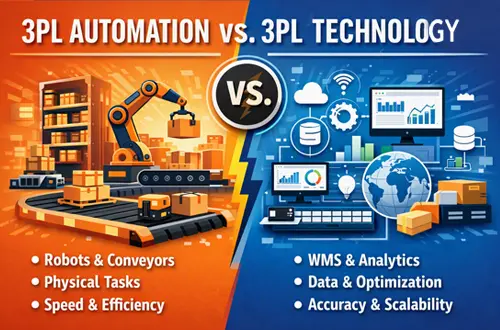
At Chinadivision, we invest in both — but we measure success differently. We don’t buy automation just to look modern; we deploy it only when it delivers clear, sustainable value. And we build our technology stack first, so every robot, conveyor, and scanner actually works harder for your business.
Below we break down the real differences, how they work together, and why picking a 3PL with the right balance directly impacts your bottom line.
What Is 3PL Warehouse Automation?
Automation refers to mechanical, electronic, or physical systems that perform repetitive warehouse tasks with minimal human input. It is the visible part of fulfillment — the things you see in facility tours and marketing videos.
Common Types of Warehouse Automation
|
Automation Type |
What It Does |
Real-World Impact |
|---|---|---|
|
AS/RS (Automated Storage & Retrieval) |
Stores and retrieves goods automatically from high-density racks |
3–5× faster putaway/picking; 99.8% inventory accuracy |
|
Conveyor & Sortation |
Moves items between zones and routes to correct lanes |
2–4× higher throughput; fewer misrouted orders |
|
Robotics |
Picking, packing, palletizing, or replenishment |
Reduces walking time by 70%; scales peaks without overtime |
|
Auto-Scanning & Dimensioning |
Weighs, measures, photographs, and scans items on arrival |
Eliminates manual entry; catches shipping errors instantly |
|
Automated Slotting |
Assigns SKUs to optimal locations based on size, weight, and velocity |
Cuts pick paths by 30%; reduces bottlenecks |
Proven Benefits of Automation
✅ Faster processing → shorter lead times
✅ Higher accuracy → fewer returns and customer complaints
✅ Predictable throughput → scales peaks without quality drops
✅ Safer operations → less repetitive lifting and motion injury
✅ Lower cost per unit as volume grows
What Is 3PL Fulfillment Technology?
Technology is the invisible layer — the software, integrations, and data systems that run the entire operation. This is what competitors rarely showcase, yet it determines whether orders ship on time, inventory stays accurate, and cross-border compliance works.
Technology does not replace people — it empowers them to work smarter. It turns piles of data into clear decisions. It connects every sales channel, every carrier, every country’s customs rules — so you don’t have to.
Core Technology Systems That Power Modern Fulfillment
|
Technology |
What It Does |
Why It Matters To You |
|---|---|---|
|
Warehouse Management System (WMS) |
Central command — inventory, orders, routing, labor, reporting |
Real-time visibility; prevents overselling; one dashboard for all channels |
|
Transportation Management System (TMS) |
Rates, routes, labels, manifests, and carrier selection |
Cheaper shipping; faster delivery; accurate landed cost calculation |
|
Sales & B2B Integrations |
Shopify, WooCommerce, Amazon, eBay, EDI, and more |
Orders flow automatically; inventory syncs instantly; no manual data entry |
|
Returns & Workflow Engines |
Auto-authorize, route, and process returns |
Faster refunds; accurate restocking; clear visibility |
|
Virtual Carrier Network (VCN) |
Aggregated buying power + smart routing logic |
Your shipping costs drop as if you were shipping our total volume |
|
Compliance & Global Tools |
HS classification, duty/tax calculation, document generation |
Fewer customs delays; accurate landed cost; DDP/DDU automation |
|
Analytics & Reporting |
Turn data into actionable insights |
See trends, seasonality, slow-movers, and cost-saving opportunities |
Key Benefits You Actually Care About
✅ One source of truth — orders and inventory sync across every sales channel automatically
✅ Real-time visibility — track stock, orders, and shipments anytime, anywhere
✅ Grow without changing partners — add channels, markets, or fulfillment centers seamlessly
✅ Global expansion made simpler — built-in compliance, landed cost, and multi-currency support
✅ Better customer experience — accurate orders, fast shipping, proactive notifications
✅ Lower hidden costs — technology catches errors before they become shipping mistakes
Automation vs. Technology: Side-by-Side Comparison
|
Factor |
Automation |
Technology |
|---|---|---|
|
Role |
Executes physical tasks |
Orchestrates the entire process |
|
Visibility |
High — everyone sees it |
Low — usually hidden from view |
|
Cost profile |
High upfront, long payback |
Lower upfront, monthly or scalable cost |
|
Scalability |
Fixed capacity; expensive to expand |
Scales instantly; add volume without limits |
|
Global capability |
Limited to one facility |
Works across all warehouses and countries |
|
Integration value |
Only as good as the system directing it |
Connects everything — people, machines, carriers, channels |
|
Risk of misalignment |
Overbuy without strategy = wasted money |
Underinvest = automation underperforms |
|
Competitive advantage |
Easy to copy — everyone can buy robots |
Hard to copy — built over years with real operational data |
3PL automation primarily performs physical warehouse tasks with less manual intervention, while fulfillment technology connects systems, data, people, inventory, orders, and transportation to coordinate the entire fulfillment operation.
How They Work Together — And Why Most 3PLs Get It Wrong
Here is the critical insight your competitors skip:
Automation follows instructions. Technology writes the instructions.
A conveyor belt cannot know which orders are DDP vs DDU, which shipments need special customs documents, or which carrier is cheapest to Germany today. Technology tells it what to do.
At Chinadivision, we build the technology foundation first. Our WMS knows your products, your channels, your global markets, and your compliance requirements. Then — and only then — we deploy automation where it delivers the highest return. Our systems direct our AS/RS, conveyors, and sorters with precision, so every piece of equipment is working at maximum efficiency.
Why Technology Drives ROI More Than Automation
Most 3PLs invest heavily in automation because it’s easy to showcase. But the highest ROI comes from technology investments that competitors often ignore.
1. Error Reduction (The Silent Cost Killer)
Industry data shows that inventory inaccuracies cost merchants 1–3% of revenue annually.
Automation doesn’t fix this — technology does.
2. Forecasting & Demand Planning
Robots can’t predict stockouts.
A WMS with predictive analytics can.
3. Multi‑Channel Complexity
Automation doesn’t understand Shopify, Amazon, TikTok Shop, or wholesale EDI requirements.
Technology does.
4. International Scalability
Automation can’t manage customs documentation or carrier mapping.
Technology does.
For most 3PLs in 2026, technology delivers faster and more reliable ROI. The WMS market is growing at 21.9% CAGR versus 13.98% for automation hardware because software scales without capital expenditure and solves the integration complexity that kills automation projects. Automation ROI is high when implemented correctly, but failure rates are significant when the technology layer is immature.
FAQ: 3PL Automation and Fulfillment Technology
Is 3PL automation the same as warehouse technology?
No. Automation generally refers to systems that perform physical or repetitive tasks with reduced manual intervention. Fulfillment technology includes the broader digital infrastructure—such as WMS, integrations, APIs, transportation systems, and analytics—that coordinates fulfillment operations.
What is the most important technology in a 3PL warehouse?
The WMS is typically the central operational system because it coordinates inventory, receiving, picking, packing, and fulfillment workflows. However, its value depends on how well it integrates with ecommerce platforms, transportation systems, warehouse equipment, and reporting tools.
Does every 3PL need robots?
No. The right level of automation depends on order volume, SKU characteristics, product dimensions, workflow consistency, and expected growth. Some operations benefit more from strong WMS technology and process optimization than from expensive physical automation.
Can automation reduce fulfillment costs?
It can, particularly for repetitive, predictable, high-volume workflows. However, automation also introduces equipment, integration, maintenance, and implementation costs. The correct question is whether the automation produces an acceptable return on investment.
Why is WMS important for ecommerce fulfillment?
A WMS provides a centralized system for managing inventory and warehouse operations. When integrated correctly with ecommerce platforms and shipping systems, it can reduce manual work and improve inventory and order visibility.


About the Author: Limi

Limi is a content marketing expert at ChinaDivision, helping businesses and e-commerce sellers navigate the complexities of international shipping by providing actionable tips and comprehensive guides on logistics, shipping, and cargo transportation.