

Priority Mail vs. Priority Mail Express (2026): Costs & Picks
Table of Contents
- What Is USPS Priority Mail?
- What Is USPS Priority Mail Express?
- Priority Mail vs. Priority Mail Express: Side-by-Side
- What Each One Actually Costs
- Priority Mail Box Sizes (and When to Use Each)
- Advantages and Disadvantages of Each Service
- When to Choose Priority Mail
- When to Choose Priority Mail Express
- How Long Does Priority Mail Really Take?
- Six Ways to Cut Your Priority Mail Costs
- How ChinaDivision Helps You Ship Smarter
- Frequently Asked Questions
What Is USPS Priority Mail?
Priority Mail is the USPS domestic service that sits above First-Class Mail and below Express. It is the workhorse of American parcel shipping — used by everyone from solo Etsy sellers to national retail brands sending return labels.
What you get as standard
- Delivery target: 2–3 business days to most of the continental United States. Note that USPS now markets Priority Mail as a 2–3 day service; the “1–3 day” figure you’ll see on many older comparison pages predates the current service standards.
- Weight limit: 70 lbs, for both Flat Rate and weight-based options.
- USPS Tracking included, with delivery scans at no extra charge.
- Insurance included — up to $100 on most shipments. (Some retail-rate pieces still cap at $50, so check your label. Additional coverage is available up to $5,000.)
- Free packaging — Flat Rate boxes, envelopes and labels cost nothing, delivered to your door.
- Saturday delivery included at no extra cost.
- No dimensional-weight penalties on most parcels, though pieces above certain size thresholds do incur surcharges.
The catch that matters most: Priority Mail carries no money-back guarantee. The 2–3 day window is a service target, not a commitment. If your package lands on day four, it’s late — but there is no refund process you can trigger, the way there is with Express.
For everyday shipments, that’s a reasonable trade for a much lower price. For anything genuinely date-critical, it isn’t.
What Is USPS Priority Mail Express?
Priority Mail Express is the fastest domestic service USPS offers — and the only one that puts money behind its delivery window.
What you get as standard
- Delivery commitment: 1–3 days by 6 PM to most U.S. addresses and PO Boxes, with next-day or 2-day service on many major metro corridors.
- A money-back guarantee. Miss the committed window and the sender can claim a full refund on postage. No other domestic USPS product works this way.
- 7-day-a-week, 365-day-a-year delivery, including Sundays and holidays in many markets.
- Sunday/Holiday delivery available for an additional fee (currently about $12.50 on top of postage).
- Weight limit: 70 lbs, same as Priority Mail.
- Insurance included up to $100 on most shipments, with additional coverage purchasable.
- USPS Tracking with more frequent scan events.
- Free package pickup included — a real convenience if you’re shipping volume and don’t want a daily post office run.
The service itself is not new. USPS began piloting an overnight product in 1970, made it a permanent class of mail in 1977 as Express Mail, and later rebranded it Priority Mail Express to align with the Priority Mail family. The core promise — guaranteed speed — has survived largely unchanged for around five decades.
Priority Mail vs. Priority Mail Express: Side-by-Side
| Feature | Priority Mail | Priority Mail Express |
|---|---|---|
| Delivery time | 2–3 business days (target) | 1–3 days by 6 PM (often 1–2 days) |
| Money-back guarantee | ✕ No | ✓ Yes |
| Saturday delivery | ✓ Included | ✓ Included |
| Sunday / holiday delivery | ✕ Not offered | ✓ Many markets, ~$12.50 extra |
| Weight limit | 70 lbs | 70 lbs |
| Included insurance | Up to $100 (as low as $50 on some retail pieces) | Up to $100 |
| Tracking | ✓ Included | ✓ Included, more scan events |
| Free packaging | ✓ Boxes, envelopes, labels | ✓ Boxes, envelopes, labels |
| Free pickup | Available | ✓ Included |
| Starting retail price | ~$11 (by weight) / ~$13 Flat Rate Envelope | ~$36 Flat Rate Envelope |
| Commercial / online rates | ~$9 and up | ~$31 and up |
| International version | Priority Mail International | Priority Mail Express International |
| Best for | Everyday and e-commerce orders where speed matters but a specific date doesn't | Deadlines where a late arrival creates a real cost |
The one-line read: same weight limit, same free packaging, same included tracking. Priority Mail Express buys you a real guarantee, a tighter window, and Sunday delivery. Everything else is broadly matched — which is exactly why the price gap is the whole conversation.
What Each One Actually Costs
This is where the decision usually gets made. Express runs roughly three to four times the cost of Priority Mail — for a delivery window that may only be one day shorter in practice.
Three price tiers, not one
Most price comparisons mislead because they quote a single number. USPS has three tiers:
- Retail counter price — the highest. Priority Mail Flat Rate Envelope is around $13, Priority Mail Express Flat Rate Envelope around $36.
- Online price (Click-N-Ship commercial rates) — typically 10–15% lower. Priority Mail commonly lands near 9–11 for the lightest pieces; Express near $31.
- Business Rate Card / volume pricing — further discounts for accounts shipping in volume, plus negotiated rates through a 3PL.
Always compare on the tier you’ll actually pay from. Quoting retail rates against commercial rates is the fastest way to make a bad logistics decision.
Flat Rate vs. by weight and zone: which is cheaper?
| Flat Rate | By Weight & Zone | |
|---|---|---|
| Price based on | Package type only | Actual weight + distance (Zones 1–8) |
| Weighing required | No — up to 70 lbs | Yes |
| Wins when | Contents are dense and heavy (tools, liquids, books, parts) | Contents are light and bulky, or shipping locally |
| Example | A 20 lb Medium Flat Rate Box ships at the Medium Flat Rate price regardless of weight | A 1 lb package to a nearby zone can cost less than any Flat Rate option |
Rule of thumb: heavy and small → use Flat Rate. Light and bulky → ship by weight and zone, or you’re paying for weight you don’t have.
One more trap: for parcels over one cubic foot (1,728 cubic inches), USPS charges on actual weight or dimensional weight, whichever is higher. A big, light box can therefore price like a heavy one.
Surcharges that surprise shippers
- Sunday/Holiday delivery (Express only): +$12.50
- Length over 22 in but not over 30 in: +$4.50
- Length over 30 in: +$21.00
- Parcels over 2 cubic feet (3,456 cu in): +$35.00
- Cylindrical tubes, cans, wooden or metal boxes, certain liquid shipments: +$4.50
- Live animals and perishables: +$7.50 | HAZMAT handling: +$7.50
Priority Mail Box Sizes (and When to Use Each)
Free packaging is one of the most underused cost levers in USPS shipping. Order the boxes and envelopes at no charge from usps.com, and match the box to the product instead of paying for empty space.
| Packaging | Interior Size | Typical Contents |
|---|---|---|
| Flat Rate Envelope | 12½″ × 9½″ | Documents, apparel, small flat goods |
| Legal Flat Rate Envelope | 15″ × 9½″ | Contracts, oversized documents |
| Padded Flat Rate Envelope | 12½″ × 9½″ | Electronics, jewelry, anything needing cushioning |
| Small Flat Rate Box | 8⅝″ × 5⅜″ × 1⅝″ | Phone cases, jewelry, small electronics |
| Medium Flat Rate Box (top-loading) | 11″ × 8½″ × 5½″ | Shoes, toys, small home goods |
| Medium Flat Rate Box (side-loading) | 13⅝″ × 11⅞″ × 3⅜″ | Books, board games, flat bundles |
| Large Flat Rate Box | 12″ × 11¾″ × 5½″ | Bulky or multi-item orders |
| APO/FPO/DPO Large Flat Rate Box | 12″ × 11¾″ × 5½″ | Military and diplomatic addresses |
Priority Mail Express offers parallel Flat Rate options — a standard envelope, a legal envelope and a padded envelope — designed around documents and small, urgent items rather than general merchandise.
Practical note: as long as the item fits and stays under 70 lbs, a Flat Rate box costs the same whether it’s empty or packed with bricks. That makes it a strong default for dense products — and a poor choice for lightweight ones.
Advantages and Disadvantages of Each Service
Priority Mail — advantages
- Cost efficiency. The lowest-cost USPS service that still includes tracking, insurance and fast air transport.
- Predictable Flat Rate pricing. One price up to 70 lbs, with no weighing.
- Free packaging and Saturday delivery included.
- Broad coverage. Every U.S. state and territory, plus APO/FPO/DPO military addresses.
- Transparent tracking, viewable by you and your customer.
Priority Mail — disadvantages
- No delivery guarantee. Weather, peak season or network congestion delays produce no refund.
- Slower than Express. 2–3 business days versus a guaranteed 1–3 day commitment.
- No standard Sunday or holiday delivery.
- Size and weight ceilings. Nothing above 70 lbs; oversize pieces trigger surcharges.
- Dimensional weight kicks in above one cubic foot, penalising large, light packages.
Priority Mail Express — advantages
- The money-back guarantee. The single most valuable feature for deadline-driven shipments.
- Fastest domestic service, with next-day delivery on many metro routes.
- 7-day delivery, including Sunday and holidays in many markets.
- Free pickup included — significant for high-volume senders.
- Greater customer confidence on time-critical orders, which shows up in reviews and repeat purchases.
Priority Mail Express — disadvantages
- Three to four times the price for a window that is often only a day shorter.
- Guarantee exceptions exist. Remote destinations, some military addresses and certain force-majeure events are excluded, and claims require documentation within the filing window.
- Fewer packaging choices, geared toward documents and small parcels.
- Overkill for most orders. Defaulting to Express is one of the fastest ways to destroy shipping margin.
When to Choose Priority Mail
Choose Priority Mail when speed matters but a specific date doesn’t. That covers:
- E-commerce orders and general retail shipping
- Returns and exchanges
- Documents that need to move quickly but carry no legal deadline
- Lightweight or low-value goods with healthy margin
- Businesses balancing delivery speed against shipping cost at volume
For most senders, the 2–3 day window is fast enough on its own, and the absence of a formal guarantee rarely becomes a real problem in day-to-day operations.
When to Choose Priority Mail Express
Choose Priority Mail Express when a missed date creates a concrete cost — financial, legal or reputational:
- Legal filings and documents with a court or regulatory deadline
- Time-sensitive medical samples, prescriptions or specimens
- Contracts, tenders and bids that must arrive by a set date
- High-value replacement parts holding up a repair or production line
- Orders where the customer has explicitly paid for guaranteed delivery
- Shipments where you want the refund guarantee purely as a risk hedge
If a package absolutely must arrive by a certain day, and missing that day would cost more than the additional postage, Express is the only domestic USPS option built to back that promise up.
How Long Does Priority Mail Really Take?
USPS transit times are driven by distance across nine postal zones:
| Route | Priority Mail | Priority Mail Express |
|---|---|---|
| Local (Zones 1–2) | 1–2 business days | Next day by 6 PM |
| Mid-distance (Zones 3–5) | 2–3 business days | 1–2 days by 6 PM |
| Cross-country (Zones 6–8) | 3 business days | 2–3 days by 6 PM |
Non-contiguous and special destinations. Both services deliver to Alaska, Hawaii, Puerto Rico and APO/FPO/DPO military addresses. Transit windows stretch beyond the standard ranges for these locations, Express commitments often extend to 2–3 days, and certain remote bases are excluded from the money-back guarantee. If you ship to these destinations regularly, build the extra day into your promised delivery date rather than promising a window USPS won’t hold.
What actually causes delays: severe weather, December peak volume, incorrect or incomplete addresses, and packages flagged for HAZMAT review. None of these generate a refund on Priority Mail — only on Express.
Six Ways to Cut Your Priority Mail Costs
- Buy postage online, not at the counter. Click-N-Ship commercial rates are consistently lower than retail, and business accounts save more again.
- Use the free packaging. Flat Rate boxes and envelopes cost nothing and ship free to your door. Free supplies are pure margin.
- Match the box to the product. Choose the smallest Flat Rate box that fits. Empty space is the most common hidden shipping cost.
- Run the Flat Rate vs. by-weight calculation on your top 20 SKUs. Dense products belong in Flat Rate; light, bulky ones belong on the scale. Do this once and it usually pays for itself within a week.
- Keep parcels under one cubic foot where possible. That’s the point where dimensional weight starts pricing your air.
- Split the mix deliberately. Route the vast majority of orders to Priority Mail and reserve Express for the genuine deadlines. Sellers who default to Express on every order typically pay 3–4× more.
How ChinaDivision Helps You Ship Smarter
Getting the service choice right is one decision. Executing it consistently across hundreds of orders a week is a different problem — and that’s where a fulfilment partner earns its keep.
As a third-party logistics provider, ChinaDivision handles the operational layer between your store and the carrier:
- Right-sized packing. We pick the correct Priority Mail box or shipping option for each order, so you’re not paying for empty space or weight you don’t have.
- Cost engineering. We route orders between Flat Rate, weight-and-zone and Express based on the actual destination and deadline, and pass our carrier rates through to you.
- Warehousing and inventory. Store stock closer to your customers to shorten USPS zones — shorter zones mean lower postage and faster transit, without upgrading the service level.
- Order management and tracking. Orders flow straight from your sales channels into our system, with tracking pushed back to your customers automatically.
- Support that answers. A dedicated team handles delivery exceptions, claims and reshipments so your customer never has to chase you for an answer.
If you want to know what your shipping really costs — and where the savings are hiding — our team will review your order profile and model it out.
Frequently Asked Questions
What is the main difference between Priority Mail and Priority Mail Express?
The guarantee. Priority Mail delivers in about 2–3 business days with no formal commitment. Priority Mail Express commits to 1–3 days by 6 PM and includes a USPS money-back guarantee if that window is missed.
How much does Priority Mail Express cost compared to Priority Mail?
Priority Mail Express typically runs three to four times the price of Priority Mail. At retail, a Priority Mail Flat Rate Envelope is around $13 while a Priority Mail Express Flat Rate Envelope is around $36. Commercial and online rates on both services are lower than counter prices.
Does Priority Mail include insurance?
Yes. Priority Mail includes up to $100 of insurance on most shipments, though some retail-rate pieces are capped at $50. Additional coverage can be purchased up to $5,000. Priority Mail Express likewise includes up to $100.
Is Priority Mail Express guaranteed overnight?
Not always. Next-day delivery is common on major metro corridors, but the official commitment runs up to 1–3 days by 6 PM depending on origin and destination. Whatever window applies, it is backed by the money-back guarantee.
Can I get a refund if my Priority Mail package arrives late?
No. Priority Mail has no delivery guarantee, so a late arrival does not trigger a refund. Priority Mail Express is the only domestic USPS service with that protection built in.
How much does Priority Mail cost?
The cheapest weight-and-zone option starts around $11 at a retail counter, and a Flat Rate Envelope around $13. Online commercial pricing starts closer to $9. The best rate depends on whether your package is better suited to Flat Rate or weight-and-zone pricing.
Which is cheaper — Flat Rate or shipping by weight?
It depends on density. Flat Rate wins for heavy, compact packages because weight is irrelevant up to 70 lbs. Weight-and-zone pricing wins for light, bulky packages or local deliveries. Run the calculation on your most common SKUs to decide.
How do USPS shipping zones affect delivery times?
Transit time depends heavily on distance across nine zones. Local shipments (Zones 1–2) often arrive in 1–2 business days, while cross-country packages (Zones 6–8) generally take the full 3 days on Priority Mail. Express routes in major metro corridors usually hit next-day delivery, while remote destinations default to a 2-day commitment.
Do Priority Mail and Priority Mail Express deliver to Alaska, Hawaii and military bases?
Yes — both serve Alaska, Hawaii, Puerto Rico, and APO/FPO/DPO addresses. Transit windows for these non-contiguous destinations can exceed the standard ranges, and some remote military bases are exempt from the Express money-back guarantee.
Which service is better for e-commerce sellers?
Most sellers use Priority Mail for day-to-day orders because of the lower cost and reliable 2–3 day window, and reserve Priority Mail Express for expedited orders or customers who have specifically paid for guaranteed delivery. Blending the two — rather than defaulting to one — is usually where the biggest savings sit.
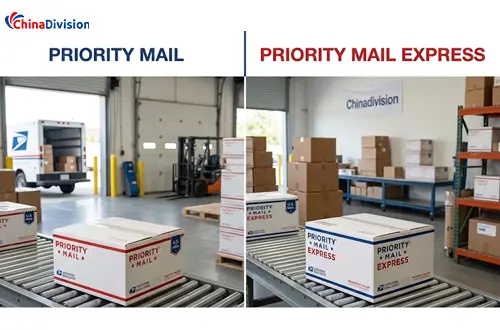
Priority Mail and Priority Mail Express look nearly identical on the shelf, but they solve two different problems. Priority Mail covers fast, affordable shipping for the overwhelming majority of packages. Priority Mail Express exists for the small set of moments when missing a delivery date simply isn’t acceptable.
Once the guarantee becomes the deciding factor instead of the speed alone, the choice stops being a guess. And once you’ve chosen correctly, the next win is operational: shipping from the right zone, in the right box, at the right rate — which is exactly what a fulfilment partner is for.


About the Author: Limi

Limi is a content marketing expert at ChinaDivision, helping businesses and e-commerce sellers navigate the complexities of international shipping by providing actionable tips and comprehensive guides on logistics, shipping, and cargo transportation.