

Entering the Correct Package Address Format for Efficient Delivery
Incorrect address formatting is not a minor clerical error—it is a profit leak. For e-commerce sellers shipping internationally, a single transposed digit, missing apartment number, or misformatted foreign postal code can trigger carrier correction fees, customs delays, failed deliveries, and chargebacks that cost $15–$40 per order. This guide breaks down the anatomy of correct address formats for domestic and international shipping, compares country-specific formatting rules, exposes the six most common address errors that destroy delivery rates, and shows how professional fulfillment providers like ChinaDivision use automated validation to prevent bad addresses before they ever reach the shipping label.
Table of Contents
- What Bad Addresses Actually Cost You
- Why Address Formatting Is Harder for International Fulfillment
- The Anatomy of a Correct U.S. Domestic Address Format
- International Address Formats: A Country-by-Country Comparison
- Special Address Scenarios That Trip Up International Shippers
- The Six Most Common Address Formatting Mistakes (And Their Costs)
- Best Practices for E-Commerce Address Collection
- Essential Labeling Guidelines to Eliminate Shipping Friction
- Address Formatting FAQ
- Recommended Resources
What Bad Addresses Actually Cost You
Most sellers treat address formatting as a customer-service issue. It is a finance issue.
When a carrier catches an incorrect or incomplete address, it does not fix it for free. In 2026, FedEx charges $24.00 per shipment for address correction, while UPS charges $13.40 to $91.00 depending on the service level. These fees are applied at the carrier's discretion, often after the package is already moving—meaning you cannot catch them in advance.
| Cost Category | Per-Order Impact | Source |
|---|---|---|
| Carrier address correction fee | $13.40–$24.00 | UPS / FedEx 2026 surcharge schedules |
| Failed delivery (redelivery + labor + support) | ~$17.20 per parcel | Industry benchmark |
| Lost customer lifetime value | $100–$500+ | 70–85% of shoppers do not return after a failed delivery |
| International return cost | Often exceeds product value | Cross-border returns require customs re-entry, duties, and double freight |
Why Address Formatting Is Harder for International Fulfillment
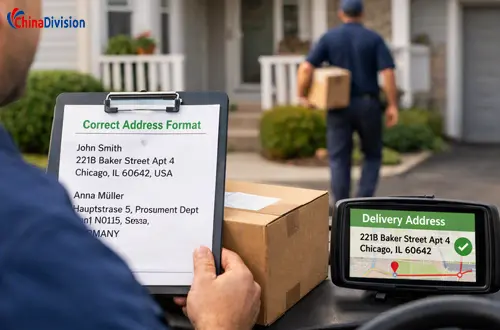
Domestic address errors are frustrating. International address errors are catastrophic. An international failed delivery means a package that crosses an ocean, clears customs, enters a foreign postal network, fails at the last mile, and then must either be abandoned or returned through customs again—often at a cost higher than the product itself.
The root cause is that address formats are not universal. What works in Austin will fail in Amsterdam. A U.S. customer might forget an apartment number. A UK customer might enter an incomplete postcode. A German customer might write the street and house number in the wrong order. A Japanese address follows an entirely different logic: postal code first, then prefecture, then city, then district, then building number, then street name.
For B2B sellers sourcing from China and shipping globally, understanding these differences is not optional. It is the difference between a 98% delivery success rate and a support queue full of angry customers.
The Anatomy of a Correct U.S. Domestic Address Format
Before tackling international complexity, master the domestic standard. The U.S. address format is the foundation most e-commerce platforms are built on, and even here, small errors cause big problems.
Standard U.S. House Address Format:
| Line | Content | Example | Common Error |
|---|---|---|---|
| Line 1 | Recipient full name (include title if known) | SARAH JENKINS | Nicknames, single names |
| Line 2 | Street number + street name + directional + unit | 4821 N MAPLE AVE APT 3B | Missing N/S/E/W; unit on wrong line |
| Line 3 | City + two-letter state abbreviation + ZIP+4 | CHICAGO IL 60614-1234 | Full state name instead of abbreviation |
| Line 4 | (Optional) Country name for international origin | USA | — |
Critical formatting rules for U.S. addresses:
- Use all capital letters for machine readability.
- Omit punctuation—periods, commas, and symbols confuse automated sorting scanners.
- Place the apartment or unit number on the same line as the street address, not below it. "4821 N MAPLE AVE APT 3B" is correct. "4821 N MAPLE AVE" with "APT 3B" on a separate line often causes carrier systems to miss the unit entirely.
- Use standard abbreviations: AVE, BLVD, ST, APT, STE, FL.
- Include the ZIP+4 extension when possible; it routes the package to the correct carrier sequence.
Business Address Format:
When shipping to a business, place the company name on the first line, followed by the recipient's name and department on the second line. This ensures the mailroom can route the package internally even if the recipient is unavailable.
Care-of (C/O) and Attention (ATTN) Addresses:
If the recipient does not normally reside at the delivery location, use C/O or ATTN to indicate who should receive the package. This prevents the carrier from returning the package as "recipient unknown."
International Address Formats: A Country-by-Country Comparison
International address formats vary in component order, postal code position, and required fields. Applying U.S. logic to a foreign address is one of the most common causes of international delivery failure.
| Country | Format Example | Key Rules | Common Error |
|---|---|---|---|
| United Kingdom | OLIVER JAMES 14 BAKER STREET LONDON W1U 7BU UNITED KINGDOM |
Postcode follows city; alphanumeric format; no state | Missing postcode space; wrong city/postcode pairing |
| Germany | ANNA MÜLLER KANTSTRASSE 12 10625 BERLIN GERMANY |
House number after street name; 5-digit PLZ before city | Writing "12 KANTSTRASSE" (U.S. style) |
| France | JEAN DUPONT 25 RUE DE RIVOLI 75001 PARIS FRANCE |
Postal code before city; no state/province | Placing postcode after city |
| Japan | TANAKA HANAKO 150-0001 TOKYO SHIBUYA-KU 2-15-1 SHIBUYA SHIBUYA BUILDING 5F |
Postcode first; prefecture, city, district, building; street name last | Reversing to U.S. order; omitting building name |
| Canada | JOHN SMITH 123 MAIN ST TORONTO ON M5H 2N2 CANADA |
Province abbreviation; alphanumeric postcode | Writing full province name; missing postcode space |
| Australia | EMILY BROWN 42 WALLABY WAY SYDNEY NSW 2000 AUSTRALIA |
State abbreviation after city; 4-digit postcode | Omitting state; wrong postcode length |
| Brazil | CARLOS SILVA RUA AUGUSTA 100 APT 42 01305-000 SÃO PAULO SP BRAZIL |
Street type (Rua, Avenida) before name; postcode before city; state after city | Missing street type; wrong state abbreviation |
The universal international rule: The destination country always appears on the final line, written in full, in English, and in all capital letters. "GERMANY" is correct. "DE" or "Deutschland" is not sufficient for international postal processing.
Non-Latin scripts: For destinations using Cyrillic, Arabic, Chinese, or Japanese scripts, the address must be transliterated into Roman characters (A–Z, 0–9) for international carrier processing. The destination country's local postal service handles the final leg using local-language labels if needed, but the cross-border label must be in Roman characters.
Special Address Scenarios That Trip Up International Shippers
Apartment and Unit Numbers
In the U.S., the unit number belongs on the same line as the street address. In many European countries, the floor and apartment number may appear on a separate line or be integrated into the building number (e.g., "12/3" in Austria means building 12, apartment 3). Always research the local convention or use address validation software that understands country-specific formatting.
Military Addresses (APO/FPO/DPO)
Military mail operates through a dedicated postal channel. You must not include city or country names, as this can accidentally route the package into domestic or foreign postal networks instead of the military system.
Note: UPS only ships to military addresses via UPS Ground Saver or UPS Mail Innovations. Express services are not available.
P.O. Boxes
UPS, FedEx, and DHL cannot deliver to P.O. Boxes. Only USPS delivers to P.O. Boxes. If your checkout system accepts a P.O. Box for a UPS/FedEx/DHL order, the label will fail or the package will be returned.
The Six Most Common Address Formatting Mistakes (And Their Costs)
Based on carrier data and fulfillment analytics, these six errors account for the majority of address-related delivery failures:
| Error Type | Frequency | Cost Impact | Prevention |
|---|---|---|---|
| 1. Missing apartment/unit number | 30% of insufficient-address failures | Full delivery failure; return to sender | Require unit field at checkout; validate against USPS database |
| 2. Transposed digits in ZIP/postal code | 22% of delivery failures | Package routed to wrong city/state | Real-time ZIP validation; autocomplete |
| 3. Wrong state/province code | High for international | Carrier label rejection (FedEx Error 030009) | Dropdown menus; never allow free-text state entry |
| 4. Nonexistent address | 28% of address failures | Return shipping + reshipment + refund | CASS-certified address validation at checkout |
| 5. Address line too long | Common for B2B | Label generation failure | Character limit enforcement; abbreviations |
| 6. Missing or invalid phone number | Label-blocking | FedEx/DHL reject label creation | Mandatory phone fields; format validation by country |
The mobile checkout multiplier: Small keyboards and rushed taps mean more errors per order. A customer on mobile is 40% more likely to submit an incorrect address than on desktop.
Best Practices for E-Commerce Address Collection
If you are still letting customers type addresses into open text fields without validation, you are subsidizing carrier correction fees. Here is the standard ChinaDivision recommends for any seller shipping internationally:
At Checkout:
- Use address autocomplete (Google Places, Loqate, or USPS API) to suggest standardized addresses as the customer types.
- Separate fields for unit/apartment—never let customers append "Apt 3B" to the street address line as an afterthought.
- Enforce country-specific formats dynamically. If the customer selects "Germany," flip the field order to street name first, house number second.
- Validate the phone number by country format. FedEx and DHL require valid recipient phone numbers for most international services.
- Flag PO Boxes for non-USPS carriers and prompt for a physical address.
At Label Generation (Warehouse):
- Re-validate every address before printing. The address may have been correct at checkout but corrupted during platform sync.
- Standardize to all caps, no punctuation for USPS and most international carriers.
- Check character limits. DHL Express allows 35 characters per address line. Overflow must move to Line 2.
- Verify state/province codes against carrier lookup tables, not just your own database.
Monthly Audit:
Review carrier billing statements for address correction fees. If you see patterns—e.g., 40% of corrections are for missing apartment numbers—you have a checkout field problem, not a warehouse problem.
Essential Labeling Guidelines to Eliminate Shipping Friction
Proper address formatting must be paired with accurate physical label placement:
- Omit Punctuation: Modern OCR sorting machines process plain text fastest. Avoid commas, periods, hyphens, and special symbols in address lines whenever possible.
- Print Clear Thermal Labels: Avoid handwritten labels. High-density thermal printing ensures barcodes scan cleanly at high conveyor speeds.
- Correct Label Placement: Place shipping labels flat on the largest surface of the package. Never wrap labels around box edges, fold over corners, or place tape directly over scannable barcodes.
- Include a Complete Return Address: Always provide a clear return address on the top-left corner. For overseas fulfillment, utilizing a local ChinaDivision return hub prevents lost inventory if a parcel proves undeliverable.
Address Formatting FAQ
Do I need to include punctuation in addresses?
No. Most postal and carrier systems prefer addresses without commas, periods, or other symbols. Use spaces and line breaks to separate elements.
What happens if I enter the wrong address format?
The package may be delayed, misrouted, or returned. You may incur address-correction fees, return shipping costs, and re-shipping expenses, and your customer may lose confidence in your store.
Should I use all capital letters for addresses?
For U.S. and many international shipments, all capital letters are preferred for machine readability. At minimum, the country name should be in all caps for international mail.
How can I reduce address errors in my store?
Use address validation and autocomplete tools, enforce required fields, validate postal codes, and review suspicious addresses before printing labels. Work with a fulfillment partner that checks addresses before dispatch.
Can Chinadivision help with address validation?
Yes. As part of our international order fulfillment service, we validate addresses, flag exceptions, and ensure labels are printed in a carrier-friendly format to reduce delivery failures and returns.
Recommended Resources
How to Write a Shipping Address
Addressing a package: How to address a box correctly
ChinaDivision helps B2B sellers and e-commerce brands eliminate address-related delivery failures before they happen. Our international order fulfillment infrastructure includes automated address validation, country-specific format standardization, remote area detection, and failed-delivery contingency protocols. We do not just ship packages. We ensure they arrive at the right door, in the right country, on the first attempt.
If you are currently eating carrier correction fees, reshipping returned international orders, or explaining to customers why their package is in the wrong city, contact ChinaDivision today for a free address-quality audit.


About the Author: Limi

Limi is a content marketing expert at ChinaDivision, helping businesses and e-commerce sellers navigate the complexities of international shipping by providing actionable tips and comprehensive guides on logistics, shipping, and cargo transportation.