

Is There a Minimum Chargeable Weight for International Air Freight? (Cost & Channel Guide)
Table of Contents
- Is There a Minimum Chargeable Weight for Air Freight?
- What Is the Standard Minimum Chargeable Weight for Commercial Air Freight?
- Why Airlines Use Minimum Charges
- Chargeable Weight vs. Actual Weight: The Volumetric Air Freight Formula
- Comparing Air Shipping Tiers for Small-to-Medium Cargo
- Traditional Air Freight vs. Dedicated Air Lines vs. Express Courier
- When Is It Cost-Effective to Ship Small Items via Air Freight?
- Can Consolidated Air Freight Make Small Shipments More Cost-Effective?
- When Is LCL Sea Freight Better Than Small-Volume Air Freight?
- FAQ: Air Freight Minimum Chargeable Weight
Is There a Minimum Chargeable Weight for Air Freight?
Yes, traditional commercial air freight carries a standard minimum chargeable weight of 45 kg (100 lbs). Traditional commercial air freight uses a 45kg industry standard minimum, dedicated air services start at 3kg, while international couriers have no minimum weight limit. Matching your shipment weight to the correct channel can cut small-item shipping costs by up to 60% compared to using the wrong air freight option.
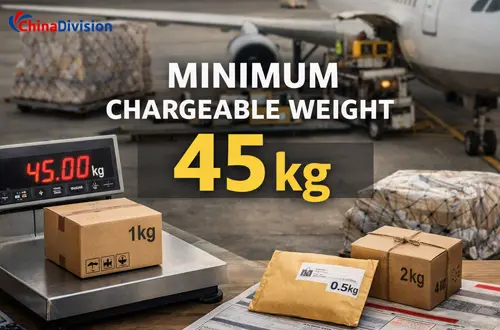
If your cargo weighs under 45 kg, traditional airline channels will still bill you at the 45 kg rate. However, alternative air transport modes cater directly to lighter shipments: Air Special Lines/Dedicated Direct Lines maintain low minimum thresholds (typically 3 kg to 5 kg), while International Express Couriers (DHL, FedEx, UPS) have no minimum weight requirement (billing from 0.5 kg). Choosing between these options depends entirely on your total billable weight, budget, and delivery urgency.
International air freight operates on a fundamentally different pricing logic than express couriers—and the minimum chargeable weight rule is the single most misunderstood concept among new exporters and cross-border e-commerce sellers. Get it wrong, and you'll pay double what you should. This guide breaks down how minimum weights actually work across channels, backed by the tiered pricing structure we use daily when planning shipments for our B2B clients.
What Is the Standard Minimum Chargeable Weight for Commercial Air Freight?
In airport-to-airport commercial air freight, 45 kg is the universal minimum chargeable threshold recognized by major airlines and International Air Transport Association (IATA) forwarders.
Airlines impose this threshold because aircraft space allocation, terminal handling, security screening, Master Air Waybill (MAWB) issuance, and customs manifest filings incur fixed operational costs regardless of package size. Billed weight scales across tiered break-rate brackets:
- M (Minimum Fee): A fixed base charge applied to extremely light parcels if the 45 kg rate isn't invoked.
- -45 kg: Cargo under 45 kg, billed at the flat 45 kg minimum rate tier.
- +45 kg / +100 kg / +300 kg / +500 kg: Volume discount tiers where unit rates ($/kg) decrease as total shipment weight increases.
For rare or non-standard freighter routes, niche carriers may raise this minimum threshold to 100 kg.
Why Airlines Use Minimum Charges
Air freight has fixed handling costs even when the cargo is small:
- Cargo acceptance and warehouse handling.
- Aviation security screening.
- Export documentation and air waybill processing.
- Airline booking and space management.
- ULD/pallet build-up or loose-cargo handling.
- Origin and destination terminal processing.
- Customs-data transmission and coordination.
- Airport pickup or final-mile delivery arrangements.
A 3 kg carton still requires most of these same operational touchpoints as a 45 kg consignment. The minimum weight helps airlines and forwarders cover the fixed cost of processing low-volume cargo.
3PL perspective: A “45 kg minimum” is not an airline rule that applies identically to every shipment. It is often a rate-card or consolidation rule. Before deciding that your cargo is too small for air freight, ask for the minimum for your exact origin, destination, commodity, and service level.
Chargeable Weight vs. Actual Weight: The Volumetric Air Freight Formula
A common trap for cross-border merchants is confusing actual scale weight with chargeable weight. Airlines calculate billing based on whichever value is higher: Gross Weight (GW) or Volumetric (Dimensional) Weight (VW).
Standard Industry Volumetric Formulas:
Traditional Air Freight Volumetric Weight (kg) = Length (cm) * Width (cm) * Height (cm)/6000
Express Courier Volumetric Weight (kg) = Length (cm) * Width (cm) * Height (cm)/5000
Comparing Air Shipping Tiers for Small-to-Medium Cargo
Selecting the correct shipping tier prevents overpaying on small items and sample shipments:
| Transport Tier | Min. Billed Weight | Best Used For | Typical Transit Time | Cost Efficiency |
|---|---|---|---|---|
| International Express (DHL/FedEx/UPS) | None (0.5 kg steps) | High-value samples, urgent documents, packages < 21 kg | 2 – 4 Days | Highest cost/kg; most cost-effective for ultra-light items |
| Air Special Line (3PL) (DDP Bulk Air) | 3 kg – 5 kg | E-commerce parcels, mid-weight inventory (21 kg – 45 kg) | 6 – 10 Days | Highly economical; consolidates small parcels under bulk Master AWBs |
| Traditional Commercial Air (Port-to-Port) | 45 kg | B2B bulk cargo, commercial pallets > 45 kg | 3 – 7 Days | Best cost/kg for heavy freight; cost-prohibitive for cargo under 45 kg |
Traditional Air Freight vs. Dedicated Air Lines vs. Express Courier
Traditional Commercial Air Freight
Traditional air freight normally refers to general cargo moved by airline under a master air waybill, often airport-to-airport or airport-to-door through a freight forwarder.
Best for:
- Consolidated B2B cargo.
- Inventory replenishment.
- Dense shipments above the applicable minimum.
- Larger orders where per-kilogram economics matter.
- Cargo requiring more freight-forwarding control than a parcel courier service.
Watch for:
- Minimum charges.
- Origin and destination terminal fees.
- Customs-brokerage costs.
- Airport storage if customs or pickup is delayed.
- Final-mile trucking charges.
- Higher dimensional-weight exposure for low-density goods.
Dedicated Air Freight Lines
Dedicated air lines are often designed for specific trade lanes, such as China-to-US, China-to-Europe, or China-to-UK ecommerce cargo. They may use consolidated air capacity, destination customs handling, and local last-mile delivery.
Best for:
- Ecommerce sellers shipping small-to-medium volumes.
- 3–100 kg consignments, depending on the line.
- Door-to-door deliveries with a simpler cost structure.
- Sellers that need a lower entry point than traditional airline cargo.
Watch for:
- Service-specific weight minimums.
- Product restrictions.
- Battery, liquid, cosmetic, food, or branded-product rules.
- DDP/DDU terms and clarity over importer-of-record responsibility.
- Whether tracking is end-to-end or only available at selected milestones.
International Express Courier
International couriers such as DHL, FedEx, and UPS are generally designed for documents, samples, urgent parcels, and small commercial shipments.
Best for:
- Product samples.
- Urgent replacements.
- Small, high-value shipments.
- Time-sensitive documents.
- Shipments that need predictable door-to-door tracking.
Watch for:
- Higher per-kilogram rates.
- Fuel surcharges.
- Remote-area, residential, oversize, and additional-handling fees.
- Dimensional-weight calculations, which can be less favorable than general air-cargo pricing on bulky goods.
- Import duties/taxes and recipient refusal under DDU/DAP deliveries.
When Is It Cost-Effective to Ship Small Items via Air Freight?

Shipping small cargo via air freight makes economic sense under specific operational conditions:
- High Value-to-Weight Ratio: Electronics, precision tools, medical components, and luxury apparel absorb higher logistics costs per unit without destroying retail margins.
- Inventory Stockout Prevention: When Amazon FBA inventory hits critical thresholds, shipping a 30 kg emergency air-line consolidation batch prevents listing suppression while slower ocean freight is in transit.
- Sample Verification & Product Launches: Rapidly delivering product samples to B2B buyers or launching seasonal items ahead of competitors outweighs transport cost differences.
Can Consolidated Air Freight Make Small Shipments More Cost-Effective?
Yes. Consolidation is one of the most practical ways to overcome the economic disadvantage of small air shipments because the forwarder combines multiple customers' cargo into a larger shipment and allocates transportation costs according to each shipment's chargeable weight.
Instead of booking a 10 kg shipment as a standalone air cargo shipment, a forwarder may consolidate it with other cargo moving on the same lane.
Industry freight guidance also identifies consolidation as a practical way to reduce the impact of minimum charges on small shipments.
When Is LCL Sea Freight Better Than Small-Volume Air Freight?
LCL can be more economical than air freight when delivery speed is less important and the shipment has enough volume or weight to justify ocean consolidation.
For small commercial shipments, a practical comparison is often:
| Shipping Option | Cost Advantage | Speed Advantage | Best Use |
|---|---|---|---|
| Express Courier | Convenient for very small shipments | Very fast | Samples, urgent parcels |
| Consolidated Air Freight | Balanced cost and speed | Fast | Replenishment, e-commerce inventory |
| Traditional Air Freight | Better as shipment size increases | Fast | Larger commercial cargo |
| LCL Ocean Freight | Lower transport cost for suitable volumes | Slow | Planned inventory replenishment |
| FCL Ocean Freight | Lowest unit cost at sufficient volume | Slow | Larger regular shipments |
The important exception is urgency.
If a stockout could cost an e-commerce seller thousands of dollars in lost sales, paying more for air freight may be economically rational even when ocean freight has a lower transportation cost.
Choosing between express, dedicated air, and traditional air freight shouldn't require a spreadsheet and a freight-broker degree. At ChinaDivision, our logistics specialists analyze your actual shipment weight, destination, and timeline—and recommend the channel that minimizes your total landed cost, not just the headline rate.
FAQ: Air Freight Minimum Chargeable Weight
Does every airline use a 45 kg air-freight minimum?
No. The 45 kg threshold is a common pricing break point, not a universal law. Some routes use different minimums, flat minimum charges, or other rate breaks such as 100 kg, 300 kg, 500 kg, and 1,000 kg.
Is air freight cheaper than DHL, FedEx, or UPS?
It can be cheaper per kilogram once the shipment is large enough, dense enough, and above applicable minimum charges. For small shipments, DHL, FedEx, UPS, or another express courier may cost less overall because they have lower entry thresholds and include more door-to-door handling.
What is the difference between actual weight and chargeable weight?
Actual weight is the weight measured on a scale. Chargeable weight is the higher of actual weight and volumetric weight. Carriers charge based on chargeable weight because both aircraft weight capacity and cargo-hold space are limited.


About the Author: Limi

Limi is a content marketing expert at ChinaDivision, helping businesses and e-commerce sellers navigate the complexities of international shipping by providing actionable tips and comprehensive guides on logistics, shipping, and cargo transportation.