

In-House Fulfillment vs Logistics Outsourcing: Which Is Cheaper in 2026?
Choosing between 3PL outsourcing and in-house fulfillment is not simply a question of which option has the lower monthly invoice. The real cost includes warehouse space, labor, packaging, software, shipping rates, management time, inventory risk, and the cost of scaling during peak periods. For many growing e-commerce and B2B businesses, a 3PL can reduce fixed overhead and provide greater flexibility, while high-volume companies with predictable operations may find in-house fulfillment more economical.
Table of Contents
- Definitions: What Each Model Actually Means
- Side-by-Side Comparison: Every Factor That Matters
- Logistics Outsourcing vs. In‑House Fulfillment: Pros & Cons
- Real Cost Breakdown: Where the Money Actually Goes
- Decision Framework: Which Should YOU Choose?
- Strategic Advantage: Sourcing & Fulfilling via ChinaDivision
- Frequently Asked Questions (FAQ)
The right decision depends on order volume, SKU count, geographic distribution, labor costs, shipping requirements, growth rate, and how much operational control your business needs.
Definitions: What Each Model Actually Means
Logistics Outsourcing (3PL)
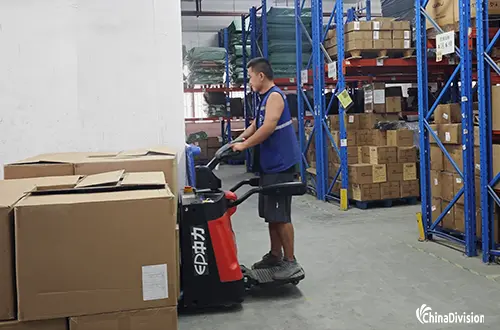
Logistics outsourcing means transferring all or part of your fulfillment process to an external specialist. Once an order lands on your website or marketplace, the 3PL handles: receiving goods, warehousing, picking, packing, labeling, shipping, tracking updates, and returns. You see the result — delivered orders and happy customers — without managing the daily operations.
Example: ChinaDivision receives your inventory, stores it, fulfills orders automatically across all your sales channels, ships via optimized carrier routes, and provides real-time visibility — all from one integrated system.
Outsourcing is now mainstream across every industry. The global logistics market reached $9.41 trillion in 2023** and is projected to hit **$14.08 trillion by 2028 — driven by businesses realizing they cannot afford to build and maintain world-class fulfillment alone.
In-House Fulfillment
In-house fulfillment means your team manages every step: warehouse lease, staffing, equipment, packing materials, carrier contracts, and problem resolution. You control the entire chain — from shelf to doorstep — with no external provider involved. This appeals to businesses with proprietary processes, highly specialized products, or very strict quality requirements.
Side-by-Side Comparison: Every Factor That Matters
| Factor | In-House Fulfillment | 3PL Outsourcing |
|---|---|---|
| Upfront Cost | High — lease, buildout, equipment, software, hiring | Near zero — pay-as-you-go |
| Variable Cost per Order | Labor + materials + shipping + overhead | Predictable all-in fulfillment fee |
| Shipping Rates | Higher — low volume = weak bargaining power | Much lower — aggregated volume discounts passed to you |
| Scalability | Slow & expensive — need warehouse space, hire, train | Instant — scale up or down overnight |
| Control | Maximum — every process, detail, and decision | Shared — within provider's standard workflow |
| Speed to Launch | Months — lease, equip, hire, test | Days — send inventory, go live |
| Expertise | Limited — you learn through trial and error | Deep — dedicated teams, systems, and experience |
| Risk & Liability | All yours — damage, loss, delays, errors | Shared — insured, SLAs, professional processes |
| Management Time | 20–40+ hours weekly — hiring, training, troubleshooting | Near zero — focus on sales & product |
| Technology | Expensive to build & maintain | Enterprise-grade included in base fee |
| Quality Consistency | Variable — depends on daily staffing & training | Standardized — QC, photos, measurable KPIs |
Logistics Outsourcing vs. In‑House Fulfillment: Pros & Cons
Logistics Outsourcing (3PL)
Pros
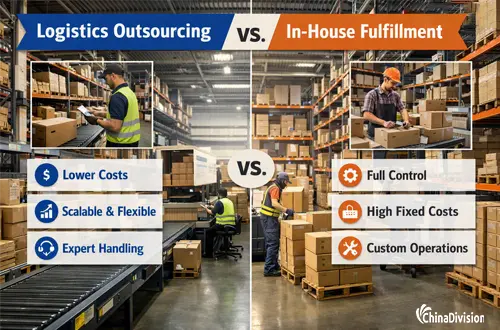
Lower operating costs
- No need to hire staff, rent large warehouses, or maintain equipment.
High scalability
- Easily handle seasonal spikes or rapid growth without infrastructure upgrades.
Better shipping rates
- 3PLs negotiate bulk discounts with carriers (FedEx, UPS, DHL).
Advanced technology
- Real‑time inventory sync, automated routing, and analytics.
Improved customer satisfaction
- Faster processing, fewer errors, and professional packaging.
Cons
Less direct control
- You rely on the 3PL’s processes and timelines.
Dependency risk
- Operational disruptions at the 3PL affect your business.
Provider selection complexity
- Choosing the wrong 3PL can cause delays, errors, or hidden fees.
Data security concerns
- Sensitive customer data is shared with external partners.
In‑House Fulfillment
Pros
Full operational control
- You manage every step of the supply chain.
Highly customized workflows
- Ideal for brands with unique packaging or proprietary processes.
Direct communication
- No intermediaries — faster internal decision-making.
Cons
High fixed costs
- Warehouse rent, staff salaries, equipment, utilities, software.
Low scalability
- Growth requires expensive expansions.
Lower shipping efficiency
- Small-volume shippers pay higher carrier rates.
Operational risk
- Errors, delays, and staff turnover directly impact performance.
Real Cost Breakdown: Where the Money Actually Goes
Hidden Costs of In-House Fulfillment
Most businesses compare only direct labor and materials — missing 60% of true cost:
| Cost Category | In-House Expense | Outsourcing Equivalent |
|---|---|---|
| Warehouse | Rent, utilities, security, maintenance, shelving, pallets | Shared facility — pay only space used |
| Staffing | Wages, benefits, training, turnover, management | Included in fulfillment fee |
| Equipment & Tech | Computers, printers, scanners, WMS software, updates | Included — enterprise systems without purchase |
| Packaging | Bulk purchase, waste, overstock | Included or at cost — discounted volume pricing |
| Shipping | Retail rates + fuel + surcharges | Wholesale negotiated rates |
| Errors & Returns | Labor, reshipping, lost revenue, customer compensation | Reduced — QC + automation; errors insured |
| Management Overhead | Hiring, scheduling, compliance, troubleshooting | None — provider handles operations |
Key Insight: An in-house operation might claim "$3.50 per order" — but when you add warehouse, equipment, software, management, and higher shipping rates, the **true cost is often $8–$14 per order**. Outsourcing often delivers comparable or lower total cost plus better speed and reliability.
Decision Framework: Which Should YOU Choose?
✅ Choose In-House Fulfillment If:
- Highly specialized, fragile, or regulated products requiring proprietary handling
- Very high, predictable, steady volume that fully utilizes your facility
- Proprietary packaging or quality standards no 3PL can match
- Complete supply-chain secrecy is critical to your business model
- You have the capital, time, and logistics expertise to operate world-class fulfillment
✅ Choose Logistics Outsourcing If:
- Seasonal or growing order volume — peaks that in-house cannot absorb
- International sales or multi-region fulfillment needed
- You want best-in-class technology without buying it
- Shipping discounts and faster delivery would win you customers
- Management time is better spent on sales and product development
- You prefer predictable costs over large upfront investments
- Risk mitigation, insurance, and backup plans matter to you
Strategic Advantage: Sourcing & Fulfilling via ChinaDivision
For brands sourcing products from Asian manufacturers, fulfilling directly from China through ChinaDivision offers distinct cost advantages over traditional domestic destination warehousing:
- Eliminate Double-Handling Freight Costs: Bypass expensive ocean freight, import duties, and domestic drayage by picking, packing, and shipping individual parcels directly from China to global end-consumers.
- Upstream Quality Control: Inspect goods at the source before international shipping. Intercepting factory defects prior to dispatch eliminates costly cross-border return loops.
- Custom Branding & Kitting: Implement custom holiday packaging, branded tissue paper, promotional cards, and fragile-item wrapping directly at the primary staging hub.
- Seamless API Integrations: Connect your e-commerce storefronts (Shopify, WooCommerce, Amazon, eBay) for automated order routing and instant tracking synchronization.
Frequently Asked Questions (FAQ)
What are the hidden costs of in‑house fulfillment?
Rent/utilities/insurance, fully burdened labor, equipment depreciation, WMS/OMS software, packaging supplies, retail carrier rates, returns labor, and management time.
When should I switch from in‑house to a 3PL?
When you fulfillment consumes >15–20 hours/week of leadership time, peaks break your operation, or you need reliable 2‑day shipping and better carrier rates.


About the Author: Limi

Limi is a content marketing expert at ChinaDivision, helping businesses and e-commerce sellers navigate the complexities of international shipping by providing actionable tips and comprehensive guides on logistics, shipping, and cargo transportation.