

Expedited Shipments for B2B: When to Use Them, Real Costs, and How to Protect Margins
Expedited shipping is designed for shipments that need to arrive faster than standard delivery. For B2B businesses, it can help prevent stockouts, meet customer deadlines, support product launches, and reduce the financial impact of delays. However, faster shipping usually costs more, so the right strategy is not to expedite every order—it is to use expedited delivery selectively where the value of speed exceeds the additional logistics cost.
Table of Contents
What Is Expedited Shipping?
Expedited shipping is a delivery service that moves a shipment faster than a carrier's standard shipping option.
Depending on the carrier, origin, destination, service level, customs requirements, and shipment type, expedited delivery can include same-day, next-day, two-day, or other priority services.

Typical delivery windows depend on carrier and destination:
- Same-day delivery — arrives the same day (orders placed before cutoff time)
- Overnight / Next-business-day — guaranteed arrival next working day
- 2-day expedited — arrives within 2 business days
- 3-day expedited — arrives within 3 business days
Bottom line: Expedited shipping = guaranteed speed. Standard shipping = lower cost, but variable transit time.
For international B2B logistics, expedited shipping may involve:
- Priority air freight
- International express courier
- Dedicated or priority transportation
- Faster customs processing where available
- Reduced handling or transfer points
- Priority fulfillment and carrier pickup
The exact transit time is not universal. A shipment advertised as "express" in one trade lane may have a very different delivery time from an express service in another.
For this reason, businesses should evaluate expedited shipping based on the actual origin-destination route and service commitment, rather than relying only on the word "express."
When Should a Business Use Expedited Shipping?
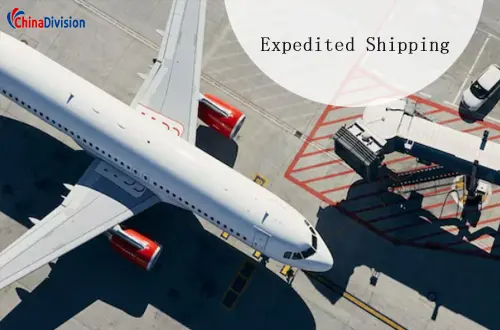
Expedited shipping is most valuable when the cost of waiting is greater than the additional transportation cost.
For example, imagine a business has a product worth $30,000 in potential sales sitting out of stock.
Paying an additional $1,000 for faster transportation may appear expensive.
But if standard shipping would cause the business to miss a major sales opportunity, delay a production line, or lose an important B2B customer, the expedited shipping premium may be economically justified.
Common situations include:
1. Emergency inventory replenishment
A business may discover that a popular SKU is approaching a stockout.
Expedited transportation can provide a short-term bridge while the next standard shipment is already in transit.
2. Product launches
New product launches often have fixed marketing dates. A logistics delay can mean that inventory arrives after advertising campaigns, influencer promotions, or retail commitments have already started.
3. B2B customer deadlines
B2B customers may require components, replacement parts, or finished products by a specific date.
Missing the deadline can create consequences far beyond the transportation fee.
4. Peak-season replenishment
During periods such as Black Friday, Christmas, or major marketplace promotions, demand can rise much faster than expected.
Expedited shipping can be used selectively to replenish high-performing SKUs.
5. Production interruptions
Manufacturers may need urgent components or replacement parts to keep production running.
In these circumstances, delivery speed can have a direct relationship with production downtime.
| Benefit | Business Impact |
|---|---|
| Faster delivery | Meets tight deadlines, avoids production halts, keeps promises |
| Lower damage risk | Less time in transit = fewer handoffs = less chance of damage or loss |
| Reduced inventory needs | Replenish stock quickly → hold less safety stock → cut storage costs |
| Higher customer satisfaction | Buyers expect speed; delivering it builds loyalty and repeat orders |
| Competitive advantage | Offer fast shipping → win contracts that slower competitors can't fulfill |
| Supply chain resilience | Fix stockouts, rush critical parts, recover from delays quickly |
| Urgent order capability | Last-minute orders, equipment failures, time-sensitive materials — all arrive on time |
Types of Expedited Shipping
The appropriate expedited service depends on how quickly the shipment needs to arrive and the value of the goods.
| Service Type | Typical Use | Speed | Relative Cost |
|---|---|---|---|
| Same-Day Delivery | Extremely urgent local shipments | Fastest | Highest |
| Overnight Shipping | Urgent domestic shipments | Very fast | High |
| Two-Day Shipping | Time-sensitive orders | Fast | High |
| International Express | Urgent cross-border parcels | Fast | High |
| Priority Air Freight | Larger international shipments | Fast | Medium–High |
| Standard Air Freight | Planned international replenishment | Moderate | Medium |
| Sea Freight | Large-volume inventory | Slowest | Lower |
Important: Transit times and service availability vary by carrier, destination, customs conditions, and shipping lane. Businesses should confirm the actual service commitment before promising a delivery date to customers.
Expedited Shipping vs. Standard Shipping
The decision between expedited and standard shipping should not be based solely on transportation price.
Instead, consider urgency, inventory availability, customer commitments, product value, and the financial consequences of delay.
| Factor | Standard Shipping | Expedited Shipping |
|---|---|---|
| Delivery speed | Slower | Faster |
| Transportation cost | Lower | Higher |
| Best for | Planned inventory | Urgent shipments |
| Inventory replenishment | Forecasted demand | Unexpected shortages |
| Customer deadlines | Less suitable | Better suited |
| Peak-season emergencies | Limited flexibility | Useful |
| Margin impact | Generally lower cost | Higher shipping cost |
| Risk of delay | Usually more tolerance | Designed for time-sensitive orders |
How ChinaDivision Helps You Master Expedited Shipping
ChinaDivision delivers B2B shipping solutions that balance speed, cost, and reliability — so you offer premium options without premium headaches.
✅ Multiple expedited tiers — air freight, express courier, priority routes — match speed to budget
✅ Transparent pricing — see all fees upfront; no surprise surcharges
✅ Customs expertise — faster clearance, fewer delays, DDP options available
✅ Warehousing + shipping together — stock positioned for fastest delivery at lowest cost
✅ Real-time tracking & alerts — you and your customers always know where goods are
✅ B2B volume discounts — access better rates through our combined shipping volume
Ready to offer reliable expedited shipping without eroding profits? Visit ChinaDivision International Shipping Services to compare rates, review options, and get a custom quote for your shipment profile.
Frequently Asked Questions
How many days is considered expedited shipping?
Typically 1–3 business days, compared to 5–15+ days for standard. Same-day and overnight are the fastest premium tiers.
Is expedited shipping guaranteed to arrive on time?
Reputable carriers offer money-back delivery guarantees for expedited services — verify this before booking.
Is expedited the same as express or overnight?
Not exactly. “Express/overnight” are usually the fastest, time‑definite services. “Expedited” is a broader term for anything faster than standard, not always next‑day.
How much more does expedited cost than standard?
For parcels, often $10–$20+ more domestically; for freight, commonly 2–3× standard due to dedicated resources and faster lanes.
What is the difference between expedited shipping and air freight?
Air freight is a transportation mode, while expedited shipping describes a faster service level. Air freight can be used for expedited transportation, but not every air shipment is necessarily an expedited service.
Recommended Industry Resources


About the Author: Limi

Limi is a content marketing expert at ChinaDivision, helping businesses and e-commerce sellers navigate the complexities of international shipping by providing actionable tips and comprehensive guides on logistics, shipping, and cargo transportation.