

Amazon AWD Europe vs. Third-Party Logistics Comparison Guide
Amazon’s Warehousing & Distribution (AWD) officially launched in the EU and UK on August 17, 2026, marking a major shift in European e‑commerce logistics.
Table of Contents
- Amazon AWD Europe at a Glance
- What Is Amazon AWD and How Does It Work?
- Eligibility & Requirements — Who Can Use AWD?
- AWD EU & UK Rate Structure (Effective August 2026)
- AWD Europe vs FBA: What Is Actually Different?
- AWD Europe and Pan-European FBA: Don't Confuse the Two
- Amazon AWD vs 3PL: Which Should You Choose?
- What Does Amazon AWD Europe Mean for 2026 Peak Season?
- The Hidden Risks Most AWD Guides Don't Mention
- The ChinaDivision Alternative: When AWD Isn't Enough
- Frequently Asked Questions (FAQ)
AWD reduces stockouts by up to 15% during peak seasons, keeps long-term storage fees fixed year-round (no Q4 surge), and waives low-inventory and storage utilization surcharges when set to auto-replenish.
Amazon AWD Europe at a Glance
|
Question |
Amazon AWD Europe 2026 |
|---|---|
|
What is AWD? |
Amazon's bulk storage and distribution service connected to FBA |
|
European launch |
August 2026 |
|
Marketplaces covered |
Germany, France, Italy, Spain and UK |
|
Main purpose |
Hold bulk inventory and replenish FBA automatically |
|
Main benefit |
Additional storage capacity without relying entirely on FBA inventory |
|
Replenishment |
Automatic or manual, depending on SKU strategy |
|
Storage model |
Flat-rate long-term bulk storage |
|
Commitment |
No long-term contract |
|
Best suited for |
Predictable, replenishable, eligible ASINs |
|
Important limitation |
AWD does not replace FBA; inventory still needs to move into FBA for customer fulfillment |
Amazon describes AWD as a long-term bulk-storage solution with automated replenishment into FBA fulfillment centers. It is intended to provide additional storage capacity, help maintain FBA inventory levels and simplify storage costs.
What Is Amazon AWD and How Does It Work?
Amazon Warehousing & Distribution, commonly called AWD, is designed to sit upstream of FBA.
Instead of sending an entire inventory position directly into FBA, a seller can use AWD as a bulk inventory layer:
Supplier / China → AWD → FBA fulfillment centers → Customer
This creates a fundamentally different inventory model from traditional FBA.
With conventional FBA planning, sellers often have to determine how much inventory to send into Amazon's fulfillment network and when to replenish it.
With AWD, Amazon can hold a larger upstream inventory position and replenish eligible FBA inventory according to demand.
Amazon states that AWD provides bulk storage with automated replenishment to FBA fulfillment centers across Europe. AWD warehouses are built for scale — no arbitrary storage limits like standard FBA. Amazon’s own data shows AWD reduces stockout rates by ~15% compared to relying solely on FBA
The important distinction
AWD is not simply another FBA warehouse.
Its value comes from the relationship between the two:
- AWD = upstream bulk inventory
- FBA = customer-facing fulfillment inventory
That distinction should influence how sellers calculate inventory requirements and total logistics costs.
Eligibility & Requirements — Who Can Use AWD?
✅ Supported Products
- Most FBA categories: clothing, beauty, consumer electronics, home, general goods
- Expiration-dated goods allowed: ≥185 days remaining on arrival / ≥105 days remaining on shipment
❌ NOT Supported
- Oversized / overweight items
- High-value goods (jewelry, luxury)
- Dangerous goods including lithium batteries
- Large appliances
- Temperature-controlled products
AWD pricing includes four main fees: Storage, Inbound Processing, Outbound Processing, and Shipping.
AWD EU & UK Rate Structure (Effective August 2026)
- EU Hubs (Germany/NRW):
- Base Storage Rate: €12.33 / m³ / month
- AMS Discount Storage Rate: €11.09 / m³ / month (10% discount)
- Inbound Processing: €0.72 / box
- Outbound Processing: €1.15 / box
- Inter-Warehouse Shipping: €37.58 / m³ (Base) | €33.82 / m³ (AMS)
- UK Hubs (South Yorkshire):
- Base Storage Rate: £0.36 / ft³ / month
- AMS Discount Storage Rate: £0.32 / ft³ / month (11% discount)
- Inbound Processing: £0.63 / box
- Outbound Processing: £1.00 / box
- Inter-Warehouse Shipping: £0.93 / ft³ (Base) | £0.83 / ft³ (AMS)
AWD Europe vs FBA: What Is Actually Different?
This is one of the most important sections for sellers because many articles simply describe AWD's benefits without explaining when it should actually be used.
|
Factor |
Traditional FBA |
AWD + FBA |
|---|---|---|
|
Primary role |
Customer fulfillment |
Bulk storage + FBA replenishment |
|
Inventory position |
Primarily in FBA |
Bulk inventory in AWD + operating inventory in FBA |
|
Capacity strategy |
Direct FBA capacity planning |
Upstream bulk inventory layer |
|
Replenishment |
Seller-managed or existing FBA processes |
Automated or manual AWD replenishment |
|
Best use |
Fast-moving customer inventory |
Larger, predictable inventory positions |
|
Peak-season planning |
More dependent on FBA capacity |
More flexible upstream stocking |
|
Long-term bulk storage |
Less suitable |
Core use case |
|
Inventory control |
Seller-managed |
Amazon-managed or seller-managed depending on replenishment mode |
The key takeaway is:
AWD does not eliminate the need for FBA. It changes where you hold the inventory before it reaches FBA.
Amazon also confirms that AWD does not replace other FBA selling costs such as fulfillment fees and referral fees.
AWD Europe and Pan-European FBA: Don't Confuse the Two
Pan-European FBA is primarily about placing eligible inventory into Amazon's European fulfillment network to serve customers efficiently.
AWD is primarily an upstream inventory and replenishment layer.
They can work together rather than compete with each other.
For an EU seller, the potential structure is:
China supplier → AWD Germany → FBA network → European customers
The exact configuration depends on ASIN eligibility, VAT obligations, Pan-EU participation and Amazon's current program rules.
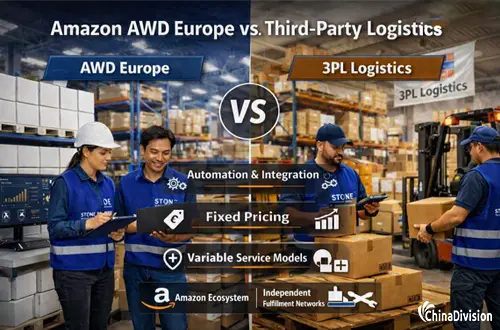
Amazon AWD vs 3PL: Which Should You Choose?
|
Requirement |
AWD |
Independent 3PL |
|---|---|---|
| Bulk storage | Strong | Strong |
| FBA replenishment | Strong | Depends on integration |
| Amazon ecosystem integration | Excellent | Varies |
| Multi-channel fulfillment | Limited compared with independent 3PL | Usually stronger |
| Custom kitting | Program-dependent | Often flexible |
| Custom packaging | Limited/standardized | Often more flexible |
| Supplier consolidation | Limited | Strong |
| DTC fulfillment | Not the primary purpose | Strong |
| Wholesale/B2B fulfillment | Not the primary purpose | Strong |
| Crowdfunding fulfillment | Not the primary purpose | Strong |
| Inventory outside Amazon | No | Yes |
| Amazon-centric operation | Excellent fit | Depends on provider |
AWD is not necessarily a replacement for a 3PL. It is better viewed as another inventory infrastructure option. A multi-channel brand may use both.
What Does Amazon AWD Europe Mean for 2026 Peak Season?
Amazon is introducing AWD in the five major European markets just as sellers begin planning the second half of 2026 and Q4.
That means sellers should not wait until Black Friday or Christmas inventory becomes urgent.
A better approach is:
Forecast → manufacture → consolidate → ship bulk inventory → AWD → automated FBA replenishment → peak sales
The biggest potential advantage is therefore not simply cheaper storage. It is decoupling bulk inventory positioning from immediate FBA capacity requirements. That can give sellers more flexibility when demand is difficult to predict.
The Hidden Risks Most AWD Guides Don't Mention
Risk 1: The "Black Box" Inventory Problem
Once your inventory enters AWD, you lose granular visibility. You cannot see exactly which units are where, or precisely when replenishment will trigger. If you sell on multiple channels or need to pull stock for a flash sale, AWD does not support that flexibility.
Risk 2: Replenishment Delays Cause Stockouts
AWD auto-replenishment does not account for its own transit delays. If your FBA stock depletes faster than predicted and AWD transfer takes 10+ days, you face a stockout that damages your Best Seller Rank. The 15% stockout reduction claim assumes the algorithm works perfectly—it does not always.
Risk 3: Inadequate Loss Reimbursement
If AWD loses or damages your inventory, Amazon reimburses at "manufacturing cost"—typically 40–50% of your landed cost, and far below your selling price. A quality 3PL replaces lost inventory at full value or absorbs the cost. On a high-value shipment, this difference can cost thousands.
Risk 4: No FBA Prep Services
Amazon discontinued prep and labeling services in the US in January 2026. While the original content mentions AWD handles labeling, the reality is that non-compliant shipments to AWD face rejection or billable manual processing. If your supplier does not apply FNSKU labels, carton labels, and SSCC codes correctly at origin, your freight will hit exceptions.
Risk 5: The Size Restriction Trap
The July 31, 2026 sortable-only rule means many sellers who planned to use AWD for Q4 bulk storage now cannot. If your catalog includes anything in the "small bulky" tier or above, you need an alternative upstream storage plan immediately.
The ChinaDivision Alternative: When AWD Isn't Enough
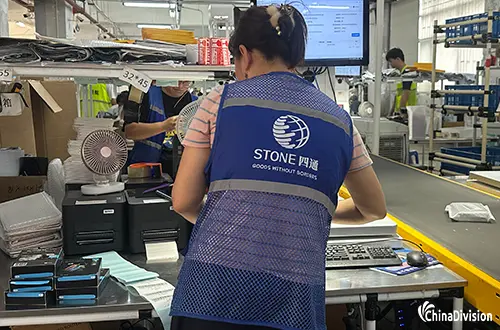
For China-based sellers and brands manufacturing in Asia, AWD Europe creates a new option—but not a complete solution. Here is where a China-based 3PL with European distribution capabilities fills the gaps AWD leaves open.
When to Choose ChinaDivision Over (or Alongside) AWD
|
Scenario |
AWD Limitation |
ChinaDivision Solution |
|---|---|---|
|
Bulky or non-sortable items |
Ineligible since July 2026 |
Receives all sizes and weight classes |
|
Multi-channel sales |
Amazon-only |
FBA prep + DTC fulfillment + B2B distribution |
|
Custom packaging/kitting |
Not supported |
Custom holiday packaging, subscription boxes, branded inserts |
|
Need inventory control |
Algorithm-driven replenishment |
Manual or scheduled replenishment to FBA on your timeline |
|
Quality control at origin |
No inspection service |
Factory-to-warehouse QC, photo documentation, discrepancy reporting |
|
Cross-border complexity |
AGL limited to China-origin only |
Multi-origin consolidation, customs documentation, and duty optimization |
|
Fragile or specialized handling |
Standard handling only |
Fragile item protection, temperature-controlled options |
The Hybrid Strategy: AWD + 3PL
Many sophisticated sellers are adopting a hybrid model:
- Fast movers & standard sizes: Route through AWD for auto-replenishment and Prime proximity benefits
- Slow movers, bulky items, and multi-channel stock: Stage with a 3PL like ChinaDivision for flexibility, lower risk, and cross-channel allocation
- New launches & promotions: Keep launch inventory at a 3PL where you control timing, then shift to AWD once velocity stabilizes
This approach maximizes AWD's strengths while insulating your business from its rigidity.
Frequently Asked Questions
Can I use AWD and FBA at the same time?
A: Yes — recommended. Keep 2–4 weeks of stock in FBA for immediate sales, and send your bulk supply to AWD for auto-replenishment.
Do I have to commit to storage volume or contract length?
A: No. AWD is pay-as-you-go with no minimums and no long-term contract. You can start or stop anytime.
What is the 70% auto‑replenishment rule?
A: To unlock AMS preferential rates and certain fee waivers, you typically need ≥70% auto‑replenishment over a rolling 90‑day window; direct‑to‑FBA emergency shipments count against this ratio.
Does AWD replace FBA for customer orders?
A: No. AWD is upstream bulk storage; orders still fulfill from FBA. AWD auto‑replenishes FBA as demand draws down.


About the Author: Limi

Limi is a content marketing expert at ChinaDivision, helping businesses and e-commerce sellers navigate the complexities of international shipping by providing actionable tips and comprehensive guides on logistics, shipping, and cargo transportation.