

Inbound Receiving: What Factors Affect Warehouse Receiving Speed?
Every shipment your suppliers send eventually hits a warehouse dock — and how fast it moves from truck to available inventory determines your restock lead times, stockout risk, and overall operational agility. Yet most brands treat warehouse receiving as a black box: goods disappear into the facility, and days later inventory appears in the system. If delays happen, you get little explanation beyond "it’s being processed."
Table of Contents
- What Arrives at the Dock — and Why Shipment Type Matters
- Inbound Receiving: What Factors Affect Speed?
- The ASN: Your Single Most Powerful Lever for Faster Receiving
- Tracking Visibility: Know When Your Freight Actually Arrives
- What Happens During Receiving — Two Paths
- Top Reasons Receiving Slows Down — And How to Fix Them
- How Receiving Speed Affects E-Commerce Fulfillment
- How to Speed Up Inbound Receiving — Your Action Checklist
- Why Fast Receiving Matters Beyond "Getting Inventory In"
- The Appointment System Is Not Bureaucracy
- How ChinaDivision Optimizes Your Inbound Receiving
- Frequently Asked Questions
- Recommended Industry Resources
This guide opens that black box. From the perspective of a fulfillment operations team, we explain exactly what drives inbound receiving speed, where delays almost always originate, and what you can do to ensure your inventory becomes available for sale as quickly as possible. This is operational insight you won’t find in generic guides — because it comes from seeing thousands of shipments flow through our docks.
What Arrives at the Dock — and Why Shipment Type Matters
Not all freight processes the same way. How your supplier packages and loads goods at origin dictates speed the moment it arrives at the warehouse.
| Shipment Type | Typical Configuration | Appointment Needed? | Receiving Speed | Common Use Case |
|---|---|---|---|---|
| Small Parcel | Individual boxes via UPS, FedEx, USPS | No | Fastest — same-day availability | Samples, replenishment, distributed suppliers |
| Palletized / LTL | Boxes stacked on pallets, wrapped | Yes — dock scheduling required | Moderate — 1–2 days | Mid-market replenishment, contract manufacturing |
| Container Freight | Full or shared container — palletized or floor-loaded | Yes — advance scheduling critical | 2–4+ days | Overseas imports, large production runs |
Why does this matter?
Consider two shipments containing exactly the same products.
Shipment A: The ASN is complete, SKUs are correct, tracking numbers are included, cartons are labeled, and the expected quantities match the supplier documentation.
Shipment B: The warehouse receives several unlabeled cartons with missing tracking numbers and no reliable SKU-level information.
The physical workload may look similar, but the second shipment creates an additional identification and reconciliation process.
Inbound Receiving: What Factors Affect Speed?
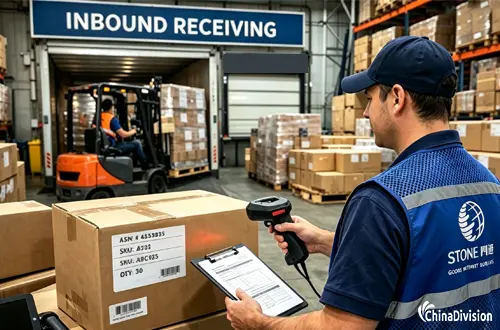
Receiving isn’t just “getting freight in the door.” It’s the data foundation for everything downstream: inventory accuracy, lot traceability, pick speed, and on‑time delivery. When receiving slows, outbound stalls; when ASN data is weak, exceptions multiply; when container receiving isn’t structured, demurrage and rework eat margins. A shipment that arrives quickly but requires extensive manual receiving may not produce inventory availability as quickly as a slightly slower shipment that arrives fully labeled, documented, and electronically pre-advised.
Key Insight: A container arriving without proper notice or documentation can sit for a week. The same container with a complete ASN, pre-scheduled appointment, and compliant labeling can be received and put away in days. Shipment format matters less than preparation.
The ASN: Your Single Most Powerful Lever for Faster Receiving
The Advance Shipping Notice (ASN) is the blueprint our receiving team works from. It tells us what is arriving, when, and where it belongs. Every shipment — whether one box or a full container — needs a corresponding ASN created before freight departs the supplier.
A complete, accurate ASN includes:
- ✅ Destination facility & receiving type (PO, transfer, etc.)
- ✅ ASN reference number, supplier name, and estimated arrival date
- ✅ Shipment configuration: boxes, pallets, or container
- ✅ All tracking numbers — so we match carrier events automatically
- ✅ SKU-level detail: quantity, lot numbers, expiration dates, barcodes
- ✅ Documentation: Bill of Lading, packing list, commercial invoice
Why This Matters More Than You Realize
- Complete ASN → Receiving team scans, verifies, and inventory available same-day or next-day
- Partial or missing ASN → Manual lookup, reconciliation emails, delays of 3–7+ business days
- No ASN at all → Classified as "unannounced freight," held separately, and special storage fees begin after 3 business days
Operational Truth: ASN quality is the single largest factor in receiving speed. Everything else — warehouse size, staffing, equipment — is secondary. Brands that treat the ASN as a careful planning document rather than a formality consistently see 2–3x faster dock-to-stock availability.
Tracking Visibility: Know When Your Freight Actually Arrives
When you enter tracking numbers during ASN creation, our system monitors carrier check-in events automatically. The moment a truck or parcel arrives at our gate, your dashboard updates — with timestamps and arrival source captured.
This is table stakes at a sophisticated 3PL receiving operation, but rare elsewhere. If you’re asking "where is my shipment?" and waiting 24 hours for a reply, your provider is working manually. With automated tracking matching, you see arrival status in real time — no support ticket needed.
What Happens During Receiving — Two Paths
Once freight arrives, it follows one of two workflows:
Standard Receiving
Team scans each carton, confirms quantity against ASN, validates lot/expiration dates, photographs any discrepancies, and routes inventory to putaway. Speed depends entirely on how closely physical goods match the ASN.
SSCC Carton Receiving (Fast-Track)
If your supplier applies GS1-128 SSCC labels to cartons and you push that data to the ASN, our team scans one barcode per carton and the system auto-receives every SKU inside. This cuts receiving time per carton by 70% or more — and provides full carton-level traceability from factory to fulfillment.
Top Reasons Receiving Slows Down — And How to Fix Them
After analyzing thousands of inbound shipments, nearly all delays trace to these six preventable causes:
| Cause | What Happens | Delay | Prevention |
|---|---|---|---|
| Missing or late ASN | Freight sits unannounced; manual research required | 3–7+ days | Create ASN before freight departs |
| Inaccurate ASN data | Wrong quantities, SKUs, or dates → reconciliation loop | 1–3 days | Verify against supplier packing list before submitting |
| No tracking numbers | Arrival invisible until carrier notifies us | 1–2 days | Enter tracking at ASN creation |
| Non-compliant labeling | No SKU, ASN #, or barcode visible → manual ID per carton | Hours to days | Print labels with: Company + ASN # + SKU + Quantity |
| No dock appointment | LTL/FTL turned away or held in yard | 1–5 days | Schedule via DataDocks or our portal in advance |
| Damaged/non-standard pallets | Cannot safely store → repalletizing required | 1–2 days | Follow stacking & weight limits in our guidelines |
Special Projects: When freight arrives non-compliant, the work shifts to manual corrective labor — relabeling, repalletizing, counting every box. These services are billable and slow everything down. Nearly every special project is preventable by communicating our requirements to your supplier before they ship.
How Receiving Speed Affects E-Commerce Fulfillment
Inbound receiving sits at the beginning of the fulfillment chain.
Supplier → Transportation → Receiving → Putaway → Inventory Available → Picking → Packing → Shipping → Customer
A delay at receiving can therefore propagate downstream.
For example:
Late supplier shipment
↓
Late warehouse receiving
↓
Inventory unavailable for fulfillment
↓
Delayed replenishment
↓
Potential stockout
↓
Lost sales
This is why inbound receiving should be considered part of your fulfillment strategy rather than an isolated warehouse activity.
How to Speed Up Inbound Receiving — Your Action Checklist
Everything that slows receiving can be inverted to accelerate it. Here’s your operational checklist:
- Create the ASN before freight departs — never after it arrives
- Populate every field — tracking numbers, exact quantities, lot/expiration dates, barcodes
- Verify supplier labels — each carton shows: Company Name + ASN # + SKU + Quantity + readable barcode
- Schedule dock appointments for pallets and containers — 48 hours before arrival
- Push SSCC data if your supplier already applies retail-compliant labels
- Upload all documents — BOL, packing list, commercial invoice — to the ASN upfront
- Communicate our requirements to your supplier — they’re the ones applying labels and loading pallets
Why Fast Receiving Matters Beyond "Getting Inventory In"
Speed matters because every downstream process depends on accurate inbound data:
- Inventory accuracy starts at the dock. Receive wrong quantities or skip lot capture → every pick, count, and forecast runs on bad data
- Outbound speed follows inbound. Inventory in receiving cannot be sold. If you carry low stock buffers, receiving delays = stockouts
- Lot & expiration traceability is captured once — at receiving. Miss it and the data doesn’t exist when you need it for recalls or audits
- Omnichannel readiness — fast, structured inbound with carton-level data supports DTC, marketplace, and retail fulfillment simultaneously
Bottom Line: Inbound receiving isn't an administrative step — it's the data foundation of your entire supply chain. Fast, accurate receiving creates operational efficiency everywhere else. Slow, error-prone receiving compounds into stockouts, inaccuracy, and lost sales.
The Appointment System Is Not Bureaucracy
Palletized freight and full-truckload shipments require dock appointments at most professional facilities. Inbound freight that arrives without a scheduled appointment may be turned away, rescheduled, or held in a yard until a dock door opens.
This is not a rigid policy—it is how a busy receiving operation maintains throughput. Unscheduled arrivals create congestion that delays every other shipment behind them. One late truck can cascade into hours of lost dock time.
Working with your carrier or supplier to schedule appointments through this system is the path of least resistance. It ensures the receiving team, dock door, and equipment are ready when the truck arrives.
How ChinaDivision Optimizes Your Inbound Receiving
At ChinaDivision, we’ve built our entire inbound operation around eliminating the friction points above:
✅ Automated arrival matching — trackers update in real time; you see when freight lands without asking
✅ Structured ASN workflow — clear templates, validation checks, and guidance so you submit complete data
✅ SSCC fast-track receiving — scan one label, receive the carton instantly
✅ Dock scheduling integrated — book appointments directly in our system; no phone-tag or delays
✅ Photographic discrepancy logging — issues documented instantly; you see photos and reconcile quickly
✅ Transparent status visibility — ASN progresses through stages: Submitted → Scheduled → Arrived → Receiving → Complete
✅ Clear guidelines — labeling, palletizing, and documentation requirements published so your supplier can comply
Frequently Asked Questions
Q: What is inbound receiving in warehousing?
A: It’s the process of accepting, verifying, and recording inventory when it arrives at a fulfillment center — including quantity checks, quality verification, labeling compliance, and preparation for storage.
Q: How long does warehouse receiving normally take?
A: With a complete ASN and compliant labeling: same-day to 48 hours for parcels and pallets. Full containers: 2–4 days. Without proper preparation: 5–14+ days are common.
Q: What happens if a shipment arrives without an ASN?
A: It’s held as unannounced freight. You’ll be notified to create the ASN within 3 business days, after which special storage fees begin accruing. Availability is delayed until reconciliation completes.
Q: Can I speed up container receiving from overseas suppliers?
A: Yes — provide the ASN, tracking, BOL, and commercial invoice before the container departs origin. Schedule the dock appointment based on vessel ETA. Ensure pallet configuration and labeling meet our guidelines.
Recommended Industry Resources


About the Author: Limi

Limi is a content marketing expert at ChinaDivision, helping businesses and e-commerce sellers navigate the complexities of international shipping by providing actionable tips and comprehensive guides on logistics, shipping, and cargo transportation.