

How ChinaDivision Helps Kickstarter Crowdfunders Complete Shipments
For a crowdfunding creator, reaching the funding goal is only the beginning. The more difficult question often comes afterward:
Can every reward actually reach every backer, in good condition, on time, and at a predictable cost?
That concern becomes even more significant when production takes place in China and backers are spread across the United States, Europe, the UK, Canada, Australia, and other markets.
Table of Contents
- Why This Kickstarter Client Wanted to Visit a 3PL Warehouse
- The Client's Main Concerns About Crowdfunding Fulfillment
- Concern 1: "How Will You Receive and Count Our Crowdfunding Inventory?"
- Concern 2: "Where Will Our Products Be Stored?"
- Concern 3: "Will Our Crowdfunding Products Be Packed Properly?"
- Concern 4: "Can You Handle International Backers?"
- Concern 5: "What About Customs, Duties, and Taxes?"
- Concern 6: "How Will We Know Where Every Package Is?"
- Concern 7: "What Happens If a Package Is Delayed?"
- Concern 8: "Can You Handle a Crowdfunding Fulfillment Spike?"
- Concern 9: "What If Our Product Has Multiple Reward Tiers?"
- Concern 10: "Can You Handle Returns and Exceptions?"
- What Neil's Warehouse Tour Changed for the Client
- What Crowdfunding Creators Should Ask a 3PL Before Signing
- Why China-Based Fulfillment Can Make Sense for Kickstarter Campaigns
- The Most Important Lesson: Fulfillment Should Start Before the Campaign Ends
- How ChinaDivision Helps Turn Crowdfunding Logistics Into a Structured Process
- Why the Warehouse Visit Matters
- Ready to Fulfill Your Kickstarter Campaign?
Kickstarter itself notes that the period after funding involves manufacturing, export preparation, freight, customs, warehousing, and last-mile delivery—and that creators often underestimate the total post-campaign timeline.
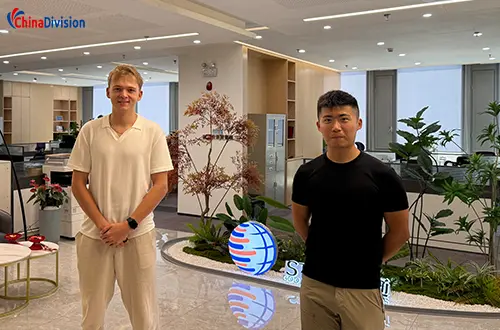
For this reason, one Kickstarter campaign client decided to visit ChinaDivision's fulfillment operation in person before entrusting its crowdfunding inventory to a third-party logistics (3PL) provider.
During the visit, the client wanted answers—not marketing promises.
They wanted to see how their products would actually be received, stored, packed, shipped, tracked, and delivered.
Our sales representative, Neil, walked the client through the process, answered their concerns, and helped turn an unfamiliar fulfillment operation into a logistics process they could understand and trust.
Why This Kickstarter Client Wanted to Visit a 3PL Warehouse
Crowdfunding fulfillment is different from ordinary e-commerce fulfillment.
A traditional e-commerce seller may already have:
- Stable SKUs
- Historical order data
- Established packaging
- Predictable demand
- Existing carrier accounts
- Repeat fulfillment processes
A Kickstarter campaign can be very different.
The product may be newly manufactured. The packaging may have never been tested at scale. The creator may have hundreds or thousands of backers across dozens of countries.
And most importantly, there is often no second chance to make a first delivery experience successful.
Kickstarter's own 2026 fulfillment guidance emphasizes that creators need to plan manufacturing, freight, customs, fulfillment, duties, and delivery before rewards are ready to ship.
That is why the client came to ChinaDivision with a long list of questions.
The Client's Main Concerns About Crowdfunding Fulfillment
During the warehouse visit, the client's concerns could be grouped into six major areas:
| Client Concern | What the Client Really Wanted to Know |
|---|---|
| Inventory receiving | Will every unit be counted and checked correctly? |
| Warehousing | Where will thousands of crowdfunding rewards be stored? |
| Packaging | Will products be packed safely and consistently? |
| International shipping | Can rewards be shipped efficiently to multiple countries? |
| Customs & duties | Could customs problems delay delivery or create unexpected costs? |
| Backer delivery | Can every backer receive accurate tracking and timely delivery? |
These are not theoretical concerns.
For a crowdfunding campaign, logistics problems quickly become customer-service problems.
A delayed shipment can generate backer comments.
A damaged product can generate refund requests.
An unexpected customs charge can create frustration.
A missing tracking number can result in repeated support tickets.
The creator therefore needs a fulfillment partner that understands not only logistics—but also the backer experience.
Concern 1: "How Will You Receive and Count Our Crowdfunding Inventory?"
One of the client's first concerns was inventory accuracy.
Crowdfunding inventory can arrive from a manufacturer in:
- Cartons
- Pallets
- Mixed SKUs
- Multiple production batches
- Different colors
- Different reward tiers
- Bundled accessories
The client wanted to know:
What happens when the factory sends the products to the warehouse?
This is important because a fulfillment mistake at receiving can multiply later.
Imagine:
Factory ships 10,000 units → warehouse records 9,800 units → 200 units are missing from inventory → 200 backers eventually cannot be fulfilled.
The problem may not be discovered until months later.
How Neil Addressed the Concern
Neil explained that receiving should not simply mean "the truck arrived."
The warehouse receiving process needs to connect the physical inventory with the shipment documentation and inventory records.
For larger shipments, advance shipment information can also help the warehouse prepare for receiving.
This gives the fulfillment team an opportunity to understand:
- What is arriving
- How many cartons are expected
- Which SKUs are included
- How much space may be required
- Whether special handling is needed
The objective is straightforward:
The quantity in the warehouse system should correspond to the physical inventory that actually arrived.
For crowdfunding, this provides an important foundation for everything that follows.
Concern 2: "Where Will Our Products Be Stored?"
A crowdfunding creator may suddenly move from having hundreds of prototype units to having thousands of finished products.
That creates a completely different warehousing requirement.
The client wanted to know:
- How is inventory organized?
- Can different reward tiers be separated?
- Can different SKUs be managed independently?
- How is inventory protected?
- Can the warehouse handle a campaign's peak fulfillment period?
- What happens if inventory arrives in multiple batches?
Neil showed the client how the warehouse is organized and explained how inventory can be managed as part of the fulfillment process.
This helped the client understand an important difference between storing products and managing fulfillment inventory
A professional 3PL should know:
what arrived + where it is + how much remains + which orders it belongs to.
Concern 3: "Will Our Crowdfunding Products Be Packed Properly?"
This was particularly important because crowdfunding products often have unique packaging requirements.
A product may have:
- Custom retail packaging
- Printed inserts
- Accessories
- Promotional materials
- Multiple components
- Fragile parts
- Special presentation requirements
The client was concerned that a fulfillment warehouse might treat every order like a standard e-commerce parcel.
That can be risky.
A crowdfunding reward may represent not just a product sale, but the fulfillment of a promise made to a backer months earlier.
Neil's Response
Neil explained how fulfillment instructions can be translated into warehouse-level packing operations.
Depending on the product, the workflow can include:
Pick → Verify → Assemble/Bundle → Protect → Pack → Weigh → Label → Dispatch
For fragile products, packaging can also be adapted with appropriate protective materials.
The goal is not simply to get the product into a box.
It is to make sure the right product, with the right accessories and packaging, goes to the right backer.
Concern 4: "Can You Handle International Backers?"
Crowdfunding campaigns are rarely limited to one country.
A campaign may have backers in:
- United States
- Canada
- United Kingdom
- Germany
- France
- Australia
- Japan
- Singapore
- South Korea
- Other international markets
This creates a logistics challenge because the same reward may need to travel through completely different shipping networks.
The client wanted to understand:
"Can one fulfillment operation handle all these destinations?"
Neil's Approach
Rather than presenting international fulfillment as one universal shipping method, Neil explained that destination, package characteristics, delivery requirements, and customs considerations all affect the appropriate shipping solution.
This is important because:
A 1-kg parcel going to the United States is not necessarily handled the same way as a 1-kg parcel going to Europe or Australia.
A professional fulfillment strategy therefore considers the destination before the parcel leaves the warehouse.
Concern 5: "What About Customs, Duties, and Taxes?"
This is one of the biggest concerns for international crowdfunding.
A backer may assume:
"I already paid for my Kickstarter reward, so why am I being asked for another payment?"
But customs duties and import taxes can be separate from the original pledge.
Kickstarter states that creators are responsible for properly declaring rewards shipped internationally, including the value of goods, while duties, taxes, VAT, and other import-related fees may be imposed by the destination country.
Kickstarter also recommends that creators communicate tax and import-duty expectations clearly to backers before fulfillment.
This makes customs planning an important part of backer experience management
Neil Helped the Client Understand the Bigger Picture
The conversation went beyond:
"Can you ship this package?"
It addressed:
"How do we prevent customs surprises from damaging the relationship with our backers?"
That means considering:
- Accurate commercial invoices
- Product descriptions
- HS classifications
- Country of origin
- Declared value
- Destination requirements
- Shipping terms
- Duties and taxes
- DDP/DDU strategy where applicable
- Backer communication
This is particularly important in 2026 because international low-value import and tariff rules continue to change.
For example, Kickstarter currently notes that the EU removed the existing customs-duty exemption for goods valued under €150 beginning July 1, 2026, with a €3 duty per item type under the new arrangement.
For campaigners, the lesson is simple: shipping costs and customs costs should be planned before fulfillment—not discovered by backers at the doorstep.
Concern 6: "How Will We Know Where Every Package Is?"
Crowdfunding creators often have hundreds or thousands of backers asking the same question:
"Where is my reward?"
Without reliable tracking, the creator's support team becomes the tracking system.
That is not scalable.
The client wanted to know whether ChinaDivision could provide shipment tracking information after orders were dispatched.
Neil explained how tracking information can be associated with individual orders so that the creator can follow shipment progress and provide information to backers.
A typical workflow is:
Order Data → Warehouse Pick → Packing → Carrier Handover → Tracking Number → In Transit → Last-Mile Delivery
The more transparent this chain is, the easier it becomes to manage backer expectations.
Concern 7: "What Happens If a Package Is Delayed?"
No logistics provider can honestly promise that every international parcel will arrive without exception.
Weather, customs inspections, carrier disruptions, incorrect addresses, remote-area delivery, and other events can affect delivery.
The better question is:
"What happens when something goes wrong?"
This was another important part of the client's conversation with Neil.
A professional fulfillment operation should have processes for handling:
- Delivery exceptions
- Address corrections
- Customs holds
- Failed delivery attempts
- Returned packages
- Lost shipments
- Damaged shipments
- Backer inquiries
This is especially important because one unusual shipment can otherwise consume disproportionate amounts of the creator's time.
Concern 8: "Can You Handle a Crowdfunding Fulfillment Spike?"
Crowdfunding fulfillment is often highly concentrated.
Instead of:
100 orders/day for 12 months
a campaign may generate:
Thousands of orders that need to ship within a relatively short period.
That creates a warehouse capacity problem.
The client wanted to know whether ChinaDivision could handle the campaign's fulfillment wave without creating a bottleneck.
Neil explained how warehouse operations can be organized around:
- Inventory preparation
- Order import
- SKU matching
- Picking
- Packing
- Label generation
- Carrier handoff
- Tracking updates
This is where a 3PL can provide value that is difficult to reproduce with a small internal team.
Concern 9: "What If Our Product Has Multiple Reward Tiers?"
Crowdfunding campaigns often have different reward levels.
For example:
| Reward Tier | Contents |
|---|---|
| Basic | Main product |
| Standard | Main product + accessories |
| Premium | Main product + accessories + bonus item |
| Collector | Multiple products + limited-edition packaging |
The logistics challenge is making sure that each backer receives exactly what they pledged for.
One missing accessory can turn an otherwise successful delivery into a support ticket.
Neil explained how reward configurations can be translated into SKU and packing instructions so warehouse staff can follow a defined fulfillment process rather than making decisions order by order.
Concern 10: "Can You Handle Returns and Exceptions?"
Creators sometimes focus heavily on the first shipment and overlook what happens afterward.
But international fulfillment can also generate:
- Returns
- Undeliverable packages
- Address changes
- Damaged items
- Replacement requests
- Missing accessories
A good crowdfunding fulfillment strategy therefore needs a post-delivery plan.
The client discussed these scenarios with Neil to understand how exceptions could be handled instead of leaving every problem to the campaign team.
What Neil's Warehouse Tour Changed for the Client
Before visiting the warehouse, the client was evaluating ChinaDivision largely through:
- Pricing
- Service descriptions
- Communication
- Shipping options
After walking through the operation, the client could see something much more tangible:
the physical process behind the promised service.
Neil did not simply tell the client:
"We can fulfill your campaign."
He demonstrated how the fulfillment process works.
That distinction matters.
For crowdfunding creators, trust is built when they can connect:
their product → the warehouse → the packing process → the carrier → the backer.
What Crowdfunding Creators Should Ask a 3PL Before Signing
The warehouse visit also highlights a useful lesson for other campaigners.
Don't evaluate a fulfillment provider based only on its quoted shipping rate.
Ask these questions:
| Question | Why It Matters |
|---|---|
| Where will my inventory be stored? | Determines operational control |
| How do you receive and count inventory? | Prevents inventory discrepancies |
| Can you manage multiple reward configurations? | Reduces packing mistakes |
| Can you handle custom packaging? | Protects product presentation |
| How are international customs documents handled? | Reduces clearance problems |
| How is tracking information provided? | Improves backer communication |
| What happens when delivery fails? | Determines exception-management quality |
| How are returns handled? | Protects post-delivery experience |
| Can you scale during the fulfillment peak? | Prevents warehouse bottlenecks |
| How do you reconcile warehouse and order data? | Improves inventory accuracy |
| Can you ship directly from China? | May reduce unnecessary transportation steps |
| What information do you need before receiving inventory? | Helps prevent inbound delays |
The best fulfillment partner should be comfortable answering these questions before the campaign's inventory arrives.
Why China-Based Fulfillment Can Make Sense for Kickstarter Campaigns
For campaigns manufacturing in China, sending all inventory to another country before shipping individual rewards can create an additional logistics stage.
For example:
China Factory → U.S. Warehouse → U.S. Backer
may be appropriate for some campaigns.
But another model may be:
China Factory → China 3PL → Global Backers
The best option depends on:
- Backer distribution
- Product weight
- Product dimensions
- Order volume
- Destination markets
- Customs strategy
- Shipping rates
- Inventory requirements
- Delivery expectations
Kickstarter's own fulfillment guidance notes that direct fulfillment from manufacturing regions can be advantageous for campaigns with international backers, large SKU counts, or cash-flow considerations.
This is why creators should evaluate fulfillment geography before production is completed, rather than automatically sending all inventory to their home country.
The Most Important Lesson: Fulfillment Should Start Before the Campaign Ends
One of the biggest mistakes a first-time campaign creator can make is waiting until the campaign has finished before thinking seriously about fulfillment.
By then, many important decisions may already have been made.
A stronger approach is to involve your fulfillment provider during campaign planning.
Before launch
Consider:
- Product dimensions
- Product weight
- Packaging
- Target markets
- Estimated backer distribution
- Shipping cost
- Customs requirements
- Duties/taxes
- Fulfillment model
- Estimated delivery timeline
During manufacturing
Confirm:
- Production schedule
- Packaging specifications
- Quality control
- Carton dimensions
- Master-carton quantities
- Final product weight
Before warehouse receiving
Prepare:
- SKU list
- Packing instructions
- Reward configurations
- Shipment information
- Purchase/order data
- Receiving schedule
- Customs documents
Before fulfillment
Complete:
- Inventory reconciliation
- Address validation
- Shipping-method selection
- Customs documentation
- Packaging testing
- Backer communication
Kickstarter's current guidance similarly recommends choosing a fulfillment model, identifying customs and broker requirements, estimating duties, and establishing realistic delivery dates before fulfillment begins.
How ChinaDivision Helps Turn Crowdfunding Logistics Into a Structured Process
The value of a 3PL for a Kickstarter creator is not simply:
"We can ship your products."
It is:
"We can help turn thousands of individual backer promises into a manageable fulfillment operation."
For campaigners, that means connecting:
Warehousing
Receive and organize campaign inventory before fulfillment.
Inventory Management
Track SKUs, quantities, and available stock.
Pick & Pack
Translate reward configurations into repeatable warehouse instructions.
Packaging
Apply campaign-specific packaging and protective materials where required.
International Shipping
Match shipments with appropriate international delivery solutions.
Customs Coordination
Prepare the information needed for international shipping and customs clearance.
Tracking
Provide shipment visibility after dispatch.
Exception Management
Help manage delivery issues, returns, and other fulfillment exceptions.
This integrated approach gives the campaign creator more time to focus on what matters most:
building the product, communicating with backers, and growing the brand.
Why the Warehouse Visit Matters
The client's visit to ChinaDivision was more than a facility tour.
It was an opportunity to test whether the logistics operation could answer the questions that matter after a Kickstarter campaign succeeds.
The client wanted to know:
Can you receive our products accurately?
Can you store them securely?
Can you pack thousands of rewards consistently?
Can you ship internationally?
Can you handle customs requirements?
Can we track our backers' shipments?
What happens when something goes wrong?
Neil's role was not simply to provide sales information.
He helped the client understand how each concern connects to a specific operational process.
And that is ultimately what a crowdfunding creator needs from a 3PL:
Not just a warehouse, but a fulfillment partner that understands the responsibility behind every backer order.
Ready to Fulfill Your Kickstarter Campaign?
For crowdfunding creators, the moment a campaign reaches its funding goal is exciting—but it is also the moment when logistics becomes real.
Thousands of backers are no longer potential customers.
They are waiting for their rewards.
Choosing the right fulfillment partner can therefore influence:
- Delivery speed
- Shipping cost
- Customs experience
- Product condition
- Tracking visibility
- Customer support workload
- Backer satisfaction
- Your brand's reputation
A warehouse visit gives creators an opportunity to see beyond a price quotation and evaluate the actual fulfillment operation.
If you're preparing a Kickstarter or other crowdfunding campaign and manufacturing in China, ChinaDivision can help you plan the journey from factory inventory to international backer delivery.
Contact the ChinaDivision team and speak with Neil about your campaign's product dimensions, expected order volume, target countries, packaging requirements, and fulfillment timeline.
Your campaign may end when you reach the funding goal. For your logistics partner, that's where fulfillment begins.


About the Author: Limi

Limi is a content marketing expert at ChinaDivision, helping businesses and e-commerce sellers navigate the complexities of international shipping by providing actionable tips and comprehensive guides on logistics, shipping, and cargo transportation.