

Can Multiple E-Commerce Stores Share the Same Inventory?
Table of Contents
- What Is Shared Inventory?
- Shared Inventory vs Separate Stock: Side-by-Side
- How It Works for Every Major Platform
- How to decide if shared inventory is right for you
- The Biggest Risks — And How to Avoid Them
- Why Professional E-Commerce Warehousing Makes All the Difference
- How Chinadivision Supports Multi-Channel Sellers
- Case Example: Multi‑Store Seller
- Frequently Asked Questions
- Recommended Industry Resources
If you sell across Amazon, eBay, Shopify, WooCommerce, or your own WordPress site, you’ve almost certainly faced these headaches:
- Listing items as “in stock” when they’ve already sold on another channel
- Tying up cash in duplicate stock spread across multiple Amazon warehouse, eBay warehouse, or Shopify warehouse locations
- Spending hours manually updating counts to avoid overselling
- Losing sales because stock sits in one place while orders pile up elsewhere
The good news: You absolutely can share the same inventory across all your stores — and it’s the smartest way to run a multi-channel business.
In this guide, we explain how shared inventory works, why it solves your biggest pain points, how it compares to managing separate stock, and how Chinadivision helps you keep e-commerce inventory accurate, secure, and ready to ship everywhere you sell.
What Is Shared Inventory?
Shared inventory means storing all your products in one central e-commerce storage location, then selling them across Amazon, eBay, Shopify, WooCommerce, WordPress, and any other sales channel — with stock levels updating automatically in real time.
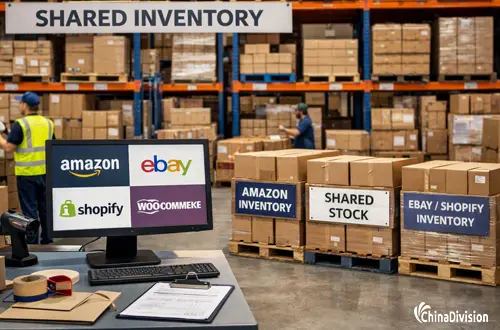
Instead of sending separate batches to an Amazon warehouse, a Shopify warehouse, and an eBay warehouse, you keep one single pool of stock. Every time an order comes in from any platform, the system deducts it from your total — so you never sell what you don’t have.
Shared Inventory vs Separate Stock: Side-by-Side
|
Factor |
Separate Stock per Channel |
Shared Inventory (Centralized) |
|---|---|---|
|
Storage Cost |
Higher — duplicate stock + multiple location fees |
Lower — single pool, no duplication |
|
Overselling Risk |
High — manual updates or mismatched timing |
Near zero — real-time sync |
|
Stockout Risk |
Higher — stock locked to one channel |
Lower — stock flows to where orders are |
|
Cash Flow |
Tied up in idle stock across locations |
Freed up — one accurate stock view |
|
Admin Work |
Hours/days updating spreadsheets |
Automated — no manual entry |
|
Scalability |
Harder — must allocate stock upfront |
Easier — adjust instantly as channels grow |
|
Best For |
Single-channel sellers |
Multi-channel brands selling on Amazon, eBay, Shopify, WooCommerce, WordPress |
How It Works for Every Major Platform
Whether you use Amazon warehousing, Shopify warehousing, WooCommerce warehousing, eBay warehousing, or WordPress warehousing, unified inventory connects them all:
|
Store/Channel |
Common Setup |
|---|---|
|
Amazon |
Amazon inventory synced from a central WMS |
|
eBay |
eBay inventory pulled from the same stock pool |
|
Shopify |
Shopify inventory updated in real time |
|
WooCommerce |
WooCommerce shared inventory via plugin, API, or WMS |
|
WordPress |
WordPress inventory connected through the same backend |
✅ Amazon: Sync Amazon inventory so listings update the second an order ships — no “out of stock” penalties or suppressed listings.
✅ eBay: Keep eBay inventory accurate to avoid cancellations and negative feedback.
✅ Shopify: Link Shopify inventory directly to your warehouse — sell on your site, social, and marketplaces from one stock.
✅ WooCommerce: Enable WooCommerce shared inventory across your store and all other channels — perfect for custom WordPress setups.
✅ WordPress: Manage WordPress inventory alongside marketplaces without extra plugins or manual work.
How to decide if shared inventory is right for you
Ask these questions:
- Do you sell the same products on multiple channels?
- Do you want one pool of stock instead of separate inventory piles?
- Can your current system sync inventory in real time?
- Do you need a warehouse partner that handles Amazon, eBay, Shopify, and WooCommerce together?
- Are overselling and manual updates hurting your customer experience?
If the answer to most of these is yes, shared inventory is probably the better model.
The Biggest Risks — And How to Avoid Them
Sharing inventory is powerful — but only if done right. Here’s what to watch for:
1. Overselling
Risk: If sync is delayed or manual, you sell more than you have.
Fix: Use a fully integrated system that deducts stock the moment an order is confirmed — Chinadivision’s platform syncs instantly with all major channels.
2. Channel-Specific Rules
Risk: Amazon has strict Amazon warehousing requirements; other platforms have different packaging or labeling rules.
Fix: Your fulfillment partner applies the right labeling, packaging, and compliance automatically per order — even from the same stock.
3. Stock Visibility
Risk: Not knowing exactly where stock is or how fast it’s moving.
Fix: Get one dashboard showing total stock, reserved stock, available stock, and sales velocity across all channels.
4. Speed to Customers
Risk: Central stock might slow delivery if not planned well.
Fix: Use strategically located e-commerce warehousing — we place stock close to your biggest markets so delivery times stay fast.
Why Professional E-Commerce Warehousing Makes All the Difference
You can connect channels yourself — but a specialist provider turns it into a seamless, low-risk operation:
- One central stock pool serving Amazon, eBay, Shopify, WooCommerce, WordPress, and more
- Automated real-time sync — no spreadsheets, no double-checking
- Channel-compliant handling — Amazon FBA prep, eBay shipping standards, custom branding for your store
- Flexible allocation — push more stock to channels that are selling faster
- Lower storage costs — no paying for duplicate space in multiple Amazon warehouse or Shopify warehouse locations
How Chinadivision Supports Multi-Channel Sellers
We built our fulfillment system specifically for brands selling everywhere:
🔗 Native integrations — connect Amazon, eBay, Shopify, WooCommerce, and WordPress in minutes
📊 Unified inventory dashboard — see all your e-commerce inventory in one place
📦 Compliant prep & packaging — meet Amazon, eBay, and carrier requirements automatically
🌍 Global e-commerce storage — store closer to buyers for faster, cheaper shipping
💰 Cost-effective storage — pay only for the space you use, no hidden fees
🛡️ Overselling protection — automatic hold and deduction so you never list unavailable items
Case Example: Multi‑Store Seller
A seller operating on Amazon, Shopify, and WooCommerce faced overselling issues. By moving to Chinadivision’s shared inventory system, they achieved:
- 30% reduction in storage costs
- 40% faster order processing
- Zero overselling incidents
- Improved customer satisfaction across all platforms
Frequently Asked Questions
Q: Can I share inventory between Amazon FBA and my own Shopify store?
A: Yes — we manage stock that feeds into Amazon warehouse and ships direct for Shopify inventory from the same pool.
Q: Does WooCommerce support shared inventory?
A: Absolutely — WooCommerce shared inventory works seamlessly with our system, even for custom WordPress builds.
Q: What if I need to keep some stock separate for specific channels?
A: You can set rules — allocate dedicated stock or use shared stock — whatever fits your business.
Q: Will this increase my costs?
A: Almost always the opposite — removing duplicate stock and idle space usually cuts total storage and shipping spend by 15–30%.
Recommended Industry Resources
WooCommerce Inventory Management Documentation
Shopify Help Center: Setting Up and Managing Multi-Location Inventory


About the Author: Limi

Limi is a content marketing expert at ChinaDivision, helping businesses and e-commerce sellers navigate the complexities of international shipping by providing actionable tips and comprehensive guides on logistics, shipping, and cargo transportation.