

EU Packaging and Packaging Waste Regulation (PPWR)
If you ship to or store goods within the European Union, packaging is no longer just about protection and branding — it is now tightly regulated under Regulation (EU) 2025/40, the Packaging and Packaging Waste Regulation (PPWR). Launching August 12 2026, this unified framework replaces fragmented national rules, covers every packaging type including e‑commerce parcels and logistics transport packaging, and raises standards for sustainability, documentation, Extended Producer Responsibility (EPR), and waste tracking.
Table of Contents
- What Is the PPWR and Why It Matters
- Key Requirements Under the New Regulation
- PPWR vs Previous Packaging Directive: Clear Comparison
- Fulfillment & Logistics Impacts We See Most Often
- Does the PPWR Apply to E-Commerce Packaging?
- Practical Action Plan for E‑Commerce Sellers
- Frequently Asked Questions (FAQ)
- Recommended Resources
From our perspective as an international order fulfillment and warehousing provider, we see sellers facing urgent pain points: unclear material limits, scattered reporting rules, fear of fines or customs holds, and uncertainty how warehouse packing, labeling, and Road Freight distribution fit in. This guide breaks down exactly what changes, compares old vs new rules, highlights fulfillment impacts, and shares actionable steps to prepare smoothly — so you can keep delivering while meeting legal goals and lowering waste costs.
What Is the PPWR and Why It Matters
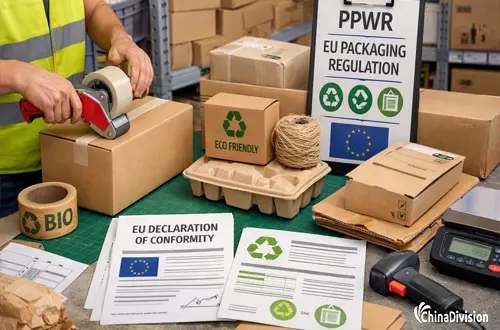
The EU Packaging and Packaging Waste Regulation applies directly across all EU member states to all packaging and Packaging Waste generated or placed on the EU market — primary consumer packaging, outer shipping cartons, filler materials, pallets, stretch wrap, and carrier bags alike.
Core objectives:
- Make all packaging economically recyclable by 2030
- Boost recycled material content and cut virgin raw material use
- Reduce total packaging waste volume and phase out harmful substances (e.g., restricted PFAS levels, certain single‑use plastic formats)
- Standardize rules to replace inconsistent national laws from the old Packaging and Packaging Waste Directive (94/62/EC)
- Strengthen traceability, documentation, and reporting through national EPR registries
Timeline:
- Entered into force: February 11 2025
- General application: August 12 2026
- Phased transition and delegated exemptions apply for specific logistics packaging like pallet wrap and straps
Key Requirements Under the New Regulation
1. Design & Material Standards
- Limit hazardous substances and set minimum recycled content targets
- Reduce overpackaging; avoid unnecessary layers and excess void fill
- Restrict specific single‑use plastic formats and non‑compliant additives
- Encourage reusable packaging systems and returnable loops
2. Documentation & Labeling
- Maintain EU Declaration of Conformity plus supporting technical records for every packaging type
- Mark packaging clearly for material sorting/recyclability
- Keep full weight, material composition, and usage records verifiable and retrievable
3. Reporting & EPR Obligations
- Register with national EPR systems and report packaging type, weight, material, and placement volumes regularly
- Track waste generated at warehouses and distribution points, not just retail sales
- Share data across supply chain partners — fulfillment centers, carriers, and Road Freight operators
Unlike the previous Packaging and Packaging Waste Directive, the PPWR establishes a more consistent EU-wide framework for packaging design, composition, labeling, reuse, recycling, waste prevention, and producer responsibility.
For e-commerce businesses, this means packaging is no longer only a warehouse or branding decision. It is also a compliance, data, cost, and market-access issue.
PPWR vs Previous Packaging Directive: Clear Comparison
|
Aspect |
Old Packaging Directive (PPWD) |
New Packaging and Packaging Waste Regulation (PPWR) |
|---|---|---|
|
Legal scope |
Minimum standards; countries implemented differently |
Directly uniform law across all EU nations |
|
Sustainability goals |
General recycling targets |
Binding recyclability deadlines, recycled content, waste reduction |
|
Producer responsibility |
Variable reporting and fees |
Unified EPR, centralized registries, stricter audit trails |
|
Logistics packaging |
Often loosely interpreted |
Explicit coverage of transport packaging, pallets, wrap, crates |
|
Compliance proof |
Local paperwork only |
Standardized EU Declaration of Conformity + full documentation |
|
Enforcement |
Uneven penalties |
Consistent checks, stronger fines, potential shipment holds |
Fulfillment & Logistics Impacts We See Most Often
As a provider managing warehousing, packing, cross‑border shipping, and Road Freight daily, here are the challenges our clients already ask about:
- Warehouse packing changes: We must shift to compliant materials, remove restricted plastics, and document every supply source declaration
- Multi‑country complexity: No more guessing different national limits — one set of rules simplifies planning but demands consistent execution
- Supply chain traceability: We need suppliers to provide declarations early; last‑minute material switches risk non‑compliance
- Reporting coordination: Sellers are responsible, but fulfillment partners help capture accurate packaging weight and category data for EPR reporting
- Cost and capacity planning: Optimized packaging cuts dimensional weight and waste disposal fees; reusable packaging loops support long‑term savings
ChinaDivision Insight: When we design parcel packing for clients now, we balance protection, brand look, carrier efficiency, and recyclability from the start — avoiding costly re‑packing or rejected shipments later.
Does the PPWR Apply to E-Commerce Packaging?
Yes. E-commerce shipping materials are within the scope of the regulation when they are used to deliver products to EU customers.
This can include:
- Outer shipping cartons.
- Branded mailers.
- Protective sleeves.
- Product inserts.
- Void-fill materials.
- Multi-item shipping cartons.
- Pallet wrap and transport straps.
- Packaging used for B2B deliveries to European customers.
The PPWR is especially relevant to fulfillment operations because packaging decisions are often made at the warehouse after the order is received.
For example, a seller may have a compliant product box but use an oversized outer carton filled with unnecessary void fill. That packaging choice can increase shipping costs, waste volume, and future compliance risk.
Practical Action Plan for E‑Commerce Sellers
Start preparing well before August 2026 with these priority steps:
| Area | What businesses need to prepare |
|---|---|
| Packaging design | Reduce unnecessary material, weight, and volume |
| Material safety | Review substances and restricted materials |
| Recyclability | Assess whether packaging can be recycled in practice |
| Documentation | Maintain technical files and conformity records |
| EPR | Register and report packaging data where required |
| Labeling | Prepare required product and disposal information |
| Fulfillment | Control packaging selection, packing rules, and data capture |
| Transport | Review pallets, wraps, straps, cartons, and road-freight packaging |
- Audit your packaging inventory — list all boxes, mailers, cushioning, tape, labels; record material, weight, and supplier details
- Verify supplier compliance — request EU Declaration of Conformity and material test reports; phase out non‑compliant stock gradually
- Confirm EPR registration status — identify relevant member states and join approved producer responsibility organizations
- Align with fulfillment partners — review packing procedures, storage workflows, and reporting data formats with your logistics team
- Plan reusable options — evaluate returnable packaging for repeat orders or bulk distribution routes to lower waste and cost
Frequently Asked Questions
Q: Does PPWR apply only to consumer packaging, or also to logistics packaging?
A: EU Packaging rules cover all packaging — including outer shipping cartons, pallets, stretch wrap, and protective materials used in storage and Road Freight transport.
Q: If I outsource warehousing and packing to ChinaDivision, am I still legally responsible?
A: The producer/seller retains ultimate compliance liability, but we help you maintain accurate records, source verified materials, and collect the data needed for reporting and audits.
Q: Can I keep using current stock after August 12 2026?
A: Only if it meets the new material, labeling, and documentation requirements. Early stock rotation prevents waste and clearance delays.
Q: How do I handle sales to multiple EU countries?
A: Rules are harmonized, but you still follow national registry reporting requirements for each market you place goods into. We help coordinate data so reporting is streamlined.
The Packaging and Packaging Waste Regulation is more than compliance — it is a chance to modernize packaging, reduce waste‑related costs, improve brand reputation, and build resilient, sustainable supply chains. Starting early lets you phase changes smoothly instead of rushing and risking fines or delivery disruptions.
Recommended Resources
For authoritative information, use the following specific pages rather than general homepages:
European Commission: Packaging and Packaging Waste Regulation
European Commission: Packaging waste and implementation information


About the Author: Limi

Limi is a content marketing expert at ChinaDivision, helping businesses and e-commerce sellers navigate the complexities of international shipping by providing actionable tips and comprehensive guides on logistics, shipping, and cargo transportation.