

China Fulfillment vs. USA Fulfillment: Which Is Better for Your E-Commerce Business?
Choosing between a China warehouse and a USA warehouse changes your costs, delivery speed, customer experience, and global growth potential. China Fulfillment offers lower storage, labor, and fulfillment costs — ideal for manufacturing, sourcing, and cross-border scaling. USA Fulfillment delivers 2–5 day domestic delivery, no customs delays, and higher conversion — but at 2–3x the operating cost.
Table of Contents
- China Fulfillment vs. USA Fulfillment: The Short Answer
- China Fulfillment vs. USA Fulfillment: What Is the Real Difference?
- China Warehouse vs. US Warehouse: Quick Comparison
- Where Does Your Inventory Risk Belong?
- Deep Dive: China Warehouse & Fulfillment
- Deep Dive: USA Warehouse & Fulfillment
- The Winning Strategy: Hybrid China + USA Fulfillment
- Choose ChinaDivision: The Hybrid Fulfillment Leader
- Frequently Asked Questions
- Recommended Industry Resources
China Fulfillment vs. USA Fulfillment: The Short Answer
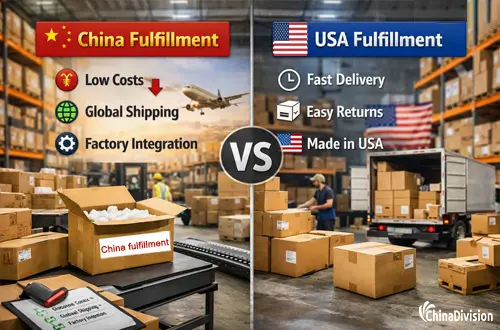
China Fulfillment is often better for sellers sourcing products from China, testing new SKUs, managing a large product catalog, or prioritizing lower inventory risk. USA Fulfillment is usually better for brands with stable US demand that need faster domestic delivery and easier returns.
For many growing e-commerce businesses, the most cost-effective strategy is a hybrid fulfillment model:
- Keep long-tail and slow-moving inventory in a China warehouse
- Move best-selling products to a US warehouse
- Use data-driven inventory allocation rather than sending every SKU to the United States
This article compares China Fulfillment, USA Fulfillment, US fulfillment, China 3PL, USA 3PL, and China E-commerce Fulfillment from the perspective of an international order fulfillment and logistics provider.
China Fulfillment vs. USA Fulfillment: What Is the Real Difference?
The biggest difference is not simply where your inventory is stored.
The real difference is where you place inventory risk.
With China Fulfillment, inventory stays close to:
- Manufacturers
- Suppliers
- Product sourcing markets
- Production facilities
- Quality inspection services
- Custom packaging operations
With USA Fulfillment, inventory is positioned closer to:
- US customers
- Domestic carriers
- Local returns facilities
- Faster last-mile delivery networks
Therefore, the decision involves a trade-off:
China warehouse = greater inventory flexibility and lower upfront inventory commitment.
US warehouse = faster customer delivery but higher inventory placement commitment.
This distinction is particularly important for brands with dozens or hundreds of SKUs.
China Warehouse vs. US Warehouse: Quick Comparison
|
Factor |
China Warehouse |
US Warehouse |
|---|---|---|
|
Best for |
Global sellers sourcing from China |
Brands with stable US demand |
|
Delivery to US customers |
Usually longer |
Usually faster |
|
Distance from Chinese suppliers |
Very close |
Long international inbound journey |
|
Inventory flexibility |
High |
Lower once stock is imported |
|
Upfront inventory commitment |
Usually lower |
Usually higher |
|
Returns from US customers |
More complex |
Easier |
|
Product inspection |
Convenient near suppliers |
More difficult after import |
|
Long-tail SKU management |
Strong |
Can become expensive |
|
Domestic US delivery |
Cross-border |
Local |
|
Customs processing |
Often part of outbound shipping workflow |
Usually handled during bulk inventory import |
Important: The best model depends on product value, demand predictability, SKU count, margins, order volume, and target markets. US fulfillment is faster and simpler at the destination, but China fulfillment is dramatically cheaper at origin. The total cost including shipping often favors China until order volume justifies splitting inventory.
Where Does Your Inventory Risk Belong?
A better strategy may be:
Localize the Fast Movers
Move high-demand products to a US warehouse.
Keep Long-Tail Inventory in China
Ship slower-moving products directly from a China warehouse when orders occur.
This is one of the main reasons why a hybrid China Fulfillment and USA Fulfillment strategy can outperform a single-location model.
Deep Dive: China Warehouse & Fulfillment
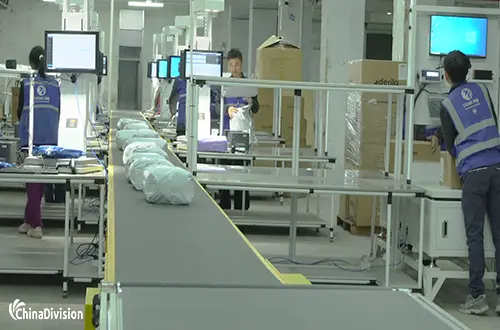
Major Advantages
- Dramatically lower operating costs: Storage, labor, and fulfillment are 50–65% cheaper than US equivalents. You keep more margin even after paying international shipping.
- Direct from manufacturing: If your products are made in China, storing in a China warehouse eliminates double shipping, cross-border freight to the US, and interim handling — saving $1.50–$4.00 per unit before you even ship to customers.
- Unlimited inventory capacity: Scale to thousands of SKUs without premium warehouse space costs. Test new products risk-free — no need to fill a US warehouse upfront.
- Global reach from one hub: Ship to 200+ countries from a single location. One inventory pool serves the world.
- Specialized China E-commerce Fulfillment expertise: Providers like ChinaDivision understand export rules, IP compliance, and customs documentation — reducing holds and delays.
China Fulfillment Pros and Cons
|
Pros |
Cons |
|---|---|
|
Lower storage costs: $0.50–$2.00 per cubic foot/month vs. $2–$5 in USA. |
Longer delivery times: 7–15 days to US/EU vs. 2–5 days from USA. |
|
No inventory risk: Ship on demand, avoid overstocking. |
Higher shipping costs per order: $3–$8 vs. $5–$12 (but offset by lower storage). |
|
Direct from manufacturer: Reduce handling and logistics steps. |
Customs complexity: Per-package clearance, potential delays. |
|
Scalable: Easy to ramp up or down based on demand. |
Customer expectations: Some shoppers expect 2-day delivery. |
|
Ideal for testing: Validate products before scaling to USA fulfillment. |
Returns complexity: International returns are slower and more expensive. |
Data point: China fulfillment is 40–60% cheaper for storage but 20–30% more expensive per order for shipping compared to USA fulfillment. The total cost depends on order volume and product type.
Real Tradeoffs You Must Know
- Transit time: 7–15 days to major US/EU destinations; 15–30 days to remote regions
- Customs & clearance risk: Every international shipment crosses borders — duties, taxes, and inspections apply
- Returns are difficult: Customers return items internationally → expensive, slow, or impossible economically
- Perceived slower delivery: Can reduce conversion vs "ships from USA" competitors
Best Use Cases for China Fulfillment
- Products manufactured in China
- New brands testing product-market fit
- Orders under 200/month to any single region
- Selling globally across many countries
- Lower-value / higher-weight goods where shipping cost dominates
Deep Dive: USA Warehouse & Fulfillment
Major Advantages
- 2–5 day domestic delivery: "Ships from USA" = massive conversion lift. Buyers pay more and buy more when they see fast delivery.
- No customs or surprises: Domestic delivery means no import duties, no surprise fees, no customs holds. What customer sees at checkout is what they pay.
- Low-cost last-mile: US domestic shipping is 60–70% cheaper than international from China.
- Easy local returns: Build trust and loyalty — customers can return locally.
- Premium brand positioning: "Shipped from our US warehouse" signals quality and reliability.
USA Fulfillment Pros and Cons
|
Pros |
Cons |
|---|---|
|
Faster delivery: 2–5 days to US customers vs. 7–15 days from China. |
Higher storage costs: $2–$5 per cubic foot/month vs. $0.50–$2 in China. |
|
Lower shipping costs: $5–$12 per order (domestic rates) vs. $3–$8 (international). |
Inventory risk: Pre-stock inventory, potential overstock or stockouts. |
|
Simpler customs: Bulk clearance at import, no per-package delays. |
Less flexible: Harder to scale down if demand drops. |
|
Better customer experience: Meets Amazon Prime expectations. |
Upfront investment: Ship bulk inventory to USA warehouse. |
|
Easier returns: Domestic returns are faster and cheaper. |
Not ideal for testing: Commit to inventory before validating demand. |
Data point: USA fulfillment is 60–80% faster for delivery but 200–300% more expensive for storage compared to China fulfillment. The total cost depends on order volume and inventory turnover.
Real Tradeoffs You Must Know
- 2–3x higher operating cost: Storage, labor, and rent are far more expensive. Your margin disappears unless order volume is high.
- Double inventory cost: You pay to ship goods to the US warehouse AND store them there. Capital is tied up twice.
- Restock lead time: Replenishing from China takes weeks — stockouts risk losing sales.
- Higher minimums: Most USA 3PL providers require minimum monthly orders or minimum storage commitments.
Best Use Cases for USA Fulfillment
- 200+ orders/month to the US market
- High-value, premium, or time-sensitive goods
- When fast delivery directly increases sales price or conversion
- Products where returns are frequent or critical
- Mature brands scaling market share
The Winning Strategy: Hybrid China + USA Fulfillment
Almost no competitor will tell you this clearly: pure one-location fulfillment is rarely optimal. The highest-growth brands use both — and here's exactly how it works:
How the Hybrid Model Works
- Manufacture → Bulk ship to ChinaDivision China warehouse
→ Low-cost storage, quality control, consolidation - Split stock:
- 80% stays in China → ships internationally, restocks US warehouse, serves global orders
- 20% sent to US warehouse in small batches → fast domestic delivery
- Orders route automatically:
- US-bound → ships from US warehouse (2–5 days)
- Everywhere else → ships from China warehouse (7–15 days)
- Low-stock US → auto-backup from China
Why Hybrid Beats Both Alone
|
Metric |
Pure China |
Pure USA |
✅ Hybrid Model |
|---|---|---|---|
|
US Delivery Speed |
Slow (7–20 days) |
Fast (2–5 days) |
Fast locally |
|
Rest of World Speed |
7–15 days |
Very slow |
Fast globally |
|
Operating Cost |
Low |
Very High |
Balanced — optimal |
|
Inventory Risk |
Low |
High |
Low — bulk in China |
|
Customer Experience |
Mixed |
Excellent |
Excellent everywhere |
|
Capital Required |
Low |
High |
Moderate — scalable |
Choose ChinaDivision: The Hybrid Fulfillment Leader
Why choose one when you can have the best of both? ChinaDivision operates integrated China warehouse + USA warehouse fulfillment from a single unified platform — giving you all the advantages without compromise.
✅ China Fulfillment — low cost, bulk storage, global export expertise
✅ USA Fulfillment — fast 2–5 day domestic delivery, local returns, premium positioning
✅ Hybrid Routing — system automatically chooses best warehouse per order
✅ One Dashboard — manage inventory, orders, and shipping from both locations together
✅ Gradual Expansion — start small, add US warehouse when ready, no penalty
Frequently Asked Questions
Can I use both China and USA fulfillment?
Yes. The hybrid model (bestsellers in USA, long-tail from China) optimizes cost and speed. Brands using hybrid fulfillment see 15–30% lower total costs and 25% higher repeat purchase rates.
What is the difference between China fulfillment and USA fulfillment?
China fulfillment stores inventory in China and ships internationally (7–15 days). USA fulfillment stores inventory in the US and ships domestically (2–5 days). China is cheaper for storage, USA is faster for delivery.
Can I start with China and add a US warehouse later?
Yes — that's the smartest path. Validate product, prove demand, then split stock. ChinaDivision supports seamless expansion — same platform, same dashboard, new warehouse location added when ready.
Recommended Industry Resources


About the Author: Limi

Limi is a content marketing expert at ChinaDivision, helping businesses and e-commerce sellers navigate the complexities of international shipping by providing actionable tips and comprehensive guides on logistics, shipping, and cargo transportation.