

Cost Per Order: How to Calculate, Control, and Reduce CPO
Every business tracks revenue and average order value — but if you don’t fully understand your Cost Per Order (CPO), you’re likely selling at a loss without realising it. Many brands only count obvious expenses like product cost and postage, overlooking dozens of small charges that add up to 20–40% of your total Order Cost. For cross-border sellers, the complexity multiplies: different pricing models, carrier surcharges, storage rules, and international fees can make your actual CPO look nothing like the headline quote you received.
Table of Contents
In this guide, we break down exactly what Cost Per Order is, how to calculate it correctly, the hidden costs most businesses miss, and how partnering with a professional international order fulfillment provider like Chinadivision gives you full visibility and control over your true cost per order.
What Is Cost Per Order (CPO)?
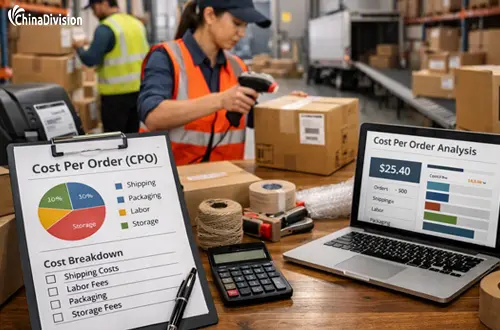
Cost Per Order (CPO) is the total expense incurred to acquire, process, fulfill, and deliver a single customer order. It determines how much profit you make from each sale and is one of the most important metrics for e-commerce businesses.
CPO is not just the cost of goods sold (COGS). It includes marketing, packaging, shipping, storage, and fulfillment fees. Understanding CPO helps businesses identify inefficiencies and make smarter decisions about pricing, fulfillment, and growth.
CPO = (Total All Costs for Period) ÷ Total Number of Orders in Period
Total Costs Include:
- Cost of Goods Sold (COGS)
- Customer Acquisition / Marketing (CAC)
- Order processing & pick/pack fees
- Packaging materials
- Storage & warehousing
- Shipping & delivery
- Carrier surcharges
- Customs & compliance fees
- Returns & replacements
- Admin & system costs
The Hidden Costs That Distort Your Order Cost
Most brands only calculate half the picture — these are the line items that quietly erode your margins:
1. Pick & Pack: The “Cheaper Quote” Trap
Headline base fees are almost meaningless — your real cost depends on your typical order size:
|
Provider |
Base Fee |
Per Additional Item |
Blended Cost for Avg 3.7 items |
|---|---|---|---|
|
Provider A |
$1.05 |
$0.45 |
$2.45 per order |
|
Provider B |
$1.55 |
$0.20 |
$2.15 per order |
Lesson: The lower upfront fee ends up costing ~14% more for multi-item orders. Always calculate using your actual average items per order, SKU weights, and dimensions — not just the advertised rate.
2. Packaging Materials: Not a Rounding Error
Packaging can make up 10–20% of total fulfillment cost — and pricing varies wildly:
- Some bundle materials into pick/pack; others charge per box, mailer, void fill, or branded insert
- Many providers charge 25–40% above wholesale market rates for standard supplies
- Rule of thumb: total packaging cost should stay under 5% of your average order value
What to ask: Request a full price list for every packaging item you use — then ask for your all-in average packaging cost per order based on your actual products.
3. Storage Rates: The Fine Print Costs More Than the Rate
Storage pricing looks simple — but structure and hidden rules change everything:
- Pallet vs cubic pricing: Pallet rates suit dense, fast stock; cubic works better for many small SKUs
- Hidden variables: Pallet height limits, daily vs monthly billing, seasonal peak surcharges
- Long-term storage: 49% of warehouses now charge escalating fees after 60–90 days — double the 2024 figure
- Dead inventory: The slowest 20% of SKUs often consume 40%+ of total storage space
Reality check: A “too-good-to-be-true” low pallet rate almost always means extra fees elsewhere.
4. Shipping: Surcharges That Shift Weekly
Fulfillment providers negotiate far better rates than most brands can get directly — but watch what’s included:
- Fuel surcharges swing weekly (15–25% of base rate recently)
- Remote / extended delivery area fees can exceed $40 per parcel
- Quotes often exclude residential fees, delivery area surcharges, and corrections for weight/dimension mismatches
- A quote “excluding surcharges” can end up costing 20–30% more than expected
Common Overlooked Costs Beyond Fulfillment
|
Cost Category |
What It Includes |
Impact on CPO |
|---|---|---|
|
Marketing / CAC |
Ads, social spend, campaigns |
If CAC > profit per order, you lose money on every sale |
|
Custom Packaging |
Branded boxes, inserts, premium materials |
Great for experience — but cap at ~5% of order value |
|
Returns & Errors |
Repacking, re-shipping, restocking |
Can add 10–25% to your effective CPO |
|
Customs & Compliance |
Duties, documentation, inspections |
Critical for all international shipments |
How to Lower Your Cost Per Order Without Sacrificing Quality
1. Audit Your True CPO First
Stop guessing — map every single expense for 1–2 months, then calculate your real average. You will almost always find costs you didn’t know existed.
2. Optimise Packaging & Inventory
- Use right-sized boxes to cut dimensional weight charges
- Reduce slow-moving stock to lower storage fees
- Bundle packaging services to get bulk rates
3. Use Volume Shipping Discounts
Professional fulfillment providers ship millions of parcels annually — unlocking carrier rates most businesses cannot access alone.
4. Outsource to an Expert International 3PL
Working with a trusted partner eliminates the need to manage pricing, carriers, storage rules, and compliance yourself — and almost always lowers your overall CPO compared to running it in-house.
Chinadivision: Transparent, Predictable Cost Per Order

As a specialist international order fulfillment and warehousing provider, we build pricing around your actual business, not hidden fees:
✅ Blended pick & pack pricing — calculated on your real order mix, not misleading base rates
✅ Transparent packaging costs — we pass through bulk savings, not markup
✅ Flexible storage — fair terms, no hidden long-term penalties, inventory performance reporting
✅ Negotiated global shipping — DHL, FedEx, UPS and local carriers at rates you can’t get directly
✅ All-inclusive pricing options — so you know your true Cost Per Order before you start
We don’t just store and ship — we help you see, understand, and lower your Order Cost so you can grow profitably.
Frequently Asked Questions
Q: How often should I calculate my CPO?
A: Review monthly — and do a full deep-dive quarterly or whenever you change carriers, packaging, or sales channels.
Q: Is a lower headline CPO always better?
A: No — it often means hidden fees or poor service that increase returns, delays, and customer loss. Always compare total cost.
Q: Can fulfillment providers really lower my CPO?
A: Yes — through bulk discounts, efficiency, and eliminating wasted spend on storage, packaging, and shipping.
Q: What is a healthy Cost Per Order percentage?
A: For most e-commerce businesses, total fulfillment + shipping costs typically sit between 15–25% of average order value — though this varies by product type and destination.
Recommended Industry Resources


About the Author: Limi

Limi is a content marketing expert at ChinaDivision, helping businesses and e-commerce sellers navigate the complexities of international shipping by providing actionable tips and comprehensive guides on logistics, shipping, and cargo transportation.