

EU's €2 Handling Fee, In Depth: The Real Watch Date Is October 22
Table of Contents
- What exactly is this fee, and what is its legal basis
- Don't conflate the two charges: the €3 duty vs the €2 handling fee
- How the charges are actually calculated (with real worked examples)
- Who pays, how it's collected, and whether it can be refunded
- Marketplaces are classified as importers — how heavy are the penalties
- Where this sits in the EU customs reform timeline
- Action checklist for sellers and freight forwarders
What exactly is this fee, and what is its legal basis
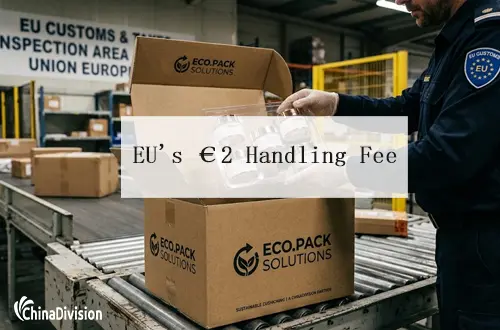
On October 7, 2026, the European Commission updated its customs reform page and added the latest guidance on the Union Handling Fee to its existing documentation.
- The fee: €2 per item.
- Legal basis: Commission Delegated Regulation C(2026) 6694, adopted on September 21, 2026, sets the fee at €2 per item.
- Entry-into-force mechanism (the key point): The regulation applies from the 10th day after its publication in the Official Journal of the EU, with a statutory latest entry-into-force date of November 1, 2026.
- Translated into calendar terms: the Official Journal publication must happen before October 22 for November 1 to hold; any later publication pushes the effective date back accordingly.
- In other words, the "countdown" currently being discussed is really two countdowns stacked together: October 22 (publication) → November 1 (entry into force).
- Official guidance (continuously updated — bookmark it): Guidance on the 3 EUR customs duty and Union handling fee (PDF). The guidance is an explanatory document with no binding legal force — the text published in the Official Journal prevails.
- New data obligations take effect simultaneously: From November 1, customs declaration data for low-value distance sales valued at €150 or less must include product identifiers M-PID (merchant product identifier) and NS-PID (non-standardised manufacturer product identifier), with S-PID (standardised identifier) to be provided where available. Note this is the narrowed scope — an earlier version required all distance sales to report these identifiers.
Don't conflate the two charges: the €3 duty vs the €2 handling fee
This is the easiest point to get wrong — and the most worth getting right — in coverage of this policy. The two differ in both legal instrument and scope:
| Dimension | €3 Temporary Customs Duty | €2 Union Handling Fee (UHF) |
|---|---|---|
| Effective date | July 1, 2026 | November 1, 2026 (subject to Official Journal publication) |
| Legal instrument | Council Regulation (EU) 2026/382 | Delegated Regulation C(2026) 6694 |
| Threshold | Only parcels ≤ €150 | No value threshold — orders above €150 are charged too |
| Charging unit | Per customs-tariff "declaration line" | Also per declaration line, regardless of the number of items on that line |
| Duration | Until July 1, 2028 | No end date (a reduced rate will apply to goods released from customs warehousing from July 1, 2028; amount TBD) |
| Refundable | Refundable if goods are defective | Never refundable, even if the goods are defective |
| VAT | Counts toward the import VAT base | Also a non-deductible customs charge |
One-line mnemonic: the €3 covers "cheap parcels," the €2 covers "all parcels," and the €2 never expires.
How the charges are actually calculated (with real worked examples)
Official worked examples (Irish Revenue — the most authoritative source)
| Scenario | €3 Duty | €2 Handling Fee | Total Added |
|---|---|---|---|
| €10 parcel containing a pen + notebook + keychain (3 line items) | 3 × 3 = €9 | 3 × 2 = €6 | €15 (plus VAT) |
| Two identical pens in one parcel | 1 × 3 = €3 | 1 × 2 = €2 | €5 |
| Jeans €100 (12%) + running shoes €150 (16.9%) | 12 + 25.35 = €37.35 | 2 × 2 = €4 | €41.35 |
The third example deserves special attention: orders above €150 still incur the handling fee — the clearest dividing line between the handling fee and the duty.
The knock-on effect on VAT
Import VAT = (declared value + fixed duty) × VAT rate, and the €3 fixed duty counts toward the VAT base; both customs charges are non-deductible for input VAT. IOSS only simplifies VAT collection — it does not exempt you from the duty or the handling fee.
Who pays, how it's collected, and whether it can be refunded
- The liable party is not the consumer: The handling fee is borne by the importer; pending application of the importer rules, it is borne by the declarant. In practice this is usually the IOSS holder (the marketplace, or the remote seller for direct sales), or the postal/express carrier when IOSS is not used.
- Two collection paths:
- Collected at checkout: The marketplace collects duty and handling fee together at the till; the customer pays nothing on delivery (best experience).
- Collected before delivery: If it wasn't collected at checkout, the carrier/postal operator will demand payment from the recipient before delivery, and may add its own €5–15 handling surcharge on top. Such parcels commonly see rejection rates of 10–20%.
- Refund rules: The handling fee is never refundable (even for defective goods); the €3 duty is refundable if goods are defective; ordinary duty on orders above €150 can be reclaimed within 90 days of return. Whether VAT is refundable depends on each website's policy.
- Anti-circumvention clause: Deliberately splitting parcels, disguising goods as non-distance sales, or smuggling consumer-facing goods in under the banner of bulk imports are all explicitly targeted circumvention practices.
Marketplaces are classified as importers — how heavy are the penalties
The new rules shift liability away from "the end consumer" and up to "the party that organises the transaction":
- Marketplaces / non-EU sellers are positioned as de facto importers: They must provide data to customs, pay or secure duties and charges, and must establish an entity in the EU, or appoint a representative holding AEO / trusted economic operator status.
- Local warehousing is encouraged: Goods imported in bulk packages, in quantities that facilitate customs inspection, can benefit from a reduction in management fees on shipments to EU-based customers.
- Penalty ladder:
- Repeat violations: fines of 1–6% of the total value of goods shipped to the EU over the preceding 12 months;
- AEO / trusted economic operator status may be suspended, withdrawn or revoked;
- Systematic violators are classified as high-risk and lose facilitation measures;
- In the most serious cases: suspension of release of all imported goods and temporary restrictions on access to their online interfaces; a finding of systematic violation constitutes grounds for refusing to release goods for at least 6 months.
Where this sits in the EU customs reform timeline
The €2 handling fee is not an isolated event — it is one component of the EU Customs Code reform that entered into force on September 20, 2026. It is the most comprehensive reform since the EU Customs Union was founded in 1968, and member states must implement it within 12 months. Three pillars: smarter risk management and customs supervision, a modernised e-commerce framework, and stronger partnership with business.
| Date | Milestone |
|---|---|
| July 1, 2026 | €150 duty exemption abolished; €3-per-tariff-code temporary duty introduced |
| Sept 16 / 20, 2026 | Parliament and Council adopt the reform; reform enters into force |
| Nov 1, 2026 | €2 handling fee expected to take effect (subject to Official Journal) + mandatory PID reporting (≤ €150) |
| 2027 | EU Customs Authority (EUCA) begins operations (HQ in Lille, France; ~285 staff) |
| July 1, 2028 | €3 temporary duty withdrawn, normal tariffs restored; Data Hub mandatory for e-commerce; reduced handling rate applies to goods released from customs warehousing |
| March 1, 2031 | Data Hub voluntary for importers (becomes mandatory thereafter) |
| March 1, 2034 | Data Hub mandatory for all traders |
Key regulations and official links:
Action checklist for sellers and freight forwarders
- Fixate on October 22: That date is the precondition for November 1. If the Official Journal publication comes later, the actual enforcement date slips — don't schedule pricing changes and system upgrades against October 31.
- Rebuild your cost model around "declaration lines": Model the combined €3 + €2 impact SKU by SKU, focusing on low-priced, high-SKU-count orders (3 line items means €15 in added charges — fatal on a €10 order).
- Consolidate declaration lines legitimately: Merge SKUs that share a 6-digit HS code into one line/group, and have your forwarder lock in that declaration practice; also confirm whether you're clearing under H7 or H1 — the choice can double your charges.
- Build out PID data fields: From November 1, orders ≤ €150 must report M-PID and NS-PID (S-PID where available). Fill these into your product master data now and confirm you can transmit them to your broker/carrier.
- Clarify "who collects at checkout": If the marketplace doesn't collect, you're pushing the cost and rejection risk onto the consumer (carriers add €5–15, rejection rates run 10–20%). Get responsibility allocation confirmed in writing with marketplaces and carriers.
- Recalculate the "direct shipping vs EU warehouse" break-even: Once the all-in added cost per directly-shipped parcel approaches €5, for stores at the thousand-orders-per-month level the economies of scale of a local warehouse start to beat direct shipping. This is also where EU regulation itself is steering you — bulk-imported, packaged-for-inspection goods qualify for management fee reductions.
- Audit marketplace compliance thresholds: Temu EU requires pre-stocking in EU local overseas warehouses (no EU warehouse, no semi-managed status); TikTok Shop EU requires a local warehouse + VAT; SHEIN US semi-managed requires domestic print-on-demand factories. Channel rules, together with the tax regime, are pushing sellers toward localised fulfilment.
- Update pricing and terms in sync: Competitors have already repriced multiple times since the start of 2026. Adjust the "tax-inclusive landed price" display on your EU storefronts, plus return terms and rejection-handling workflows — avoid a pile-up of failures during the peak season.


About the Author: Limi

Limi is a content marketing expert at ChinaDivision, helping businesses and e-commerce sellers navigate the complexities of international shipping by providing actionable tips and comprehensive guides on logistics, shipping, and cargo transportation.