

Does China Export Tax Rebate Require Air Freight? (2026 Guide)
Table of Contents
- What Determines Eligibility for a China Export Tax Rebate?
- Why Export Tax Rebates Do Not Depend on Air Freight
- General Trade vs. Cross-Border E-Commerce
- Can Sea Freight and Rail Freight Qualify for China Export Tax Rebates?
- What Documents Are Required for an Export Tax Rebate?
- How Can Exporters Prevent Document Mismatches Before Shipment?
- How Does an Overseas Warehouse Affect Export Tax Rebates?
- How Can a 3PL Help Reduce Export Tax-Refund Documentation Risks?
- Frequently Asked Questions About China Export Tax Rebates
- Choose the Export Structure Before the Freight Method
No. China export tax rebates do not require international air freight. Eligible exports may be transported by air, sea, rail, or other suitable methods. Whether an exporter can claim an export VAT refund or exemption depends on the applicable tax policy, the exporter’s eligibility, the customs declaration and export model, and the supporting commercial, tax, transportation, and foreign-exchange records.
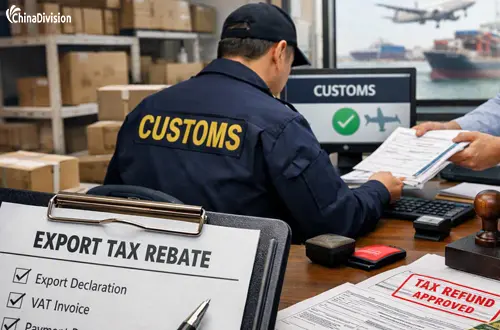
For example, ocean bills of lading, air waybills, and railway waybills are all recognized as potential supporting documents under China’s export tax-refund recordkeeping rules. The mode of transportation is therefore not, by itself, the deciding factor.
For manufacturers, B2B exporters, and cross-border e-commerce sellers, the more important question is whether the chosen export arrangement supports the intended tax treatment and produces the records needed to substantiate the transaction.
Choosing air freight solely because a supplier or forwarder claims it is mandatory for export tax rebates can increase logistics costs unnecessarily. A better approach is to confirm the applicable tax rules and customs declaration model first, then select the transportation method that best balances compliance, delivery speed, and total landed cost.
What Determines Eligibility for a China Export Tax Rebate?
China export tax rebate eligibility depends on the applicable export tax policy, the taxpayer’s status, the nature of the export transaction, and whether the required declarations and supporting records are available.
China’s 2026 export VAT and consumption-tax policy distinguishes between export transactions eligible for tax refund or exemption, transactions eligible for tax exemption without a refund, and transactions subject to taxation. These treatments are not interchangeable.
Before shipping, exporters should verify the following five areas:
- Taxpayer eligibility: Confirm that the legal entity meets the conditions for the relevant export tax treatment. Requirements can differ according to the taxpayer category and applicable policy.
- Export declaration: Determine whether the goods will be declared under an appropriate customs supervision or trade model and whether the declaration supports the intended tax treatment.
- Purchase and tax documentation: Retain the applicable purchase contracts, supplier invoices, VAT documentation, and other evidence required for the exporter’s business model.
- Transaction and transportation evidence: Maintain records that connect the commercial transaction to the goods actually exported, including the relevant customs and carrier documents.
- Foreign-exchange compliance: Check the applicable collection deadlines, acceptable evidence, and any permitted exceptions or deemed-collection arrangements.
Not every export transaction follows the same procedure. An exporter should confirm its specific requirements with its tax adviser or the competent tax authority rather than assume that one checklist applies to all businesses.
Why Export Tax Rebates Do Not Depend on Air Freight
Export tax rebates are a tax-compliance matter, whereas air freight, sea freight, and rail freight are transportation choices. The two decisions are related operationally, but one does not automatically determine the other.
China’s export tax-refund administration measures recognize several types of supporting transportation documents, including:
- Ocean bills of lading
- Air waybills
- Railway waybills
- Other carrier-issued cargo documents
- Postal receipts
- Certain domestic transportation invoices
- Certain international freight-forwarding service invoices
These records help substantiate the export transaction and support the required document-retention process.
An air waybill is one possible supporting document, not a universal requirement for every export. A shipment transported by sea or rail may also be supported by the appropriate transportation records.
The important distinction is whether the shipment and its documentation satisfy the applicable requirements. A valid transportation document alone does not guarantee a tax refund, just as using air freight does not automatically make a transaction eligible.
General Trade vs. Cross-Border E-Commerce: Which Export Model Should You Use?
The customs declaration model can affect how an export transaction is documented and how the exporter applies the relevant tax rules. However, it is inaccurate to claim that every export tax refund must use customs supervision code 0110 or that all e-commerce exports are ineligible.
Exporters should distinguish conventional general trade from the different cross-border e-commerce export models.
1. General trade — customs supervision code 0110
Code 0110 generally refers to conventional general trade exports. It is commonly used for commercial shipments involving manufacturers, trading companies, bulk inventory, and B2B orders.
Depending on the transaction, the exporter may need to retain:
- Sales contracts and purchase contracts
- Commercial invoices and packing lists
- Export customs declaration records
- Applicable VAT invoices and purchase-side tax documentation
- Transportation documents
- Foreign-exchange collection evidence or other permitted supporting evidence
Tax treatment: An eligible export under code 0110 may qualify for export VAT refund or exemption, subject to the applicable rules and the exporter’s circumstances.
Typical use cases: Bulk shipments, containerized sea freight, commercial air cargo, and other conventional export transactions.
2. Cross-border e-commerce retail exports — code 9610
Code 9610 is associated with cross-border e-commerce retail exports. Its declaration and information-reporting arrangements differ from those used in conventional general trade.
The fact that a seller ships individual parcels does not, by itself, determine the tax outcome. The exporter must establish which tax treatment applies and whether the transaction and supporting records satisfy the relevant conditions.
Tax treatment: Do not assume that every 9610 export qualifies for a conventional VAT refund, or that every 9610 export is automatically ineligible. The applicable tax policy, exporter status, declaration records, and supporting information must be checked.
Typical use cases: Cross-border e-commerce orders shipped to overseas consumers.
3. Cross-border e-commerce B2B direct exports — code 9710
Code 9710 is associated with cross-border e-commerce B2B direct exports. It supports eligible transactions in which domestic businesses sell to overseas businesses through cross-border e-commerce arrangements.
Tax treatment: Eligibility must be assessed under the applicable export tax rules and the particular transaction structure.
Typical use cases: Overseas business orders fulfilled directly from China.
4. Cross-border e-commerce overseas warehouse exports — code 9810
Code 9810 is associated with cross-border e-commerce exports to overseas warehouses. It is especially relevant to sellers who ship inventory in bulk to a foreign warehouse and fulfill customer orders after the inventory arrives.
China’s State Taxation Administration Announcement No. 3 of 2025 introduced a procedure allowing eligible overseas warehouse exports to apply for export tax refund or exemption after the goods have cleared export customs, even if the goods have not yet been sold. Subsequent accounting is required according to the applicable rules.
Tax treatment: Eligible transactions can use the special export-refund-upon-departure procedure, subject to the required declaration, documentation, and follow-up accounting.
Typical use cases: Marketplace sellers replenishing overseas fulfillment centers and businesses maintaining inventory abroad.
General trade and e-commerce export models compared
| Comparison factor | General trade (0110) | E-commerce retail (9610) | B2B direct (9710) | Overseas warehouse (9810) |
|---|---|---|---|---|
| Typical business model | Conventional commercial exports | Consumer orders | Cross-border B2B orders | Bulk inventory sent to overseas warehouses |
| Typical shipment pattern | Commercial cargo | Individual or consolidated parcels | Commercial shipments | Bulk inventory replenishment |
| Export records | Standard customs and commercial records | E-commerce transaction and declaration records | E-commerce B2B transaction and declaration records | Overseas warehouse export and subsequent sales records |
| Tax treatment | Depends on eligibility and applicable rules | Depends on eligibility and applicable rules | Depends on eligibility and applicable rules | Special procedure may be available for eligible exports |
| Is air freight mandatory? | No | No | No | No |
Key takeaway: Select the customs declaration model according to the real transaction and applicable customs and tax requirements. Do not select a model merely because a logistics provider recommends it or because one mode of transport is assumed to offer better tax treatment.
Can Sea Freight and Rail Freight Qualify for China Export Tax Rebates?
Yes. Sea freight and rail freight can form part of an export transaction that qualifies for a China export tax rebate or exemption, provided the transaction satisfies the relevant requirements.
The transportation mode affects cost, transit time, cargo suitability, and the type of carrier documentation available. It does not independently establish eligibility for a tax refund.
Air freight
Air freight is useful when delivery speed, high-value inventory, or urgent replenishment is the priority. The exporter should retain the relevant air waybill and other transaction records.
Ocean freight
Ocean freight is often suitable for bulk cargo and planned replenishment because it can reduce transportation costs per unit. The bill of lading and other relevant records should be retained as part of the export documentation.
Rail freight
Rail freight can be an option for suitable routes, particularly between China and parts of Europe. Railway waybills and other applicable transport records can support the documentation chain.
| Decision factor | Air freight | Ocean freight | Rail freight |
|---|---|---|---|
| Transit speed | Generally fastest | Generally slowest | Route-dependent |
| Cost per unit | Often higher | Often economical for bulk cargo | Route-dependent |
| Typical application | Urgent or high-value inventory | Bulk shipments and planned replenishment | Suitable international rail corridors |
| Supporting transport record | Air waybill | Ocean bill of lading | Railway waybill |
| Tax-refund eligibility | Depends on the export transaction and tax rules | Depends on the export transaction and tax rules | Depends on the export transaction and tax rules |
For many exporters, the most effective approach is to compare transportation options only after confirming the declaration and tax requirements. This avoids paying a premium for air freight when a slower, less expensive option meets the business’s delivery needs.
What Documents Are Required for an Export Tax Rebate?
The documents required for an export VAT refund or exemption depend on the exporter’s business model, the applicable tax treatment, and the nature of the transaction.
Under China’s 2026 export tax-refund administration measures, businesses claiming eligible export tax treatment must maintain relevant supporting documents and make them available for inspection when required.
The documentation may include the following:
| Document | Why it matters | What to check |
|---|---|---|
| Sales or export contract | Establishes the commercial transaction | Buyer, seller, goods, price, and terms |
| Purchase contract | Supports the procurement record | Supplier, products, quantities, and purchase terms |
| Commercial invoice | Documents the declared transaction value | Product descriptions, quantities, currency, and values |
| Packing list | Describes the physical shipment | Carton count, quantities, weights, and dimensions |
| Export customs declaration | Establishes the declared export transaction | Exporter identity, declaration details, goods, and values |
| Applicable VAT invoices | Support the relevant purchase-side tax records | Invoice validity, supplier details, and product information |
| Transportation document | Supports the shipment record | Carrier, shipment details, route, and consistency with other records |
| Foreign-exchange evidence | Supports compliance with applicable collection rules | Collection date, amount, currency, and any permitted exception |
| Customs brokerage records | Support outsourced declaration arrangements | Broker authorization and service documentation |
| Warehouse records | Link the declared goods to the physical inventory | Receiving, picking, packing, and dispatch records |
Not every item applies identically to every exporter. Businesses should follow the record-retention and filing requirements applicable to their own export arrangements.
China’s 2026 rules also provide for retaining certain export tax-refund supporting documents, generally for ten years unless an applicable exception or different rule applies. The rules recognize substitute evidence in specified circumstances when an expected document cannot be obtained.
For regulatory reference, consult the official Announcement on the Administrative Measures for VAT and Consumption Tax Refund (Exemption) on Export Business issued by China’s State Taxation Administration in 2026.
How Can Exporters Prevent Document Mismatches Before Shipment?
One of the most useful ways to reduce export tax-refund compliance risk is to reconcile shipment records before the goods leave the warehouse.
The core operational principle is straightforward: the commercial transaction, declared goods, physical inventory, transportation record, and tax documentation should be consistent and traceable.
A fulfillment provider can help organize the records, but the exporter remains responsible for ensuring that its tax declarations and supporting evidence meet the applicable requirements.
A practical document-matching framework
- Confirm the legal entities. Verify which entity purchases the goods, which entity sells them, which entity appears as exporter on the customs declaration, and which entity claims the tax treatment.
- Reconcile product information. Compare product descriptions, specifications, quantities, and relevant classification information across the commercial invoice, packing list, customs declaration, and warehouse records.
- Reconcile shipment quantities. Confirm that the declared quantity can be traced to the goods picked, packed, and dispatched. Investigate partial shipments, substitutions, and split orders.
- Reconcile shipment values. Check that declared values and commercial documents reflect the actual transaction and applicable valuation requirements. Differences should be explainable and supported, not concealed.
- Retain transportation evidence. Make sure the appropriate carrier document or permitted alternative evidence is available and linked to the export transaction.
- Track foreign-exchange requirements. Establish the applicable collection deadline and retain the evidence required under the relevant rules. Do not assume that payment must always arrive before the initial application, or that a shipment can remain unresolved indefinitely.
- Preserve the audit trail. Keep the relevant purchase, customs, tax, transport, and warehouse records in a retrievable format for the required retention period.
A useful internal control is to assign one shipment reference across the warehouse management system, commercial documents, customs records, and freight records wherever operationally feasible. This makes reconciliation easier and helps identify missing evidence before a tax filing is submitted.
How Does an Overseas Warehouse Affect Export Tax Rebates?
An overseas warehouse changes the timing and documentation of the transaction, but it does not make air freight mandatory.
For eligible exports under customs supervision code 9810, China’s State Taxation Administration introduced an export-refund-upon-departure procedure in 2025. Under this arrangement, an eligible exporter may apply for an export tax refund or exemption after the goods have left China, even when the inventory has not yet been sold overseas.
The exporter must distinguish between goods that have already been sold and goods that remain unsold, and perform the required subsequent accounting in accordance with the applicable rules.
This arrangement can be particularly relevant to e-commerce sellers who replenish overseas warehouses in bulk. It allows their logistics planning to focus on inventory availability, replenishment schedules, and freight costs rather than assuming that every unit must first be sold to a consumer before a refund application can be made.
However, the special procedure should not be interpreted as automatic eligibility for every overseas warehouse shipment. The exporter must still verify the applicable tax treatment, declaration details, and reporting obligations.
How Can a 3PL Help Reduce Export Tax-Refund Documentation Risks?
A third-party logistics provider does not determine the exporter’s tax eligibility, but it can help maintain the operational records that support an export transaction.
A well-organized fulfillment workflow can help exporters by:
- Maintaining receiving records that connect supplier shipments to warehouse inventory.
- Recording picking, packing, carton quantities, and outbound shipment details.
- Reconciling packing lists against actual warehouse dispatch quantities.
- Coordinating shipment information with customs brokers and freight forwarders.
- Collecting available transportation records and organizing them by shipment reference.
- Flagging differences in product descriptions, quantities, or shipment values for review.
- Preserving records that help the exporter respond to document requests.
For example, consider a seller replenishing an overseas warehouse with 500 units of a product. The warehouse records 500 units received, but the export packing list shows 480 units and the customs declaration contains a different product description.
The problem is not whether the cargo travels by air or sea. The immediate issue is that the inventory, commercial, and customs records do not align. The discrepancy should be investigated and resolved through the appropriate procedures before the exporter relies on those records for a tax claim.
The value of a capable 3PL lies in traceability, accurate fulfillment records, and coordination across the supply chain—not in promising a tax refund based on a particular freight method.
Frequently Asked Questions About China Export Tax Rebates
Does international air freight have to be used for an export tax rebate?
No. International air freight is not a universal requirement for a China export tax rebate. Eligibility depends on the applicable tax rules, the exporter’s circumstances, the customs declaration model, and the supporting documentation.
Can sea freight shipments qualify for export tax rebates?
Yes. Eligible export transactions can use sea freight. Ocean bills of lading are recognized as potential supporting transportation documents under China's export tax-refund recordkeeping rules.
Can rail freight shipments qualify for export tax rebates?
Yes, potentially. Railway waybills are also recognized as supporting transportation documents. The exporter must still meet the applicable tax and customs requirements.
Can express shipments and small parcels qualify for export tax rebates?
The answer depends on the export arrangement, declaration method, exporter eligibility, and applicable tax policy. A small parcel is not automatically ineligible, but not every simplified parcel-clearance arrangement provides the documentation or tax treatment required for a particular refund claim.
Is customs supervision code 0110 the only code that can support an export tax refund?
No. Eligible exports under other arrangements may also qualify. For example, qualifying overseas warehouse exports under code 9810 can use the applicable special refund procedure. The appropriate model must be assessed according to the actual transaction and current regulations.
Must the exporter receive foreign-exchange payment before applying for a tax refund?
Not universally. The applicable rules specify collection deadlines and recognize certain exceptions and deemed-collection arrangements. Exporters should confirm the requirements for their transaction rather than apply a blanket rule.
Does shipping goods to an overseas warehouse mean the goods must be sold before the exporter can apply for a refund?
Not necessarily. Eligible code 9810 exports can use the special procedure introduced in 2025 that permits an application after export departure, followed by the required accounting based on subsequent sales status.
What documents should an exporter prepare first?
Start by identifying the applicable export model and collecting the relevant commercial contract, invoice, purchase-side VAT documentation, customs declaration, transportation evidence, and foreign-exchange records where required. The exact documentation depends on the exporter’s tax treatment and circumstances.
Choose the Export Structure Before the Freight Method
China export tax rebates do not require international air freight. Eligible transactions may be transported by air, sea, rail, or other suitable methods, provided the exporter satisfies the applicable tax and customs requirements and maintains the necessary supporting records.
For B2B exporters and cross-border e-commerce sellers, the most effective approach is to:
- Confirm the applicable export tax treatment and taxpayer eligibility.
- Select the customs declaration model that matches the actual transaction.
- Establish a traceable chain of commercial, customs, transportation, and tax records.
- Verify the applicable foreign-exchange collection and record-retention requirements.
- Choose the transportation method based on total landed cost, delivery commitments, and inventory needs.
Do not pay for air freight simply because someone claims it is required for a tax rebate. Confirm the regulatory requirements first, coordinate with your customs broker and tax adviser, and use a fulfillment process that keeps shipment records consistent and retrievable.


About the Author: Limi

Limi is a content marketing expert at ChinaDivision, helping businesses and e-commerce sellers navigate the complexities of international shipping by providing actionable tips and comprehensive guides on logistics, shipping, and cargo transportation.