

SIOC Packaging: How to Reduce E-commerce Fulfillment Costs
Table of Contents
- What Is SIOC Packaging (Ships in Own Container)?
- Understanding the difference between SIOC, SIPP, and FFP
- Why Is SIOC Packaging Becoming More Important for E-commerce Businesses in 2026?
- How SIOC affects fulfillment costs
- What Products Are Suitable for SIOC Packaging?
- Why E-Commerce and DTC Brands Are Adopting SIOC Beyond Amazon
- Ready to Stop Paying for Packaging Twice?
- Frequently Asked Questions About SIOC Packaging
If you've ever opened a shipping box only to find another box inside — and wondered who paid for both — you've already understood the core problem with traditional e-commerce packaging.
That extra corrugated carton, the air pillows, the void-fill kraft paper: none of it protects your product any better than the packaging the manufacturer already designed. It exists because of a habit, not a requirement. The habit is expensive. And as of early 2026, it's become a direct hit to your margins, because Amazon now charges additional packaging fees for non-SIOC items.
What Is SIOC Packaging (Ships in Own Container)?
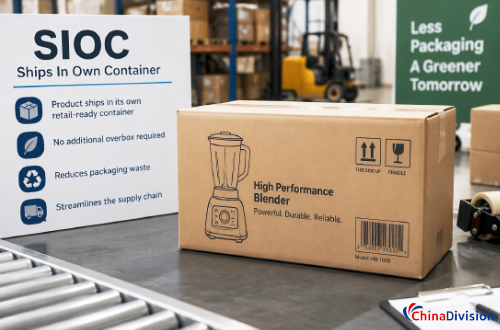
SIOC packaging, short for Ships in Own Container, is a packaging method that allows products to be shipped to customers in their original manufacturer or retail packaging without requiring an additional outer shipping carton.
Instead of placing a product inside a second corrugated box or protective mailer, the fulfillment provider ships the product in packaging that is already designed to withstand transportation, handling, and delivery.
SIOC is particularly relevant to Amazon sellers, but its benefits extend to direct-to-consumer (DTC) brands, Shopify merchants, and other international e-commerce businesses looking to optimize their packaging and fulfillment costs.
The terminology is closely connected to Amazon's Ships in Product Packaging (SIPP) program, which brings together the previous Frustration-Free Packaging (FFP) and SIOC designations.
Understanding the difference between SIOC, SIPP, and FFP
Although these terms are closely related, they do not mean exactly the same thing.
| Packaging term | Definition | Main objective |
|---|---|---|
| SIOC | Ships in Own Container | Ship products in their own sufficiently protective packaging without an additional shipping box |
| SIPP | Ships in Product Packaging | Amazon's overarching packaging program for products shipped in their original packaging |
| FFP | Frustration-Free Packaging | A packaging tier with additional requirements, including recyclability and customer experience |
| Traditional packaging | Product packaging placed inside another shipping carton | Provide an additional protective layer during transportation |
The important distinction is that SIOC focuses on whether the product's existing packaging can safely withstand transportation without secondary packaging, while FFP adds further packaging and customer-experience considerations.
For e-commerce sellers, adopting SIOC principles does not necessarily require participating in Amazon's program. Any business can evaluate whether its existing product packaging is strong enough to serve as the shipping container.
Why Is SIOC Packaging Becoming More Important for E-commerce Businesses in 2026?
SIOC is no longer simply a packaging sustainability initiative. It has become an important consideration in e-commerce cost management.
Three operational changes make it particularly relevant:
- Packaging-related fees: Additional packaging requirements can create extra fulfillment expenses, especially for products that do not meet applicable marketplace packaging standards.
- Rising parcel shipping costs: Shipping carriers increasingly calculate charges using dimensional weight, making unnecessary packaging volume expensive.
- Customer expectations: Online shoppers increasingly expect packaging that is easy to open, protects the product, and avoids unnecessary waste.
For Amazon sellers, the financial implications deserve particular attention.
According to the reference information provided for this article, new packaging fees for certain small, large, and bulky products in the U.S. took effect on January 15, 2026, while fees for oversized products in the EU took effect on February 1, 2026.
These changes make it important for sellers to assess their SIPP eligibility and understand the applicable fee structure for each marketplace and product category.
Importantly, sellers should not assume that every non-SIPP product automatically incurs the same fee. The actual charge depends on the applicable marketplace policy, product classification, and fulfillment arrangement.
How SIOC affects fulfillment costs
The financial impact goes beyond avoiding packaging fees. A successful SIOC implementation can reduce expenses across several stages of the fulfillment process.
| Cost category | Traditional packaging | SIOC packaging |
|---|---|---|
| Outer carton | Additional carton required | Eliminated where appropriate |
| Void-fill materials | Bubble wrap, kraft paper, air pillows | Reduced or eliminated |
| Dimensional weight | Increased by secondary packaging | Potentially lower |
| Packing labor | Additional packing and sealing steps | Fewer handling steps |
| Packaging inventory | Multiple packaging supplies | Simplified supply requirements |
| Marketplace fees | Potential packaging-related fees | Potential SIPP benefits when certified |
Amazon's published U.S. FBA fee information confirms that SIPP-certified products can receive fulfillment fee benefits, while certain bulky products requiring additional packaging incur packaging fees. For example, the published 2026 packaging fee schedule lists charges ranging from $1.51 to $4.04 depending on dimensional weight.
SIOC should be evaluated as a complete fulfillment cost optimization strategy, rather than simply a way to eliminate cardboard boxes.
What Products Are Suitable for SIOC Packaging?
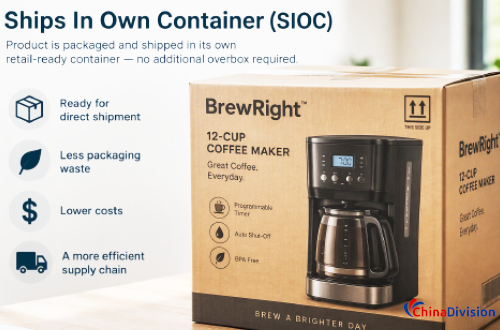
Not every product is suitable for SIOC. The most important consideration is whether the original packaging can protect the product throughout the entire transportation process without an additional protective carton.
Amazon provides minimum packaging dimensions and testing requirements for SIPP enrollment. However, meeting the dimensional requirements alone does not guarantee certification.
Minimum packaging requirements
According to Amazon's published SIPP guidance:
- Minimum package dimensions: 6 × 4 × 0.375 inches.
- Packaging must accommodate the required shipping label.
- Products must pass the applicable physical performance testing.
- Rigid and flexible packaging are subject to different requirements.
- Products containing liquids, sharp objects, or fragile items may require laboratory testing rather than self-testing.
Flexible packaging also has specific regional size and weight restrictions. For example, Amazon's published North American requirements specify a maximum of 18 × 14 × 6 inches and 7 lb for qualifying flexible packaging.
Which products are good candidates?
Generally suitable
| Product category | Why it may qualify | Packaging considerations |
|---|---|---|
| Apparel | Relatively flexible and resistant to impact | Durable polybags or mailers |
| Shoes and boots | Often supplied in rigid retail boxes | Box strength and corner protection |
| Household storage products | Many products have durable rigid packaging | Compression resistance |
| Non-fragile accessories | Lightweight and relatively durable | Sealed, label-compatible packaging |
| Durable consumer goods | Often have structurally strong packaging | Drop and vibration resistance |
Products requiring additional evaluation
| Product category | Main risk | Recommended approach |
|---|---|---|
| Glassware | Breakage during impact | Protective inserts and additional cushioning |
| Cosmetics | Leakage, deformation, and contamination | Seal protection and leak testing |
| Electronics | Shock damage and static electricity | Internal cushioning and appropriate protective materials |
| Jewelry | Theft, loss, and privacy concerns | Tamper-evident packaging |
| Liquids and gels | Leakage and pressure changes | Sealed containers and laboratory testing where required |
| Gift products | Customer presentation and privacy | Consider an additional unbranded shipping carton |
A common mistake is assuming that a product is automatically suitable for SIOC because its retail packaging looks sturdy.
In practice, the packaging must protect both the product and its own structural integrity during transportation. A carton that looks strong on a warehouse shelf may still fail when exposed to repeated drops, compression, or conveyor handling.
Why E-Commerce and DTC Brands Are Adopting SIOC Beyond Amazon
While Amazon’s fee structure accelerated adoption, direct-to-consumer (DTC) brands shipping from independent 3PL warehouses are adopting SIOC across Shopify, TikTok Shop, and crowdfunding fulfillment for three measurable operational gains:
1. Eliminating Dimensional Weight Penalties
Parcel carriers calculate shipping rates using the greater of actual weight or dimensional (dim) weight. Adding a 2-inch buffer of corrugated cardboard and air pillows around a retail box routinely bumps a parcel into a higher weight bracket. By shipping in the product's own container, you shrink the cubic footprint of every outbound parcel—often saving more on freight than the cost of the eliminated carton itself.
2. Reclaiming Warehouse Pick-and-Pack Velocity
From our floor experience managing high-velocity international fulfillment operations, the hidden bottleneck in traditional packing lines is void-fill assembly. When a SKU is SIOC-ready, warehouse associates bypass box erection, dunnage dispensing, and taping—reducing station touchpoints to a single scan-and-label workflow.
3. Stronger Unboxing & Lower Material Waste
Removing outer brown boxes eliminates unnecessary cardboard and plastic air pillows before they ever enter the waste stream. At the same time, your customer sees your custom-printed packaging on the doorstep rather than a generic carrier box—turning delivery into a direct brand touchpoint.
Ready to Stop Paying for Packaging Twice?
Whether you sell through Amazon FBA, your own DTC storefront, or a mix of channels, SIOC packaging is one of the few changes that simultaneously cuts costs, reduces waste, and improves your customer experience. But the 2026 fee changes mean the cost of inaction has a number attached now. Contact our fulfillment team for a free SKU-level packaging assessment.
Frequently Asked Questions About SIOC Packaging
Can my brand use SIOC packaging if we don’t sell on Amazon?
Yes. While Amazon formalized the SIPP and SIOC terminology, any DTC brand selling through Shopify, WooCommerce, or crowdfunding platforms can instruct its 3PL to ship single-unit orders in their primary packaging. You immediately capture savings on outer boxes, void-fill, and carrier dimensional weight.
How do international 3PLs handle mixed orders containing both SIOC and non-SIOC items?
A modern Warehouse Management System (WMS) flags each SKU as SIOC-Eligible or Requires Overbox. When a single-unit SIOC order drops in, the packer applies the shipping label directly to the product box. When a customer orders multiple items together, the WMS automatically assigns an appropriately sized outer carton to consolidate the shipment.
Can I keep sending units in master cartons to the warehouse?
Yes. SIOC describes the packaging that reaches the customer, not how you bundle stock for inbound transport. For FBA, Amazon says to continue sending units to its fulfillment centers the same way while ensuring the individual units meet its SIPP packaging standards.
Does removing the outer box change customs or labeling requirements?
Don’t treat a packaging change as a customs change. Ask your provider or customs broker to confirm the documents, required marks, and placement rules for the product, carrier service, and destination. Leave room on the tested package for the shipping label and any extra labels or document pouch the route requires.
Official resources for further reading


About the Author: Limi

Limi is a content marketing expert at ChinaDivision, helping businesses and e-commerce sellers navigate the complexities of international shipping by providing actionable tips and comprehensive guides on logistics, shipping, and cargo transportation.