

USPS Plans to Convert Shipping Surcharges into Permanent Fuel Surcharges
The United States Postal Service (USPS) has proposed a significant pricing change that could reshape shipping costs for millions of e-commerce merchants, marketplace sellers, and international brands serving U.S. customers.
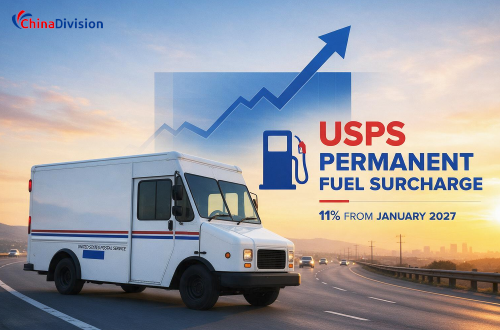
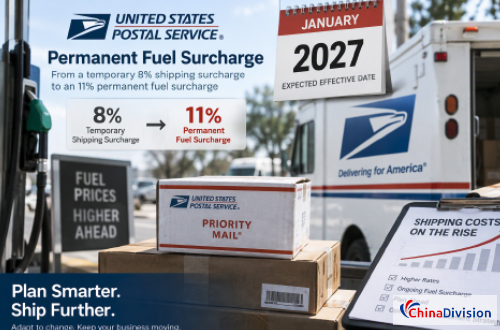
Under the proposal, the current 8% USPS Surcharge would no longer remain a temporary measure. Instead, it would become an 11% Permanent Fuel Surcharge starting in January 2027. Combined with broader shipping rate increases and ongoing operational challenges at USPS, businesses involved in international trade need to prepare now for a future where shipping volatility becomes a permanent part of logistics planning.
The changes are scheduled to take effect on January 17, 2027, pending regulatory review.
For e-commerce businesses, the impact goes beyond a higher postage bill. Sellers using USPS for domestic delivery, U.S. warehouse distribution, or the final mile of their fulfillment network need to reassess shipping budgets, carrier selection, product pricing, and inventory positioning. International sellers should also distinguish the proposed domestic fuel surcharge from the separate international rate increases, because the new 11% surcharge is not currently planned for international USPS products.
Key USPS shipping changes at a glance
| Pricing change | Proposed adjustment | Expected effective date |
|---|---|---|
| Domestic shipping prices | 5.9% average increase | January 17, 2027 |
| Existing transportation-related price adjustment | Convert temporary 8% adjustment into a permanent 8% fuel surcharge | January 17, 2027 |
| Additional fuel-related adjustment | Add 3 percentage points, bringing the total fuel surcharge to 11% | January 17, 2027 |
| Selected international shipping rates | 7.9% average increase | January 17, 2027 |
| International fuel surcharge | New 11% surcharge not planned for international products at this time | Not applicable under the current proposal |
| Fuel surcharge review | Reassess using fuel prices from the first half of 2027 | July 2027 |
USPS is not simply replacing an 8% surcharge with an 11% surcharge. Its announcement describes converting the existing 8% transportation-related price adjustment into a permanent 8% fuel surcharge and adding another 3 percentage points. The resulting proposed surcharge is 11%.
The USPS Board of Governors approved the proposed adjustments before the filing was submitted. However, the changes remain subject to the PRC review process. Businesses should therefore treat January 17, 2027, as the proposed effective date rather than assuming the filing is already final.
Which USPS Shipping Services Could Be Affected?
The proposed domestic price adjustment covers four major shipping categories:
- Priority Mail
- Priority Mail Express
- USPS Ground Advantage
- Parcel Select
USPS proposes an average domestic shipping price increase of 5.9% across these services. This is an average across the affected products, not a guarantee that every package, weight category, or destination will receive exactly the same increase.
The proposed permanent fuel surcharge is another important pricing consideration for businesses using eligible domestic shipping products. Sellers should review the final product-level price tables rather than applying one percentage to every USPS shipment.
Why Is USPS Making Its Fuel Surcharge Permanent?
Fuel is a major component of transportation costs for any parcel delivery network. Higher fuel prices can increase the cost of moving packages between processing facilities, transportation hubs, regional distribution centers, and final delivery locations.
USPS introduced its temporary 8% transportation-related price adjustment in April 2026. The new proposal would convert that temporary adjustment into a permanent fuel surcharge and increase the total to 11%.
The financial context helps explain why this matters.
According to USPS's November 10, 2026, fiscal-year results:
- USPS reported a GAAP net loss of approximately $6.5 billion for fiscal year 2026.
- Operating revenue reached approximately $82.9 billion.
- Transportation expenses increased by $225 million compared with the previous fiscal year.
- Shipping and Packages revenue increased by 5.1%, even as shipment volume declined by 5.3%.
These figures show that higher shipping revenue does not necessarily mean lower operating pressure. Transportation expenses and declining package volumes remain important challenges for the postal network.
For shippers, the practical lesson is that transportation-related price changes should be included in longer-term logistics planning. A temporary surcharge can be treated as a short-term cost fluctuation. A permanent surcharge needs to be incorporated into a more durable shipping-cost model.
How Will the Permanent Fuel Surcharge Affect E-Commerce Businesses?
The impact depends on where inventory is stored, which USPS services are used, how orders are fulfilled, and whether shipping costs are absorbed by the seller or passed on to customers.
Businesses relying heavily on USPS domestic parcel services may face a direct increase in delivery expenses. International sellers may experience a more indirect impact through their U.S. distribution partners, domestic replenishment shipments, returns, or other USPS-dependent delivery arrangements.
Low-priced products may be more sensitive to shipping increases
A shipping increase does not affect every product category equally.
For a low-priced item, delivery expenses can represent a substantial share of the customer's total purchase. A small increase in postage may therefore have a noticeable impact on contribution margin.
For higher-priced products, the same dollar increase may represent a smaller percentage of order value. However, heavier or oversized products may still face substantial shipping expenses because of their weight and dimensional characteristics.
Businesses should evaluate shipping costs against contribution margin rather than looking only at the percentage increase in postage.
Free-shipping promotions may become more expensive
Free shipping is a common conversion strategy for online stores. However, it does not eliminate shipping expenses; it transfers those expenses from the customer to the seller.
When USPS prices increase, businesses relying on free-shipping thresholds should review:
- Minimum order values for free delivery.
- Shipping subsidies on low-margin products.
- Average shipping cost per order.
- Profitability by destination and delivery zone.
- Promotional performance after fulfillment expenses.
A free-shipping threshold that was profitable in 2026 may no longer produce the same margin in 2027.
Multi-channel sellers may experience inconsistent cost increases
Businesses selling through Shopify, Amazon, eBay, and other channels often use different shipping services depending on order value, destination, product dimensions, and delivery promises.
If one channel relies heavily on USPS while another uses a different carrier, the financial impact may vary considerably.
This makes channel-level shipping analysis essential. Sellers should avoid applying one general shipping-cost adjustment to all sales channels without checking the underlying carrier mix.
Direct shipping versus U.S. warehousing: Which model offers more cost control?
| Comparison | Direct Shipping from China | China-Based 3PL with U.S. Distribution Options |
|---|---|---|
| Inventory location | Supplier or China warehouse | Centralized China warehouse before export; optional overseas inventory positioning |
| International transportation | Arranged for individual customer orders or consolidated batches | Can consolidate inbound inventory shipments |
| Domestic delivery | Depends on the selected international carrier and last-mile arrangement | Can select domestic delivery options based on destination and service requirements |
| Carrier flexibility | May be limited by the supplier's shipping arrangements | More opportunities to compare available carrier services |
| Inventory visibility | May be fragmented across suppliers | Centralized inventory records and fulfillment reporting |
| Order processing | Depends on supplier dispatch capacity | Dedicated picking, packing, and dispatch workflows |
| Cost analysis | Shipping costs may be difficult to compare across suppliers | Easier to analyze fulfillment, packaging, and transportation costs together |
| Best suited for | Small campaigns and simple products | Growing brands, multiple SKUs, and businesses requiring coordinated fulfillment |
A China-based 3PL does not automatically eliminate USPS-related expenses. The benefit is greater operational control: businesses can consolidate inventory, compare available delivery services, standardize packaging, and decide where inventory should be positioned.
For sellers with sufficient U.S. demand, holding inventory closer to customers may reduce reliance on individual international parcel shipments. However, this strategy must be evaluated against storage fees, inventory turnover, import costs, and the cash tied up in overseas stock.
5 Practical Ways to Control Shipping Costs in 2027
The USPS proposal is a useful reason to review fulfillment operations before the new pricing takes effect. Instead of relying exclusively on price negotiations with carriers, businesses can also reduce the number of avoidable costs generated inside their supply chains.
Audit carrier usage by product, destination, and package size
Start by exporting at least three months of shipment data. Categorize shipments by:
- Destination ZIP code or delivery zone.
- Actual and dimensional weight.
- Package dimensions.
- Carrier and service level.
- Shipping cost per order.
- Delivery time and exception rate.
This analysis can reveal products or destinations where a particular service is consistently more expensive than alternatives.
For example, a lightweight product shipped to a nearby U.S. destination may have different cost and delivery requirements from a bulky product traveling across the country.
Do not compare carriers using postage alone. Include delivery performance, tracking quality, surcharges, and the cost of failed deliveries or replacements.
Reduce dimensional weight through packaging optimization
Dimensional weight can increase shipping costs when a package occupies more space than its actual weight suggests.
A product that weighs only 0.5 kg may still incur a higher billable weight if it is packed in an unnecessarily large carton.
A warehouse packaging review should examine:
- Whether carton sizes match product dimensions.
- Whether multiple products can be consolidated safely.
- Whether protective materials are being overused.
- Whether packaging can be redesigned without increasing damage risk.
- Whether product bundles can be packed more efficiently.
Packaging optimization is particularly useful for sellers shipping lightweight consumer products, accessories, gifts, and customized crowdfunding rewards.
Consolidate supplier shipments before international transportation
Businesses sourcing from multiple manufacturers in China may incur unnecessary transportation expenses when every supplier ships inventory independently.
A centralized fulfillment warehouse can receive goods from multiple suppliers, inspect incoming inventory, consolidate products, and prepare shipments for export.
This approach can help reduce fragmented inbound transportation and improve inventory coordination.
However, consolidation should be planned around inventory availability and delivery deadlines. Waiting too long for one supplier's products can delay an entire campaign or sales batch.
Position inventory according to demand and fulfillment economics
Not every product needs to be stored in the United States.
A more practical inventory strategy divides products according to sales volume, demand predictability, and replenishment lead time.
| Inventory category | Suggested fulfillment approach | Main objective |
|---|---|---|
| High-volume, predictable products | Consider U.S. inventory positioning | Reduce delivery time and individual international parcel dependence |
| Low-volume or experimental products | Retain centralized China inventory | Avoid excessive overseas storage |
| Seasonal products | Pre-position inventory before peak demand | Reduce replenishment delays |
| Customized or bundled products | Use centralized kitting and assembly | Maintain consistent order accuracy |
| Slow-moving products | Review replenishment frequency and stock levels | Reduce inventory holding costs |
This approach helps businesses balance international freight, warehouse storage, domestic delivery, and working capital.
The correct decision is not always to move more inventory overseas. It is to place inventory where the combined cost of storage, transportation, and order fulfillment is most competitive.
Build a fulfillment cost model instead of tracking postage alone
A useful logistics cost model should include all major expenses associated with getting an order from the supplier to the customer.
| Cost component | What businesses should monitor | Potential optimization |
|---|---|---|
| Supplier transportation | Pickup and transfer charges | Consolidate supplier collections |
| International freight | Air, ocean, or other transportation costs | Compare shipping methods and shipment sizes |
| Customs clearance | Duties, taxes, and brokerage fees | Improve classification and documentation accuracy |
| Warehouse storage | Pallet, shelf, bin, or volume-based charges | Improve inventory turnover |
| Pick and pack | Per-order and additional-item charges | Optimize order workflows |
| Packaging | Cartons and protective materials | Standardize packaging sizes |
| Domestic delivery | Postage and carrier surcharges | Compare eligible services and destinations |
| Returns and replacements | Reverse logistics and reshipment costs | Improve quality checks and address validation |
A complete cost model helps sellers identify where their money is actually going. It also prevents businesses from focusing on a single surcharge while overlooking larger opportunities in inventory management, packaging, or transportation planning.
Frequently Asked Questions About USPS Surcharges and International Fulfillment
When will the USPS 11% fuel surcharge take effect?
The proposed effective date is January 17, 2027. The change remains subject to the Postal Regulatory Commission's review, so businesses should check the official USPS price-change page for the final status and approved rates.
Does the USPS fuel surcharge apply to international shipments?
Under the current proposal, the new 11% fuel surcharge will not apply to USPS international products at this time. However, USPS has separately proposed an average 7.9% price increase for selected international services, including Priority Mail International and First-Class Package International Service.
Should international sellers move all inventory to a U.S. warehouse?
Not necessarily. U.S. warehousing may improve delivery speed and reduce dependence on individual international parcel shipments, but it also introduces storage costs, import-related expenses, and inventory investment. Sellers should compare demand, stock turnover, replenishment lead time, and total landed fulfillment costs before deciding which products to position overseas.
How often will USPS review its permanent fuel surcharge?
USPS has indicated that it will reevaluate the proposed 11% fuel surcharge in July 2027, using fuel prices from the first half of 2027. Businesses should monitor official announcements rather than assume the surcharge will remain unchanged.
Prepare Your Fulfillment Strategy for 2027 with ChinaDivision
The proposed USPS Permanent Fuel Surcharge is a reminder that shipping expenses can change even when a business's products, suppliers, and order volumes remain the same.
For international sellers, the best response is not simply to increase product prices or pass every additional expense to customers. A more sustainable approach is to understand the full logistics cost structure, improve inventory positioning, optimize packaging, and select fulfillment methods based on actual demand.
ChinaDivision provides China-based warehousing and e-commerce fulfillment support for businesses that need coordinated supplier receiving, inventory management, picking and packing, customized packaging, and international shipping.
Whether you operate a Shopify store, manage multiple e-commerce channels, or are preparing to fulfill a large crowdfunding campaign, a well-organized fulfillment network can help you maintain better cost visibility and operational flexibility as carrier pricing evolves.
Looking for a more efficient way to manage your international fulfillment operations?
Contact ChinaDivision to discuss your warehousing, order fulfillment, and international shipping requirements.
Official Sources and Further Reading


About the Author: Limi

Limi is a content marketing expert at ChinaDivision, helping businesses and e-commerce sellers navigate the complexities of international shipping by providing actionable tips and comprehensive guides on logistics, shipping, and cargo transportation.