

Amazon FBA Fees Rise in Europe: How Protect Profitability in 2026
Table of Contents
- What Is Changing in Amazon Europe's Fuel and Logistics Surcharge?
- How Much Will the Amazon Europe Surcharge Actually Cost Your Business?
- Why a 0.5-Percentage-Point Increase Can Put FBA Profit Margins Under Pressure
- Seven Practical Ways to Protect Amazon FBA Profit Margins in 2026
- How an International Fulfillment Provider Can Help Sellers Control Total Logistics Costs
- When Should Amazon Sellers Consider ChinaDivision?
- Frequently Asked Questions About Amazon Europe Surcharges and Fulfillment Costs
- Protect Profitability by Managing the Whole Fulfillment Process
- Industry Resources and Further Reading
Amazon's European fuel and logistics surcharge is increasing from 1.5% to 2% on November 2, 202. Although Amazon estimates the average increase at just £0.02/€0.02 per unit, the actual impact depends on fulfillment fees, product dimensions, sales volume, and existing profit margins. For sellers managing multiple European marketplaces, the bigger challenge is controlling total fulfillment costs—not simply absorbing another fee increase.
Shortly after, on November 19, 2026, this same increase will apply to Multi-Channel Fulfillment (MCF) orders across major European nations.
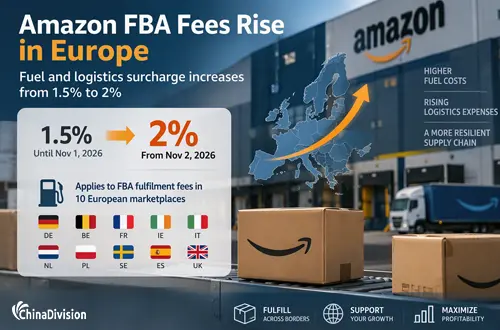
For cross-border e-commerce brands, this rate adjustment adds to the rising baseline of Amazon FBA fees 2026. While an average increase of £0.02 / €0.02 per unit may sound modest, high-volume sellers and brands dealing in bulky or multi-channel goods face compounding operational costs.
What Is Changing in Amazon Europe's Fuel and Logistics Surcharge?
Amazon has announced an increase in its fuel and logistics-related surcharge for European fulfillment services. The company introduced the original surcharge in April 2026 to recover part of the elevated fuel and logistics costs affecting the industry. Because these costs have continued to rise, Amazon is increasing the rate.
The change is important for sellers who depend on FBA to store, pick, pack, and ship orders across Europe. Even a small per-unit increase can become material when applied to thousands of orders or combined with other operating expenses.
Amazon FBA surcharge changes at a glance
| Item | Announcement details |
|---|---|
| Previous surcharge | 1.5% of eligible fulfillment fees |
| New surcharge | 2% of eligible fulfillment fees |
| FBA effective date | November 2, 2026 |
| MCF effective date | November 19, 2026 |
| FBA marketplaces affected | UK, France, Germany, Italy, Spain, Poland, Sweden, Netherlands, Ireland, and Belgium |
| MCF marketplaces affected | UK, France, Germany, Italy, and Spain |
| Calculation basis | Eligible fulfillment fees, not the product's selling price |
| Amazon's estimated average FBA impact | Approximately £0.02/€0.02 more per unit, depending on item size and dimensions |
Official source: Amazon Seller Central — Update to FBA and MCF EU fuel and logistics-related surcharge
Sellers should distinguish between the two effective dates. The 2% surcharge applies to FBA in the ten listed marketplaces starting November 2, while the corresponding MCF increase begins November 19 in five marketplaces.
Why is Amazon increasing the surcharge from 1.5% to 2%?
Amazon attributes the adjustment to continued increases in fuel and logistics costs. Transportation, carrier operations, and other logistics activities are exposed to changes in energy prices, network capacity, and operating expenses. Amazon says it absorbed some of these elevated costs where possible before introducing the surcharge in April 2026.
The new rate is intended to recover part of those costs. It does not mean that every seller's total fulfillment bill will rise by 0.5%, nor does it mean that Amazon is charging an additional 2% of every product's selling price.
The distinction matters because the surcharge is calculated on eligible fulfillment fees. A seller's exposure therefore depends on the fees associated with the products being fulfilled, rather than simply on gross merchandise sales.
For sellers, the practical takeaway is straightforward: the surcharge is a small percentage adjustment, but its profitability impact depends on unit economics and order volume.
How Much Will the Amazon Europe Surcharge Actually Cost Your Business?
The most useful way to evaluate Amazon FBA fees in 2026 is to calculate the change at three levels: per unit, per product or SKU, and across the entire business.
This is more actionable than relying on a headline percentage because two sellers with the same sales revenue can face very different fee impacts.
Understand the calculation before changing prices
The new surcharge rate is 2%, compared with the previous rate of 1.5%.
The incremental rate is:
2% − 1.5% = 0.5 percentage points
The additional cost per unit is:
Eligible fulfillment fee per unit × 0.5%
Use a SKU-level cost audit instead of a revenue-based estimate
A revenue-based estimate can be misleading because the surcharge is not calculated on the selling price. A better approach is to review products individually.
For each SKU, record:
- The eligible FBA fulfillment fee per unit.
- The old surcharge rate and the new rate.
- The average number of units fulfilled each month.
- The current contribution margin per unit.
- The share of sales generated by each affected marketplace.
Then calculate:
Incremental monthly surcharge = Eligible fulfillment fee × 0.005 × Monthly units fulfilled
For a catalog with different fee levels, calculate the increase for each SKU and add the results together. Use the correct fee basis for each product rather than applying one average fee to every item.
This process also helps identify the products most exposed to the change. A low-priced product with a relatively high fulfillment fee may have less room to absorb an additional cost than a higher-priced product with a stronger contribution margin.
How to check the impact in Amazon's own tools
Amazon states that its Profit Analytics, Revenue Calculator, and Fee and Economics Preview reports have been updated to reflect the surcharge. These are the appropriate starting points for checking the per-unit and overall business impact.
Use them to compare affected products, then reconcile the estimates against actual fee statements after the new rate takes effect. Confirm that the marketplace, product dimensions, fulfillment method, and fee assumptions are correct.
For a multi-marketplace business, do not assume that one SKU will have identical fulfillment economics in every country. Product size, applicable fees, sales mix, and local operating arrangements can all affect the final result.
Why a 0.5-Percentage-Point Increase Can Put FBA Profit Margins Under Pressure
The surcharge increase may look small in isolation, but Amazon seller costs are interconnected. Sellers already managing narrow margins may find it difficult to absorb additional fulfillment expenses without reviewing pricing, sourcing, and inventory decisions.
Should sellers increase product prices?
Not automatically. A price increase may recover the additional expense, but it can also affect conversion rates, advertising efficiency, competitiveness, and sales volume.
Before changing prices, sellers should evaluate:
- Contribution margin: How much profit remains after variable costs?
- Price sensitivity: Are customers likely to respond negatively to a small price adjustment?
- Competitive positioning: How do competing products compare on price, delivery speed, and perceived value?
- Sales velocity: Could a price increase slow inventory turnover and increase storage exposure?
- Marketplace differences: Does the same product have different margins in the UK, Germany, France, or other European markets?
A more reliable strategy is to identify the SKUs with the least margin flexibility first. Some products may absorb the surcharge without a pricing change, while others may need a broader cost review.
Seven Practical Ways to Protect Amazon FBA Profit Margins in 2026
The surcharge is one part of a larger cost-management challenge. Sellers can improve resilience by examining the entire fulfillment process, from supplier dispatch to final delivery.
1. Audit fulfillment costs by SKU and marketplace
Start with a cost baseline. Consolidate product costs, inbound freight, customs-related expenses where applicable, FBA fulfillment fees, storage, returns, and other variable expenses.
Separate the results by SKU and destination marketplace. This helps distinguish between products that remain profitable and those that are vulnerable to cost increases.
Practical action: Create a monthly report showing contribution per unit, contribution margin, fulfillment cost as a percentage of revenue, and sales volume for each major SKU.
2. Review packaging dimensions and product configuration
Product dimensions can influence fulfillment fees, shipping costs, and warehouse storage requirements. Oversized packaging may create avoidable expenses, particularly for lightweight products or products with substantial empty space.
Review whether packaging can be made smaller without compromising protection, presentation, or applicable product requirements.
Practical action: Compare the current packed dimensions with a proposed packaging configuration. Confirm the effect on Amazon's applicable fee category before implementing a change.
Do not assume that smaller packaging will automatically lower every fee. Validate the relevant fee rules and actual package measurements.
3. Improve inventory forecasting and replenishment
Excess inventory can create storage expenses and tie up working capital. Insufficient inventory can cause stockouts, missed sales, and emergency replenishment costs.
Both outcomes can damage profitability more than a small surcharge adjustment.
A more disciplined replenishment plan considers:
- Historical sales and current demand trends.
- Supplier production and dispatch lead times.
- International transit and customs clearance variability.
- Warehouse receiving and processing time.
- Expected seasonal peaks and promotional events.
- Safety stock appropriate to demand uncertainty.
Practical action: Set replenishment triggers using expected demand during the complete replenishment lead time, plus an appropriate safety buffer. Review assumptions regularly instead of relying on a fixed reorder quantity throughout the year.
4. Compare inbound shipping methods using total landed cost
The cheapest freight quotation is not necessarily the cheapest end-to-end solution. A lower transport rate may be offset by longer transit times, additional handling, unpredictable arrival dates, or higher inventory carrying costs.
Compare shipping methods using a common cost framework:
| Comparison factor | What to evaluate |
|---|---|
| Freight rate | Total transport charge, not just the advertised rate |
| Transit time | Expected door-to-door or warehouse-to-warehouse duration |
| Reliability | Variation in transit time and risk of delays |
| Customs and documentation | Applicable clearance, brokerage, and documentation expenses |
| Receiving and handling | Destination processing and warehouse charges |
| Inventory implications | Safety stock, stockout exposure, and capital tied up in transit |
For cross-border sellers, the objective is not always to choose the fastest or cheapest method. It is to select a shipping plan that meets replenishment deadlines at an acceptable total cost.
5. Reduce avoidable warehouse handling and order errors
Fulfillment expenses can accumulate through inefficient picking, repacking, inaccurate stock records, returns processing, and unnecessary transfers.
A warehouse operating with accurate inventory data and clear picking procedures can help reduce these avoidable costs.
Practical action: Track order accuracy, receiving discrepancies, inventory adjustments, return reasons, and orders requiring manual intervention. Investigate recurring issues rather than treating them as isolated incidents.
When evaluating a fulfillment partner, ask how it measures these metrics and whether it can provide reports that help identify cost drivers.
6. Reconsider where inventory should be stored
Storing inventory closer to customers can reduce some delivery costs or shorten delivery times, but distributing inventory across multiple locations may increase storage commitments, transfer expenses, and operational complexity.
The best arrangement depends on demand distribution, order volume, product characteristics, delivery promises, and the economics of each location.
| Inventory strategy | Potential advantage | Main trade-off |
|---|---|---|
| Centralized inventory | Simpler stock control and consolidated storage | Longer delivery routes for some destinations |
| Distributed inventory | Stock can be positioned closer to regional demand | More complex allocation, transfers, and stock visibility |
| Hybrid approach | Balances centralized stock with selective regional positioning | Requires accurate forecasting and clear replenishment rules |
Practical action: Start with actual order destinations and fulfillment costs. Consider regional stock placement only when the potential delivery and service benefits justify the additional operating costs.
7. Compare FBA with third-party fulfillment based on total economics
The Amazon Europe surcharge is a useful reason to review fulfillment options, but it is not proof that moving away from FBA will save money.
FBA may remain attractive for sellers who value Amazon's integrated fulfillment infrastructure and eligible customer-facing delivery programs. A third-party logistics provider may be more suitable for businesses that need broader channel support, flexible inventory storage, customized handling, or fulfillment outside Amazon.
Compare both models across the complete cost structure:
| Cost or capability | Amazon FBA | Third-party fulfillment |
|---|---|---|
| Fulfillment charges | Amazon's applicable fee structure | Provider-specific picking, packing, and handling rates |
| Storage | Amazon's applicable storage charges | Contracted storage rates and terms |
| Sales channels | Primarily Amazon fulfillment workflows, with MCF options where available | Potential support for multiple marketplaces and sales channels |
| Packaging and handling | Subject to Amazon's service rules and available options | Options depend on provider capabilities and agreement |
| Inventory control | Amazon seller tools and inventory workflows | Provider systems, reporting, and integration capabilities |
| Delivery options | Amazon's fulfillment network and applicable programs | Available carrier services and destination coverage |
| Cost predictability | Depends on Amazon's current fee structure and inventory profile | Depends on rate transparency, contract terms, and additional charges |
A fair comparison should include receiving, storage, pick-and-pack, packaging materials, shipping, returns, account or integration fees, and any other applicable charges. Also account for the operational consequences of changing fulfillment methods.
For some businesses, a hybrid strategy may be more appropriate than a full migration. However, any change must preserve applicable marketplace requirements, delivery promises, and eligibility for programs the seller relies on.
How an International Fulfillment Provider Can Help Sellers Control Total Logistics Costs
For sellers sourcing products internationally, Amazon fulfillment fees are only one part of the cost chain. Expenses may begin at the supplier's facility and continue through export preparation, international transportation, customs clearance, destination receiving, storage, order processing, and final delivery.
A professional fulfillment partner should help sellers understand these connected costs rather than focusing only on a single warehouse or shipping rate.
Improve cost visibility from supplier to customer
A useful fulfillment cost analysis maps each stage of the order journey and identifies where charges arise.
For example, a seller shipping goods from China to European customers may need to consider supplier coordination, export preparation, international freight, applicable import requirements, destination storage, and last-mile delivery.
Separating these expenses makes it easier to determine whether the primary cost problem is freight, packaging, inventory, warehouse handling, or final fulfillment.
Coordinate inbound shipments and inventory availability
Poor coordination between suppliers, freight providers, and warehouses can create delays and additional handling. Better shipment planning can help sellers align production completion, dispatch dates, warehouse receiving capacity, and replenishment requirements.
Ask potential providers whether they can coordinate supplier pickups, shipment consolidation where appropriate, receiving schedules, inventory checks, and outbound fulfillment.
The objective is to reduce preventable delays and improve inventory availability—not to promise that every shipment will arrive without disruption.
Support multi-channel order fulfillment
Businesses selling through Amazon and other channels may need a consistent inventory view across multiple sales sources. A suitable fulfillment partner can help centralize stock management and order processing where its systems support the relevant integrations.
This can be particularly useful when sellers want to avoid managing separate stock pools without sufficient demand to justify them.
Before choosing a provider, confirm its actual platform integrations, inventory synchronization capabilities, order cutoff times, service coverage, and reporting options.
Evaluate service quality alongside price
A low warehouse rate may not produce the lowest total cost if orders are processed inaccurately, receiving is delayed, inventory records are unreliable, or support issues take too long to resolve.
A practical provider evaluation should include:
- Receiving accuracy and processing timelines.
- Inventory visibility and reporting frequency.
- Pick-and-pack accuracy.
- Order processing cutoffs.
- Shipping service options and tracking.
- Returns handling.
- Fee transparency and contract terms.
- Escalation procedures for missing or delayed shipments.
These measures help sellers compare fulfillment providers on operational value, not just headline pricing.
When Should Amazon Sellers Consider ChinaDivision?
ChinaDivision provides e-commerce fulfillment and warehousing services for businesses that need support with inventory handling and order fulfillment. For Amazon sellers reviewing their logistics costs, the relevant question is whether a provider's actual service scope, pricing, and operational capabilities fit the business's requirements.
ChinaDivision may be worth evaluating if your business needs support with international order fulfillment, inventory storage, order processing, or coordinating logistics between suppliers and customers.
Before committing, ask for a quote based on your actual shipment profile, including product dimensions and weight, monthly order volume, destination countries, storage requirements, packaging needs, and returns expectations.
The goal is not simply to replace one surcharge with another provider's fees. It is to build a fulfillment model that supports sustainable margins, reliable inventory availability, and consistent customer service.
Frequently Asked Questions About Amazon Europe Surcharges and Fulfillment Costs
Does the surcharge increase mean that every seller's profit margin will fall by the same amount?
No. The impact depends on fulfillment fees, unit volume, existing margins, and the seller's ability to adjust other costs or prices. Products with higher eligible fulfillment fees incur a larger absolute increase per unit, all else being equal.
Will the same increase apply to Multi-Channel Fulfillment?
Amazon has announced the same increase for MCF beginning November 19, 2026, in the UK, France, Germany, Italy, and Spain. This date and marketplace coverage differ from the FBA change.
What information should I provide when requesting an international fulfillment quote?
Provide your product list, packed dimensions and weights, expected monthly order volume, destination countries, inventory volume, inbound shipping requirements, packaging preferences, expected dispatch times, and returns needs. The more accurate the information, the more useful the cost comparison will be.
Protect Profitability by Managing the Whole Fulfillment Process
Amazon's increase in the European fuel and logistics surcharge from 1.5% to 2% is a relatively small adjustment per unit, but it is a timely reminder that fulfillment economics can change throughout the year.
Sellers should verify the new fee basis, quantify the impact at SKU and business levels, review their pricing assumptions, and investigate avoidable costs across sourcing, shipping, warehousing, inventory management, and order processing.
For businesses operating across international supply chains, the most effective response is rarely to focus on one fee in isolation. A more resilient strategy combines accurate cost visibility, disciplined inventory planning, suitable shipping methods, and a fulfillment model aligned with actual demand.
If you are reviewing your Amazon FBA costs for 2026, use the announced change as an opportunity to benchmark your existing operations. ChinaDivision can be considered as one potential fulfillment partner for businesses evaluating international warehousing and e-commerce order fulfillment. Compare its service scope and quoted total cost with your current arrangement to determine whether it is the right fit for your business.
Industry Resources and Further Reading
Update to FBA and MCF EU fuel and logistics-related surcharge


About the Author: Limi

Limi is a content marketing expert at ChinaDivision, helping businesses and e-commerce sellers navigate the complexities of international shipping by providing actionable tips and comprehensive guides on logistics, shipping, and cargo transportation.