

Plush Toy Fulfillment Case Study: Custom Packing & Peak-Season Solutions
Table of Contents
- Background
- The seller major concerns
- Visiting ChinaDivision: Turning Questions Into a Practical Fulfillment Plan
- ChinaDivision's Customized Fulfillment Solution
- Measuring the Impact of Customized Fulfillment
- Why the Client Felt More Confident Entrusting ChinaDivision With Fulfillment
- What Other Cross-Border E-Commerce Sellers Can Learn
- Build a More Scalable Fulfillment Operation With ChinaDivision
For plush toy sellers, a successful product launch or seasonal sales campaign can bring a welcome surge in orders. However, higher sales volumes also create new operational challenges: inventory must be organized, products need appropriate packaging, orders must be dispatched accurately, and international shipments must move through the delivery network efficiently.
Background
Client Profile: Fast-growing international direct-to-consumer (DTC) & B2B plush toy brand
Category: Stuffed Animals, Plush Collectibles, and Seasonal Novelties
Target Markets: North America, Europe, Australia
Fulfillment Partner: ChinaDivision

In this representative case, a growing cross-border e-commerce seller specializing in plush toys was preparing to expand its international sales. Its product range included soft toys in different sizes, gift-ready plush collections, and seasonal designs intended for occasions such as holidays and promotional events.
As order volumes grew, the seller began looking for a third-party logistics (3PL) partner that could handle warehousing, customized packing, and international shipping under one coordinated fulfillment process.
The seller major concerns
1. International Logistics: How Could Shipments Be Managed More Reliably?
Shipping plush toys internationally involved more than selecting a carrier. The seller needed to understand the available shipping options, estimated transit times, tracking visibility, customs documentation, and how to balance delivery speed against transportation costs.
The team was particularly concerned about coordinating outbound shipments from China with delivery expectations in overseas markets. Unclear shipping arrangements could make it difficult to plan inventory replenishment, communicate realistic delivery estimates to customers, and respond to delayed shipments.
The seller wanted a fulfillment partner that could explain the shipping process clearly and help match shipping methods to different order priorities.
2. E-Commerce Order Fulfillment: Could Customized Orders Be Handled Accurately?
Plush toys may appear straightforward to pack, but different product dimensions, fabric materials, accessories, and presentation requirements can complicate fulfillment.
Some products may require individual protective bags, while others may need branded packaging, gift-ready presentation, or additional protection to maintain their appearance during transportation.
The seller was concerned about whether a fulfillment provider could:
- Maintain accurate inventory records across multiple plush toy SKUs.
- Pick the correct product, size, and variant for each order.
- Follow product-specific packing instructions consistently.
- Process orders efficiently without compromising presentation or quality.
- Handle returns, exceptions, and inventory discrepancies when necessary.
The seller needed more than basic storage and shipping. It needed a fulfillment workflow tailored to its products and brand requirements.
3. Peak-Season Delivery: What Would Happen When Orders Surged?
Seasonal promotions can dramatically increase order volumes within a short period. For plush toy sellers, holiday campaigns and limited-time promotions can create pressure on inventory availability, picking capacity, packing stations, and carrier handoff schedules.
The seller worried that its existing fulfillment arrangements might struggle to keep pace during these busy periods. Delayed dispatches could lead to missed delivery expectations, more customer inquiries, and additional pressure on its customer service team.
The key question was straightforward: Could a 3PL partner scale fulfillment operations during peak season without allowing costs, accuracy, or service quality to deteriorate?
Visiting ChinaDivision: Turning Questions Into a Practical Fulfillment Plan
Rather than making a decision based solely on quotations and service descriptions, the seller arranged a visit to ChinaDivision to learn how its fulfillment operations worked in practice.
During the visit, the client toured the warehouse and discussed its requirements with Shawn, ChinaDivision's senior sales representative.
The warehouse tour gave the client an opportunity to examine the operational processes behind the service, including inventory storage, order picking, packing arrangements, and shipment preparation. Instead of discussing fulfillment as an abstract service, the conversation focused on how the seller's actual products and order patterns could be accommodated.
Shawn addressed the client's questions about international logistics, order processing, packaging customization, and seasonal capacity planning. He also discussed how the fulfillment workflow could be adjusted to account for differences in product size, packaging requirements, shipping priorities, and order volume.
Several practical questions guided the discussion:
- How would different plush toy SKUs be stored and identified?
- Which packaging options could protect the products without creating unnecessary shipping costs?
- How could customized packing instructions be followed consistently?
- How would the warehouse prepare for a sudden increase in daily orders?
- What shipment information could the seller use to monitor fulfillment progress?
The visit helped the client evaluate not only the proposed services but also the operational processes and communication needed to support its business.
Most importantly, the discussion shifted from whether ChinaDivision could simply ship plush toys to how ChinaDivision could build a fulfillment process around the seller's specific products and business goals.
ChinaDivision's Customized Fulfillment Solution
After understanding the seller's requirements, ChinaDivision developed a representative fulfillment approach built around four priorities: product-specific packing, efficient warehouse operations, coordinated international shipping, and peak-season preparation.
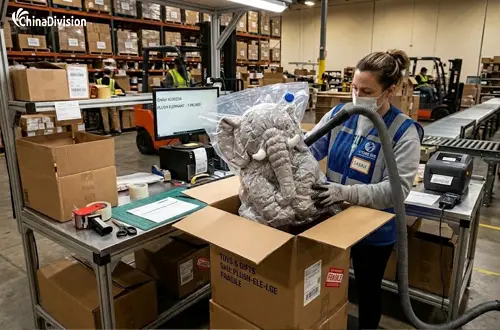
1. Product-Specific Packing for Plush Toys
Standardized packaging does not always suit every plush toy. Oversized cartons may increase dimensional shipping costs, while insufficient protection can damage retail packaging or affect the product's presentation.
ChinaDivision's proposed approach focused on matching packaging to each product and order type.
The workflow could include:
- SKU-based packing instructions: Define the appropriate packaging method for each plush toy size or product variant.
- Right-sized packaging: Select suitable mailers or cartons to reduce unused space while maintaining sufficient protection.
- Customized presentation: Accommodate approved branded inserts, gift packaging, thank-you cards, or other promotional materials.
- Packing quality checks: Verify the product, quantity, and required packaging before dispatch.
- Packaging trials: Test suitable packaging configurations before applying them across larger order volumes.
Where appropriate, flexible or compression packaging could also be evaluated for suitable plush products. However, compression would only be used when compatible with the toy's materials, construction, shape, and presentation requirements.
The objective was to avoid a one-size-fits-all packing method and instead establish repeatable packing standards that balanced product protection, customer experience, and cost efficiency.
2. A More Organized E-Commerce Fulfillment Workflow
To improve processing efficiency, the proposed workflow connected inventory management, picking, packing, and dispatch.
Inventory organization. Products would be identified by SKU and stored in designated locations, helping warehouse staff locate the correct items and maintain clearer stock records.
Order picking. Picking instructions would identify the required products and quantities, reducing unnecessary searching and the risk of selecting the wrong variant.
Packing and verification. Staff would follow the relevant packing instructions and check the order before sealing the package.
Dispatch coordination. Completed orders would be organized for carrier handoff, with shipment information recorded to support order tracking and exception management.
By defining the steps and requirements in advance, ChinaDivision could help the seller reduce avoidable handling, improve consistency, and make fulfillment performance easier to monitor.
3. International Shipping Aligned With Order Priorities
Different orders may require different shipping arrangements. A standard customer order, a time-sensitive gift purchase, and a bulk replenishment shipment do not necessarily need the same transportation solution.
ChinaDivision's representative plan involved evaluating available shipping options according to destination, parcel characteristics, delivery expectations, and cost.
The process would focus on:
- Comparing suitable shipping services and their estimated transit times.
- Preparing accurate shipment information and the required customs documentation.
- Coordinating carrier handoff and shipment tracking.
- Identifying delayed or exceptional shipments for follow-up.
- Reviewing shipping performance and costs to inform future fulfillment decisions.
The intention was not to promise identical delivery times for every destination, but to help the seller make better-informed shipping decisions and communicate realistic delivery expectations to customers.
4. Peak-Season Preparation Before Order Volumes Increased
Peak-season performance depends on preparation before the busiest days arrive. Increasing warehouse activity at the last minute can make it harder to maintain inventory accuracy, packing quality, and dispatch schedules.
ChinaDivision's representative peak-season plan emphasized forecasting, resource planning, and operational monitoring.
| Peak-season priority | Proposed action | Intended benefit |
|---|---|---|
| Inventory readiness | Review stock levels and expected sales before promotions | Reduce avoidable stockouts and fulfillment interruptions |
| Capacity planning | Estimate daily order volumes and identify potential bottlenecks | Prepare suitable staffing and packing capacity |
| Packing efficiency | Standardize instructions and prepare packaging materials in advance | Reduce packing delays and unnecessary handling |
| Order prioritization | Establish clear rules for urgent orders and dispatch deadlines | Improve workflow visibility and prioritization |
| Shipment monitoring | Track dispatch progress and flag exceptions | Enable faster investigation of potential delays |
| Post-peak review | Compare actual volume, costs, and processing performance | Improve planning for future sales events |
This approach helps make peak-season fulfillment a planned operational process rather than a last-minute response to rising demand.
Measuring the Impact of Customized Fulfillment
Within six months of transitioning fulfillment operations to ChinaDivision, the client achieved significant operational improvements and cost reductions:
| Metric | Before ChinaDivision | With ChinaDivision | Operational Impact |
|---|---|---|---|
| Packaging & Volumetric Shipping Cost | High (Uncompressed) | Reduced by 34% | Saved ~$2.15 per unit in international shipping |
| Order Processing Time (Peak Season) | 48–72 Hours | < 12 Hours | 100% same-day/next-day dispatch SLA during Q4 |
| Inventory & Pick Accuracy | ~92.5% | 99.92% | Barcode-driven scanning helped reduce picking errors |
| Damage & Return Rate | 4.8% | < 0.3% | Sealed protective packaging helped preserve product quality |
| Peak Season Order Capacity | 2,500 orders/day max | 15,000+ orders/day | Up to 6x throughput capacity, helping reduce processing backlogs |
Why the Client Felt More Confident Entrusting ChinaDivision With Fulfillment
The client's decision was not based on a single shipping quote or one attractive performance metric. It came from seeing how the proposed service could address its operational concerns as a whole.
A clearer view of warehouse operations. The warehouse tour helped the client understand the practical steps involved in storing, picking, packing, and dispatching its products.
A solution built around its products. The discussion with Shawn focused on the requirements of plush toys, including product identification, packaging presentation, protection, and cost control.
A more structured approach to peak season. Inventory preparation, capacity planning, standardized packing, and shipment monitoring provided a framework for managing periods of higher demand.
Greater visibility into performance. Metrics such as order processing time, packaging cost per order, dispatch timeliness, and picking accuracy offered a practical basis for reviewing service performance.
One coordinated fulfillment partner. By bringing warehousing, packing, and shipping coordination into a single fulfillment arrangement, the seller could reduce the need to manage multiple operational handoffs independently.
These considerations helped establish a more informed basis for the seller to entrust its fulfillment operations to a 3PL provider.
What Other Cross-Border E-Commerce Sellers Can Learn
This representative case highlights several lessons for businesses selling plush toys and other lightweight consumer products internationally.
- Evaluate fulfillment beyond the quoted price. Compare total operating costs, including storage, picking, packing, packaging materials, shipping, and the consequences of fulfillment errors.
- Customize packaging around the product. The best packaging protects the item, supports the desired customer experience, and avoids unnecessary material or parcel volume.
- Prepare for peak season early. Forecasting demand, confirming inventory readiness, and establishing clear packing and dispatch procedures can help reduce avoidable bottlenecks.
- Measure operational performance consistently. Establish a baseline and review the same metrics after process changes. Separate warehouse-controlled performance from external shipping and delivery factors.
- Evaluate your provider through direct communication. Ask how the provider handles SKU complexity, packaging instructions, inventory discrepancies, shipment exceptions, and sudden increases in daily orders.
A capable 3PL partner should be able to explain not only which services it offers, but also how those services fit your products, order profile, customer expectations, and growth plans.
Build a More Scalable Fulfillment Operation With ChinaDivision
For cross-border plush toy sellers, reliable fulfillment requires more than finding warehouse space and purchasing international shipping labels. It requires a coordinated process that connects inventory management, product-specific packing, order accuracy, shipping decisions, and peak-season preparation.
In this representative case, the visit to ChinaDivision and the discussion with senior sales representative Shawn helped the seller examine these requirements in practical terms. The proposed customized approach focused on improving warehouse efficiency, controlling packaging costs, supporting international shipping coordination, and preparing for seasonal demand.
Looking for a fulfillment partner for your plush toys or other e-commerce products? ChinaDivision can discuss your warehousing, customized packing, and international shipping requirements to help you evaluate a fulfillment workflow suited to your business.


About the Author: Limi

Limi is a content marketing expert at ChinaDivision, helping businesses and e-commerce sellers navigate the complexities of international shipping by providing actionable tips and comprehensive guides on logistics, shipping, and cargo transportation.