

How EU Tax Reforms Demand Localized Fulfillment Compliance
For years, many cross-border e-commerce sellers relied on direct-mail small parcels from China to European consumers. Low-value shipments, simplified customs declarations, and relatively inexpensive international delivery made this approach attractive, particularly for businesses selling through Shopify, Amazon, and other online marketplaces.
Table of Contents
- How Is the 2026 EU Customs Reform Changing Cross-Border E-commerce?
- Why Are Direct-Mail Small Parcels Becoming a Riskier Fulfillment Strategy?
- European Overseas Warehousing vs. Direct Shipping: Which Model Is More Cost-Effective?
- How to Choose a Reliable European Fulfillment and Customs Clearance Partner
- How ChinaDivision Helps E-commerce Sellers Build More Reliable International Fulfillment Operations
- Frequently Asked Questions (FAQ)
However, the economics of this model are changing.
Since July 2026, the EU has introduced a temporary €3 customs duty on qualifying low-value e-commerce consignments. From November 1, 2026, a separate €2 handling fee has also applied to small parcels. Meanwhile, mandatory product identifiers have introduced additional requirements for customs declaration data.
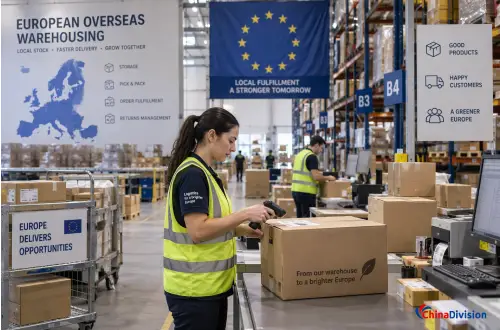
For sellers, the challenge is no longer simply finding a cheaper international shipping service. It is ensuring that every shipment has accurate documentation, meets applicable customs requirements, and reaches its destination without unexpected costs or delays.
A more sustainable approach is to combine compliant international transportation, strategically positioned inventory, and local European order fulfillment.
For cross-border brands shipping regularly to European customers, working with an experienced third-party logistics provider (3PL) can help turn regulatory pressure into an opportunity to improve supply chain efficiency.
How Is the 2026 EU Customs Reform Changing Cross-Border E-commerce?
The 2026 EU customs reform is increasing the financial and data-compliance requirements associated with importing goods into Europe, particularly for businesses using direct-to-consumer international parcel delivery.
Three developments are especially important for non-EU e-commerce sellers.
1.1 The €150 Customs Duty Exemption Has Been Removed
Before July 1, 2026, imported consignments with an intrinsic value not exceeding €150 generally benefited from customs duty relief. Import VAT was still payable, but the customs duty exemption made low-value direct-mail shipments attractive.
That exemption has now been removed.
Under Council Regulation (EU) 2026/382, a temporary €3 customs duty applies to qualifying consignments with a total intrinsic value not exceeding €150 from July 1, 2026, through July 1, 2028.
The duty is calculated according to distinct tariff categories represented in the consignment, rather than simply charging €3 for every physical unit.
This distinction matters for sellers shipping product bundles, mixed-SKU orders, and multi-category packages.
The duty also needs to be distinguished from import VAT, which has applied to imported commercial goods regardless of their value since the EU's 2021 VAT e-commerce reforms.
1.2 A Separate €2 Handling Fee Adds Another Cost
From November 1, 2026, the EU introduced a €2 handling fee for small e-commerce consignments.
This fee is separate from the €3 temporary customs duty.
For sellers relying on qualifying low-value direct-mail consignments, the combined impact of these two measures can be significant.
Consider the following simplified illustration:
| Cost Component | Before July 2026 | From November 2026 |
|---|---|---|
| Temporary Customs Duty | €0 | €3 |
| EU Handling Fee | €0 | €2 |
| Combined Additional Charges | €0 | €5 |
Illustrative comparison of the two new charges for an affected shipment with one applicable tariff category. Other duties, VAT, carrier charges, and clearance costs are excluded. Actual liability depends on the applicable customs rules and shipment characteristics.
For a business shipping 10,000 qualifying orders each month, an illustrative €5 additional charge per shipment would represent €50,000 in monthly additional costs.
That figure demonstrates why sellers should reassess their fulfillment economics rather than automatically passing every new expense to consumers.
1.3 Mandatory Product Identifiers Increase Customs Data Requirements
Another important development took effect on November 1, 2026.
Product identifiers (PIDs) must now be included in customs declarations for goods sold through distance sales to EU buyers.
The European Commission identifies three types:
| Identifier | Full Name | Purpose |
|---|---|---|
| M-PID | Merchant Product Identifier | Identifies the product using the seller's or platform's own product reference. |
| NS-PID | Non-standardised Manufacturer Product Identifier | Identifies the manufacturer's product or model using its own reference system. |
| S-PID | Standardised Manufacturer Product Identifier | Identifies products through recognized standards, such as EAN, UPC, or ISBN. |
These identifiers improve product traceability and help customs authorities identify products associated with safety or regulatory concerns.
For sellers, the practical implication is that product information must be managed consistently across storefronts, inventory systems, commercial invoices, and customs declarations.
A product may have an accurate sales listing but still encounter declaration problems if its identifiers are missing or inconsistent across the supply chain.
Sellers should therefore maintain a structured product master database containing:
- SKU and product variant references.
- Manufacturer and model information.
- EAN, UPC, ISBN, or other applicable standardized identifiers.
- HS codes and product descriptions.
- Country of origin.
- Customs valuation information.
Why Are Direct-Mail Small Parcels Becoming a Riskier Fulfillment Strategy?
The biggest challenge facing cross-border sellers is not necessarily the additional €5 in charges. It is the combination of higher shipment costs, more detailed data requirements, and greater exposure to customs-related disruptions.
A low shipping quotation does not necessarily represent the lowest total fulfillment cost.
2.1 Incomplete Customs Declarations Can Disrupt the Entire Delivery Process
Historically, some sellers attempted to reduce shipping expenses through inaccurate product descriptions, undervaluation, or incomplete customs declarations.
Such practices are increasingly difficult to sustain.
Customs authorities can use declaration information, product identifiers, and advance cargo information to assess potential risks.
For example, describing an electronic device as a generic accessory or declaring a commercial product at an artificially low value can create inconsistencies between the shipment, invoice, product listing, and actual goods.
Potential consequences include:
- Requests for additional documentation.
- Customs inspection and clearance delays.
- Reassessment of customs value or classification.
- Additional duties, taxes, or administrative charges.
- Return-to-origin or storage costs.
- Potential penalties or other enforcement measures.
The EU's Import Control System 2 (ICS2) also requires economic operators involved in bringing goods into or transiting through the EU to submit advance safety and security information through an Entry Summary Declaration (ENS).
Incomplete or inaccurate ENS information can trigger requests for additional data and delay the entry process.
2.2 The Hidden Costs of Direct International Shipping
When comparing logistics providers, sellers often focus on the price per parcel.
However, the actual cost of delivering an order includes several components beyond international transportation.
| Cost component | Potential impact on sellers |
|---|---|
| International shipping | Higher per-order transportation expenses |
| Customs duty | Increased import costs under applicable tariff rules |
| Handling fees | Additional charges associated with low-value imports |
| Customs brokerage | Fees for declaration and clearance services |
| Storage and inspection | Unexpected expenses when shipments require intervention |
| Failed delivery | Additional transportation and customer-service costs |
| Return handling | Expensive international reverse logistics |
| Refunds and reshipments | Lost revenue and additional fulfillment expenses |
A shipment that appears inexpensive at the booking stage may become significantly more expensive when additional charges and delivery exceptions are included.
For B2B sellers, this creates a more important performance metric:
Total landed fulfillment cost per successfully delivered order.
A practical calculation is:
Total fulfillment cost per delivered order =
International transportation + applicable duties and fees + customs brokerage + local delivery + warehouse handling + exception costs + return costs, divided by successfully delivered orders.
VAT should also be included when evaluating the seller's actual economic burden and cash flow, taking into account whether it is recoverable or collected through an applicable VAT arrangement.
The purpose of this calculation is to evaluate the complete delivery model rather than comparing shipping quotations in isolation.
2.3 Delivery Delays Can Damage Customer Lifetime Value
Customs problems do not end when a shipment is held.
A delayed order can create a chain reaction:
- The customer contacts the seller for an update.
- Customer service investigates the shipment.
- The delivery date becomes uncertain.
- The customer requests a refund or replacement.
- The seller incurs additional transportation and service expenses.
For DTC brands, these problems can damage repeat purchases, customer reviews, and advertising profitability.
This is particularly important during Black Friday, Christmas, and other seasonal sales periods, when customers have stronger delivery expectations.
A reliable fulfillment strategy should therefore prioritize shipment compliance, inventory availability, delivery predictability, and exception management together.
European Overseas Warehousing vs. Direct Shipping: Which Model Is More Cost-Effective?
European overseas warehousing offers an alternative to shipping every individual order internationally from China.
Instead of sending each customer order across borders, sellers can transport inventory in consolidated shipments to an appropriately authorized European import or storage arrangement, complete the applicable customs formalities, and distribute orders locally.
However, the model should be selected according to sales volume, inventory turnover, product characteristics, and the total landed cost.
3.1 How European Overseas Warehousing Changes the Fulfillment Process
A typical China-to-Europe direct shipping process looks like this:
China supplier → China fulfillment center → Individual international parcel → EU customs clearance → Local delivery carrier → European customer.
An overseas warehouse model follows a different process:
China supplier → China consolidation and export → Consolidated transportation → EU import clearance → European warehouse → Local order picking and packing → Domestic or regional delivery → European customer.
The difference is operationally important.
Rather than processing each consumer order as a separate international transportation movement, businesses can import inventory in planned batches and fulfill individual orders from stock already positioned in Europe.
This can offer several advantages:
- More predictable international transportation planning.
- Lower dependence on individual cross-border parcel movements.
- Faster local order dispatch.
- Better inventory visibility.
- More convenient return processing.
- Improved flexibility during seasonal demand fluctuations.
Importantly, an ordinary European warehouse is not automatically a customs warehouse or a bonded facility. Goods must have the appropriate customs status before they can be distributed. Duties and VAT do not disappear simply because inventory is stored in Europe.
3.2 Direct Shipping vs. European Overseas Warehousing
| Comparison factor | Direct shipping from China | European overseas warehousing |
|---|---|---|
| Inventory location | China | Europe |
| International transportation | Individual customer parcels | Primarily consolidated inventory shipments |
| Customs processing | Repeated parcel-level import processes | Import formalities for incoming inventory, followed by local distribution |
| Applicable import charges | Depend on shipment and customs treatment | Duties and taxes depend on the bulk import arrangement and applicable regulations |
| Final-mile delivery | International or cross-border parcel network | Local or regional delivery network |
| Delivery predictability | More dependent on international transit and border processing | Generally easier to manage for stocked products |
| Inventory investment | Lower overseas stock commitment | Higher upfront inventory commitment |
| Returns | Potentially expensive international returns | More convenient local return handling |
| Suitable business model | Low-volume, long-tail, or testing products | Established products with predictable European demand |
Neither model is universally superior.
The right decision depends on whether the savings from consolidated transportation and localized delivery outweigh warehousing, inventory financing, import, and operational costs.
3.3 When Should Sellers Switch to European Warehousing?
European overseas warehousing becomes increasingly attractive when a business has:
Stable European sales volume
Products with consistent demand can justify holding inventory closer to customers instead of repeatedly shipping individual parcels from China.
High international shipping costs
Bulky products, heavier goods, or products with relatively high parcel transportation costs may benefit from consolidated transportation and local distribution.
Time-sensitive customer expectations
Brands competing on delivery speed may benefit from having popular products available within the European market.
Frequent seasonal demand
Businesses preparing for Black Friday, Christmas, or product launches can position inventory in advance and reduce their dependence on international transportation during peak periods.
High return rates or customer-service requirements
Local inventory and return handling can make product exchanges, inspections, and reshipments more manageable.
For example, a seller shipping 20,000 orders annually to Germany, France, and the Netherlands may find it worthwhile to compare the economics of holding selected fast-moving SKUs in a European fulfillment location.
However, a seller with only a handful of monthly orders for highly customized products may be better served by shipping directly from China.
How to Choose a Reliable European Fulfillment and Customs Clearance Partner
A logistics provider should do more than offer a low shipping rate.
For businesses shipping into Europe, the right partner should understand international transportation, customs documentation, warehouse operations, inventory management, and last-mile delivery.
The following factors are particularly important when evaluating a third-party logistics provider.
4.1 Customs Clearance Experience
Ask whether the provider can explain the customs process for your specific products and transportation routes.
A qualified partner should be able to clarify:
- Applicable customs documentation.
- HS code and product information requirements.
- Importer and customs representative responsibilities.
- VAT and IOSS considerations.
- DDP and DAP service differences.
- Procedures for customs inspections and clearance exceptions.
Be cautious of providers that promise guaranteed customs clearance without first understanding the products, documentation, and import arrangements.
4.2 Warehouse Infrastructure and Inventory Visibility
A reliable warehouse operation should provide accurate inventory records and clear order processing procedures.
Important capabilities include:
- SKU-level inventory management.
- Barcode scanning.
- Warehouse Management System (WMS) integration.
- Receiving and quality inspection.
- Order picking and packing.
- Inventory reconciliation.
- Real-time stock visibility.
- Return processing.
Sellers should also confirm the actual warehouse location, facility operator, storage conditions, and whether the facility is a standard warehouse or an authorized customs warehouse.
4.3 International Transportation and Last-Mile Delivery
An effective 3PL should offer multiple transportation options rather than relying on one shipping route.
Depending on the product and delivery destination, sellers may need:
- Air freight for time-sensitive replenishment.
- Sea freight for larger inventory shipments.
- Rail transportation for suitable China-Europe routes.
- Local parcel delivery for European customer orders.
- Specialized transportation for restricted or sensitive products.
The provider should also explain how tracking information is integrated into the seller's e-commerce platform.
4.4 Transparent Pricing and Operational KPIs
A low quotation is not necessarily a competitive fulfillment proposal.
Request a detailed breakdown of:
| Pricing component | Questions to ask |
|---|---|
| Inbound transportation | Are freight and destination charges included? |
| Customs clearance | Which brokerage and declaration fees apply? |
| Import charges | Who is responsible for duties and taxes? |
| Storage | How are storage fees calculated? |
| Picking and packing | Is pricing based on orders, units, or additional operations? |
| Packaging | Are standard and customized materials charged separately? |
| Last-mile delivery | Are remote-area and additional delivery charges included? |
| Returns | What are the inspection, handling, and reshipment fees? |
Beyond pricing, evaluate the provider using measurable performance indicators.
How ChinaDivision Helps E-commerce Sellers Build More Reliable International Fulfillment Operations
As EU customs requirements become more demanding, sellers need a fulfillment partner that understands both the transportation process and the operational challenges of managing international inventory.
ChinaDivision provides international order fulfillment, China-based warehousing, shipping coordination, and customs clearance support to help cross-border businesses manage their global supply chains.
With more than 14 years of experience, 8,000+ brands served, and 20,000㎡ of fulfillment center infrastructure, ChinaDivision supports DTC brands, crowdfunding businesses, and enterprises expanding into international markets.
Its operational capabilities are relevant to several challenges created by the changing European logistics environment.
5.1 Customs Documentation and International Shipping Coordination
ChinaDivision's European air freight customs clearance guidance addresses common documentation, classification, and clearance challenges associated with transportation from China to Europe.
Through shipment planning and document review support, sellers can identify potential information gaps before goods enter the international transportation process.
This helps businesses prepare more systematically for customs requirements rather than responding only after a shipment encounters a problem.
5.2 Integrated Warehousing and Order Fulfillment
An effective fulfillment strategy connects inventory receiving, storage, order management, packing, and transportation.
ChinaDivision's fulfillment operations use warehouse management and automated processing to improve inventory visibility and coordinate order handling.
Its automated fulfillment solutions include:
- Barcode-based inventory management.
- Automated order processing.
- Product measurement and packaging optimization.
- Shipping-label generation.
- Intelligent shipping-channel selection.
- Tracking synchronization.
- Return-processing workflows.
These capabilities help sellers improve order accuracy and control the operational workload associated with growing order volumes.
5.3 Flexible Inventory and International Shipping Strategies
Not every SKU requires the same fulfillment arrangement.
Fast-moving products may justify inventory positioning closer to customers, while slower-moving or customized products may be more efficiently shipped directly from China.
ChinaDivision can help sellers evaluate their inventory, order destinations, shipping requirements, and transportation options to develop a more appropriate fulfillment strategy.
For businesses considering European inventory positioning, the important first step is to evaluate the actual destination warehouse, import arrangements, and local distribution capabilities rather than assuming every overseas storage model offers the same customs treatment.
5.4 Technology-Driven Operational Efficiency
International fulfillment becomes increasingly complicated as businesses add products, sales channels, and destination markets.
A connected fulfillment system helps reduce fragmented information and manual coordination.
ChinaDivision's technology-supported operations provide inventory visibility, order processing, tracking synchronization, and integration support for e-commerce businesses.
ChinaDivision helps cross-border e-commerce businesses build more efficient international order fulfillment operations through integrated warehousing, technology-driven processing, and international shipping coordination.
Whether you are expanding into Europe, managing increasing customs requirements, or looking to optimize your existing China-to-Europe supply chain, ChinaDivision can help you evaluate a fulfillment strategy aligned with your business goals.
Ready to optimize your European e-commerce fulfillment strategy? Contact ChinaDivision today for a customized logistics and fulfillment consultation.
Frequently Asked Questions (FAQ)
1. What changed in EU customs regulations in 2026?
The EU removed the previous €150 customs duty exemption on July 1, 2026, introducing a temporary €3 customs duty for qualifying low-value consignments. A separate €2 handling fee applies from November 1, 2026. Mandatory product identifiers also became effective on November 1, 2026, for applicable e-commerce imports.
2. Does the €3 EU customs duty apply to every item in a parcel?
Not necessarily as a charge on every physical unit. The temporary €3 duty is calculated according to the distinct tariff categories represented in a qualifying consignment. Multiple identical products classified under the same tariff heading can attract one €3 charge, while products from different tariff categories may attract separate charges.
3. Is the €2 EU handling fee the same as the €3 customs duty?
No. They are separate charges with different purposes. The €3 amount is a temporary customs duty, while the €2 amount is an EU handling fee intended to help cover customs processing and supervision costs. Sellers should account for both where applicable.
4. Can European overseas warehousing help sellers reduce customs costs?
European overseas warehousing can help reduce repeated individual cross-border parcel movements by consolidating inventory imports and fulfilling customer orders locally.
However, it does not automatically eliminate customs duties or import VAT. Sellers must account for the applicable import procedure, customs value, product classification, taxes, and warehouse arrangements.
5. Is direct shipping from China still suitable for European e-commerce sellers?
Yes. Direct shipping can remain appropriate for low-volume products, product testing, customized orders, and businesses with uncertain demand.
However, sellers with consistent European sales volumes should compare direct shipping against consolidated inventory imports and local fulfillment to determine which model provides the lowest total cost per successfully delivered order.
Official reference:


About the Author: Limi

Limi is a content marketing expert at ChinaDivision, helping businesses and e-commerce sellers navigate the complexities of international shipping by providing actionable tips and comprehensive guides on logistics, shipping, and cargo transportation.