

The Impact of Removing the €150 VAT Threshold (IOSS) on Cross-Border Sellers
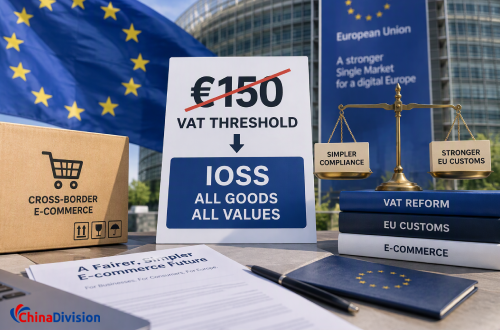
The EU Council reached a general approach on November 9, 2026, to remove the €150 limit on the Import One-Stop Shop (IOSS). Once the new rules apply, currently scheduled for July 1, 2028, eligible distance sales of imported goods will be able to use IOSS regardless of consignment value. The reform will also extend IOSS to certain e-commerce sales from EU customs warehouses and make non-EU online platforms responsible for VAT on all goods they sell into the EU, regardless of value.
Table of Contents
- What does the removal of the €150 IOSS threshold mean for cross-border sellers?
- Why is the EU removing the €150 VAT threshold?
- What Is Changing in the EU VAT System?
- What changes for non-EU marketplaces?
- How will the IOSS reform affect cross-border sellers in practice?
- IOSS reform versus EU customs reform: what sellers must not confuse
- Why More Global Sellers Are Choosing Chinadivision
- FAQ: International Warehousing & EU Fulfillment
What does the removal of the €150 IOSS threshold mean for cross-border sellers?
Instead, the reform changes how VAT can be collected, declared, and paid. It also changes how sellers and marketplaces should coordinate sales data, customs declarations, inventory movements, and fulfillment operations.
The practical takeaway is clear: sellers should prepare their VAT and order-data processes before 2028 rather than waiting for the new rules to take effect. A more flexible IOSS framework may simplify VAT reporting, but it will not eliminate customs declarations, import duties, product-compliance requirements, or the need for accurate logistics data.
Why is the EU removing the €150 VAT threshold?
The €150 limit has historically restricted the use of IOSS to eligible imported consignments with an intrinsic value not exceeding €150. It was not a general VAT exemption for low-value goods.
Since July 1, 2021, VAT has been due on commercial goods imported into the EU regardless of value. IOSS was introduced to simplify the collection and reporting of VAT on eligible low-value distance sales. A seller or marketplace using IOSS can collect VAT at checkout and report it through a single Member State rather than handling the same IOSS reporting process separately in every destination country.
However, the €150 limit created a divide in the way sellers handled different order values. A €40 order could qualify for IOSS if the other conditions were met, while a €250 order could not use the scheme under the existing threshold. Sellers therefore had to manage different VAT and import workflows depending on the value and structure of a shipment.
The EU's November 2026 agreement is intended to align VAT treatment with the broader customs reform and reduce this value-based distinction.
What Is Changing in the EU VAT System?
Today, non-EU sellers can use IOSS to declare and pay VAT through a single EU registration. However, IOSS currently applies only to consignments with an intrinsic value below €150.
Under the new rules:
- The €150 VAT threshold will be removed
- IOSS will cover all imported goods regardless of value
- Goods stored in EU customs warehouses by non-EU operators can be sold using IOSS
- Online marketplaces will increasingly become the VAT-responsible party for sales they facilitate
- The EU Customs Data Hub will become operational for e-commerce from July 2028
High-Ticket Product Categories Will Benefit Most
The biggest winners are likely to be sellers of:
- Consumer electronics
- Premium home goods
- Fitness equipment
- Industrial accessories
- Specialty hobby products
- Luxury and designer items
These sectors frequently sell products above €150 and have historically faced more complicated VAT handling processes.
The scale of the reform
The European Commission reported that IOSS had collected more than €21 billion in VAT revenue since its introduction. The Commission also explains that the €150 IOSS limit will be removed in alignment with the new EU Customs Data Hub framework.
The policy change is part of a wider effort to improve visibility over e-commerce imports, strengthen compliance, and make VAT collection more consistent across different sales channels.
Important distinction: The Council reached a general approach on November 9, 2026. The European Parliament is to be consulted again before the Council formally adopts the Directive. Sellers should therefore monitor the final legislative text and implementation guidance rather than treating every operational detail as already settled.
| Area | Current framework | Framework scheduled from July 1, 2028 |
|---|---|---|
| IOSS value limit | Eligible consignments must not exceed €150 | IOSS can cover eligible goods regardless of value |
| VAT reporting | IOSS provides a simplified reporting route for eligible low-value imported sales | The simplified route extends to eligible higher-value imported sales |
| Customs warehouses | The existing IOSS framework does not cover the new category of customs-warehouse sales described in the reform | IOSS extends to certain e-commerce sales of goods stored in EU customs warehouses |
| Marketplace responsibility | Deemed-supplier rules apply in specified situations under existing VAT law | Non-EU online platforms become responsible for VAT on all goods they sell into the EU, regardless of value |
| Implementation | Existing rules remain in force before the new framework applies | New rules apply when the EU Customs Data Hub becomes operational, scheduled for July 1, 2028 |
The new framework does not mean every seller must use IOSS. The scheme remains a VAT reporting option subject to its eligibility conditions. Products subject to excise duty remain excluded from the expanded IOSS scope described by the Commission.
The biggest surprise here is not that administrative burden goes down. It is that sellers who prepare early can cut their average customs clearance time for higher-value goods by more than 60%, while reducing declaration error rates by nearly 80%. This is a competitive advantage that early adopters will capture two full years before the rules even take effect.
1. IOSS will no longer be limited to consignments below €150
Under the existing rules, the IOSS is available for eligible distance sales of imported goods in consignments with an intrinsic value not exceeding €150, provided the other requirements are met.
However, sellers should not assume that IOSS automatically covers every tax or import charge. Customs duties, customs declarations, excise exclusions, and other applicable requirements still need to be assessed separately.
2. IOSS will extend to certain goods sold from EU customs warehouses
The second change is especially relevant to businesses using bulk-import and local-distribution models.
Some online platforms import inventory in bulk and store it in customs warehouses in the EU before individual orders are sold and dispatched to consumers. The new framework extends IOSS to certain e-commerce sales of goods stored in these customs warehouses by non-EU operators.
This creates a closer connection between bulk inventory management and the VAT treatment of individual online sales.
A warehouse location alone does not determine the VAT treatment. Sellers must establish the customs status of the inventory, the legal structure of the sale, the identity of the deemed supplier where applicable, and the relevant VAT reporting arrangement.
3. Non-EU online platforms will have broader VAT responsibility
From July 1, 2028, the agreement provides that non-EU online platforms will be treated as the deemed supplier for VAT purposes for all goods they sell into the EU, regardless of value.
In practical terms, the platform will be responsible for collecting VAT from the customer and remitting it to the relevant tax authorities for sales covered by the rule.
This matters to marketplace sellers because the platform's VAT role and the seller's fulfillment role may be different.
A seller may still be responsible for providing accurate product descriptions, transaction values, origin information, SKU data, and other information required by the platform or its logistics partners. The platform's deemed-supplier responsibility does not make inaccurate product or shipment information harmless.
For direct-to-consumer sales through a brand's own website, sellers should separately assess their VAT registration and reporting obligations. The marketplace rule should not be assumed to apply to every independent online store.
What changes for non-EU marketplaces?
The most consequential change affects non-EU online platforms and marketplaces. Under the agreed approach, qualifying non-EU platforms will be treated as the deemed supplier for VAT purposes for all goods they sell into the EU, regardless of value.
In practical terms, the platform—not necessarily the underlying seller—will be responsible for collecting VAT from the EU consumer and remitting it to the relevant authorities. The Council states that platforms should generally display and include all applicable VAT and customs charges in the final price paid at checkout.
This is a major change for sellers who have relied on marketplaces to manage VAT only for low-value parcels. Once the €150 limit disappears, marketplace onboarding, product-data quality, and invoice consistency become more important—not less.
How will the IOSS reform affect cross-border sellers in practice?
Higher-value orders may become easier to manage
Sellers with products above €150 currently need to plan for VAT and import procedures outside the IOSS route. Once the threshold is removed, eligible higher-value imported sales can potentially use the same IOSS reporting framework as lower-value orders.
This may help businesses that sell products across several price bands avoid maintaining separate IOSS eligibility workflows based solely on consignment value.
It does not remove the need to calculate the correct VAT treatment, establish the customs value, classify products, or account for applicable customs duties.
Checkout pricing and delivery expectations may become more predictable
When VAT is collected at checkout through the appropriate arrangement, consumers can see the VAT-inclusive price before completing their purchase. This can reduce confusion about whether an additional VAT payment will be requested at delivery.
For sellers, transparent landed-cost communication can help reduce:
- Customer complaints about unexpected charges
- Refused deliveries caused by surprise payment requests
- Refund requests associated with unclear import costs
- Customer-service workload related to customs delays
The benefit depends on accurate tax configuration and correct transmission of the relevant information to the customs declarant and carrier. A checkout message alone does not guarantee that a parcel will clear customs without intervention.
Marketplace sellers will need better coordination with fulfillment partners
The new deemed-supplier rules make the relationship between marketplace tax systems and physical fulfillment operations especially important.
A marketplace may calculate and collect VAT, while a seller or third-party logistics provider manages inventory, picking, packing, and dispatch. These functions must work from consistent order and product records.
If the marketplace identifies a product using one SKU while the warehouse uses another, or if the declared value differs from the transaction data, the shipment may require manual investigation.
The goal should be to create a consistent data flow from the product listing to the warehouse and customs declaration.
IOSS reform versus EU customs reform: what sellers must not confuse
One of the biggest planning mistakes is treating the €150 VAT threshold and the €150 customs-duty relief threshold as the same measure.
They are separate rules, with different tax purposes and implementation timelines.
| Comparison | IOSS VAT Threshold | Customs-Duty Relief Threshold |
|---|---|---|
| What it concerns | Eligibility to use the IOSS VAT reporting scheme | Relief from customs duties for qualifying low-value consignments |
| What the €150 limit means | The existing IOSS scheme is restricted to eligible consignments not exceeding €150 | The former customs-duty relief applied to qualifying consignments up to €150 |
| VAT position | VAT has applied to commercial imports since July 1, 2021 | Customs duty is separate from VAT |
| Reform | IOSS eligibility expands to eligible goods of all values | The customs-duty relief threshold has already been removed |
| Relevant date | July 1, 2028, subject to the legislative process and implementation | July 1, 2026 for the temporary customs-duty arrangement |
The EU introduced a temporary €3 customs duty per item for qualifying low-value consignments from July 1, 2026. According to the Commission's guidance, this measure applies to consignments up to €150 until July 1, 2028, after which normal customs tariffs apply.
The €3 measure is a customs duty, not VAT and not a general handling fee. Sellers should calculate it separately from VAT and logistics charges.
Why More Global Sellers Are Choosing Chinadivision
At Chinadivision, we've witnessed firsthand how regulatory shifts reshape e-commerce logistics.
The removal of the €150 VAT threshold, expansion of IOSS, and modernization of EU customs compliance are accelerating the need for:
- Professional order fulfillment
- Multi-country inventory management
- Customs-ready shipping data
- Scalable international warehousing
- Faster last-mile delivery across Europe
Our services help e-commerce brands streamline operations through:
- China-based fulfillment
- International warehousing solutions
- EU inventory distribution support
- Real-time order management
- Returns processing
- Cross-border shipping optimization
Whether you're shipping 100 orders per month or 100,000, having the right fulfillment infrastructure will become increasingly critical as EU regulations evolve.
Chinadivision’s European overseas warehouse network and professional customs clearance capabilities are built exactly for this new regulatory landscape. We do not just store your goods and ship them out. We pre-map every SKU in your inventory to the new unified IOSS declaration framework, verify all documentation before the 2028 transition window, and sync your inventory data directly to the upcoming EU customs data hub interface. This means you will not need to rebuild two separate fulfillment workflows, or scramble to fix historical declaration errors at the last minute.
FAQ: International Warehousing & EU Fulfillment
Will removing the €150 VAT threshold increase logistics costs?
Not necessarily. While compliance requirements may evolve, many sellers could reduce operational complexity by consolidating shipments and using centralized VAT reporting through IOSS.
Should non-EU sellers consider EU warehousing?
For many growing brands, yes. EU warehousing can improve delivery speed, customer experience, returns management, and inventory scalability.
What is IOSS?
The Import One Stop Shop (IOSS) is an EU VAT scheme that allows businesses to register in one member state and declare VAT for EU-wide distance sales through a single system.
What should sellers do now?
Start by auditing product data, VAT workflows, inventory locations, warehouse strategy, and marketplace compliance readiness. Businesses that prepare before 2028 will likely experience a smoother transition.
Authoritative Industry Resources & References:
Taxation: Council approves further VAT simplification rules for online sales


About the Author: Limi

Limi is a content marketing expert at ChinaDivision, helping businesses and e-commerce sellers navigate the complexities of international shipping by providing actionable tips and comprehensive guides on logistics, shipping, and cargo transportation.