

Amazon US Launches AI SMS Shopping Service: What It Means for Sellers and E-Commerce Fulfillment
Table of Contents
- What Is Amazon’s New AI SMS Shopping Service?
- What Does Amazon AI SMS Shopping Mean for Amazon Sellers?
- How AI Shopping Changes Demand Forecasting for Amazon Sellers
- What Comes Next for AI Shopping and International E-Commerce?
- Amazon FBA, MCF, and Independent 3PL Fulfillment: Which Should Sellers Choose?
- How ChinaDivision Helps International Sellers Build a More Reliable Fulfillment Operation
- Frequently Asked Questions (FAQ)
- Recommended Industry Resources
What Is Amazon’s New AI SMS Shopping Service?
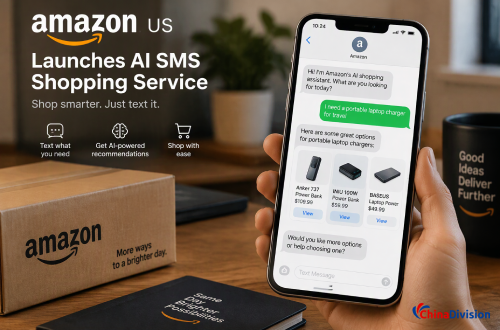
Amazon is making online shopping more conversational. On November 6, 2026, the company announced that selected U.S. customers could begin shopping through text messages with its AI assistant, Alexa for Shopping, without opening the Amazon Shopping app or visiting Amazon.com.
The service allows customers to describe what they need in everyday language, send product images, compare recommendations, and ask the AI assistant to help complete purchases. Amazon plans to expand access to millions more U.S. customers over the following weeks.
Rather than requiring shoppers to search through product categories, filters, and individual listings, the new experience allows them to communicate their shopping intentions directly.
What can customers do with Alexa for Shopping by text?
| Feature | How It Works | Potential Shopping Impact |
|---|---|---|
| Product discovery | Describe a product or shopping need in a text message | Makes product discovery more conversational |
| Product comparison | Ask Alexa to compare products, prices, and reviews | Helps customers evaluate alternatives |
| Image-based search | Send a photo of a product or outfit to find similar items | Creates another route from visual inspiration to purchase |
| Cart building | Ask Alexa to add selected products to a shopping cart | Reduces manual shopping steps |
| Purchasing | Ask Alexa to complete a purchase on the customer's behalf | Shortens the path from product discovery to checkout |
| Reordering | Request previously purchased products | Supports repeat purchases and replenishment |
| Price tracking | Request price history or alerts when prices drop | May influence when customers decide to buy |
| Order updates | Ask about package and delivery status | Makes post-purchase communication more conversational |
The service is designed to work across different Amazon shopping touchpoints. Amazon says conversations can carry over between text messages, the Amazon Shopping app, its website, and Alexa-enabled devices.
Amazon's announcement also describes personalized recommendations based on customer preferences and shopping history.
The important change is that Amazon is moving beyond AI-assisted product search toward AI-assisted shopping actions. The assistant can help customers move from expressing a need to selecting products and completing purchases.
What Does Amazon AI SMS Shopping Mean for Amazon Sellers?
The launch does not automatically change Amazon's seller fulfillment requirements, nor does Amazon's announcement establish a guaranteed increase in seller sales.
Nevertheless, it provides a useful signal about where the customer experience is heading.
For Amazon sellers, the operational challenge is to make sure their products remain discoverable, available, and deliverable when customers use AI-assisted shopping.
Product information may become more important than keyword coverage alone
Traditional Amazon SEO often focuses on product titles, search terms, bullet points, descriptions, images, and reviews.
Conversational shopping introduces additional ways for customers to express what they want.
A useful product listing should communicate relevant attributes, including:
- Waterproof or water-resistant material
- Laptop compartment dimensions
- Product weight
- Storage capacity
- Available colors
- Intended use
- Product compatibility and limitations
If these details are incomplete or inconsistent, an AI assistant may have less reliable information for comparing products.
Seller recommendation: Treat product attributes as structured commercial data, not merely content written to fill out a listing. Maintain consistent specifications across product listings, SKU records, packaging information, and warehouse systems.
Inventory accuracy becomes a direct customer-experience issue
Imagine a shopper asks Alexa for a particular product, receives a recommendation, and proceeds to purchase it.
However, the seller's actual warehouse stock is lower than the quantity displayed online.
This creates several possible problems:
- Orders cannot be fulfilled on time.
- Customers receive unexpected delivery delays.
- Sellers need to cancel or backorder purchases.
- Customer satisfaction and seller performance may suffer.
These problems are not unique to AI shopping, but conversational shopping makes inventory accuracy even more important because customers expect the assistant to simplify the purchasing process.
A practical recommendation is to establish a daily inventory reconciliation process between the e-commerce platform, warehouse management system (WMS), and order management system (OMS).
For sellers using multiple warehouses or sales channels, inventory synchronization is particularly important.
Faster shopping can expose weaknesses in fulfillment operations
A customer may complete a purchase in seconds, but the seller still needs to pick, pack, label, dispatch, and deliver the product.
The customer-facing shopping experience can become faster without the physical supply chain becoming faster automatically.
This creates a potential mismatch:
AI shopping speed ≠ warehouse processing speed ≠ international delivery speed.
For international sellers, fulfillment performance depends on several operational stages:
- Inventory must be available at the correct fulfillment location.
- The order must be transmitted accurately to the warehouse.
- Warehouse staff must identify the correct SKU and product variation.
- Packaging must meet product-protection and carrier requirements.
- Shipping labels and customs documentation must contain accurate information.
- The shipment must be handed to the appropriate carrier.
- Tracking information must be updated and communicated to the customer.
A weakness in any stage can undermine the convenience created by AI shopping.
How AI Shopping Changes Demand Forecasting for Amazon Sellers
One overlooked consequence of AI-powered shopping assistants is demand volatility.
Historically, shoppers spent time researching products.
AI now compresses research, comparison, and checkout into a single conversation.
This can lead to:
| Fulfillment Challenge | Potential Impact |
|---|---|
| Sudden demand spikes | Stockouts |
| Viral product recommendations | Inventory shortages |
| Faster repeat purchases | Replenishment pressure |
| Increased convenience | Higher order frequency |
| Personalized suggestions | Unpredictable SKU demand |
For international sellers sourcing from Asia, inventory forecasting becomes increasingly important.
What should sellers do?
Instead of forecasting demand only by monthly sales volume, consider monitoring:
- Daily orders by SKU
- Repeat-purchase frequency
- Inventory turnover
- Stockout frequency
- Order processing time
- Peak-day warehouse capacity
- Average units per order
- Returns by product variation
These metrics help sellers identify which products require additional safety stock, faster replenishment, or dedicated warehouse workflows.
What Comes Next for AI Shopping and International E-Commerce?
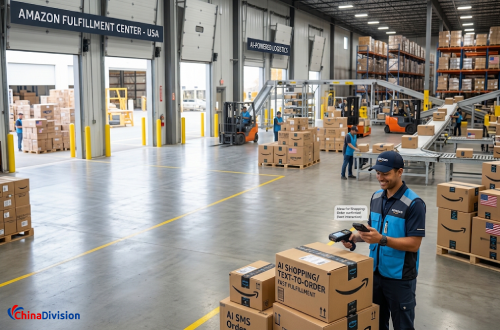
Amazon's AI SMS Shopping Service is one example of a broader movement toward conversational and agent-assisted commerce.
The next stage may involve more shopping activities being handled through natural-language requests, including product research, comparison, replenishment, and order management.
For sellers, three developments deserve particular attention.
First, product data will become increasingly important. AI shopping assistants need reliable product information to identify relevant products and distinguish between similar listings.
Second, inventory availability will remain a competitive factor. Product recommendations have little commercial value if the item cannot be fulfilled when the customer decides to buy.
Third, fulfillment flexibility will matter more as sales channels diversify. Sellers may need to coordinate Amazon orders, independent website orders, social commerce, and other channels through a more connected inventory and warehouse system.
The key lesson is that AI can simplify the customer-facing shopping journey, but it cannot replace the physical supply chain.
For international e-commerce sellers, long-term competitiveness will depend on connecting product data, inventory management, warehousing, order processing, and international delivery into one reliable operating system.
Amazon FBA, MCF, and Independent 3PL Fulfillment: Which Should Sellers Choose?
Amazon's new AI SMS Shopping Service does not replace FBA, MCF, or independent third-party logistics providers.
Instead, sellers should consider how their existing fulfillment structure supports their wider sales strategy.
| Fulfillment Model | How It Works | Main Advantage | Potential Limitation |
|---|---|---|---|
| Amazon FBA | Amazon stores, picks, packs, and ships eligible Amazon orders | Amazon-managed fulfillment and access to FBA services | Inventory is positioned within Amazon's fulfillment network and subject to its requirements and fees |
| Amazon MCF | Amazon fulfills orders from other sales channels using eligible Amazon inventory | Supports multichannel fulfillment from Amazon's network | Sellers must assess MCF costs, eligibility, packaging options, and inventory requirements |
| Independent 3PL | An external fulfillment provider stores and dispatches products for the seller | More flexibility in warehouse operations, shipping arrangements, and value-added services | Requires effective system integration and operational oversight |
Amazon confirms that MCF can fulfill orders from channels outside Amazon, including a seller's own website. Its MCF and FBA services can also draw from a shared inventory pool.
When should sellers consider an independent 3PL?
An independent 3PL may be worth evaluating when a seller:
- Operates across multiple e-commerce platforms.
- Needs customized packaging or product inspection.
- Wants more flexibility in choosing shipping routes.
- Needs warehousing outside Amazon's fulfillment network.
- Ships products internationally from China.
- Wants to separate inventory planning from a single marketplace's fulfillment infrastructure.
Some sellers may benefit from a hybrid strategy: keeping part of their inventory in Amazon's fulfillment network while using an independent 3PL for additional stock, customized orders, international shipping, or other sales channels.
The best solution depends on total fulfillment costs, inventory turnover, platform requirements, and customer delivery expectations.
How ChinaDivision Helps International Sellers Build a More Reliable Fulfillment Operation
As AI-powered shopping experiences become more common, e-commerce sellers need a supply chain that can support convenient online purchasing with dependable physical fulfillment.
ChinaDivision provides international order fulfillment, warehousing, and shipping support for e-commerce businesses that source products from China and sell to customers worldwide.
Rather than focusing only on transportation, ChinaDivision supports the operational steps between inventory arrival and outbound shipment.
ChinaDivision fulfillment services
| Service | Operational Support | Business Value |
|---|---|---|
| Warehousing | Inventory receiving, storage, and stock management | Provides a centralized location for inventory |
| Order fulfillment | Picking, packing, and dispatch coordination | Helps sellers process customer orders |
| Product inspection | Checks products according to agreed inspection requirements | Helps identify potential product issues before dispatch |
| Customized packaging | Supports different packaging and presentation requirements | Helps protect products and support brand presentation |
| Shipping coordination | Supports international shipping arrangements | Helps sellers evaluate suitable shipping options |
| Order and inventory management | Supports operational visibility and order coordination | Helps reduce manual work across fulfillment processes |
Why choose ChinaDivision?
ChinaDivision combines China-based supply chain access with international fulfillment operations.
For e-commerce brands, this can be particularly useful when products are manufactured or sourced in China but sold to customers in the United States, Europe, and other international markets.
Key service considerations include:
- Flexible fulfillment: Support for different order volumes and product requirements.
- Inventory management: Warehouse-level stock visibility and operational coordination.
- Customized services: Product inspection, packing, and other value-added operations.
- International shipping: Support for coordinating suitable shipping solutions.
- E-commerce operations: Fulfillment support for businesses selling through online channels.
The objective is straightforward: help sellers maintain better control over inventory, order processing, packaging, and international shipping as their businesses grow.
Explore ChinaDivision's fulfillment services or use the ChinaDivision Shipping Cost Calculator to evaluate potential shipping costs.
Preparing for the next stage of AI-driven e-commerce? Contact ChinaDivision to discuss your warehousing, order fulfillment, and international shipping requirements.
Frequently Asked Questions (FAQs)
1. What is Amazon's AI SMS Shopping Service?
Amazon's AI SMS Shopping Service allows selected U.S. customers to interact with Alexa for Shopping through text messages. Customers can search for products, compare options, share images, build shopping carts, complete purchases, and check order updates without opening the Amazon Shopping app.
2. Is Amazon AI SMS Shopping available to all U.S. customers?
No. Amazon initially launched the service to a small group of U.S. customers through invitations on November 6, 2026. The company announced plans to expand access to millions more customers over the following weeks. Availability may depend on Amazon's rollout and invitation process.
3. Can customers use images to search for products through Alexa for Shopping?
Yes. Amazon says customers can send photos of products or outfits and ask Alexa for Shopping to find similar items. This creates an additional product discovery method alongside traditional keyword searches.
4. Does Amazon AI SMS Shopping change FBA fulfillment requirements?
The SMS shopping launch does not itself announce changes to FBA fulfillment requirements. Sellers should continue following applicable Amazon policies, inventory requirements, shipping standards, and order handling rules.
5. How can sellers prevent inventory problems when selling through multiple channels?
Sellers should maintain a centralized inventory record, synchronize stock updates across sales channels, distinguish available stock from reserved and damaged inventory, and reconcile warehouse quantities regularly. An integrated OMS and WMS can help reduce manual updates and overselling risks.
Recommended Industry Resources
The following resources provide useful official guidance for sellers researching Amazon fulfillment, inventory management, and supply chain operations.
- Amazon – Alexa for Shopping: Text, shop, done — Amazon's official announcement of the SMS shopping experience.
- Amazon – Multi-Channel Fulfillment FAQs — Details about MCF, shared FBA/MCF inventory, order fulfillment, and tracking.
- Amazon – Fulfillment Outbound API Documentation — Technical documentation for creating and retrieving MCF fulfillment orders.
- Amazon – Seller Central Guide for MCF — Practical guidance on order creation, inventory, packaging, tracking, and returns.
Build a fulfillment operation that keeps pace with changing e-commerce behavior. Whether you are an Amazon seller, a DTC brand, or a cross-border e-commerce business sourcing products from China, ChinaDivision can help coordinate warehousing, order fulfillment, packaging, and international shipping to support your growth.


About the Author: Limi

Limi is a content marketing expert at ChinaDivision, helping businesses and e-commerce sellers navigate the complexities of international shipping by providing actionable tips and comprehensive guides on logistics, shipping, and cargo transportation.