

TikTok Shop Extends Shipping Deadlines for Black Friday in the US: How Avoid Late Orders
Table of Contents
- what TikTok Shop actually changed?
- How Does the TikTok Shop BFCM Shipping Extension Work?
- Why Is TikTok Shop Extending Shipping Deadlines During Black Friday?
- How Should TikTok Shop Sellers Prepare Their Warehouses for Black Friday?
- Should TikTok Shop Sellers Ship Directly from China or Use US Warehousing?
- How Can a Third-Party Logistics Provider Help TikTok Shop Sellers During Black Friday?
- How Can ChinaDivision Support TikTok Shop Sellers with International Fulfillment?
- What Should TikTok Shop Sellers Do After the Black Friday Shipping Extension Ends?
- Frequently Asked Questions About TikTok Shop Shipping, Delivery, and International Fulfillment
- Recommended Industry Resources and Official Policy References
TikTok Shop has introduced temporary fulfillment Service Level Agreement (SLA) extensions for eligible US Black Friday and Cyber Monday (BFCM) orders received between November 11 and December 5, 2026. The policy gives qualifying sellers additional time to dispatch orders and meet specified delivery deadlines during the holiday peak.
what TikTok Shop actually changed?
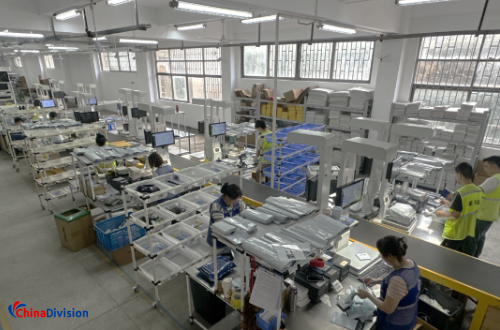
The maximum extension is two business days for local shipping and two calendar days for international shipping. However, the full two-day extension applies only to orders received during November 25–December 1. Orders received during the earlier and later periods receive one additional day.
To qualify, sellers must maintain a Late Dispatch Rate (LDR) of 20% or lower over the previous 30 days. TikTok Shop also monitors seller performance during the campaign, and products with repeated missed dispatch SLAs may lose campaign eligibility.
This is more than a temporary deadline adjustment. For sellers operating across international supply chains, it is a reminder that inventory availability, warehouse processing capacity, carrier handover, and delivery visibility must work together during peak demand.
TikTok Shop Shipping Deadline Extension: Key Details at a Glance
| Policy Detail | TikTok Shop's 2026 BFCM Arrangement |
|---|---|
| Applicable market | United States |
| Policy period | November 11–December 5, 2026 |
| Local shipping extension | Up to 2 additional business days |
| International shipping extension | Up to 2 additional calendar days |
| Seller eligibility | 30-day Late Dispatch Rate of 20% or lower |
| Monitoring | Seller fulfillment performance is monitored during the campaign |
| Excluded order types | Pre-orders and backorders are not covered by the SLA extension |
| Main operational concern | Maintaining dispatch capacity, inventory availability, and delivery performance |
Important: The extension is not a blanket two-day allowance throughout the entire period. Sellers should check the order-specific deadlines displayed in Seller Center rather than automatically adding two days to every order's processing schedule.
How Does the TikTok Shop BFCM Shipping Extension Work?
TikTok Shop divides the temporary SLA extension into three order-receipt periods. The additional time differs depending on whether an order is classified as local or international shipping.
1. The shipping extension changes by order date
The following table summarizes the extension for standard and auction orders under the official 2026 BFCM Seller Campaign Guide.
| Order Receive Date | Local Shipping | International Shipping |
|---|---|---|
| November 11–24 | +1 business day | +1 calendar day |
| November 25–December 1 | +2 business days | +2 calendar days |
| December 2–5 | +1 business day | +1 calendar day |
The extension applies to three fulfillment deadlines:
- Dispatch SLA: The deadline for dispatching an order and meeting the platform's qualifying dispatch requirements.
- Auto-Cancellation SLA: The deadline associated with the platform's automatic order cancellation rules.
- Deliver-by SLA: The deadline by which the order is expected to be delivered.
Made-to-Order and Custom Handling Time orders have their own extension arrangements. The guide specifies an additional day during the first and last periods and up to two additional days during November 25–December 1. Pre-orders and backorders are excluded.
For sellers, this distinction matters because a longer dispatch window does not necessarily mean every order has the same additional delivery time. Dispatch, cancellation, and delivery deadlines are separate SLA checkpoints.
2. Sellers must maintain a Late Dispatch Rate of 20% or lower
The policy requires sellers to maintain a Late Dispatch Rate (LDR) of no more than 20% over the preceding 30 days.
LDR measures the proportion of applicable orders that are dispatched later than their required dispatch SLA. It is not simply a measure of how many packages have arrived late.
However, sellers should not treat 20% as a recommended operating target. A shop operating close to the threshold has little room for unexpected order spikes, warehouse congestion, inventory discrepancies, or carrier pickup failures.
A more resilient strategy is to establish an internal LDR target comfortably below the platform's maximum and monitor the trend throughout the campaign.
3. A longer deadline does not eliminate fulfillment requirements
The extension gives eligible sellers more time, but it does not remove the need to:
- Maintain accurate inventory quantities.
- Process orders within the revised dispatch SLA.
- Prepare accurate shipping labels and documentation.
- Hand packages to carriers on time.
- Ensure that TikTok Shop recognizes a qualifying dispatch event.
- Monitor delivery performance and customer complaints.
One particularly important detail is that a shipping label being generated does not necessarily prove that an order has been dispatched. Sellers should verify that the carrier handover or other qualifying dispatch event is recorded correctly.
TikTok Shop's Late Dispatch Rate guidance explains how qualifying dispatch events are recognized and how sellers can monitor their fulfillment performance.
Why Is TikTok Shop Extending Shipping Deadlines During Black Friday?
Black Friday and Cyber Monday create a concentrated increase in e-commerce order volume. Sellers may experience more orders in a few days than their normal warehouse and shipping operations can comfortably handle. A delay at any stage can affect the seller's ability to meet the platform's requirements.
Peak-season demand creates warehouse processing bottlenecks
During ordinary periods, a warehouse may have sufficient labor and packing capacity to process daily orders. During Black Friday, order volume can rise rapidly, especially for products promoted through livestreams, creator campaigns, and limited-time discounts.
The real bottleneck is often the number of orders a warehouse can correctly process and hand over to carriers within a given time window.
This is why sellers should evaluate fulfillment capacity in orders per hour or orders per shift—not simply the total quantity of stock in storage.
International shipping involves more than warehouse dispatch
For international sellers shipping from China to US customers, the fulfillment process includes additional transportation and customs-related steps.
Even when a package leaves the warehouse on time, it may still encounter:
- International flight or vessel capacity constraints.
- Export documentation errors.
- Customs inspection or clearance delays.
- Destination-country sorting congestion.
- Last-mile carrier capacity limitations.
TikTok Shop's extension provides additional time under its platform SLA rules, but it does not make international transportation faster or remove customs requirements.
Sellers should therefore distinguish between two separate questions:
- Can the warehouse prepare and dispatch the order within the required deadline?
- Can the transportation network deliver the package within the customer-facing delivery promise?
Solving the first problem does not automatically solve the second.
How Should TikTok Shop Sellers Prepare Their Warehouses for Black Friday?
The most effective response to a temporary shipping extension is not simply to delay dispatch. Sellers should use the additional time to improve inventory allocation, warehouse scheduling, and carrier coordination.
1. Forecast demand before promotional campaigns begin
Sellers should estimate expected order volume using historical sales, current inventory, advertising plans, product promotion schedules, and campaign participation.
A practical way to start is to classify products into three groups:
| Product Category | Typical Characteristics | Recommended Fulfillment Strategy |
|---|---|---|
| High-demand products | Strong sales history, high promotional exposure | Pre-position sufficient inventory and prioritize picking capacity |
| Medium-demand products | Stable sales with moderate campaign growth | Maintain safety stock and monitor daily sales |
| New or unpredictable products | Limited sales history or creator-driven demand | Use conservative inventory allocation and frequent replenishment reviews |
A useful metric is the inventory coverage period:
Inventory Coverage (Days) = Available Sellable Inventory ÷ Average Daily Orders
During Black Friday, sellers should also calculate coverage using a promotional demand forecast rather than relying exclusively on ordinary daily sales.
This helps prevent a common problem: inventory appears sufficient under normal conditions but runs out during a short-lived sales spike.
2. Separate inventory for different sales channels
Many e-commerce sellers operate across TikTok Shop, Shopify, Amazon, and other marketplaces.
If the same inventory pool supports multiple channels, a sudden TikTok Shop sales increase can consume stock originally allocated to other customers or marketplaces.
The important principle is to avoid treating all warehouse inventory as freely available for every sales channel.
A warehouse management system (WMS) or order management system (OMS) can help sellers track stock by SKU, warehouse location, sales channel, and inventory status. It should also distinguish sellable inventory from reserved, damaged, pending-inspection, and in-transit stock.
3. Increase picking and packing capacity before the order surge
Warehouse capacity should be planned around the expected peak, not the average daily workload.
A useful starting point is to calculate the required daily processing capacity:
Required Daily Capacity = Forecast Daily Orders ÷ Available Processing Hours
In practice, sellers should also consider:
- Additional warehouse shifts or temporary labor.
- Dedicated packing stations for high-volume SKUs.
- Pre-packed standard product combinations.
- Barcode scanning to reduce picking errors.
- Separate workflows for fragile, oversized, or customized products.
- Priority queues for orders approaching their dispatch deadlines.
The objective is to reduce the time between receiving an order and completing a carrier handover—not simply to increase the number of packages packed.
4. Coordinate carrier pickups and dispatch scans
One overlooked source of late dispatch is the gap between warehouse completion and carrier acceptance.
A package may be picked, packed, labeled, and placed in the outbound area, but if the carrier does not collect it or the qualifying scan is not recorded within the required window, the seller may still face a dispatch-performance problem.
To reduce this risk:
- Confirm daily carrier pickup schedules before the campaign.
- Arrange additional pickups when order volume increases.
- Establish an earlier internal dispatch cut-off than the platform deadline.
- Keep outbound packages organized by carrier and service level.
- Monitor uncollected parcels and missing tracking events.
- Retain handover records and supporting evidence.
A useful warehouse KPI is the Order-to-Carrier Handover Time, measured from order release to the carrier's recognized acceptance event.
This is more operationally meaningful than measuring only the time required to print a shipping label.
Should TikTok Shop Sellers Ship Directly from China or Use US Warehousing?
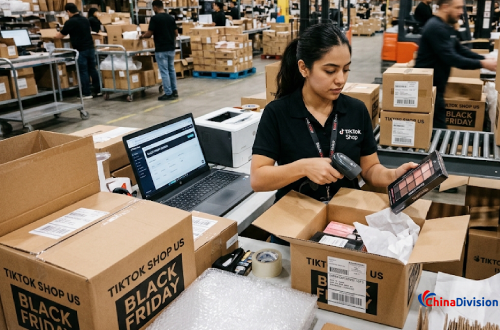
For international sellers, one of the most important Black Friday decisions is where to position inventory before the campaign.
Shipping every order individually from China may reduce the need to hold large quantities of stock in the United States, but it can make delivery performance more sensitive to international transportation and customs delays.
Pre-positioning inventory in the US can shorten the domestic fulfillment leg, but it requires earlier inventory planning, additional storage costs, and more careful stock allocation.
Neither model is universally better. The right choice depends on product demand, order volume, product size, inventory investment, and customer delivery expectations.
China direct shipping vs. US local warehousing
| Comparison | Direct Shipping from China | US Local Warehousing |
|---|---|---|
| Inventory location | China-based warehouse or supplier | Warehouse located in the United States |
| International transportation | Required for individual customer orders | Usually completed before customer orders arrive |
| Customer delivery | Includes international transportation and customs-related stages | Usually relies on domestic delivery after dispatch |
| Inventory investment | Can support smaller or more flexible stock positions | Requires inventory to be positioned in advance |
| Peak-season risk | Exposed to international shipping and customs variability | More dependent on local warehouse and last-mile capacity |
| Best suited for | Testing products, lower-volume orders, flexible inventory models | Proven products, predictable demand, and faster domestic fulfillment requirements |
| Main planning priority | International transit and dispatch coordination | Local stock accuracy and warehouse processing capacity |
A hybrid fulfillment model can be useful for growing TikTok Shop sellers.
For example, a seller can keep a portion of proven, high-demand inventory in the United States while maintaining additional stock in China. US inventory supports faster domestic fulfillment, while China-based inventory provides a replenishment source for future demand.
This approach can reduce the risk of placing all inventory in one market. However, replenishment lead times must be planned carefully. Stock that is still in international transit should not be treated as immediately available for US customer orders.
How Can a Third-Party Logistics Provider Help TikTok Shop Sellers During Black Friday?
A third-party logistics provider (3PL) can help sellers manage the physical operations behind TikTok Shop orders, particularly when the seller does not have sufficient warehouse space, labor, or international shipping resources.
However, sellers should evaluate a 3PL based on its actual operational capabilities rather than simply its advertised storage capacity or shipping rates.
One especially useful practice is to track these KPIs by SKU and order channel rather than looking only at warehouse-wide averages.
How Can ChinaDivision Support TikTok Shop Sellers with International Fulfillment?
For cross-border sellers sourcing products from China, a dependable origin-side fulfillment operation can help reduce the operational workload between suppliers, warehouses, and international carriers.
ChinaDivision provides e-commerce fulfillment and international logistics support for businesses that need warehousing, inventory handling, order processing, packaging, and shipping coordination.
During peak shopping periods, these services can help sellers organize their supply chain before orders begin to accumulate.
1. Centralized warehousing and inventory management
When products come from multiple Chinese suppliers, receiving inventory into a centralized warehouse can make stock management easier.
Instead of coordinating separate shipments from different factories for every customer order, sellers can consolidate inventory, organize SKUs, and prepare products for fulfillment.
This is particularly useful for businesses selling multiple product variations or operating across several e-commerce channels.
2. Product inspection before international dispatch
Product quality issues can create additional work during peak season. A wrong product, missing accessory, or damaged package may lead to customer complaints, returns, and replacement shipments.
ChinaDivision can support product inspection based on agreed requirements, helping sellers identify issues before products enter the international shipping process.
Inspection standards should be agreed in advance, including the inspection scope, sampling method, defect criteria, and reporting requirements.
3. Picking, packing, and customized packaging
Peak-season fulfillment requires more than simply moving products out of storage.
Order picking, packaging materials, shipping labels, and outbound preparation all affect processing time and shipping costs.
ChinaDivision supports order picking and packing, customized packaging, and shipping coordination. Sellers can work with the fulfillment team to define packaging specifications for different products and order types.
For products charged by volumetric weight, packaging dimensions deserve particular attention. Oversized packaging can increase shipping costs even when the actual product is lightweight.
4. International shipping coordination
For sellers shipping from China to the United States, transportation planning should begin before the promotional campaign.
ChinaDivision can help coordinate shipping options and prepare outbound orders for international transportation. Sellers should evaluate shipping methods based on cost, estimated transit time, product characteristics, and destination requirements.
It is also important to understand that origin-side fulfillment and US domestic warehousing solve different problems. A China-based fulfillment operation can help consolidate stock and prepare international shipments, but it does not replace US-based inventory positioning when a seller needs domestic delivery.
What Should TikTok Shop Sellers Do After the Black Friday Shipping Extension Ends?
The temporary extension runs through December 5, but the fulfillment challenges of the holiday season do not necessarily end on that date.
Sellers should prepare for the transition back to normal SLA requirements and continue monitoring inventory, carrier capacity, and customer delivery expectations.
Three areas deserve particular attention:
- Reassess warehouse processing capacity. Determine whether additional labor or temporary warehouse arrangements are still necessary.
- Replenish inventory strategically. Review products that sold faster than forecast and update replenishment plans for the next promotional period.
- Review fulfillment exceptions. Identify whether delays were caused by stockouts, picking errors, packaging bottlenecks, or carrier handover problems.
The data collected during Black Friday can become a useful input for planning Christmas, year-end promotions, and the next major sales campaign.
Sellers who track order-level performance can also identify which SKUs, suppliers, and shipping routes create the greatest operational risk.
Frequently Asked Questions About TikTok Shop Shipping, Delivery, and International Fulfillment
How much extra time do sellers receive?
Local shipping orders can receive up to two additional business days, while international shipping orders can receive up to two additional calendar days. The exact extension is one day for orders received November 11–24 or December 2–5, and two days for orders received November 25–December 1.
Does the extended TikTok Shop dispatch deadline mean customers will receive their orders later?
Not necessarily. TikTok Shop's policy adjusts specified fulfillment SLAs. It does not require sellers to delay shipments, and sellers should continue dispatching orders as quickly as their operations allow. The actual delivery date also depends on transportation, customs clearance, and last-mile delivery.
Can international sellers ship TikTok Shop orders directly from China?
International sellers may use cross-border shipping arrangements where supported by their account, shipping method, and applicable platform policies. They should confirm the available shipping options and order-specific requirements in Seller Center.
Shipping directly from China can reduce the need to pre-position all inventory in the United States, but individual orders remain exposed to international transit and customs-related variability.
Is a China-based fulfillment warehouse suitable for US TikTok Shop sellers?
A China-based fulfillment warehouse can be useful when sellers source products from Chinese suppliers and need centralized receiving, inventory management, inspection, picking, packing, and international shipping coordination.
It is particularly useful for consolidating stock from multiple suppliers before dispatch. However, it does not provide the same delivery-time advantage as inventory already stored in a US warehouse.
Sellers should choose between China-based fulfillment, US local warehousing, or a hybrid model according to demand patterns and delivery requirements.
Recommended Industry Resources and Official Policy References
For sellers who want to review the original rules and improve their fulfillment planning, the following resources provide more detailed guidance:
- TikTok Shop — 2026 Black Friday & Cyber Monday Seller Campaign Guide: Official campaign eligibility requirements and the detailed fulfillment SLA extension schedule.
- TikTok Shop — Late Dispatch Rate Requirements: Explains how LDR is calculated, what counts as a qualifying dispatch event, and how sellers can monitor dispatch performance.
- Amazon — MCF Peak Season Readiness Guide: Practical guidance on inventory positioning and fulfillment preparation for peak shopping periods, including multichannel sellers.


About the Author: Limi

Limi is a content marketing expert at ChinaDivision, helping businesses and e-commerce sellers navigate the complexities of international shipping by providing actionable tips and comprehensive guides on logistics, shipping, and cargo transportation.