

Amazon FBA Inbound Delays 2026: Peak Season Inventory Guide
Table of Contents
- Amazon FBA Inbound Delays Are Putting 2026 Holiday Inventory at Risk
- What Is Causing Amazon FBA Inbound Delays?
- Which Amazon US FBA Warehouses Are Reportedly Experiencing Delays?
- How FBA Receiving Delays Can Affect Black Friday and Cyber Monday Sales
- 7 Practical Ways to Reduce Amazon FBA Inbound Risk
- How ChinaDivision Can Help Amazon Sellers Manage Peak-Season Logistics
- Amazon FBA Inbound Delays: Frequently Asked Questions
- Sources and further reading
Amazon FBA Inbound Delays Are Putting 2026 Holiday Inventory at Risk
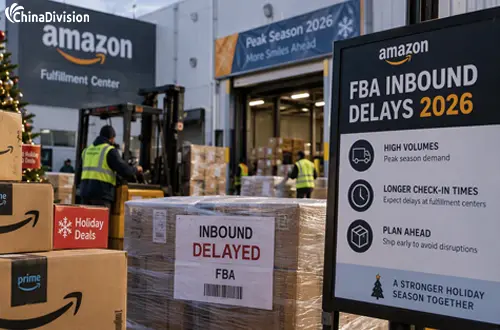
Amazon sellers preparing for Black Friday and Cyber Monday 2026 need to pay close attention to inbound inventory scheduling. Industry reports published on October 12 described tightening capacity at major US Fulfillment by Amazon (FBA) facilities, including CLT2, IND9, ONT8, and LAX9, with some reported appointment queues exceeding 25 days. These reports indicate that sellers relying on last-minute replenishment may face a greater risk of delayed receiving and inventory shortages.
The core risk is not simply a delayed truck appointment. It is the downstream effect: inventory that has arrived in the United States but cannot be received, checked in, or made available for fulfillment in time for peak-season sales. Warehouse conditions, appointment availability, and Amazon inbound requirements can change quickly. Confirm current appointment availability, shipment eligibility, and receiving requirements in Seller Central before booking transportation or creating shipment plans.
Amazon's own peak-season guidance warns that inbound processing typically takes two to three weeks and can take longer during periods of high volume. The practical implication is clear: sellers should build extra time into replenishment plans instead of treating the carrier's estimated arrival date as the date inventory will become sellable.
What Is Causing Amazon FBA Inbound Delays?
FBA inbound delays can result from several connected stages of the supply chain. A shipment may be delayed before it reaches the fulfillment center, while waiting for an appointment, or after physical delivery while the inventory is being received and processed.
1. Limited fulfillment center capacity
Amazon manages storage and fulfillment capacity across its network. Available inbound placement options depend on factors including inventory levels, customer demand, product type, shipment quantities, and fulfillment center capacity. Sellers may therefore have limited flexibility when creating a shipping plan, even if their goods are ready to ship.
Amazon's published FBA guidance explains how capacity limits are monitored in Seller Central and how inventory limits can be affected by factors such as sales history, seasonal demand, product forecasts, and fulfillment network conditions. Sellers should review their own account data rather than assume every seller or warehouse faces the same restrictions.
2. Inbound appointment availability and receiving backlogs
For shipments delivered by truck or other scheduled transport, a delivery appointment is a critical operational checkpoint. When appointment availability is limited, cargo may wait after reaching a destination region, increasing storage, detention, demurrage, or trucking-related costs where applicable.
An appointment also does not necessarily mean inventory will become immediately available for sale. Sellers must distinguish between a scheduled delivery, physical arrival, receipt confirmation, and completed inventory processing.
3. Peak-season shipment volume
The holiday shopping period concentrates demand across transportation networks, warehouses, and fulfillment operations. More sellers are trying to position inventory before major promotions, while carriers and receiving facilities are handling higher volumes.
Amazon's September 2026 peak-season guidance recommends positioning inventory early and notes that inbound processing can extend beyond typical timelines during high-volume periods. This makes advance planning particularly important for products with long international transit times or limited replenishment flexibility.
4. Incomplete shipment data or missed delivery windows
Operational errors can add avoidable delays to an already constrained inbound process. Incorrect tracking details, inaccurate delivery windows, missing box-content information, or shipments arriving outside their scheduled windows can complicate receiving.
Amazon advises sellers to provide accurate tracking information and delivery windows, comply with scheduled appointments, and supply detailed box-content data. It also recommends exploring eligible partner-carrier options and night or weekend delivery appointments where available.
Which Amazon US FBA Warehouses Are Reportedly Experiencing Delays?
Industry coverage published on October 12, 2026, identified four facilities in reports of tight inbound capacity and extended appointment queues. The reports are useful warning signals, but sellers should verify current appointment availability for their own shipment plans in Amazon's systems.
| Reported facility | What sellers should check | Recommended action |
|---|---|---|
| CLT2 | Current appointment availability and assigned delivery window | Confirm the appointment before dispatching time-sensitive freight |
| IND9 | Whether the assigned destination has a suitable receiving slot | Review the shipping plan and eligible alternatives before arranging final-mile delivery |
| ONT8 | Appointment lead time and transit schedule alignment | Add contingency time for West Coast inbound movements |
| LAX9 | Current receiving requirements and appointment availability | Coordinate with the carrier before cargo reaches the facility |
This is industry reporting, not a live Amazon appointment feed. Conditions can change by shipment, carrier, facility, and date; the table does not mean that every shipment to these facilities is currently delayed.
The most important operational lesson is to avoid sending a truck or arranging a time-sensitive delivery solely on the assumption that a fulfillment center will accept the cargo immediately. Confirm the assigned destination, delivery window, carrier requirements, and contingency arrangements before dispatch.
How FBA Receiving Delays Can Affect Black Friday and Cyber Monday Sales
FBA inbound delays can affect more than delivery schedules. They can disrupt inventory availability, advertising plans, and replenishment decisions at the point when demand may be most valuable.
Increased stockout risk
If inventory is delayed before receiving or processing, a product can run out of available stock even when replacement units are already in the United States. Products with fast sales velocity or limited inventory buffers are particularly exposed.
Lost promotional opportunities
Sellers planning Black Friday or Cyber Monday deals need inventory to be available when promotional traffic arrives. If receiving delays push availability beyond the campaign window, the seller may lose the opportunity to convert planned traffic into orders.
Advertising inefficiency
Advertising campaigns may continue to spend while a product has little or no available inventory, unless the seller adjusts or pauses campaigns. Sellers should coordinate advertising budgets with inventory status, inbound milestones, and expected sell-through.
Higher logistics and working-capital costs
A delayed shipment may generate additional handling, storage, or waiting charges, depending on the carrier, destination, and contract terms. At the same time, capital remains tied up in inventory that cannot yet generate sales through FBA.
Greater pressure on replenishment decisions
When inbound timing becomes less predictable, sellers may need to choose between shipping earlier, carrying a larger buffer, using a different eligible inbound option, or placing inventory in an alternative warehouse. Each choice affects cost, cash flow, and service levels.
7 Practical Ways to Reduce Amazon FBA Inbound Risk
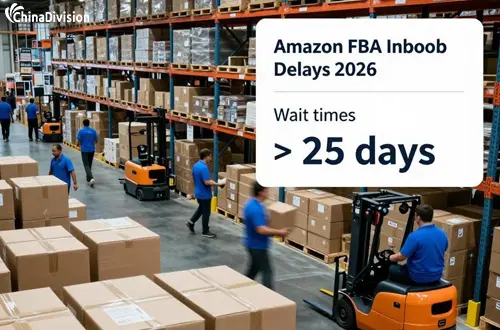
1. Build a receiving buffer into your replenishment schedule
Do not calculate your replenishment date using international transit time alone. Your full lead time should account for supplier preparation, export handling, international transportation, customs clearance, domestic transport, appointment availability, and FBA receiving and processing.
A practical planning formula is:
Total replenishment lead time = Production time + Origin handling + International transit + Customs clearance + Domestic transport + Appointment and receiving buffer
The buffer should reflect your own shipment history, product velocity, shipping method, and current appointment information. Amazon's guidance indicates that inbound processing typically takes two to three weeks and can take longer during high-volume periods, so sellers should not automatically assume that cargo arriving at a receiving location will be available for sale within a few days.
2. Prioritize inventory by sales velocity and stockout risk
Not every SKU needs the same replenishment priority. Concentrate first on products that are most likely to run out before the next shipment becomes available.
| Inventory category | Recommended priority | Planning approach |
|---|---|---|
| High-velocity bestsellers | Highest | Review daily sales, days of cover, and inbound milestones |
| Seasonal and promotional products | High | Work backward from the campaign date and allow contingency time |
| Stable, medium-velocity products | Moderate | Replenish based on forecast demand and supplier lead time |
| Slow-moving products | Lower | Avoid unnecessary stock accumulation and monitor storage exposure |
| New product launches | Case-specific | Build a launch buffer and avoid relying on a single inbound shipment |
A simple starting point is to calculate days of cover:
Days of cover = Sellable inventory ÷ Average daily sales
For more reliable planning, use a forward-looking sales forecast rather than relying exclusively on a historical average, especially during promotions or seasonal demand spikes.
3. Confirm appointment and carrier details before dispatch
Before goods leave the origin warehouse or arrive at the final-mile carrier, confirm:
- The current assigned Amazon fulfillment center and shipment destination.
- The applicable delivery appointment and accepted delivery window.
- The carrier's ability to meet Amazon's delivery requirements.
- The accuracy of tracking IDs, shipment details, and box-content information.
- The process for handling a missed appointment, rejected delivery, or rescheduled slot.
Amazon specifically recommends accurate tracking and delivery-window information, adherence to scheduled windows, and complete box-content data to reduce avoidable inbound problems.
4. Evaluate available inbound placement options
Amazon offers different inbound placement options, but availability depends on the shipment and the network conditions. In some cases, sellers can compare a minimal-split option with Amazon-optimized shipment splits or other eligible arrangements.
Before choosing, compare the total cost and operational implications, including:
- Inbound placement fees.
- Number of destinations and shipment splits.
- Additional transportation and handling costs.
- Whether the shipment meets eligibility requirements.
- Whether the selected option works with the inventory arrival deadline.
Amazon explains that available placement options and fees can vary according to product size, weight, shipment composition, inventory levels, demand geography, and fulfillment center capacity. Do not assume that a particular destination or option will be available for every shipment.
5. Consider third-party warehousing for inventory buffers
For sellers who import in bulk, a third-party logistics provider (3PL) can offer an additional place to hold inventory before releasing it to FBA in smaller or more carefully timed shipments.
This strategy can help separate two different needs: transporting inventory internationally in commercially efficient quantities, and delivering inventory to Amazon according to actual replenishment demand and receiving availability.
A 3PL buffer may be particularly useful when:
- Several SKUs need different replenishment schedules.
- The seller wants to avoid sending all available stock to FBA at once.
- Domestic inventory needs to be prepared, labeled, inspected, or consolidated before dispatch.
- A shipment must be held while the seller confirms an acceptable delivery window.
However, a 3PL does not guarantee earlier Amazon appointments or faster Amazon receiving. Sellers should evaluate the provider's actual warehouse locations, service capabilities, handling costs, and onward transportation options before moving inventory.
6. Create a contingency plan for delayed shipments
A contingency plan should define what happens if inventory misses its expected receiving date. Establish decision points in advance rather than waiting until a product is nearly out of stock.
For example:
- Early warning: Check inventory coverage and shipment milestones more frequently.
- Potential stockout: Evaluate eligible alternative inbound options, existing inventory at other locations, and promotional adjustments.
- Confirmed delay: Coordinate with the carrier, 3PL, and Amazon support as appropriate; update the inventory and sales forecast.
- Recovery: Reconcile received quantities, revise replenishment assumptions, and document the cause of the delay.
Avoid creating duplicate shipments or changing destinations without checking Amazon's applicable shipment requirements and the financial consequences.
7. Monitor inventory availability—not just shipment tracking
A tracking status such as “delivered” is not equivalent to “available for sale.” Build a dashboard or operational report that distinguishes between goods in transit, customs-cleared inventory, goods awaiting appointment, delivered shipments, units being received, and sellable FBA inventory.
This gives the operations team a clearer view of the true inventory position and helps the marketing team make better decisions about advertising and promotions.
How ChinaDivision Can Help Amazon Sellers Manage Peak-Season Logistics
When Amazon FBA receiving becomes less predictable, sellers may benefit from reviewing the entire supply chain instead of focusing only on the final delivery appointment. A flexible logistics plan can help coordinate international transportation, inventory staging, and scheduled replenishment.
ChinaDivision provides international logistics and e-commerce transportation services that sellers can evaluate as part of their FBA contingency plan. Its service portfolio includes multimodal and FBA transportation options, global warehouse capabilities, shipment tracking, and cross-border e-commerce logistics. The appropriate solution depends on the seller's origin, destination, cargo type, schedule, and service requirements. Explore ChinaDivision's logistics services.
International shipping coordination
For sellers shipping products from China, transportation planning needs to account for the entire journey—not just the quoted transit time. Ocean, air, rail, and express services have different cost and timing profiles. The right choice depends on inventory urgency, cargo characteristics, and the consequences of missing a sales window.
ChinaDivision offers multiple transportation modes for international and FBA-related shipments. Sellers can compare suitable options according to their budgets and replenishment deadlines.
Inventory staging and shipment consolidation
Where a suitable warehouse service is available, holding inventory outside the Amazon network can give sellers greater control over when products are released for FBA replenishment. It may also support order consolidation, product preparation, and shipment coordination, subject to the provider's actual service scope.
Before choosing this approach, confirm warehouse location, storage and handling fees, minimum requirements, onward shipping arrangements, and whether the provider can support the required Amazon shipment preparation and labeling.
Shipment visibility and exception management
Tracking visibility helps sellers identify problems before they become stockouts. A well-managed logistics workflow should provide shipment milestones, communicate delays, and clarify which party is responsible for resolving each exception.
A more flexible fulfillment strategy
For businesses selling across Amazon and other e-commerce channels, a diversified logistics setup can reduce dependence on a single inventory location. Depending on the business model, this may involve a combination of FBA stock, third-party storage, and other fulfillment arrangements.
The objective is not necessarily to replace FBA. It is to build a replenishment strategy that allows inventory to move according to demand, lead times, and actual receiving constraints.
Planning your next FBA shipment? Visit ChinaDivision to explore international shipping and logistics options for your business.
Amazon FBA Inbound Delays: Frequently Asked Questions
1. Are Amazon US FBA warehouse appointment delays exceeding 25 days in 2026?
Industry reports published on October 12, 2026, described appointment queues exceeding 25 days at some facilities, including CLT2, IND9, ONT8, and LAX9. These are reported conditions, not a guarantee that every shipment to those warehouses will face the same wait. Check your assigned destination and current appointment availability before dispatching cargo.
2. How long does Amazon FBA inbound receiving usually take?
Amazon's peak-season guidance says inbound processing typically takes two to three weeks and can take longer during high-volume periods. Actual timing depends on the shipment, receiving location, operational conditions, and whether the shipment meets delivery and data requirements. Sellers should use current shipment information and allow an appropriate buffer rather than treating this timeframe as a guarantee.
3. What should I do if my shipment has arrived in the United States but cannot be delivered to FBA?
First, confirm the shipment's status, assigned destination, and applicable appointment requirements with your carrier. Check whether the shipment is awaiting customs clearance, domestic transportation, an appointment, or another step. Then coordinate with the carrier and your logistics provider on the available options. If appropriate and contractually feasible, evaluate temporary storage or a revised delivery schedule before additional costs accumulate.
4. Should I send all my inventory to Amazon before Black Friday and Cyber Monday?
Not necessarily. The right allocation depends on sales velocity, forecast demand, available FBA capacity, storage costs, and the reliability of your replenishment process. Some sellers may benefit from maintaining a buffer at a suitable third-party warehouse and replenishing FBA in stages. Others may prefer to place more inventory within Amazon's network early. Compare the total cost and risk of each option before deciding.
5. Can a 3PL guarantee faster FBA appointments?
No. A 3PL can help coordinate transportation, stage inventory, improve shipment visibility, and manage exceptions, but it cannot guarantee that Amazon will provide an earlier appointment or process inventory faster. Confirm the provider's service capabilities and evaluate the appointment and receiving status separately.
6. What information should I monitor to prevent FBA stockouts?
Monitor sellable inventory, average daily sales, days of cover, open shipment quantities, estimated arrival dates, appointment status, receiving progress, and inventory-processing status. For seasonal products, also track promotion dates and expected demand spikes. These metrics help identify potential shortages before they affect product availability.
7. When should Amazon sellers start preparing for the holiday peak?
As early as their product and supply-chain lead times require. Sellers importing internationally should work backward from their target in-stock dates, allowing time for production, transportation, customs clearance, appointment scheduling, and receiving. Amazon's 2026 peak-season guidance also emphasizes early inventory positioning and warns that receiving can take longer during high-volume periods.
Amazon FBA inbound delays can turn a transportation problem into a sales problem when inventory arrives too late to support seasonal demand. For the 2026 holiday peak, sellers should plan around the full replenishment cycle, confirm appointments before dispatch, prioritize high-risk SKUs, and monitor the difference between delivered inventory and sellable inventory.
A third-party logistics provider such as ChinaDivision may help sellers coordinate international transportation, warehouse staging where available, and shipment visibility. The best approach is to assess the full logistics plan early, compare realistic alternatives, and build a contingency strategy before a delayed shipment becomes a stockout.
Sources and further reading
Ebrun — Amazon US FBA capacity constraints and reported appointment queues, October 12, 2026
Amazon Supply Chain Services — MCF Peak Season Readiness Guide, September 16, 2026


About the Author: Limi

Limi is a content marketing expert at ChinaDivision, helping businesses and e-commerce sellers navigate the complexities of international shipping by providing actionable tips and comprehensive guides on logistics, shipping, and cargo transportation.