

Logistics Fee Changes: Amazon FBA, Maersk, CMA CGM & Hapag-Lloyd
Table of Contents
- October 15 Fee Changes at a Glance
- Amazon FBA Peak Fees
- Ocean Freight Surcharges
- Maersk's Five-Day Automatic Cancellation Rule
- The Hidden Cost: Why Sellers Need a Landed-Cost View, Not Just a Freight-Rate View
- How Sellers Can Respond: A Five-Step Peak-Season Action Plan
- How a Third-Party Logistics Partner Can Help
- Frequently Asked Questions
Amazon's US and selected European marketplaces begin applying seasonal fulfillment fees, while ocean carriers introduce or activate additional charges on specific trade lanes. Maersk also changes its automatic booking cancellation timeline, making shipment readiness and booking execution more important.
For cross-border sellers, the issue is not simply that shipping is becoming more expensive. Fulfillment fees can reduce the margin on every eligible order, container surcharges can increase the landed cost of an entire shipment, and an unfulfilled booking can disrupt inventory replenishment even after transportation has been arranged.
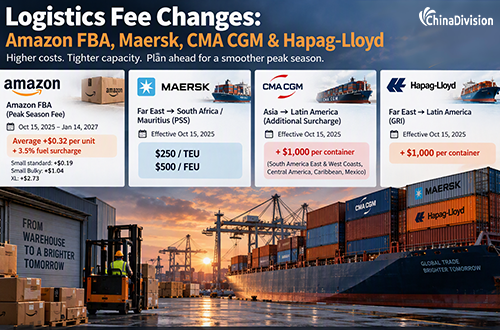
The changes fall into three operational categories:
- Marketplace fulfillment costs: Amazon's seasonal fees and applicable fuel and logistics-related surcharges.
- Ocean freight costs: Maersk's peak season surcharge (PSS), CMA CGM's Asia-to-Latin America rate increase, and Hapag-Lloyd's general rate increase (GRI) on specified routes.
- Capacity and booking risk: Maersk's updated automatic cancellation rule for eligible bookings that have not materialized.
These changes do not apply universally to every seller or shipment. Their impact depends on product size, fulfillment channel, trade lane, container type, contract terms, and the relevant fee calculation or loading date.
October 15 Fee Changes at a Glance
| Carrier or platform | Change effective October 15 | Published or reported rate | What sellers should check |
|---|---|---|---|
| Amazon US | Holiday peak fulfillment fees for eligible orders | Average increase of approximately $0.32 per unit, according to the supplied market figures; the 3.5% fuel and logistics-related surcharge also applies to relevant fees | Product size tier, shipping weight, price tier, and actual fulfillment fee |
| Amazon UK and Germany | Festive-season peak fulfillment fees for eligible FBA orders | UK average: £0.12 per parcel item and £0.07 per large or extra-large envelope item; Germany average: €0.27 per unit | Eligible fulfillment program, destination, product category, and delivery date |
| Maersk | PSS from the Far East to South Africa and Mauritius | $250 per 20-foot dry container; $500 per 40-foot dry container | Origin, destination, container type, booking terms, and applicable price calculation date |
| CMA CGM | Rate increase from Asia to specified Latin American destinations | +$1,000 per container | Destination coverage, container type, loading date, and other applicable charges |
| Hapag-Lloyd | GRI from the Far East to specified Latin American destinations | Published increases of $1,000 per standard container on specified lanes and equipment | Exact route, container type, tariff validity, and exceptions |
| Maersk | Updated automatic cancellation timeline | Eligible bookings may be cancelled when five days or more have passed since the first vessel's estimated time of departure (ETD) and the shipment has not materialized | Cargo readiness, gate-in status, booking status, and revised vessel schedule |
The Amazon UK and Germany figures are published average increases, not flat fees for every unit. Amazon confirms that the seasonal fee applies to eligible orders delivered between October 15, 2026, and January 14, 2027. Maersk, CMA CGM, and Hapag-Lloyd apply their respective changes to defined routes and equipment rather than every shipment. Review the official notices before treating any figure as a final quote.
Amazon FBA Peak Fees: Why the Average Increase Can Be Misleading
Amazon's US holiday peak fulfillment fee period runs from October 15, 2026, through January 14, 2027. The 3.5% fuel and logistics-related surcharge also applies to relevant US FBA fulfillment fees. In the UK and Germany, Amazon applies festive-season fees to specified eligible FBA orders during the same period.
The important distinction is that an average fee increase does not describe the cost increase for an individual SKU. Product size and fee category can create significant differences between sellers, even when their order volumes are identical.
Oversized products can experience a disproportionate increase
Using the product-tier figures supplied for this analysis, the peak-season increases are:
| Product size tier | Increase per unit | Additional cost for 1,000 units |
|---|---|---|
| Small standard | $0.19 | $190 |
| Small Bulky | $1.04 | $1,040 |
| Extra-large (XL) | $2.73 | $2,730 |
| Illustrative average benchmark | $0.32 | $320 |
For sellers with bulky products, thin margins, or high order volumes, this difference can materially affect promotional pricing, advertising budgets, and replenishment decisions.
The fuel surcharge adds another layer
Amazon's 3.5% fuel and logistics-related surcharge is calculated on applicable fulfillment fees, not on the item's selling price. Sellers should therefore avoid treating it as a simple 3.5% deduction from revenue or automatically adding 3.5 percentage points to the peak fee increase.
To estimate the fee impact correctly:
- Identify the applicable non-peak and peak fulfillment fees for each SKU.
- Apply the relevant fuel and logistics-related surcharge to the fee base specified by Amazon.
- Check whether the product and fulfillment program are eligible for the seasonal fee.
- Recalculate contribution margin after fulfillment fees, referral fees, advertising, returns, and other variable costs.
Amazon's Revenue Calculator, Profit Analytics dashboard, and FBA Fee Preview tools can help sellers validate SKU-level costs. Official references: Amazon US FBA fee guidance and Amazon UK festive-season fee guidance.
What fulfillment operators should do differently
For brands using a third-party logistics provider (3PL), the practical response is to review inventory by SKU rather than apply one blanket cost adjustment across the catalog.
- Recalculate high-volume and oversized SKUs first. These items can have a larger per-unit exposure than lightweight standard products.
- Review packaging dimensions and shipping weight. Accurate measurements help prevent avoidable fee surprises, although packaging changes must remain compliant with product protection and marketplace requirements.
- Separate FBA inventory from direct-to-consumer inventory. The best fulfillment channel may differ by SKU, order destination, and expected demand.
- Revisit promotional economics. Discounts and advertising campaigns planned before October 15 may no longer deliver the expected contribution margin.
A well-managed fulfillment operation should connect inbound inventory, SKU-level storage records, order routing, and fee analysis. This makes it easier to decide which products should be replenished first and which orders may be better served through an alternative channel.
Ocean Freight Surcharges: Three Changes, Three Different Cost Exposures
The ocean freight changes effective October 15 do not represent one universal increase across global shipping. They affect specific trade lanes and have different implications for containerized cargo.
Maersk: Far East to South Africa and Mauritius PSS
Maersk's published notice specifies a peak season surcharge for the covered Far East Asian origins to South Africa and Mauritius:
20-foot dry container PSS: $250
40-foot dry container PSS: $500
The notice states that the surcharge takes effect on October 15, 2026, and remains in force until further notice. Its application depends on the booking type and the applicable price calculation date. For non-spot bookings, that date is determined under Maersk's stated rules; spot bookings are excluded from the notice's PSS.
Operational implication: Sellers should compare the surcharge with the complete quotation, not just the headline ocean freight rate. Confirm whether the quotation is spot or non-spot, the container size, and the relevant pricing basis before comparing providers.
Official source: Maersk — PSS from the Far East to South Africa and Mauritius.
CMA CGM: Asia to Latin America rate increase
CMA CGM announced a $1,000-per-container increase effective October 15, 2026, based on the date of loading. The published scope covers shipments from Asian ports, including Japan, Southeast Asia, and Bangladesh, to specified destinations across the west and east coasts of South America, Central America, the Caribbean, and Mexico.
The notice covers dry, reefer, out-of-gauge (OOG), and paying empty containers. The increase is additional to applicable basic freight and may coexist with bunker-related surcharges, terminal handling charges, security-related charges, and other local or contingency charges.
This means a seller should not assume that a $1,000 increase represents the total change in landed cost. The full impact depends on the shipment's existing freight rate and other applicable charges.
Official source: CMA CGM — Rate announcement from Asia to Latin America.
Hapag-Lloyd: Far East to Latin America GRI
Hapag-Lloyd also published a general rate increase effective October 15, 2026, for specified Far East-to-Latin America routes. Its announcement lists increases of $1,000 per standard container on several covered lanes, including South America's west and east coasts, Mexico's west coast, parts of Central America, and the Caribbean.
However, the published rate tables show route- and equipment-specific details. For example, the announced increase is not identical across every container type and destination combination.
This is an important distinction for sellers and freight procurement teams: a carrier's headline GRI should not be interpreted as a uniform increase for every container on every route within a broad region.
Before confirming a booking, check:
- Origin and destination ports.
- Container size and type.
- Whether the cargo is covered by the published tariff.
- The tariff's effective date and validity.
- Whether bunker, security, terminal handling, peak-season, or local charges also apply.
Official source: Hapag-Lloyd — GRI from the Far East to Latin America.
Maersk's Five-Day Automatic Cancellation Rule: A Booking Is Not the Same as Secured Capacity
The most operationally significant change may be Maersk's updated automatic booking cancellation timeline.
Effective October 15, 2026, Maersk states that an eligible booking may be automatically cancelled when five days or more have passed since the first vessel's estimated time of departure (ETD) and the shipment has not materialized. The stated purpose is to release unused capacity earlier and improve capacity management.
This is more than an administrative change. It means that a booking which remains unresolved after the planned departure can be exposed to cancellation under the applicable rule.
Official source: Maersk — Update to Automatic Booking Cancellation Timeline.
A practical booking-readiness checklist
| Checkpoint | What to verify | Why it matters |
|---|---|---|
| Production readiness | Supplier confirms completion date and quantities | Prevents bookings from being made against uncertain production schedules |
| Quality inspection | Inspection status and release approval | Reduces the risk of cargo being held after the planned shipping date |
| Packing and labeling | Carton counts, dimensions, shipping marks, and required labels | Avoids last-minute warehouse or documentation corrections |
| Export documentation | Commercial invoice, packing list, and other required documents | Helps identify missing information before cargo handover |
| Warehouse handover | Cargo pickup, receiving, and gate-in arrangements | Connects physical cargo readiness with the booked sailing |
| Booking status | First-vessel ETD, schedule changes, and carrier notifications | Helps teams identify bookings requiring immediate follow-up |
| Exception ownership | Named person responsible for resolving delays | Prevents missed updates between suppliers, warehouses, forwarders, and sellers |
A useful improvement is to set internal escalation deadlines before the carrier's cancellation threshold. For example, a business could flag any booking with incomplete cargo readiness several days before ETD, then escalate immediately if the shipment has not materialized after the planned departure. This is a recommended internal control, not a substitute for the carrier's official terms.
The Hidden Cost: Why Sellers Need a Landed-Cost View, Not Just a Freight-Rate View
The fee changes affect different points in the order lifecycle. Comparing them only as isolated numbers makes it difficult to understand their combined business impact.
A more useful model separates costs into three layers:
| Cost layer | Examples | Business impact |
|---|---|---|
| Product-level fulfillment | FBA peak fees, fuel and logistics-related surcharges | Reduces contribution margin on eligible units |
| Shipment-level transportation | PSS, GRI, basic freight, terminal handling, and other applicable charges | Increases the cost of moving inventory to the destination market |
| Execution and inventory risk | Missed sailings, rebooking, extra storage, delayed replenishment | Can create additional costs and delay inventory availability |
These layers should not be added together without checking their units and applicability. Amazon charges may be assessed per eligible unit, while ocean surcharges may be assessed per container. A seller must first calculate each charge against the correct number of units, containers, or shipments.
How Sellers Can Respond: A Five-Step Peak-Season Action Plan
Step 1: Recalculate SKU-level margins
Export current product and fulfillment data, then compare non-peak and peak fees for each eligible SKU. Prioritize high-volume, low-margin, bulky, and oversized products.
Do not rely on a single average increase. A weighted calculation based on the actual product mix will give a more useful estimate of the overall financial exposure.
Step 2: Audit bookings against cargo readiness
Ask suppliers and logistics partners to confirm production completion, inspection release, carton data, documentation, and cargo handover dates. Track unresolved items against the first vessel's ETD.
For bookings that may be affected by the new cancellation timeline, contact the carrier promptly rather than assuming the original booking remains secure.
Step 3: Review inventory allocation across channels
Not every unit needs to follow the same fulfillment path. Depending on service requirements and economics, sellers may allocate inventory among FBA, a third-party warehouse, and direct-to-consumer fulfillment.
The decision should account for marketplace eligibility, customer delivery promises, inventory availability, total cost, and the operational effort required to split stock across channels.
Step 4: Compare complete quotes, not headline rates
For every carrier quotation, confirm the route, container type, applicable surcharges, validity period, and charging basis. A low base freight rate may not remain the lowest-cost option after PSS, GRI, fuel, terminal, and local charges are included.
Keep a dated record of the quote and its assumptions. This makes it easier to distinguish an actual rate change from a difference in quotation scope.
Step 5: Build a realistic replenishment buffer
Use sales velocity, supplier lead times, transit-time variability, and receiving lead times to determine when inventory needs to leave the origin. A buffer should reflect actual demand and risk; excessive inventory can create unnecessary storage and working-capital costs.
For businesses shipping from China, coordinating supplier production, inspection, warehouse receiving, export handling, and international transport through a consistent process can help reduce preventable delays.
How a Third-Party Logistics Partner Can Help
A third-party logistics provider (3PL) cannot eliminate carrier surcharges or guarantee that a sailing will remain unchanged. However, a well-coordinated fulfillment operation can help sellers manage the factors they control.
A practical 3PL workflow should connect:
- Inbound coordination: Advance notice of supplier deliveries and expected cargo quantities.
- Receiving and inspection: Clear records of received units, discrepancies, and inspection status.
- Inventory visibility: Accurate stock balances by SKU, warehouse, and sales channel.
- Order fulfillment: Appropriate routing, picking, packing, and dispatch according to the seller's delivery commitments.
- Shipping coordination: Timely communication of cargo readiness, documentation status, booking milestones, and exceptions.
- Cost analysis: A consolidated view of warehousing, handling, fulfillment, and transportation costs.
For sellers with inventory split between marketplace fulfillment and direct-to-consumer orders, a 3PL can also help coordinate stock allocation and staged replenishment. The objective is not simply to find the cheapest freight rate, but to keep inventory available while managing total fulfillment costs.
If you are reviewing your peak-season supply chain, contact Chindivision to discuss warehousing, fulfillment, and international shipping requirements.
Frequently Asked Questions
When do Amazon's 2026 holiday peak fulfillment fees end?
Amazon's US holiday peak fulfillment fee period runs from October 15, 2026, through January 14, 2027. The UK and Germany also have seasonal fees for specified eligible FBA orders during this period. Eligibility varies by marketplace, program, product category, and order conditions.
Does Amazon's average $0.32 peak fee increase apply to every product?
No. An average is not a flat per-unit charge. Actual increases vary by SKU and fee category. Sellers should use Amazon's current fee tables and preview tools to estimate their own costs.
What is the Maersk booking cancellation change effective October 15?
Maersk's updated rule states that an eligible booking may be automatically cancelled when five days or more have passed since the first vessel's ETD and the shipment has not materialized. Sellers should check the carrier's current terms and contact customer service if a shipment may be affected.
October 15 is important because several changes affect different parts of the cross-border supply chain at once. Amazon's peak fulfillment fees can put pressure on unit margins; ocean carrier surcharges can raise shipment costs; and Maersk's booking rule makes execution discipline more important.
The most effective response is to translate every published change into the correct cost unit, verify which shipments and SKUs are affected, and coordinate inventory readiness before peak-season deadlines. Sellers that manage fulfillment fees, container economics, and booking milestones together will be better equipped to protect margins and maintain stock availability.


About the Author: Limi

Limi is a content marketing expert at ChinaDivision, helping businesses and e-commerce sellers navigate the complexities of international shipping by providing actionable tips and comprehensive guides on logistics, shipping, and cargo transportation.