

Carbon Taxes vs. Environmental Surcharges in International Air Freight
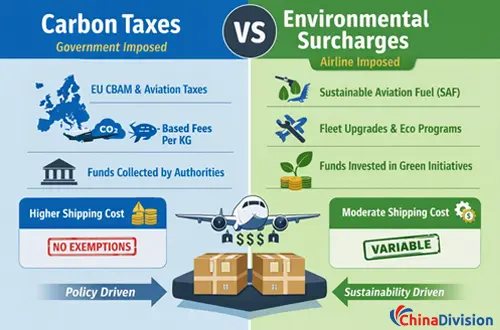
Carbon taxes and environmental surcharges are two distinct "green" costs now embedded in international air freight. Carbon taxes are mandatory government levies — such as the EU's Carbon Border Adjustment Mechanism (CBAM) — charged on emissions from flights into or out of regulated regions, allocated per kilogram of cargo. Environmental surcharges are airline-imposed operational fees funding sustainable aviation fuel (SAF), fuel-efficient aircraft, and low-carbon routing — transparent, published, and adjusted dynamically by carriers. Neither is optional, but both are manageable: together they add only a modest per-kg premium (ranging from fractions of a yuan to a few yuan per kilogram, with Europe and trans-Atlantic routes most affected), and both are forecastable costs that belong in your standard logistics budget — not surprise line items.
Table of Contents
- What Is an Aviation Carbon Tax, and Who Charges It?
- What Is an Environmental Surcharge, and Why Do Airlines Impose It?
- Carbon Tax vs. Environmental Surcharge: Side-by-Side Comparison
- How Much Do These Green Fees Actually Add to Your Freight Bill?
- 2026 Real-World Cost Benchmarks: What Shippers Pay Per Kg
- How to Manage and Forecast Green Air Freight Costs: A 4-Step Playbook
- Frequently Asked Questions (FAQ)
- Industry Resources
Sellers see line items labeled "carbon tax" or "environmental surcharge" on freight invoices without understanding what drives them, whether they're negotiable, or how to forecast them. This guide separates the two fee types, explains who sets them and how they're calculated, and shows how to build them into your landed-cost math.
What Is an Aviation Carbon Tax, and Who Charges It?
Aviation carbon taxes are policy-driven levies imposed by governments to curb emissions and accelerate aviation decarbonization. The most prominent frameworks include the EU Carbon Border Adjustment Mechanism (CBAM) and European aviation emissions pricing schemes. Aviation carbon taxes are mandatory government levies — such as the EU CBAM — calculated from flight distance and emissions equivalents, collected by airlines per kilogram of cargo, with no exemptions on affected routes.
Key characteristics:
- Who sets it: Governments and regulatory blocs (not airlines)
- Who collects it: Airlines collect centrally and remit to authorities
- What it's based on: Flight distance and carbon-emission equivalents, allocated to each shipment on a per-kilogram basis
- Where it hits hardest: Routes to, from, and across Europe and the Atlantic
- Negotiability: None — it's a mandatory compliance cost with no exemptions; all cargo owners bear it
The important mental model: a carbon tax is fiscal policy routed through your freight bill. You can't opt out, and your carrier can't waive it — the only variables are route exposure and shipment weight.
What Is an Environmental Surcharge, and Why Do Airlines Impose It?
Environmental surcharges are green operational fees implemented by airlines themselves to fund decarbonization initiatives. Where the money goes:
- Upgrading to newer, energy-efficient aircraft
- Procuring sustainable aviation fuel (SAF) — typically 2–4x the cost of conventional jet fuel
- Optimizing low-carbon flight paths and operations
- Aviation waste management and ground-operation upgrades
Environmental surcharges are airline-imposed fees that fund sustainable aviation fuel, efficient aircraft, and low-carbon operations — published, transparent, dynamically adjusted by carriers, and far more stable season-to-season than fuel surcharges.
Key characteristics:
- Who sets it: Individual airlines (industry-standardized, but carrier-specific)
- What it's based on: Carrier operating costs, published in rate sheets and fuel/green surcharge tables
- Transparency: Fee structures are publicly disclosed
- Seasonality: Minimal fluctuation between peak and off-peak seasons — unlike fuel surcharges, which swing with oil markets
- Adjustment logic: Dynamically updated by airlines as SAF procurement costs and fleet programs evolve
Think of it as the airline's cost-recovery mechanism for its own green transition — a value-added operational fee, not a tax.
Carbon Tax vs. Environmental Surcharge: Side-by-Side Comparison
| Dimension | Carbon Tax | Environmental Surcharge |
|---|---|---|
| Nature | Government policy levy | Airline operational fee |
| Set by | Regulators (e.g., EU CBAM) | Individual airlines |
| Purpose | Curb emissions via price | Fund airline decarbonization (SAF, fleet) |
| Calculation basis | Flight distance × emission equivalents, per kg | Carrier cost tables, typically per kg of chargeable weight |
| Affected routes | Primarily Europe / trans-Atlantic | Global, all carrier routes |
| Mandatory? | Yes — no exemptions | Yes in practice — built into carrier tariffs |
| Volatility | Policy-driven; changes with regulation | Cost-driven; stable, gradual adjustments |
| Disclosure | Regulatory frameworks | Published in carrier surcharge schedules |
The practical difference for shippers: carbon tax exposure is route-dependent (you reduce it by changing lanes), while environmental surcharges are carrier-dependent (you reduce or compare them by choosing between carriers — or by consolidating volume for better tariff treatment). Carbon tax is a government levy you avoid by changing routes; environmental surcharge is a carrier fee you manage by choosing carriers and consolidating volume.
How Much Do These Green Fees Actually Add to Your Freight Bill?
This is the question sellers actually care about, and the honest answer: manageable, forecastable, and modest relative to base rates.
- Fee structure: Depending on the route and carrier, the green surcharge typically ranges from a few jiao to a few yuan RMB per kilogram.
- Route gradient: Europe-bound and trans-Atlantic cargo sees the most noticeable increases (carbon tax exposure); intra-Asia and other non-regulated routes see mainly the airline surcharge component.
- Direction: Steady and gradual — not the violent swings of fuel surcharges or peak-season capacity spikes.
- Long-run effect: Green fees pressure airlines to optimize capacity and cut energy consumption per ton-kilometer, which contributes to a more stable logistics system — lower risk of extreme policy shocks or route cutbacks, and indirectly more reliable transit times.
Green fees add roughly single-digit percentage loadings to air freight rates — most visible on Europe/US routes — and are stable enough to budget precisely, unlike fuel surcharges or peak-season spikes.
2026 Real-World Cost Benchmarks: What Shippers Pay Per Kg
To budget accurately, shippers must evaluate the actual cost impact across major global trade lanes.
- Asia–Europe Trade Lane: Subject to both ReFuelEU SAF mandates and EU ETS carbon compliance, generating a combined green surcharge ranging between €0.04 and €0.12 per chargeable kg depending on carrier and routing.
- Transpacific Trade Lane: Lower carbon tax burdens compared to Europe, but carries an increasing SAF surcharge component ($0.02 to $0.06 per kg) as airlines fulfill corporate climate commitments and origin-hub mandates.
- Hub-Specific SAF Levies: Hubs like Singapore (CAAS) enforce tiered SAF levies on departing cargo, ranging from S$0.01/kg for intra-Southeast Asia routes up to S$0.15/kg for long-haul routes to the Americas.
How to Manage and Forecast Green Air Freight Costs: A 4-Step Playbook
1. Separate the Line Items in Your Quotes
Ask forwarders to break out base rate, fuel surcharge, carbon tax component, and environmental surcharge separately. Bundled "all-in" quotes hide which component is driving annual increases — and which you can influence.
2. Model Carbon Tax Exposure by Route
Since carbon tax is route-dependent, build a simple lane-level table: base rate + green loading per destination. When comparing air vs. rail/sea alternatives, use the fully loaded green-inclusive figure — on some Europe lanes, rail's cost advantage widens once carbon pricing is included.
3. Compare Carrier Surcharge Schedules
Environmental surcharges vary by carrier and adjust on different cadences. For volume shippers, consolidating freight with one or two carriers also improves your position to negotiate surcharge treatment as part of annual rate agreements.
4. Pass It Through Transparently in Pricing
Build green fees into landed-cost templates as a standard percentage loading by lane, and review quarterly. Treat them like insurance or security fees — a permanent cost line, not an occasional anomaly.
Manage green costs the way you manage fuel surcharges: demand itemized quotes, model exposure by route, compare carrier schedules, and bake a standard loading into your landed-cost pricing.
Frequently Asked Questions
Are carbon taxes and environmental surcharges the same thing?
No. Carbon taxes are government-imposed policy levies (e.g., EU CBAM); environmental surcharges are airline-imposed operational fees funding green initiatives. They appear separately on invoices and are set by different parties.
Can I avoid paying these green fees?
Effectively no. Carbon taxes on regulated routes are mandatory with no exemptions; airline environmental surcharges are embedded in tariffs. Your levers are route choice (for carbon tax exposure) and carrier choice (for surcharge levels) — not exemption.
Do green fees apply to all international air freight routes?
Environmental surcharges generally apply across a carrier's network. Carbon tax exposure is concentrated on routes touching regulated jurisdictions — most significantly Europe and trans-Atlantic lanes under EU frameworks.
Green air freight costs are the new baseline, not a passing surcharge. The sellers who handle them well do three things: they demand itemized freight quotes, they model green loadings into landed-cost templates by lane, and they review carrier surcharge schedules annually. The sellers who handle them poorly discover them as invoice surprises — usually on their highest-volume lanes.
At ChinaDivision, we build these costs into our quoting from day one: itemized rate breakdowns across base, fuel, carbon, and surcharge components; lane-level green cost modeling for your key destinations; and multi-carrier comparisons so you're choosing the cheapest compliant route — not discovering the most expensive one on the invoice.
Industry Resources


About the Author: Limi

Limi is a content marketing expert at ChinaDivision, helping businesses and e-commerce sellers navigate the complexities of international shipping by providing actionable tips and comprehensive guides on logistics, shipping, and cargo transportation.