

Customs Valuation Explained: How to Declare the Right Value and Avoid Penalties
Customs value is the true economic worth of your goods at the border, and in most cases it must equal the actual transaction price paid or payable. Under WTO rules, this "transaction value" is the primary and preferred valuation method — declared on your commercial invoice and waybill, matched against payment records. All goods require a declared value, including free items (gifts, samples, warranty replacements) — zero or token values are prohibited. If no transaction price exists, customs applies five fallback methods in strict order: identical goods, similar goods, deductive, computed, and a final fallback estimate. Undervaluation — declaring $50 for a $300 item — triggers fines, seizure, and blacklisting, with penalties routinely exceeding the duties avoided.
Table of Contents
- What Is Customs Value and Why Does It Matter?
- WTO Customs Valuation Rules: The Framework Your Shipment Lives Under
- How to Determine the Right Customs Value: The 6-Method Hierarchy
- What Is Undervaluation — and Why It Always Costs More Than It Saves
- Why Incoterm Mismatches Cause Problems
- Frequently Asked Questions (FAQ)
- Industry Resources
One number on one document can determine whether your shipment clears customs in hours or sits in a warehouse for weeks: the declared customs value. In our fulfillment operations, valuation errors are among the top three causes of border delays we see — and almost all of them are preventable. Whether you're a first-time exporter or managing a global supply chain, this guide covers what customs value is, how to determine it correctly, and exactly what happens when you get it wrong.
What Is Customs Value and Why Does It Matter?
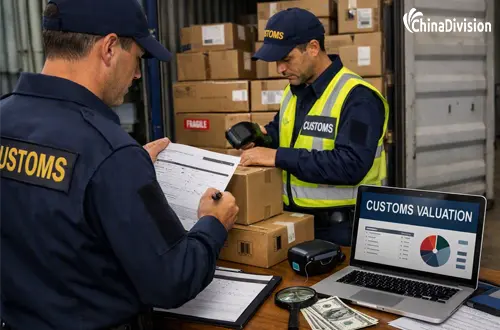
Customs value is the declared economic worth of goods crossing a border — the figure on which import duties, taxes, and trade statistics are calculated. Customs value is the declared worth of your goods used to calculate duties — and in the digital era, customs systems cross-check it against payment records automatically, so accuracy is now a speed advantage, not just a compliance one. It serves three functions:
- Duty and tax calculation: Duties are a percentage of customs value (or value + freight/insurance, depending on the method). An inaccurate value means an inaccurate duty bill.
- Trade compliance: Customs authorities use declared values to enforce trade policy, monitor imports, and detect fraud.
- Fair competition: Accurate valuation prevents dishonest importers from undercutting compliant businesses through duty evasion.
Why it matters practically, in three lines:
- Accurate declarations move faster. Consistently correct values reduce inspection rates and qualify repeat shippers for expedited clearance programs.
- The math punishes dishonesty. Penalties for undervaluation routinely exceed the duties avoided — often by an order of magnitude.
- Digital matching has ended the guessing era. Customs systems now cross-check declared values against payment records, market price databases, and carrier data automatically. Discrepancies flag instantly.
WTO Customs Valuation Rules: The Framework Your Shipment Lives Under
The WTO Agreement on Customs Valuation sets the global standard that member countries' customs authorities apply. The rules most relevant to shippers:
1. Every Shipment Needs a Declared Value — Even Free Goods
All goods must carry a declared value, including items provided free of charge: gifts, samples, warranty replacements, and promotional items. Zero values or token amounts ($1 declarations) are strictly prohibited. For free items, declare the fair market or transaction-equivalent value.
2. Transaction Value Is the Primary Method
The declared value must reflect the actual price paid or payable between buyer and seller — the figure on your commercial invoice. Where freight and insurance are included in the price and cannot be separated (due to the Incoterm used), the total is declared as-is; where they can be separated, valuation rules differ by country on whether they're included.
3. Declarations Must Match Across Documents
The waybill value, commercial invoice, and payment records must be consistent. Mismatches — even innocent ones — trigger holds.
How to Determine the Right Customs Value: The 6-Method Hierarchy
If transaction value cannot be determined (no sale occurred, related-party pricing is unreliable, etc.), customs applies fallback methods in strict order — you cannot skip ahead to a more favorable one:
| Order | Method | Basis |
|---|---|---|
| 1 | Transaction Value | Actual price paid or payable (the standard) |
| 2 | Identical Goods Value | Price of identical goods sold to the same country, same time, same level |
| 3 | Similar Goods Value | Price of comparable goods with similar characteristics |
| 4 | Deductive Value | Resale price in the destination market, minus post-import costs and profit |
| 5 | Computed Value | Production cost + profit + expenses (used mainly for integrated production) |
| 6 | Fallback Method | Reasonable estimate from available data, applied flexibly using methods 1–5 logic |
For the overwhelming majority of e-commerce and B2B shipments, method 1 applies — which is why the practical discipline is simple: your declared value should match your invoice, which should match your payment.
Customs applies six valuation methods in strict order — transaction value first, then identical goods, similar goods, deductive, computed, and a final fallback — and you can't skip to a more favorable method.
What Is Undervaluation — and Why It Always Costs More Than It Saves
Undervaluation is intentionally declaring a lower customs value than the actual transaction price to reduce duties. Common forms:
- Declaring a $50 value for a $300 smartphone
- Labeling commercial goods as "gifts" with nominal values
- Splitting invoices so per-shipment values fall below thresholds
The De Minimis Trap
Many shippers target the de minimis threshold — the value below which imports enter duty-free (e.g., $50 in some markets, €150 historically in the EU — note the EU removed its €150 customs duty exemption in July 2026, so check current rules for your destination).
| Scenario | Actual Value | Declared Value | Outcome |
|---|---|---|---|
| Honest declaration | $75 | $75 | Duty paid correctly; smooth clearance |
| De minimis targeting | $75 | $48 | Flagged by risk systems; fine + duty reassessment |
| "Gift" mislabel | $120 | $20 | Seizure risk; repeat offender blacklisting |
Two hard truths here:
- Logistics providers aren't your shield. A carrier may not flag an undervalued shipment below de minimis — but customs authorities can and do impose fines anyway, retroactively.
- Small discrepancies get flagged. Risk engines compare declared values against product-category price databases. A $48 declaration for a product type that averages $70–$90 is a statistical anomaly, not a clever optimization.
The Real Cost Stack
- Fines and penalties (frequently multiples of the evaded duty)
- Seizure or indefinite holds
- Duty reassessment plus interest
- Blacklisting for repeat offenders — meaning every future shipment faces 100% inspection
- Marketplace account risk, for e-commerce sellers whose payment records contradict declared values
Undervaluation — including nudging declarations just under de minimis thresholds — gets caught by automated risk systems comparing declared values to price databases, and the fines, seizures, and blacklisting it triggers cost far more than the duties avoided.
Why Incoterm Mismatches Cause Problems
If your invoice says FOB, but the customs declaration shows a CIF-style value without a documented freight component, customs may question the valuation.
If your invoice says DDP, but the declared goods value includes duties, domestic taxes, and post-import delivery without a breakdown, customs may require clarification.
3PL insight: The Incoterm should appear consistently on the commercial invoice, freight booking, customs instructions, and internal cost sheet. When freight, insurance, duty, tax, or delivery costs are bundled, maintain a breakdown even if customs rules ultimately require the full amount or a different calculation.
Frequently Asked Questions
What is customs value in simple terms?
The declared worth of your goods used by customs to calculate import duties and taxes — in most cases, simply the price you actually paid or were paid for them.
Can I declare $0 for free samples or gifts?
No. Zero or token values are prohibited under WTO rules. Declare the fair market or transaction-equivalent value even when no money changed hands.
Does the declared value include shipping and insurance?
It depends on the Incoterm and destination country. Under CIF-type terms where freight and insurance can't be separated, the total is declared as-is. Verify the valuation basis your destination applies.
What happens if customs thinks my declared value is too low?
Expect a hold, a request for documentation (invoice, payment proof), reassessment with back duties, and potential fines. Repeat issues lead to blacklisting and 100% inspection of future shipments.
What's the difference between customs value and declared value for carriers?
They should be the same number. The carrier's waybill declared value feeds the customs declaration; discrepancies between the waybill, invoice, and payment records trigger audits.
Customs valuation isn't a formality — it's the number your entire border experience hinges on. The sellers who move fastest through customs aren't the ones with the cleverest values; they're the ones whose invoices, waybills, and payment records all tell the same true story, shipment after shipment.
At ChinaDivision, accurate customs declaration is built into our fulfillment workflow: commercial invoice preparation with correct valuation and Incoterm handling, document consistency checks across invoice/waybill/payment data, and pre-shipment compliance review — so your shipments clear on the first pass, every time.
Industry Resources
DHL: Customs clearance and restrictions guide
DHL: Commercial invoice guide for international shipping
Customs Support: Customs value and the six valuation methods


About the Author: Limi

Limi is a content marketing expert at ChinaDivision, helping businesses and e-commerce sellers navigate the complexities of international shipping by providing actionable tips and comprehensive guides on logistics, shipping, and cargo transportation.