

Shipping Cosmetics Internationally: Packaging, Dangerous Goods, and Fulfillment
You can ship cosmetics internationally, but the correct process depends on the product formula, destination-market regulations, transport classification, packaging, and customs documentation. Before handing cosmetics to a carrier, confirm whether the product is regulated as a cosmetic or another product category, check destination-market requirements, determine whether the product contains dangerous goods such as alcohol, and build packaging and fulfillment procedures around leakage, breakage, temperature, and shelf-life risks.
Table of Contents
- What Are the Main Challenges When Shipping Cosmetics Internationally?
- How Do You Check Whether Cosmetics Are Dangerous Goods?
- What Cosmetic Regulations Apply When Shipping to the U.S.?
- What Cosmetic Requirements Apply When Shipping to the EU?
- What Documents Do You Need to Ship Cosmetics Internationally?
- How Should You Package Cosmetics for International Shipping?
- How Should You Package Cosmetic Liquids?
- How Should You Package Powders and Pressed Makeup?
- How Do You Protect Cosmetics From Heat During Shipping?
- What Is the Best Shipping Method for Cosmetics?
- How Can Cosmetic Brands Reduce International Shipping Costs?
- How Should a Fulfillment Warehouse Handle Cosmetics?
- FAQ: Shipping Cosmetics Internationally
- Industry Resources
For e-commerce beauty brands, the biggest mistake is treating every cosmetic shipment as an ordinary parcel. A lipstick, glass serum bottle, sunscreen, aerosol spray, and alcohol-based perfume can have completely different compliance and transportation requirements.
What Are the Main Challenges When Shipping Cosmetics Internationally?
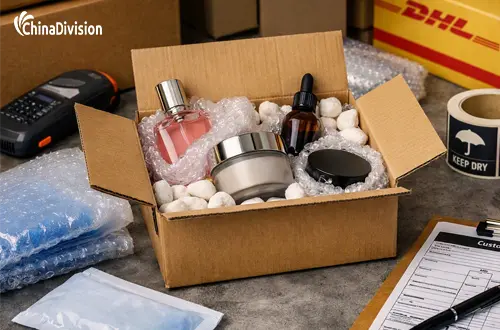
The main challenges are regulatory compliance, dangerous-goods classification, temperature exposure, leakage and breakage, shelf life, and accurate customs documentation. These risks can interact: a product that is legally saleable in the destination country may still require special transportation handling, while a product that is safe to transport may still fail the destination market's cosmetic requirements.
1. Shelf life and product stability
Cosmetics are not simply inventory that can sit indefinitely in a warehouse.
Creams, serums, sunscreens, active-ingredient products, and natural formulations can have stability limitations. Long transit times, excessive heat, freezing temperatures, and repeated temperature changes can affect product quality even when the outer package arrives undamaged.
A useful operational control is FEFO — First Expired, First Out — rather than relying only on FIFO. This becomes particularly important when a brand has multiple production batches with different expiration dates.
- FIFO ships the oldest received inventory first.
- FEFO ships the inventory with the earliest expiry date first.
FEFO is more appropriate when batches can arrive out of order or have different remaining shelf life.
2. Temperature sensitivity
Temperature-sensitive cosmetics should be evaluated for their realistic temperature exposure during storage, line-haul transportation, customs clearance, and last-mile delivery.
Products such as balms, creams, wax-based products, emulsions, and some natural formulations can soften, melt, separate, crystallize, or otherwise change when exposed to extreme temperatures.
The risk is especially relevant when shipments move through:
- Hot fulfillment warehouses
- Outdoor loading areas
- Airport tarmacs
- Containers or trailers
- Customs inspection facilities
- Regional delivery hubs
- Summer last-mile routes
The key insight for e-commerce brands is that insulated packaging cannot compensate for an unsuitable logistics process indefinitely. If a product requires strict temperature control, the fulfillment strategy should be designed around that requirement before the product is launched internationally.
3. Leakage and breakage
Cosmetic damage is often caused by movement, pressure, leakage, or inadequate internal cushioning rather than simply by weak outer cartons.
Common high-risk products include:
- Glass serum bottles
- Glass cream jars
- Dropper bottles
- Pressed powders
- Makeup palettes
- Perfume bottles
- Pump bottles
- Tubes with fragile caps
- Aerosol containers
A package can pass a basic warehouse inspection but fail after thousands of kilometers of vibration and handling.
4. International cosmetic regulations
Cosmetic products must satisfy the rules of the destination market before commercial distribution, and those requirements are separate from the carrier's transportation rules.
For example, U.S. cosmetics are subject to FDA requirements, including applicable MoCRA facility registration and product-listing obligations. FDA specifically states that registration or listing does not mean that FDA has approved the cosmetic product.
For the EU market, Regulation (EC) No. 1223/2009 establishes requirements including a responsible person, safety assessment, cosmetic product safety report, product information file, and notification through the Cosmetic Products Notification Portal (CPNP).
Therefore, “FDA approved” or “EU compliant” should not be treated as generic shipping labels. Brands need to identify the actual regulatory obligations applicable to their product and market.
| Product Type | Typical Logistics Risk | Additional Check |
|---|---|---|
| Lipstick | Low–medium | Heat sensitivity |
| Powder makeup | Medium | Breakage and powder containment |
| Cream | Medium | Leakage and temperature |
| Serum | Medium | Glass packaging and leakage |
| Nail polish | High | Flammable liquid classification |
| Perfume | High | Alcohol/flammability and dangerous-goods rules |
| Aerosol spray | High | Pressurized container and dangerous-goods requirements |
| Essential-oil products | Product-specific | Composition and transport classification |
| Sunscreen | Market-dependent | Cosmetic/drug classification may differ by country |
This table is a logistics screening framework, not a legal classification. The actual transportation classification should be confirmed from the product's formulation, Safety Data Sheet (SDS) where applicable, and the carrier's current acceptance requirements.
How Do You Check Whether Cosmetics Are Dangerous Goods?
Do not assume that a product is safe to ship by air simply because it is sold as a cosmetic; check its formulation and transportation classification before booking the shipment.
Cosmetics That Commonly Require Extra Review
| Cosmetic Type | Possible Transport Classification | What to Check |
|---|---|---|
| Alcohol-based perfume or cologne | Often Class 3 flammable liquid | SDS, flash point, UN number, shipping name, carrier DG acceptance |
| Aerosol deodorant, hair spray, dry shampoo | Often Class 2 aerosol/gas | Propellant, aerosol classification, quantity limits, labels |
| Nail polish or nail varnish | Often regulated as paint-related material | SDS, solvent content, UN classification |
| Nail-polish remover | Often Class 3 if acetone-based | Flash point, UN number, packing group |
| Alcohol-based sanitizer | Often Class 3 flammable liquid | Alcohol concentration, packaging, air-service acceptance |
| Essential oils | Product-specific | SDS, flash point, chemical composition |
| Hair dye or chemical treatment | Product-specific | SDS, corrosivity, oxidizer/reactivity risk |
| Water-based lotion or cleanser | Often non-hazardous, but product-specific | SDS, carrier acceptance, destination cosmetic regulations |
| Pressurized spray products | Often regulated | Aerosol classification, pressure, quantity limits |
Perfumes are a common example. DHL notes that perfumes containing flammable chemicals can fall under Dangerous Goods requirements for air and sea transportation.
For a new cosmetic SKU, a fulfillment or logistics team should request:
- Product name and SKU
- Full ingredient list
- Alcohol concentration where applicable
- SDS, if available/applicable
- Product specification sheet
- Net volume or weight
- Packaging type
- Destination countries
- Intended transport mode
- Any existing dangerous-goods classification
What Cosmetic Regulations Apply When Shipping to the U.S.?
U.S. cosmetics must comply with applicable FDA requirements, and applicable businesses may have MoCRA facility registration and product-listing obligations; these requirements are not the same as obtaining FDA product approval.
Under MoCRA, manufacturers and processors generally have facility-registration obligations, with required renewal every two years. A responsible person must list each marketed cosmetic product with FDA and provide annual updates. Certain small businesses and specific product categories have exemptions.
FDA also makes an important distinction that is often missed in e-commerce content:
Cosmetic facility registration and product listing are not an FDA approval program. FDA does not issue a certificate proving that a cosmetic product is “FDA approved” simply because the facility is registered or the product is listed.
For U.S.-bound fulfillment, brands should therefore review:
- Product classification
- Ingredient compliance
- Labeling
- Responsible person information
- Applicable MoCRA registration
- Applicable product listing
- Safety substantiation records
- Import documentation
- Customs classification
- Carrier restrictions
Imported cosmetics are subject to the same applicable FDA laws and regulations as cosmetics produced domestically.
What Cosmetic Requirements Apply When Shipping to the EU?
For cosmetics placed on the EU market, brands generally need an EU-based responsible person, a safety assessment and Cosmetic Product Safety Report, a Product Information File, and CPNP notification before the product is placed on the market.
The EU Cosmetics Regulation requires a responsible person for each cosmetic product and requires a safety assessment before placing the product on the market.
The product information file must include the required safety and manufacturing information and generally be retained for 10 years after the last batch was placed on the market.
The CPNP provides the EU-wide electronic notification mechanism. Once a product has been notified through CPNP, separate national notification is generally not required within the EU.
This creates an important distinction for logistics teams:
A shipment can be physically capable of entering the EU while the product is still not ready for lawful commercial placement on the EU market.
Fulfillment providers should not treat a shipping label, commercial invoice, or tracking number as evidence of regulatory compliance.
What Documents Do You Need to Ship Cosmetics Internationally?
Most international cosmetic shipments require accurate commercial and transportation documentation, while additional documents may be needed depending on the product and destination.
A practical document package can include:
| Document | Why It Matters |
|---|---|
| Commercial invoice | Establishes seller, buyer, value, description, and transaction information |
| Packing list | Identifies quantities, packaging, and shipment contents |
| HS code | Supports customs classification |
| Product description | Helps customs understand what is being imported |
| Ingredient information | Useful for regulatory review and product identification |
| SDS | Important for products that may have hazardous characteristics |
| Product certification | Required where applicable by destination market |
| Import permit/license | Required for certain products or jurisdictions |
| Origin information | Supports customs and origin requirements |
| Dangerous-goods documentation | Required where the shipment falls under applicable DG rules |
Avoid vague customs descriptions
“Beauty products” is usually much less useful than a specific description such as:
- “Facial moisturizing cream, 50 ml”
- “Lip balm, cosmetic, 4 g”
- “Facial serum, cosmetic preparation, 30 ml”
- “Perfume containing alcohol, 50 ml”
The exact customs description should match the actual product and applicable classification requirements.
How Should You Package Cosmetics for International Shipping?
Cosmetics should be packaged using a product-specific protection system that controls leakage, movement, impact, and temperature rather than relying on a single layer of bubble wrap.
A practical three-layer approach is:
Layer 1: Product protection
Protect the individual product first.
- Secure caps and pumps.
- Use leak-resistant primary packaging.
- Protect glass bottles individually.
- Use protective sleeves around fragile containers.
- Place liquid products in appropriate secondary containment where required.
- Separate products that can damage one another if leakage occurs.
Layer 2: Internal protection
Prevent products from moving inside the carton.
Use:
- Bubble wrap
- Molded inserts
- Foam
- Corrugated dividers
- Paper cushioning
- Appropriate protective bags
- Product-specific inserts
The objective is not simply to make the box “soft.” The objective is to limit movement and absorb impact.
Layer 3: Outer carton
Use a rigid carton appropriate for the shipment's weight and handling environment.
Leave as little uncontrolled empty space as practical. Excessive void space allows products to move, while excessive compression can damage fragile packaging.
How Should You Package Cosmetic Liquids?
Liquid cosmetics should be protected against leakage at both the individual-product and shipment levels, with additional controls applied when the product is regulated for air transport.
For ordinary non-dangerous liquid products, a practical workflow is:
- Verify the bottle or tube is securely closed.
- Add an appropriate leak-resistant secondary layer.
- Individually protect glass containers.
- Separate multiple bottles with dividers or cushioning.
- Prevent movement inside the carton.
- Use a rigid outer carton.
- Apply any required transportation labels or handling marks.
For perfumes, alcohol-based products, aerosols, and other potentially regulated liquids, do not apply ordinary cosmetic packaging procedures automatically. The transportation classification should be confirmed first.
How Should You Package Powders and Pressed Makeup?
Powder cosmetics should be protected against impact, vibration, and contamination because the product can remain cosmetically damaged even when the outer carton looks intact.
Pressed powders and palettes are particularly vulnerable to cracking during parcel handling.
Recommended controls include:
- Individual cushioning around palettes and compacts
- Separation between products
- Tight-fitting inserts
- Protection against internal movement
- Rigid outer cartons
- Extra protection for glass mirrors
- Batch testing of the packaging before large-scale fulfillment
A useful fulfillment test is to compare damage rates by SKU, rather than treating all cosmetics as having the same packaging requirements.
If one palette has a 2% damage rate and another has a 0.1% rate, the solution is not necessarily “use more bubble wrap.” The problem may be the product's internal packaging, carton dimensions, stacking configuration, or handling process.
How Do You Protect Cosmetics From Heat During Shipping?
Heat protection should be based on the product's stability requirements and actual route exposure, not simply on whether the destination is a hot country.
Consider the complete route:
Warehouse → pickup → consolidation → airport/port → line-haul → customs → local hub → last mile
A product may experience several different temperature environments during this journey.
For temperature-sensitive SKUs, consider:
- Maximum storage temperature
- Minimum storage temperature
- Maximum acceptable transit duration
- Seasonal route exposure
- Insulated packaging
- Cold packs where appropriate
- Faster transportation services
- Warehouse temperature controls
- FEFO inventory rotation
A useful operational metric
Instead of simply measuring “shipping time,” track:
Order-to-delivery elapsed time + temperature-risk exposure + remaining shelf life
This gives beauty brands a more realistic picture of whether their fulfillment model is suitable for temperature-sensitive products.
What Is the Best Shipping Method for Cosmetics?
The best shipping method depends on product classification, destination, delivery speed, cost, temperature sensitivity, and whether the product requires dangerous-goods handling.
| Shipping Priority | Typical Approach | Best For |
|---|---|---|
| Fast delivery | Express air | High-value or urgent orders |
| Cost control | Standard air | Regular e-commerce cosmetics |
| Large-volume replenishment | Ocean freight | Bulk inventory |
| Temperature-sensitive products | Faster or controlled logistics | Heat-sensitive formulations |
| Regulated liquids | Approved carrier/DG service | Perfumes and other restricted products |
| Global DTC orders | Multi-carrier fulfillment | Brands serving multiple markets |
There is no universally “best” carrier for every cosmetic product.
How Can Cosmetic Brands Reduce International Shipping Costs?
Cosmetic shipping costs can often be reduced by optimizing packaging dimensions, inventory placement, shipping method, order consolidation, and SKU-level fulfillment rules rather than simply choosing the cheapest carrier.
1. Reduce dimensional weight
Large cosmetic packaging can create unnecessary volumetric weight.
Measure the packed dimensions of each SKU and compare:
Actual weight vs. dimensional/volumetric weight
A smaller but equally protective carton can reduce transportation costs across thousands of orders.
2. Reduce unnecessary packaging
Over-packaging increases:
- Carton size
- Dimensional weight
- Material costs
- Warehouse packing time
- Waste-disposal costs
The objective should be right-sized protection, not maximum packaging.
3. Pre-position inventory
If demand is predictable in the U.S., Europe, Australia, or another major market, regional inventory can reduce repeated international parcel movements.
A common scalable structure is:
China sourcing → China quality inspection → bulk replenishment → regional fulfillment → local last mile
Instead of:
China warehouse → international parcel → customer
for every individual order.
4. Segment SKUs
Not every cosmetic SKU needs the same logistics treatment.
A useful segmentation is:
- Standard cosmetics
- Fragile cosmetics
- Liquid cosmetics
- Temperature-sensitive cosmetics
- Dangerous-goods products
- High-value products
- Slow-moving products
This prevents the warehouse from applying the most expensive handling procedure to every SKU.
How Should a Fulfillment Warehouse Handle Cosmetics?
A cosmetics fulfillment warehouse should manage product compliance data, inventory batches, packaging instructions, inspection checkpoints, and carrier restrictions as part of the SKU master data.
A practical warehouse workflow is:
- SKU onboarding
Collect formulation, dimensions, weight, packaging, shelf-life, and regulatory information. - Product classification
Determine whether special shipping or dangerous-goods review is required. - Inbound inspection
Check quantities, packaging condition, batch information, and visible damage. - Storage assignment
Assign appropriate storage conditions and locations. - FEFO/FIFO control
Prioritize inventory based on expiration and batch requirements. - Order allocation
Select inventory based on destination and product restrictions. - Packing SOP
Use the predefined packaging configuration for that SK
Step-by-Step Packing Rules
- Double-Containment for Liquids: Every liquid container must feature a primary seal (induction seal or shrink band) and be placed inside a leak-proof, sealed polyethylene bag. If the primary container breaks, the outer bag contains the spill, preventing damage to surrounding parcels.
- Cushioning & Shock Absorption: Glass bottles and pressed powders must be wrapped individually in a minimum of 2 inches (5 cm) of high-density bubble wrap or expandable honeycomb paper.
- Rigid Outer Box & Void Elimination: Use corrugated boxes rated for at least 200 lbs/sq inch Bursting Test (or Edge Crush Test 32). Fill all empty space with kraft paper or void-fill peanuts so items cannot shift when shaken.
- Handling Labels: Apply bold handling instruction stickers to the exterior:
- This Way Up (Orientation Arrows): Ensures carriers keep liquid containers upright.
- Fragile - Glass - Handle with Care: Flags the parcel for manual handling in automated sorting centers.
- Keep Away from Heat: Alerts tarmac handlers to avoid direct sunlight exposure.
FAQ: Shipping Cosmetics Internationally
Can I ship cosmetics internationally?
Yes. Many cosmetics can be shipped internationally, but the correct process depends on the product’s formula, dangerous-goods status, carrier acceptance, destination customs rules, and destination cosmetic-market requirements.
Can ChinaDivision store and fulfill cosmetics?
ChinaDivision can support eligible cosmetic products with warehouse receiving, storage, lot/expiry workflows, FEFO rotation, pick-and-pack, kitting, branded packaging, B2B distribution, DTC fulfillment, marketplace preparation, and returns handling. Dangerous goods or temperature-controlled products require product-specific review and confirmed warehouse/carrier capabilities.
Industry Resources
FDA: What are dangerous goods?
UK Government: EU Cosmetic Regulation and Northern Ireland enforcement guidance


About the Author: Limi

Limi is a content marketing expert at ChinaDivision, helping businesses and e-commerce sellers navigate the complexities of international shipping by providing actionable tips and comprehensive guides on logistics, shipping, and cargo transportation.