

How to Pack Glass for Shipping: Safe Packaging & Damage Prevention
Table of Contents
- How do you pack glass for shipping without breaking it?
- What packaging materials are best for shipping glass?
- How much cushioning should you use when shipping glass?
- Why is double-boxing recommended for fragile glass?
- How should you prevent glass from moving inside the box?
- How should different types of glass be packaged for shipping?
- How should you pack bottles and other liquid-filled glass containers?
- How should mirrors and flat glass be packaged?
- What Are Carrier-Specific Rules for Shipping Glass and Fragile Items?
- What are the most common causes of glass shipping damage?
- How can a fulfillment warehouse reduce glass breakage?
- How should you test packaging before shipping glass at scale?
- How can you reduce glass shipping costs without increasing breakage?
- What labels should be used when shipping fragile glass?
- FAQ: Shipping Glass Safely
- Industry Resources
How do you pack glass for shipping without breaking it?
The safest way to pack glass for shipping is to individually wrap the item, protect vulnerable edges and corners, prevent movement inside a rigid inner box, and add a second outer box with cushioning between the two boxes. For fragile or high-value glassware, the packaging should be designed around the item's shape, weight, breakage points, and shipping method—not simply covered with more bubble wrap.
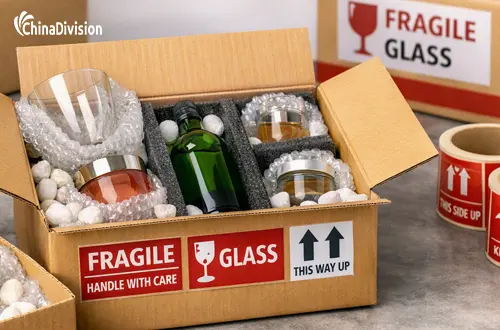
A reliable glass-shipping package typically uses five protection layers:
- Surface protection to prevent scratches and abrasion.
- Individual wrapping to prevent direct contact between glass items.
- Edge and corner protection for vulnerable impact points.
- Inner and outer cushioning to absorb shocks and limit movement.
- Rigid outer packaging to protect the contents from compression and impacts.
For e-commerce fulfillment, the objective is not to use the maximum amount of packaging. It is to create a repeatable packout that protects the product while controlling damage rate, packaging cost, dimensional weight, packing time, and customer experience.
What packaging materials are best for shipping glass?
The right packaging materials depend on the glass item's shape, weight, fragility, and shipping environment, but a typical setup combines foam or protective wrap, bubble wrap, corrugated cardboard, edge protection, void fill, and a strong outer carton.
| Packaging Material | Primary Purpose | Best Used For |
|---|---|---|
| Bubble wrap | Shock absorption and surface protection | Glassware, bottles, small fragile items |
| Foam sheets | Scratch and surface protection | Decorative glass, lenses, polished surfaces |
| Corrugated cardboard | Structural separation and reinforcement | Dividers, panels, inner boxes |
| Foam corners/edge guards | Protect vulnerable impact points | Mirrors, framed glass, panels |
| Kraft paper | Void filling and movement reduction | General glass shipments |
| Air cushions | Lightweight void filling | Lightweight glass products |
| Molded inserts | Product-specific positioning | High-volume e-commerce SKUs |
| Double-wall corrugated cartons | Outer structural protection | Heavy or high-value glass |
| Waterproof outer bag/pouch | Moisture protection | Shipments exposed to wet conditions |
The packaging should be selected by SKU rather than using one packing method for every glass product. A drinking glass, perfume bottle, mirror, glass tabletop, and optical lens have different failure points and therefore require different packaging controls.
How much cushioning should you use when shipping glass?
Use enough cushioning to create a protective buffer around every vulnerable surface while preventing the glass from moving inside the package; the required thickness depends on the product and packaging system rather than one universal measurement.
For fulfillment operations, cushioning should be validated by package size, product weight, and actual movement inside the carton. The objective is controlled movement, not simply maximum cushioning volume. Excessive void fill can increase carton dimensions and shipping costs without necessarily improving protection.
Why is double-boxing recommended for fragile glass?
Double-boxing creates a second protective barrier that separates the fragile product from external impacts and reduces the chance that a damaged outer carton will directly affect the glass.
A typical double-boxing structure is:
Glass product → individual wrap → inner carton → cushioning → outer carton
The inner carton should hold the product securely without allowing excessive movement. The outer carton should be large enough to provide a protective cushioning zone around the inner carton.
This approach is particularly useful for:
- High-value glassware
- Perfume bottles
- Decorative glass
- Collectibles
- Antique glass
- Mirrors and framed glass
- Products with high replacement costs
- Long-distance international shipments
Double-boxing is not only a damage-prevention technique. It can also create a standardized packout specification.
How should you prevent glass from moving inside the box?
The product should remain immobilized during normal package handling, because internal movement can allow repeated impacts between the glass and the carton or between individual glass items.
Common movement-control methods include:
- Corrugated dividers
- Molded pulp inserts
- Foam inserts
- Edge guards
- Kraft-paper void fill
- Air cushions
- Custom-fit packaging
- Inner cartons inside an outer carton
Do not rely on a “Fragile” label to compensate for excessive internal movement. Labels can communicate handling requirements, but physical packaging provides the primary mechanical protection.
A useful warehouse quality-control question is:
If the package is rotated or gently shaken, can the glass move enough to contact another hard surface?
If the answer is yes, the packout should be reviewed.
How should different types of glass be packaged for shipping?
Different glass products require different protection because their most vulnerable points are not the same.
| Glass Product | Main Risk | Recommended Protection |
|---|---|---|
| Drinking glasses | Rim and side-wall breakage | Individual wrap, dividers, cushioning |
| Wine glasses | Thin stems and bowls | Individual wrapping, stem protection, rigid inserts |
| Glass bottles | Impact and neck breakage | Full wrap, bottle divider, leak protection where applicable |
| Perfume bottles | Glass breakage and liquid leakage | Individual wrap, secondary containment, cushioning |
| Mirrors | Edge damage and flexing | Edge protection, rigid panels, double-boxing |
| Picture frames | Corner and glass-panel damage | Corner guards, rigid cardboard protection, double-boxing |
| Glass tabletops | Flexing, edge impact, weight | Edge guards, rigid support, reinforced outer packaging |
| Antique glass | Surface damage and breakage | Surface-safe tissue, foam, custom cushioning |
| Cookware | Edge and lid breakage | Separate component wrapping, dividers, cushioning |
| Optical lenses | Scratches and surface damage | Protective surface layer, rigid positioning, cushioning |
How should you pack bottles and other liquid-filled glass containers?
Glass bottles containing liquids require both breakage protection and leakage control, because a broken bottle can damage the product itself, surrounding shipments, and the carrier network.
A suitable packaging workflow may include:
- Inspect the bottle, cap, closure, and container.
- Protect the glass surface with appropriate cushioning.
- Add additional protection around the neck and base.
- Use secondary containment when appropriate.
- Prevent the bottle from moving inside the carton.
- Keep multiple bottles separated.
- Review the product's transport classification before selecting the shipping service.
- Apply any required documentation or labels.
This is especially important for perfume, alcohol-containing products, essential oils, and other liquid formulations. Whether a product is subject to dangerous-goods requirements depends on its specific formulation and transport mode, so the product documentation and carrier requirements should be checked before shipment.
How should mirrors and flat glass be packaged?
Flat glass such as mirrors, framed glass, and panels needs strong edge protection and structural support because flexing and edge impacts can cause cracks even when the surface is well cushioned.
Recommended controls include:
- Protect all four edges.
- Add rigid cardboard or corrugated sheets.
- Use corner protection.
- Prevent direct contact between the glass and the outer carton.
- Consider double-boxing for smaller high-value pieces.
- Use appropriately reinforced packaging for large panels.
- Keep the glass securely positioned during transport.
For larger or unusually shaped glass products, standard parcel packaging may not be appropriate.
What Are Carrier-Specific Rules for Shipping Glass and Fragile Items?
Major carriers such as DHL, FedEx, and UPS all require sturdy corrugated boxes, adequate cushioning, individual wrapping of fragile items, and clear labeling, with double-boxing recommended or required for high-value or heavy fragile shipments. Exact requirements vary by service and country.
DHL Express Guidelines
- Use double-wall corrugated boxes for fragile items.
- Maintain at least 2.4 inches (6 cm) of cushioning between item and box walls.
- Wrap each item individually in small-cell bubble wrap.
- Use the box-in-box method for fragile goods.
- Apply “Fragile” and “Glass” handling labels on all sides.
- For glass panels, use protective internal cushioning, a sturdy outer box or crate, and clear labeling.
FedEx Guidelines
- Use new single- or double-wall corrugated boxes with appropriate ECT rating.
- Provide at least 2 inches of cushioning for general items; 3–4 inches for fragile items.
- Wrap each fragile piece individually in at least two layers of bubble wrap.
- Use double-boxing for extremely fragile items.
- Perform a rattle test: no movement should be detectable inside the sealed box.
- Clearly mark “This Side Up” and “Fragile.”
UPS Guidelines
- Recommend double-boxing for sharp or fragile goods.
- Require double-boxing for fragile items over 10 pounds in many service contexts.
- Require minimum 2 inches of cushioning between inner and outer boxes.
- Expect new corrugated boxes for items over 10 pounds.
- Refer to ISTA 3A-type standards for packaging performance.
Operational insight: If your packaging would not meet DHL, FedEx, or UPS fragile-item guidelines, it is unlikely to survive long-haul, multi-handling international transit.
What are the most common causes of glass shipping damage?
Most glass-shipping failures are caused by uncontrolled movement, insufficient edge protection, inadequate cushioning, carton weakness, or a packout that does not match the product's shape and weight.
A useful fulfillment damage analysis is to classify every breakage into one of these categories:
| Damage Pattern | Likely Packaging Problem | Corrective Action |
|---|---|---|
| Cracked corner | Insufficient edge protection | Add corner/edge guards |
| Broken rim | Direct impact or inadequate cushioning | Increase localized protection |
| Multiple items collide | Poor internal separation | Add dividers or inserts |
| Glass contacts carton | Insufficient void protection | Increase cushioning or redesign inner carton |
| Crushed carton | Weak outer packaging | Upgrade carton strength |
| Product shifts | Excessive internal void | Improve fit and void fill |
| Surface scratches | Direct contact or abrasive material | Add surface-protection layer |
| Liquid leakage | Broken container or failed closure | Add secondary containment and closure checks |
Tracking the damage pattern is more useful than simply increasing the amount of bubble wrap. If the same SKU repeatedly breaks in the same location, the packaging design should be changed at that failure point.
How can a fulfillment warehouse reduce glass breakage?
A fulfillment warehouse can reduce glass damage by creating SKU-specific packaging SOPs, separating fragile inventory, standardizing packout materials, and monitoring damage by SKU, carrier, packaging type, and destination.
A practical fragile-SKU workflow is:
SKU onboarding → Packaging test → Packout SOP → Warehouse training → Pick → Pack → QC → Carrier handoff → Damage monitoring → Packaging improvement
How should you test packaging before shipping glass at scale?
Before using a fragile-glass packout for large-scale fulfillment, test whether the package prevents product movement, protects vulnerable points, and remains structurally intact after handling.
A practical pre-launch test can include:
1. Movement test
Check whether the glass shifts inside the carton.
2. Compression check
Inspect whether the carton collapses or loses its protective structure when handled.
3. Packaging integrity check
Verify that tape, inserts, dividers, and cushioning remain in position.
4. Product inspection
Open the package and check edges, corners, surfaces, and closures.
5. Repeated-order test
Pack multiple units using different warehouse operators to determine whether the SOP is easy to follow consistently.
6. Damage-rate monitoring
After launch, compare breakage rates by SKU, packaging version, carrier, and destination.
The best packaging design is not necessarily the thickest or most expensive one; it is the one that consistently protects the product at an acceptable total cost per delivered order.
How can you reduce glass shipping costs without increasing breakage?
The most effective way to reduce fragile-product fulfillment costs is to optimize packaging dimensions and shipping configuration while maintaining the required protection level.
For example, reducing a carton by several centimeters may lower dimensional-weight charges, but removing too much cushioning could increase breakage. The correct optimization target is therefore:
Total delivered cost = Packaging + Fulfillment + Shipping + Damage/Replacement + Returns
This is particularly important for e-commerce brands because the cheapest carton is not necessarily the cheapest fulfillment solution when damage and replacement costs are included.
What labels should be used when shipping fragile glass?
Packages containing fragile glass should carry accurate shipping and handling labels, but labels should supplement—not replace—proper physical protection.
Depending on the shipment, labels may include:
- Fragile
- Handle with Care
- This Way Up
- Shipping label
- Recipient information
- Return information
- Carrier-required markings
- Customs documentation
- Product-specific regulatory markings where applicable
For international shipments, the commercial and customs documentation should also accurately describe the product and its contents.
FAQ: Shipping Glass Safely
What is the safest way to ship glass?
The safest general approach is to individually wrap the glass, protect edges and corners, immobilize the product in an inner carton, and use additional cushioning and an outer carton when appropriate.
Is bubble wrap enough to ship glass?
Bubble wrap alone may not provide sufficient structural protection for fragile or high-value glass. Dividers, foam, edge guards, rigid inserts, and double-boxing may be necessary depending on the product.
Should glass be double-boxed?
Double-boxing is recommended for many fragile, high-value, or long-distance shipments because it provides an additional protective layer between the glass and external impacts.
Can I ship perfume bottles in glass containers?
Yes, but perfume combines fragile glass packaging with a liquid product that may have additional transport requirements. Check the product's formulation, safety documentation, and carrier requirements before selecting the shipping service.
How do I ship multiple glass items in one box?
Wrap each item separately and use dividers or molded inserts to prevent the items from contacting each other. Additional cushioning should prevent movement between the product and carton walls.
What is the best box for shipping glass?
A rigid, appropriately sized corrugated carton is generally preferred. For fragile or high-value items, a double-wall carton and double-boxing configuration may provide additional protection.
How can I reduce breakage in my fulfillment operation?
Start by identifying where breakage occurs, then adjust the specific packaging failure point. Track damage by SKU, product type, packaging configuration, carrier, and destination instead of treating all breakage as a single problem.
Shipping glass safely requires a packaging system rather than a single material. Individual wrapping, edge protection, controlled cushioning, movement prevention, strong cartons, and appropriate labeling should work together as one packout design.
For e-commerce brands, the next step is to turn that design into a repeatable SKU-level fulfillment SOP. This allows every order to receive consistent protection while giving the warehouse measurable data for reducing breakage, packaging costs, and fulfillment exceptions over time.
Industry Resources
DHL Express: Packing instructions for shipping – fragile and glass items


About the Author: Limi

Limi is a content marketing expert at ChinaDivision, helping businesses and e-commerce sellers navigate the complexities of international shipping by providing actionable tips and comprehensive guides on logistics, shipping, and cargo transportation.