

E‑Commerce Fulfillment Needs: How to Helps Businesses Deliver Trust and Speed
E-commerce order fulfillment encompasses every step between a online customer clicking "buy" and receiving their package on their doorstep, including order processing, warehouse pick-and-pack, shipping, tracking, and reverse logistics.
Table of Contents
- What Do Shoppers Expect From E‑Commerce Delivery in 2026?
- Key Challenges in Scaling Cross-Border E-Commerce Logistics
- Why Delivery Experience Drives Repeat Purchases and Loyalty
- How Does a 3PL Solve E‑Commerce Fulfillment Needs?
- What Is the End‑to‑End E‑Commerce Fulfillment Workflow?
- How Do You Provide Real‑Time Order Visibility to Customers?
- How Do You Design a Low‑Friction Returns Experience?
- How Do You Maintain Inventory Accuracy Across Channels?
- How Do You Decide Between In‑House, 3PL, and Hybrid Fulfillment?
- Why Choose ChinaDivision for E‑Commerce Fulfillment?
- Industry Resources
Modern shoppers expect precision: delivery at a specific hour, real‑time tracking, and effortless returns. According to MetaPack, 87% of customers are more likely to return after a positive delivery experience, proving that fulfillment quality directly builds trust and repeat business.
Partnering with a specialized 3PL like Chinadivision bridges the gap between customer expectations and logistical reality, allowing growing e-tailers to offer express shipping, end-to-end tracking, and automated returns without massive capital expenditure.
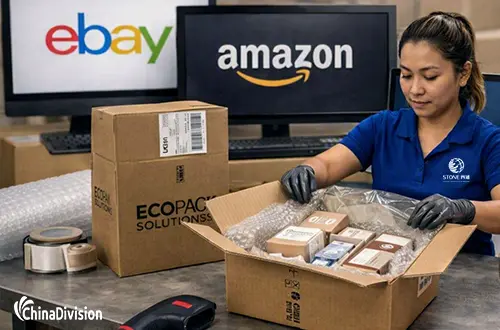
Data shows that 61% of online shoppers choose one retailer over another based on delivery options, and 47% prioritize free shipping. DHL’s report found that companies offering express shipping grow 60% faster than those limited to standard delivery.
What Do Shoppers Expect From E‑Commerce Delivery in 2026?
Shoppers expect multiple delivery choices at checkout, accurate delivery promises, real‑time tracking, and convenient return options—often more than they expect from the product page itself. Delivery experience has become a primary conversion and loyalty lever.
Key Consumer Expectations
| Damage Pattern | Likely Packaging Problem | Corrective Action |
|---|---|---|
| Cracked corner | Insufficient edge protection | Add corner/edge guards |
| Broken rim | Direct impact or inadequate cushioning | Increase localized protection |
| Multiple items collide | Poor internal separation | Add dividers or inserts |
| Glass contacts carton | Insufficient void protection | Increase cushioning or redesign inner carton |
| Crushed carton | Weak outer packaging | Upgrade carton strength |
| Product shifts | Excessive internal void | Improve fit and void fill |
| Surface scratches | Direct contact or abrasive material | Add surface-protection layer |
| Liquid leakage | Broken container or failed closure | Add secondary containment and closure checks |
Industry analysis shows delivery options at checkout directly influence conversion, and omnichannel plus out‑of‑home delivery is becoming the operational default in many markets.
Key Challenges in Scaling Cross-Border E-Commerce Logistics
While marketplace giants maintain localized distribution centers around the world, independent e-tailers face severe structural hurdles when scaling global shipping operations internally:
| Operational Challenge | Internal In-House Handling Risk | 3PL Solution (ChinaDivision Advantage) |
|---|---|---|
| Global Shipping Costs | High retail carrier rates, unexpected surcharges | Bulk-negotiated regional rates & multi-carrier rate shopping |
| System Order Visibility | Fragmented carrier tracking, high support inquiry loads | API-first tracking auto-synced across Shopify, Amazon & custom OMS |
| Inbound Quality Control | High return rates due to factory defects shipped to buyers | China-side receiving inspections & pre-shipment SKU verification |
| Cross-Border Returns | Prohibitive shipping fees for reverse logistics back to origin | Centralized receiving, quality audits, re-labeling & restocking |
Why Delivery Experience Drives Repeat Purchases and Loyalty
A good delivery experience materially increases the likelihood of repeat purchase because it builds trust between brand and consumer. Research cited by Metapack indicates customers were 87% more likely to return to a business after a good delivery experience.
How Delivery Builds Trust
- Reliability: Orders arrive when promised, in good condition.
- Transparency: Customers see order status and tracking without chasing support.
- Control: Shoppers can choose delivery speed, location, and return method.
- Recovery: Issues are resolved quickly with clear communication.
Operational insight: Delivery is not a back‑office function; it is part of your brand promise. A late or damaged order can undo months of marketing investment.
How Does a 3PL Solve E‑Commerce Fulfillment Needs?
A 3PL solves e‑commerce fulfillment needs by providing warehousing, technology, labor, carrier relationships, and process discipline that most brands cannot cost‑effectively build in‑house. The 3PL becomes your physical fulfillment engine while you focus on product, marketing, and growth.
Core 3PL Capabilities
| Capability | What the 3PL Does | Benefit to Brand |
|---|---|---|
| Receiving and storage | Unloads, counts, inspects, and stores inventory in a WMS | Accurate, sellable stock ready for orders |
| Order integration | Connects to Shopify, Amazon, eBay, TikTok Shop, WooCommerce, ERP, OMS | Orders flow automatically to warehouse |
| Pick, pack, ship | Picks by barcode, packs per SKU rules, applies labels, hands to carrier | Fast, accurate fulfillment with tracking |
| Carrier management | Contracts with multiple carriers, selects service by rules | Lower cost, better delivery options |
| Tracking and notifications | Returns tracking to store and customer | Fewer “where is my order” inquiries |
| Returns processing | Receives, inspects, restocks, repairs, or disposes per brand rules | Faster refunds, cleaner inventory |
| Reporting and KPIs | Provides inventory, order, shipping, and returns reports | Data-driven decisions and SLA management |
What Is the End‑to‑End E‑Commerce Fulfillment Workflow?
The end‑to‑end workflow runs from supplier to customer to returns, with each handoff controlled by data, barcode scans, and clear rules. A well‑designed workflow prevents errors before they reach the customer.
Standard Fulfillment Flow
- Inbound planning – Brand sends an Advanced Shipping Notice (ASN) with SKU, quantity, carton, and arrival date.
- Receiving – 3PL unloads, counts, inspects, and logs inventory into the WMS.
- Storage – Inventory is put away into bin, shelf, or pallet locations with barcode control.
- Order creation – Customer places an order on Shopify, marketplace, or B2B portal.
- Order routing – Order data flows to 3PL WMS; carrier and service rules are applied.
- Picking – Warehouse staff pick items by barcode from assigned locations.
- Packing – Items are packed per SKU instructions; labels and inserts are added.
- Shipping – Carrier scans parcel; tracking number returns to store and customer.
- Delivery – Parcel moves through carrier network to customer or pickup point.
- Returns – Returned parcels are received, inspected, and processed per disposition rules.
ChinaDivision differentiator: We treat this as one connected system, not isolated steps. Inventory accuracy, packaging rules, carrier selection, and returns logic are designed together to minimize errors and cost.
How Do You Provide Real‑Time Order Visibility to Customers?
Real‑time visibility requires tight integration between your ecommerce platform, 3PL WMS, and carriers so that every milestone—label created, carrier accepted, in transit, out for delivery, delivered—flows back to the customer.
Visibility Requirements
- Order status sync – Orders move from “received” to “processing” to “shipped” with accurate timestamps.
- Tracking number sync – Tracking numbers and carrier names return to the store immediately after label creation and carrier handoff.
- Customer notifications – Automated emails or SMS inform customers of key milestones.
- Exception alerts – Delays, failed deliveries, or address issues trigger proactive communication.
- Self‑service tracking – Customers can view order status on your site without contacting support.
How Do You Design a Low‑Friction Returns Experience?
A low‑friction returns experience combines clear policy, easy initiation, simple labeling or QR codes, local drop‑off options, and fast inspection and refund processing. Returns are now a core part of the fulfillment journey, not an afterthought.
Returns Best Practices
- Clear policy – State return windows, eligible items, and conditions prominently.
- Self‑service portal – Allow customers to initiate returns and choose refund or exchange.
- Multiple return methods – Offer prepaid labels, QR codes, and out‑of‑home drop‑off where available.
- Fast inspection – Inspect returns quickly and update inventory status.
- Disposition rules – Define restock, refurbish, liquidate, or disposal rules by product type.
- Communication – Notify customers when return is received, inspected, and refunded or replaced.
2026 delivery analyses show returns shifting to out‑of‑home channels faster than deliveries, making flexible return options a competitive advantage.
How Do You Maintain Inventory Accuracy Across Channels?
Inventory accuracy depends on disciplined receiving, barcode‑controlled storage, regular cycle counts, and synchronized updates across all sales channels. Inaccurate inventory leads to overselling, cancellations, and lost trust.
Inventory Control Essentials
- ASN‑driven receiving – Match physical shipments to advance notices before making stock sellable.
- Barcode everywhere – Scan at receiving, put‑away, picking, packing, and shipping.
- Cycle counting – Regularly count subsets of inventory to catch and correct discrepancies.
- Channel synchronization – Ensure Shopify, marketplaces, and B2B portals see the same available quantities.
- Safety stock and alerts – Set reorder points and low‑stock alerts to prevent stockouts.
Industry data shows inventory accuracy can be a weak point (often around 83% in some surveys), while best‑in‑class operations push accuracy toward 99.9%.
ChinaDivision approach: We treat inventory accuracy as the foundation of all other KPIs. If the system does not match the shelf, nothing else works reliably.
How Do You Decide Between In‑House, 3PL, and Hybrid Fulfillment?
The right model depends on order volume, product complexity, capital, growth plans, and desired control. Many brands evolve from in‑house to 3PL or adopt a hybrid model as they scale.
| Model | Best For | Main Limitation |
|---|---|---|
| In-house fulfillment | Small local operations, highly specialized products | Requires space, labor, systems, and peak capacity |
| 3PL fulfillment | Growing ecommerce brands, multi-channel sellers, global expansion | Requires strong onboarding, integration, and SLA management |
| Hybrid fulfillment | Brands mixing DTC, wholesale, and marketplace channels | More complexity in inventory allocation and rules |
A 3PL becomes attractive when logistics work limits growth, delivery quality, or management focus, and when outsourced operations can perform more reliably than internal setups at current or expected scale.
Why Choose ChinaDivision for E‑Commerce Fulfillment?
ChinaDivision helps ecommerce brands, B2B sellers, and marketplace operators meet modern fulfillment needs with integrated warehousing, technology, and carrier solutions—without the capital cost of building their own network.
How ChinaDivision Supports Your Fulfillment Needs
- End‑to‑end workflow – From supplier consolidation and inbound receiving to pick, pack, ship, tracking, and returns.
- Platform and marketplace integration – Connect Shopify, Amazon, eBay, TikTok Shop, WooCommerce, and other channels to our WMS.
- Inventory control – Barcode‑driven receiving, storage, cycle counts, and FEFO/FIFO where required.
- Flexible shipping – Multi‑carrier options, service mapping, and regional delivery strategies.
- Returns management – Inspection, restock, refurbish, liquidate, or dispose according to your rules.
- Reporting and KPIs – Inventory, order, shipping, and returns reports aligned to your SLAs.
- Cross‑border support – Documentation, HS code guidance, and international shipping coordination.
Our Differentiators
- Operational discipline – We design receiving, storage, picking, packing, and shipping as one connected system.
- Data integrity – We prioritize inventory accuracy and clean order data over “fast but messy” fulfillment.
- Scalable network – We help you position inventory strategically as you grow domestically and internationally.
- Brand‑aligned packing – We support branded packaging, inserts, kitting, and subscription fulfillment.
- Transparent partnership – We agree on KPIs, SLAs, and exception workflows up front and review them regularly.
Industry Resources


About the Author: Limi

Limi is a content marketing expert at ChinaDivision, helping businesses and e-commerce sellers navigate the complexities of international shipping by providing actionable tips and comprehensive guides on logistics, shipping, and cargo transportation.