

FEFO vs. FIFO: Which Inventory Rotation Method Should Your Warehouse Use?
Businesses often struggle with inventory spoilage, rising storage costs, and inconsistent customer delivery quality. The choice between FEFO (First Expired, First Out) and FIFO (First In, First Out) directly determines how efficiently a warehouse moves goods, how much waste is generated, and how reliably customers receive safe, high‑quality products.
Table of Contents
- FEFO vs. FIFO: What Is the Difference?
- What Is FIFO (First In, First Out)?
- What Is FEFO (First Expired, First Out)?
- FEFO vs. FIFO: The Most Important Operational Difference Is the Data You Need
- When Should an E-Commerce Business Use FEFO Instead of FIFO?
- FEFO vs. FIFO: A Product-Level Decision Matrix
- A Better FEFO Workflow for International E-Commerce Fulfillment
- What About FIFO for Non-Perishable E-Commerce Products?
- How ChinaDivision Can Support E-Commerce Fulfillment
- FAQ: FEFO vs. FIFO for International Fulfillment
- Choose the Rotation Rule That Matches the Product Risk
FIFO (First In, First Out) ships inventory based on when it entered the warehouse, while FEFO (First Expired, First Out) prioritizes inventory with the earliest expiration date. For products with meaningful shelf-life risk, FEFO is usually the more appropriate operational rule because arrival date and expiration date do not necessarily move together. The right method depends on product characteristics, shelf life, lot structure, customer requirements, and the warehouse system's ability to track expiration data.
For an international e-commerce business, choosing between FEFO vs. FIFO is not simply a warehouse preference. The decision affects inventory aging, write-offs, customer complaints, replenishment decisions, picking accuracy, returns, and ultimately fulfillment cost.
A common mistake is to assume that the oldest inventory is automatically the inventory that should ship first.
That is true under FIFO (First In, First Out).
It is not necessarily true under FEFO (First Expired, First Out).
Consider two batches:
- Batch A arrived on January 10 and expires on December 31.
- Batch B arrived on February 20 but expires on September 30.
A strict FIFO process would prioritize Batch A because it arrived first. A FEFO process would prioritize Batch B because it expires first.
That difference can determine whether inventory is sold normally or becomes short-dated, discounted, returned, or written off.
The wrong inventory rotation method can quietly drain profit margins. Common pain points include:
- Rising expired inventory losses
- Poor stock visibility across multiple global warehouses
- Regulatory compliance risks (especially for food, cosmetics, supplements, pharmaceuticals)
- Customer complaints about old stock, short shelf life, or inconsistent product quality
- Difficulty scaling operations without advanced tracking systems
FEFO vs. FIFO: What Is the Difference?
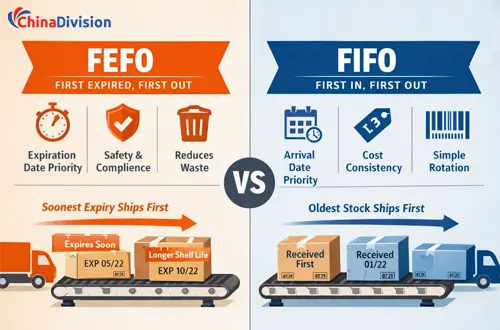
FIFO prioritizes inventory by receipt date, while FEFO prioritizes inventory by expiration date. FIFO is primarily an arrival-based rotation method; FEFO is a shelf-life-based rotation method.
| Factor | FIFO | FEFO |
|---|---|---|
| Full name | First In, First Out | First Expired, First Out |
| Primary rule | Ship the oldest received inventory first | Ship the inventory with the earliest expiration date first |
| Main data field | Receipt date / inventory age | Expiration date |
| Best suited to | Stable, non-perishable inventory | Products with meaningful shelf-life constraints |
| Typical products | Apparel, electronics, accessories, durable goods | Food, supplements, cosmetics with expiry dates, pharmaceuticals |
| Main objective | Maintain stock rotation | Reduce expiry and short-dated inventory risk |
| Lot tracking importance | Useful | Usually critical |
| Expiration-date tracking | Not necessarily required | Required for effective execution |
| Warehouse complexity | Lower | Higher |
| Risk if incorrectly applied | Older stock can remain unnecessarily long | More operational controls are required |
| Key KPI | Inventory age / turnover | Remaining shelf life / expiry exposure |
The fundamental distinction is simple:
FIFO asks, “Which inventory arrived first?” FEFO asks, “Which inventory expires first?”
Those are two different questions.
What Is FIFO (First In, First Out)?
FIFO means the first inventory received is prioritized for picking before inventory received later.
Suppose a warehouse receives:
- 1,000 units on March 1
- 1,000 units on April 1
- 1,000 units on May 1
Under FIFO, the March inventory should normally be picked before the April inventory, and April before May.
This creates a straightforward inventory rotation sequence:
March receipt → April receipt → May receipt → customer order
FIFO is particularly practical when inventory does not have a meaningful expiration date or when product aging is primarily related to how long it has been stored.
Where FIFO works well
FIFO can be appropriate for:
- Apparel
- Home goods
- Consumer electronics
- Accessories
- Packaging materials
- Durable consumer products
- Products with very long or stable shelf lives
For these products, receiving date may be a useful proxy for inventory age.
For example, an apparel SKU may not have an expiration date, but holding one batch for 18 months while a newer batch is continuously shipped can create inventory-aging and obsolescence problems.
The limitation of FIFO
FIFO becomes less reliable when arrival date does not predict remaining shelf life.
This is common when:
- Different suppliers manufacture the same SKU at different times.
- A supplier ships older and newer batches together.
- Manufacturing dates vary significantly between lots.
- Products have different expiration dates.
- Shelf-life extensions or retesting affect individual batches.
- Inventory is transferred between warehouses.
- Products spend different amounts of time in transit before receiving.
ASCM specifically describes FEFO as a methodology developed for shelf-life-controlled inventory because FIFO does not always correspond with expiration dates.
That is the point at which simply rotating by receipt date can create avoidable inventory risk.
What Is FEFO (First Expired, First Out)?
FEFO means the inventory with the earliest expiration date is prioritized for picking, regardless of when that inventory entered the warehouse.
For example:
| Batch | Received | Expiration | FIFO Priority | FEFO Priority |
|---|---|---|---|---|
| A | Jan. 10 | Dec. 31 | 1 | 3 |
| B | Feb. 5 | Oct. 31 | 2 | 2 |
| C | Mar. 15 | Aug. 31 | 3 | 1 |
FIFO selects A first because A arrived first.
FEFO selects C first because C expires first.
This distinction becomes particularly important when a fulfillment center handles multiple production lots of the same SKU.
Why FEFO matters for international fulfillment
International fulfillment adds another layer of complexity.
Inventory may spend days or weeks moving through:
Supplier → export warehouse → international transport → customs → destination warehouse → customer
The warehouse cannot simply look at the date the inventory arrived at its facility.
It needs to understand how much usable shelf life remains at the time of fulfillment.
For example, a supplement with a 12-month shelf life may arrive at a China warehouse with 11 months remaining. After ocean transportation and destination receiving, the customer may receive it with substantially less remaining shelf life.
The relevant operational question is therefore not just:
“How old is this inventory?”
It is:
“How much commercially usable shelf life remains when we ship it?”
FEFO vs. FIFO: The Most Important Operational Difference Is the Data You Need
FIFO can often be executed from receipt-date data, while FEFO requires reliable lot-level expiration data and a warehouse system capable of using that data during picking.
This is one of the most important differences for a business evaluating a 3PL.
A warehouse may claim to support FEFO, but effective FEFO requires more than putting an “expiration date” column into an inventory spreadsheet.
At minimum, the warehouse should be able to associate:
SKU + lot/batch + quantity + receipt date + expiration date + warehouse location
with the physical inventory.
For regulated or shelf-life-sensitive products, additional information may also be relevant depending on the product and market, such as manufacturing date, retest date, storage conditions, or regulatory identifiers.
FDA guidance illustrates why expiration data matters for regulated products: expiration dates represent the period during which a product is expected to retain specified quality characteristics when stored according to labeled conditions.
When Should an E-Commerce Business Use FEFO Instead of FIFO?
Use FEFO when expiration date materially affects the product's usability, compliance, customer acceptance, or economic value.
FEFO is particularly relevant for:
- Food and beverages
- Dietary supplements
- Pharmaceuticals
- Certain cosmetics and personal-care products
- Beauty products with manufacturer-assigned expiration or shelf-life requirements
- Some chemicals
- Medical products
- Products with customer-specific minimum remaining shelf-life requirements
For durable goods such as apparel, furniture, many electronics accessories, and ordinary household products, FIFO may be sufficient unless another product-aging rule applies.
However, product classification should not be based solely on the product category.
Two products in the same category can require different inventory rules.
For example, one cosmetic SKU may have a clearly controlled shelf-life requirement while another may be managed primarily through batch information and manufacturer guidance.
FEFO vs. FIFO: A Product-Level Decision Matrix
| Product Situation | Recommended Rotation Logic | Why |
|---|---|---|
| No expiration date and low obsolescence risk | FIFO | Simple inventory rotation is usually sufficient |
| No expiration date but fashion/technology obsolescence | FIFO + aging controls | Receipt age helps identify older stock |
| Clearly defined expiration dates | FEFO | Expiry date is the key risk variable |
| Multiple lots with different expiration dates | FEFO | Arrival order may not match expiry order |
| Short remaining shelf life | FEFO + minimum shelf-life rule | Prevents unsuitable customer shipments |
| Regulated products | FEFO + lot traceability | Expiration and lot information can be operationally critical |
| Mixed bundles with shelf-life-sensitive items | FEFO at component level | One expired component can compromise the bundle |
| Products without expiry but with seasonal demand | FIFO + demand/aging controls | Inventory age and seasonality matter |
| Products with customer-specific shelf-life requirements | FEFO + allocation rules | Earliest-expiry stock may not satisfy every customer |
A Better FEFO Workflow for International E-Commerce Fulfillment
Effective FEFO starts at receiving, not at the picking station.
A practical workflow is:
1. Capture lot and expiration information at receiving
When inventory arrives, the warehouse should record the relevant lot/batch and expiration information.
Do not wait until the first customer order to discover that different lots have different expiry dates.
2. Separate inventory when necessary
If two lots have materially different expiration dates, physically separating them can reduce picking errors.
3. Store expiration data at SKU-lot level
The warehouse management system should associate the expiration date with the specific inventory lot rather than only the SKU.
4. Generate FEFO pick instructions
When an order is released, the system should identify the appropriate lot according to the configured FEFO rule.
5. Scan the physical inventory
Barcode or location scanning helps confirm that the picker has selected the intended lot.
6. Apply minimum shelf-life rules
Some customers may require inventory to have a minimum remaining shelf life at shipment.
This is different from simply choosing the earliest expiration date.
For example:
Customer requirement: minimum 90 days remaining at shipment.
If a lot has only 60 days remaining, it may be the earliest-expiring lot but still be unsuitable for that order.
7. Monitor short-dated inventory
Create an exception queue for inventory approaching a defined threshold.
Possible actions include:
- promotional allocation,
- accelerated sales,
- customer/channel allocation,
- supplier discussion,
- return-to-vendor evaluation,
- controlled disposal where required.
8. Audit inventory physically
Periodically compare system expiration data with physical labels.
A FEFO system is only as reliable as the underlying inventory data.
What About FIFO for Non-Perishable E-Commerce Products?
FIFO is still highly useful.
A common mistake is to conclude that FEFO is a “better” version of FIFO for every warehouse.
It is not.
If a seller handles phone accessories, apparel, household goods, or other products without meaningful expiration dates, implementing full FEFO infrastructure may add unnecessary operational complexity.
For these products, FIFO can provide:
- predictable inventory rotation,
- easier warehouse execution,
- lower process complexity,
- better visibility into aging inventory,
- reduced risk of very old stock remaining untouched.
However, another method may sometimes be more appropriate.
For example, products with serial numbers, high-value electronics, customer-specific allocations, or strict lot requirements may require additional picking rules beyond FIFO.
The correct question is therefore:
What characteristic determines which inventory should ship first?
If it is receipt age, FIFO may fit.
If it is expiration date, FEFO is more appropriate.
If it is serial number, customer allocation, condition, or another attribute, a different rule may be necessary.
How ChinaDivision Can Support E-Commerce Fulfillment
For B2B e-commerce sellers, inventory rotation should be connected to the broader fulfillment system rather than treated as an isolated warehouse task.
ChinaDivision describes its warehouse operation as using a customized warehouse management system for receiving, inventory control, and real-time inventory visibility. Its integration tools also support order, inventory, and tracking synchronization across e-commerce platforms.
For Shopify sellers, ChinaDivision's integration can automatically synchronize orders and SKU information and return fulfillment and shipping data to the store.
This matters because inventory rotation works best when warehouse inventory data, order data, SKU data, and fulfillment execution are connected.
For B2B brands selling internationally, the objective should not simply be to find a warehouse that stores inventory. It should be to build a fulfillment process that can:
- receive inventory accurately,
- maintain SKU and lot-level visibility,
- apply appropriate rotation rules,
- identify aging inventory,
- connect orders to warehouse execution,
- synchronize inventory with sales channels,
- and support international shipping at scale.
If you are evaluating a 3PL for international e-commerce fulfillment, ChinaDivision can help you design the warehouse and order-fulfillment workflow around your product characteristics rather than forcing every SKU into the same inventory rule.
FAQ: FEFO vs. FIFO for International Fulfillment
Can a warehouse use both FIFO and FEFO?
Yes. A warehouse can use FIFO for some SKUs and FEFO for others. A business may also use additional rules such as minimum remaining shelf life, customer allocation, or serial-number control.
Does FIFO prevent products from expiring?
Not necessarily. FIFO reduces aging based on receipt sequence, but it cannot guarantee that the shortest-dated lot is shipped first when expiration dates differ between lots.
Should every e-commerce warehouse use FEFO?
No. The correct inventory rotation method depends on the product. Use the attribute that actually determines which inventory should ship first: receipt date for FIFO, expiration date for FEFO, or another controlled attribute where appropriate.
Choose the Rotation Rule That Matches the Product Risk
FIFO and FEFO solve different inventory problems. FIFO rotates stock according to when it arrived; FEFO rotates stock according to when it expires.
For durable products, FIFO can provide a simple and effective stock-rotation framework.
For products where remaining shelf life affects safety, compliance, customer acceptance, or financial value, FEFO provides a more direct connection between warehouse picking and product risk.
For international e-commerce, the strongest approach goes one step further:
Do not manage inventory only by how long it has been in the warehouse. Manage it according to how much commercially usable life remains.
That requires accurate receiving, lot-level visibility, appropriate WMS rules, physical picking discipline, minimum-shelf-life controls, and reporting that lets the seller identify risk before inventory becomes unsellable.
For B2B brands scaling across Shopify, Amazon, crowdfunding, and other international channels, working with a fulfillment provider that can connect inventory data with order execution is often more valuable than simply choosing between the words “FIFO” and “FEFO.”
ChinaDivision provides international warehousing, inventory management, e-commerce integrations, and fulfillment infrastructure designed to connect these operational layers. Explore ChinaDivision's warehousing and fulfillment services
For sellers that need integrated order and inventory synchronization, its e-commerce fulfillment integration supports platforms including Shopify, Amazon, WooCommerce, eBay, and others.


About the Author: Limi

Limi is a content marketing expert at ChinaDivision, helping businesses and e-commerce sellers navigate the complexities of international shipping by providing actionable tips and comprehensive guides on logistics, shipping, and cargo transportation.