

E-commerce Order Fulfillment API Integration: Automate Real-Time Order Sync
For e-commerce businesses selling across multiple platforms, the biggest fulfillment challenge is often not shipping itself—it is the delay between receiving an order and getting that order into the fulfillment system.
Table of Contents
- E-commerce Order Fulfillment API workflow
- Why Real-Time Order Synchronization Matters
- Which E-commerce APIs Can Connect to a Fulfillment Provider?
- The Role of Fulfillment and Shipping APIs
- How API Integration Reduces Order Processing Delays
- How to Select the Right Fulfillment API Integration
- Automate Your E-commerce Fulfillment with ChinaDivision
When orders from Shopify, WooCommerce, Amazon, eBay, or other sales channels must be manually exported, checked, and entered into a warehouse or logistics system, businesses face unnecessary delays, data-entry errors, inventory discrepancies, and higher operating costs.
An e-commerce order fulfillment API solves this problem by connecting online stores and sales channels directly with a fulfillment provider's warehouse and logistics systems. Orders can be synchronized automatically, inventory can be updated in real time, and tracking information can be returned to the original sales channel without repetitive manual work.
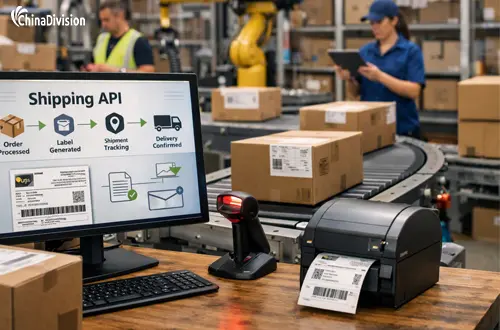
For businesses that want to scale international fulfillment, the right combination of e-commerce APIs, logistics APIs, and platform plugins can create a more efficient end-to-end order processing workflow.
E-commerce Order Fulfillment API workflow
Customer places an order → Order data is synchronized → Warehouse receives the order → Products are picked and packed → Shipment is created → Tracking information is returned to the sales platform
Depending on the integration, the API can synchronize:
- Customer and shipping information
- Product and SKU data
- Order details
- Inventory levels
- Order status
- Shipping methods
- Tracking numbers
- Fulfillment status
- Return information
This allows businesses to build a connected order fulfillment process rather than managing each step manually.
Why Real-Time Order Synchronization Matters
1. Reduce Manual Data Entry
Without integration, employees may need to export orders from an e-commerce platform and manually upload or enter them into a fulfillment system.
This process can create:
- Duplicate data entry
- Incorrect addresses
- Incorrect SKU information
- Delayed order processing
- Human errors during busy periods
API-based order synchronization eliminates many of these repetitive tasks by transferring order data automatically.
2. Process Orders Faster
When an order is transmitted to the fulfillment center immediately after payment or order confirmation, warehouse operations can begin sooner.
This reduces the time between:
Order Received → Order Processed → Order Shipped
Faster processing is particularly important for:
- DTC e-commerce brands
- Dropshipping businesses
- Subscription businesses
- Crowdfunding campaigns
- Seasonal sellers
- High-volume marketplace sellers
3. Improve Inventory Accuracy
Real-time inventory synchronization helps connect inventory data between the warehouse and sales channels.
When products are sold across multiple channels, disconnected inventory systems can create overselling problems.
For example, a business may sell the same SKU through:
- Shopify
- Amazon
- WooCommerce
- eBay
- Its own website
An integrated fulfillment system can update inventory across these channels after an order is processed, helping merchants maintain more accurate stock information.
4. Improve Order Visibility
API integration can provide visibility across the complete fulfillment process.
Businesses can monitor whether an order is:
- Received
- Being processed
- Awaiting inventory
- Picked
- Packed
- Shipped
- In transit
- Delivered
- Returned
This allows merchants and customer service teams to respond to customer questions more quickly.
Which E-commerce APIs Can Connect to a Fulfillment Provider?

The best integration method depends on the platform where orders are generated and the level of automation required.
Shopify API Integration
The Shopify API can connect a Shopify store with a fulfillment provider's system.
A typical workflow includes:
- A customer places an order on Shopify.
- The order is sent to the fulfillment system.
- The warehouse receives the order automatically.
- Inventory is updated according to fulfillment activity.
- The order is picked, packed, and shipped.
- Tracking information is synchronized back to Shopify.
For Shopify merchants, API integration is particularly useful when order volume is growing and manual order processing is becoming inefficient.
WooCommerce API Integration
WooCommerce provides a flexible API environment that allows online stores to connect with external fulfillment, warehouse, ERP, and logistics systems.
WooCommerce merchants can use integration to synchronize:
- Orders
- Products
- Customer details
- Inventory
- Fulfillment status
- Tracking information
For businesses that do not have an internal development team, a WooCommerce fulfillment plugin can be a more practical option than developing a custom integration from scratch.
Amazon and Marketplace Integration
Marketplace sellers often manage large order volumes across multiple channels.
Connecting marketplace orders with a fulfillment provider can help automate:
- Order import
- Inventory updates
- Shipping confirmation
- Tracking synchronization
This is particularly valuable for sellers operating across multiple marketplaces and geographic regions.
Custom API Integration
Standard platform integrations may not be sufficient for every business.
Companies with complex workflows may need a custom API integration connecting:
- ERP systems
- WMS platforms
- OMS systems
- Custom e-commerce platforms
- B2B ordering portals
- Internal inventory systems
A custom integration can be designed around the company's existing technology architecture and operational requirements.
For example, a global publishing business may need a customized system connecting its sales channels, inventory management software, warehouse operations, and fulfillment provider. In this situation, a bespoke API can automate order transmission, inventory synchronization, fulfillment updates, and tracking information.
The Role of Fulfillment and Shipping APIs
APIs act as the bridge between your e-commerce platform and logistics infrastructure. Instead of operating in silos, your systems communicate automatically.
Core capabilities of fulfillment and shipping APIs:
- Order synchronization: Automatically push orders from platforms like Shopify, Amazon, or WooCommerce to your warehouse.
- Inventory synchronization: Maintain real-time stock levels across multiple channels.
- Shipping automation: Generate labels, select carriers, and calculate shipping rates instantly.
- Tracking visibility: Provide end-to-end shipment tracking to both merchants and customers.
- Returns management: Handle reverse logistics efficiently.
A strong API setup transforms fulfillment from a manual workflow into a fully automated pipeline.
How API Integration Reduces Order Processing Delays
Manual fulfillment workflows often contain several points where delays can occur.
For example:
Customer Order → Manual Export → Data Verification → Manual Upload → Warehouse Processing
Each additional manual step increases the possibility of delay or error.
With API integration, the process can become:
Customer Order → Automatic API Synchronization → Warehouse Processing
This can help reduce:
- Order processing time
- Manual data entry
- Duplicate work
- Communication delays
- Order status errors
For high-volume businesses, even a small reduction in processing time per order can create significant operational benefits.
How to Select the Right Fulfillment API Integration
Before choosing an API or plugin, businesses should evaluate the following factors.
Platform Compatibility
Check whether the integration supports your primary sales channels, such as Shopify, WooCommerce, Amazon, eBay, or other platforms.
Real-Time Synchronization
Determine whether the system supports real-time or scheduled synchronization for:
- Orders
- Inventory
- Fulfillment status
- Tracking information
Scalability
The integration should be able to support future business growth and increased order volume.
Data Security
API authentication, encrypted data transmission, and appropriate access controls are important when transferring customer and order information.
Customization
If your business has unique workflows, make sure the integration can support custom data fields and business rules.
Technical Support
Reliable technical and fulfillment support is important when integration issues affect live orders.
Automate Your E-commerce Fulfillment with ChinaDivision
As e-commerce businesses grow, manual order processing becomes increasingly difficult to manage.
An integrated fulfillment solution can connect your sales channels, inventory systems, warehouse operations, and logistics network into a more efficient workflow.
Whether you need a standard e-commerce plugin, an order fulfillment API, or a customized integration connecting your existing business systems, ChinaDivision can help you build a more automated fulfillment process.
With real-time order synchronization, automated inventory updates, and integrated fulfillment operations, businesses can reduce manual processing, minimize errors, improve order visibility, and scale international fulfillment more efficiently.
Ready to reduce manual order processing and automate your fulfillment workflow? Contact ChinaDivision to discuss the right e-commerce API, plugin, or custom fulfillment integration for your business.
Read more on related topics:
How Fulfillment Velocity by 40% Using Chinadivision Bespoke API
Unlock Automated Order Processing With the Shopify Fulfillment API
How Does Shipping Api Reshape Global Supply Chain Efficiency?


About the Author: Limi

Limi is a content marketing expert at ChinaDivision, helping businesses and e-commerce sellers navigate the complexities of international shipping by providing actionable tips and comprehensive guides on logistics, shipping, and cargo transportation.