

Order Management System (OMS): Benefits, Features & Best Practices
Learn what an Order Management System (OMS) is, how it works, why B2B and e-commerce businesses will need it in 2026, and when to adopt it.
Table of Contents
- What Is an Order Management System (OMS)?
- OMS vs. WMS vs. ERP: What's the Difference?
- When Should You Adopt an OMS? 5 Clear Signals
- 4 Ways an OMS Transforms Your Business
- How an Order Management System Works: The 4-Stage Workflow
- Key Benefits of Using an OMS
- OMS vs Traditional Order Processing
- Integration with Fulfillment and Shipping APIs
- Why Chinadivision Is the Ideal OMS‑Enabled Fulfillment Partner
- Industry Use Cases: Real Results
- Frequently Asked Questions (FAQ)
- Is an OMS Worth It?
What Is an Order Management System (OMS)?
An Order Management System (OMS) is the operational backbone that tracks, processes, and fulfills orders across your entire business. It sits at the intersection of your sales channels, inventory, warehouse, and shipping — turning chaotic multi-channel order flows into a single, manageable stream.
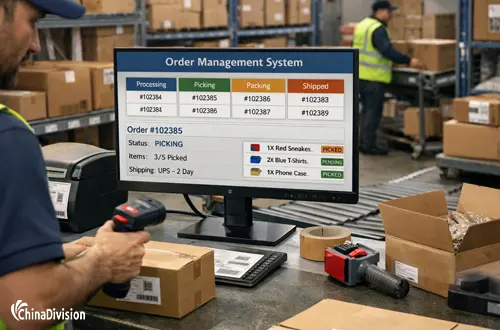
Unlike basic order tracking in your e-commerce platform or ERP, a dedicated OMS provides end-to-end visibility: from the moment a customer clicks "Buy" on Shopify, Amazon, or your B2B portal, through inventory allocation, warehouse picking, shipping, and returns. It's the single source of truth for where every order is, what inventory you have, and what needs attention right now.
Global e-commerce order volume is projected to surpass 217 billion parcels annually by 2026 , and retailers are operating across more channels and fulfillment nodes than ever before. Companies using an OMS reduce order-to-ship time by 49% and achieve 99.5%+ order accuracy — directly translating to higher customer lifetime value and lower operational costs.
OMS vs. WMS vs. ERP: What's the Difference?
One of the most common points of confusion is how an OMS differs from a WMS or ERP. Here's the breakdown:
| Metric / Function | Order Management System (OMS) | Warehouse Management System (WMS) | Enterprise Resource Planning (ERP) |
|---|---|---|---|
| Primary Focus | Order lifecycle, multi-channel routing & tracking | Physical warehouse picking, bin locations & packing | Financials, procurement, accounting & HR |
| Key Users | E-commerce ops, customer service, supply chain teams | Warehouse managers, pickers & packers | CFOs, accountants, executive management |
| Main Advantage | Eliminates overselling & speeds up order-to-ship times | Optimizes physical warehouse layout & staff efficiency | Centralizes enterprise financial reporting |
The ERP records that a sale happened; the OMS decides how that sale gets fulfilled accurately and profitably; the WMS executes the physical picking, packing, and shipping on the warehouse floor.
The practical pattern for mid-market e-commerce: ERP as the financial backbone, OMS controlling order flow, and WMS executing in the warehouse — with clean integrations between all three.
When Should You Adopt an OMS? 5 Clear Signals
You don't need an OMS from day one — but ignoring the signals for too long can choke your growth. Here are the five clear indicators:
- Order volume exceeds 100/day — manual processing starts breaking down, and error rates compound.
- You sell on 2+ channels (e.g., Shopify + Amazon + wholesale) and inventory sync is a daily headache.
- Returns exceed 10% and reverse logistics is manual, slow, and error-prone.
- Order management tasks consume 20%+ of your team's time — time better spent on growth, not data entry.
- B2B customers demand PO integration, credit terms, and custom pricing — basic e-commerce tools can't handle this complexity.
4 Ways an OMS Transforms Your Business
1. Automation That Actually Saves Time
Manual order entry is the silent profit killer in logistics. For every 100 orders, a team spends roughly 4–6 hours on data entry, cross-referencing inventory, and generating shipping labels. An OMS automates this entire workflow: orders flow from sales channels directly into the system, inventory is allocated based on pre-set rules (nearest warehouse, FIFO, reserved stock), and shipping labels are generated automatically.
For a mid-market B2B distributor processing 500+ orders daily, this alone can free up 25+ hours of staff time per week. Automation isn't about replacing people — it's about letting your team focus on exceptions and growth instead of repetitive data entry.
2. Drastically Reduced Human Error
Studies show that manual order processing has an error rate between 1–3% — which sounds small until you're shipping 10,000 orders a month. That's 100–300 wrong items, wrong addresses, or wrong quantities every month. Each error costs $15–50 in return shipping and processing, not counting the lost customer.
An OMS virtually eliminates these errors through barcode scanning validation, address verification, and automated picking rules. The result: 99.5%+ order accuracy that protects both your margins and your reputation.
3. Real-Time Data That Drives Decisions
Spreadsheets and gut feelings don't scale. A modern OMS gives you a live dashboard of orders by status, inventory levels by warehouse, fulfillment costs per order, and channel performance — all updated in real time.
For B2B operations, this means you can answer customer questions instantly: "Where is my PO?" becomes a 10-second lookup instead of three emails and a phone call. For e-commerce sellers, you can see which channels are most profitable and adjust your strategy accordingly.
4. A Customer Experience That Wins Loyalty
In the age of Amazon Prime, customers expect to know exactly where their order is and when it will arrive. An OMS provides branded tracking pages, proactive status notifications, and faster resolution when things go wrong.
This isn't just nice-to-have — it directly impacts your bottom line:
- 93% of customers want proactive order updates
- Businesses that provide them see a 25% reduction in "where is my order" support tickets
How an Order Management System Works: The 4-Stage Workflow
An OMS operates as a central hub connecting four critical workflows:
| Stage | What Happens |
|---|---|
| 1. Order Capture & Validation | Orders are automatically pulled from all connected channels (Shopify, Amazon, B2B portals, EDI) and validated: Are items in stock? Is the address complete? Are payment terms met? Invalid orders are flagged for review, while valid orders proceed instantly. |
| 2. Inventory Allocation & Routing | The OMS checks real-time inventory across all locations and applies routing rules, such as selecting the nearest warehouse, splitting shipments when necessary, and reserving stock for VIP or B2B accounts. Inventory is updated immediately to prevent overselling. |
| 3. Order Fulfillment & Shipping | Picking lists are sent to the warehouse, shipping labels are generated using the most suitable carrier and rate, and tracking information is synchronized back to the sales channels. Customers receive automated notifications throughout the fulfillment process. |
| 4. Returns & Reverse Logistics | When a return is initiated, the OMS creates a return label, tracks the product back to the warehouse, supports inspection and restocking, and processes refunds or exchanges. For B2B businesses, it also manages RMA workflows, credit memos, and purchase order adjustments. |
Key Benefits of Using an OMS
Implementing an OMS delivers measurable operational and financial improvements:
- Improved order fulfillment efficiency through automation and workflow standardization.
- Real-time inventory visibility across multiple warehouses and sales channels.
- Faster order processing and reduced order-to-ship time.
- Lower operational costs by minimizing manual work and errors.
- Better customer experience with accurate delivery timelines and tracking updates.
For example, a multi-channel seller using an OMS can automatically route orders to the nearest warehouse, reducing shipping time and cost simultaneously.
OMS vs Traditional Order Processing
Traditional order management methods rely heavily on manual input and disconnected tools, which limit scalability.
Key differences include:
- Manual vs automated workflows: OMS eliminates repetitive data entry.
- Delayed updates vs real-time synchronization: OMS provides instant system-wide updates.
- Fragmented systems vs centralized control: OMS connects all channels and operations.
- Limited reporting vs data-driven insights: OMS offers real-time analytics and dashboards.
This shift is critical for businesses aiming to scale efficiently.
Integration with Fulfillment and Shipping APIs
An OMS becomes significantly more powerful when integrated with fulfillment and shipping APIs.
These integrations enable:
- Automatic order synchronization from platforms like Shopify, Amazon, and WooCommerce.
- Real-time shipping rate comparison and carrier selection.
- Instant label generation and tracking updates.
- Seamless communication between OMS, WMS, and logistics providers.
For example, once an order is placed, the OMS can instantly trigger warehouse fulfillment and push tracking details back to the customer without manual intervention.
Why Chinadivision Is the Ideal OMS‑Enabled Fulfillment Partner.
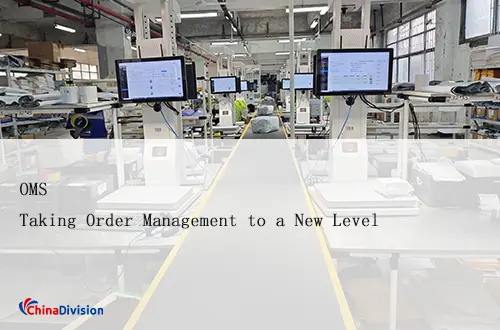
Chinadivision provides:
- Real‑time OMS integration
- Multi‑warehouse fulfillment
- Automated picking & packing
- API connectivity with Shopify, Amazon, WooCommerce
- Global shipping with full tracking
- Dedicated B2B support for PO workflows
Industry Use Cases: Real Results
B2B Wholesale Distributor
A midwest industrial parts distributor with 2,000+ SKUs and 150 B2B accounts switches from spreadsheets to an OMS. Results within 6 months:
- Order-to-ship time: 3 days → 4 hours
- Inventory accuracy: 87% → 99.2%
- "Where's my order?" calls: ↓ 60%
DTC E-Commerce Brand
A fast-growing Shopify brand managing $5M/year across 4 sales channels implements an OMS. Benefits:
- Inventory overselling: eliminated
- Returns processing: 3x faster
- Founder time saved: 15 hours/week previously spent reconciling orders
Multi-Channel Retailer
A home goods retailer selling on Amazon, Walmart, their own site, and two wholesale platforms centralizes operations with an OMS. They discover their own website has the highest profit margin (no marketplace fees), shift ad spend accordingly, and grow DTC revenue 40% year-over-year — an insight invisible without unified analytics.
3PL / Fulfillment Provider
A third-party logistics provider serving 30+ merchant clients deploys an OMS with a client portal. Merchants get real-time inventory visibility without calling the warehouse, and the 3PL reduces client onboarding from 3 weeks to 3 days — becoming a competitive advantage in RFPs.
People Also Ask (FAQ)
Q: What's the difference between an OMS, WMS, and ERP?
An OMS manages the order lifecycle (capture, routing, fulfillment, returns). A WMS handles physical warehouse operations (bin locations, picking paths, labor management). An ERP is the financial backbone — accounting, procurement, HR. Most growing businesses need all three, but an OMS is the logical first step if orders are the bottleneck .
Q: Can Shopify's built-in order management replace a dedicated OMS?
For single-channel sellers under 50 orders/day, Shopify's native tools are sufficient. Once you add a second channel, need inventory sync, or handle B2B orders, you'll outgrow Shopify's capabilities quickly. The tipping point is usually when you start using spreadsheets to fill gaps .
Q: Can an OMS handle international orders?
Yes — but verify these capabilities before buying: multi-currency pricing, landed cost calculation (duties + taxes built into customer price), international carrier integration, and multi-language tracking pages. Not all OMS platforms support this natively.
Q: Is cloud-based or on-premise OMS better?
In 2026, cloud-based is the default for 95%+ of businesses. On-premise only makes sense for organizations with extreme data sovereignty requirements. Cloud OMS offers faster deployment, automatic updates, and lower upfront cost.
Q: Do I need a technical team to implement an OMS?
Not necessarily. Many modern OMS platforms offer no-code integrations with Shopify, WooCommerce, and BigCommerce via plugins. For custom ERP integrations or bespoke workflows, you'll need developer resources or a vendor implementation partner.
Is an OMS Worth It?
An Order Management System isn't just another piece of software — it's the central nervous system of your order operations. For B2B distributors drowning in spreadsheets, DTC brands scaling across channels, or retailers who can't afford another holiday season meltdown, the right OMS pays for itself within months — not years.
The key isn't finding the "best" OMS. It's finding the one that matches your operational complexity, integrates with your existing stack, and has the flexibility to grow with you. Use the checklist and comparison table above as your evaluation framework, and always run a pilot before committing.
Ready to evaluate OMS platforms for your business? Start by mapping your current order flow, counting your daily orders and SKUs, and calculating your current error rate. The data will tell you exactly where to invest first.
Recommended Industry Resources


About the Author: Limi

Limi is a content marketing expert at ChinaDivision, helping businesses and e-commerce sellers navigate the complexities of international shipping by providing actionable tips and comprehensive guides on logistics, shipping, and cargo transportation.