

Formal Customs Declaration vs. Simplified Customs Declaration
Formal Customs Declaration, also called General Trade Customs Declaration, is the full, compliant process for commercial shipments, supports tax refunds, and applies to high-value or regular trade. Simplified Customs Declaration (also known as Informal Customs Declaration) is streamlined, fast, and for low-value samples, gifts, or non-commercial goods — no tax refund allowed. Choosing correctly ensures compliance, avoids fines, and aligns perfectly with your international warehousing and logistics strategy.
Table of Contents
For most businesses engaged in regular international trade, B2B exports, Amazon FBA shipments, or large-volume orders, Formal Customs Declaration is the preferred and often required option. Choosing the wrong declaration method can result in tax refund losses, customs penalties, delayed clearance, and financial reconciliation issues.
As a professional international warehousing and logistics provider, Chinadivision helps you select, prepare, and file the right declaration — ensuring smooth clearance, safe storage, and reliable global shipping.
Formal Customs Declaration and Simplified Customs Declaration: What Are They?
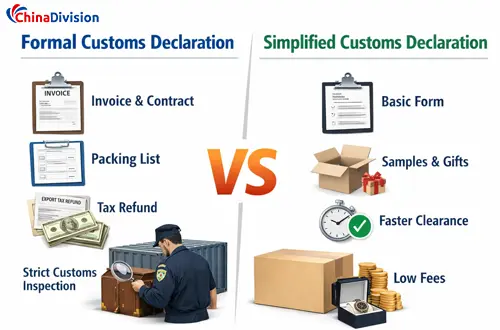
International shipping customs declarations fall into two core categories, each designed for different business needs, shipment values, and trade purposes. Mischoosing leads to delays, financial loss, or compliance risks.
✅ Formal Customs Declaration (General Trade Customs Declaration)
This is the standard, fully regulated method used in official import/export trade. It requires complete documentation, strict data accuracy, and full review by customs authorities. It is legally recognized worldwide, supports export tax refunds, and creates permanent, traceable records — essential for companies with import/export rights and regular trade activities.
⚡ Simplified Customs Declaration (Informal Customs Declaration)
A streamlined, faster process with reduced paperwork and fewer checks. It is intended for non-commercial or low-value shipments, such as samples, gifts, or small parcels. Process is quicker, fees are lower, but you cannot claim tax refunds, and it is not accepted for formal commercial transactions.
Core Differences: Side-by-Side Comparison
Below is a clear breakdown of how they differ — critical for planning your logistics and warehousing flow.
| Comparison Item | Formal Customs Declaration | Simplified Customs Declaration |
|---|---|---|
| Full Name / Alias | General Trade Customs Declaration | Informal Customs Declaration / Sample Declaration |
| Documentation | Complete set: contract, invoice, packing list, authorization, HS codes, certificates | Simplified: basic invoice, short declaration form; no full contract required |
| Tax Refund | ✅ Supported — main benefit for exporters | ❌ NOT allowed — no tax refund eligibility |
| Value Limit | No limit; suitable for high-value goods | Usually ≤ $2,500–$5,000 (varies by country) |
| Inspection Rate | Moderate–high; strict review | Low; faster release |
| Regulatory Oversight | Full compliance, permanent records, fully traceable | Lighter oversight; simplified records |
| Customs Recognition | Accepted worldwide; ideal for international trade | Limited; generally not suitable for formal commercial imports |
| Best For | Regular orders, bulk shipments, branded products, taxable goods | Samples, gifts, promotional materials, small parcels, non-commercial shipments |
1. Formal Customs Declaration (General Trade Customs Declaration)
✔️ What It Is
The most orthodox, compliant, and widely accepted method. Every detail — product name, HS code, value, quantity, origin, and transaction terms — is declared and verified. It is the only type that supports export tax refund, a major cost-saving benefit for traders.
✔️ Required Documents
Commercial invoice (detailed value, brand, model, HS code)
Packing list
Sales contract / purchase order
Customs declaration authorization letter
Product compliance certificates (CE, FDA, etc.)
Trademark/brand authorization (for branded goods)
Certificate of Origin (for tariff benefits)
✔️ Key Advantages
✅ Export Tax Refund: Recover VAT or taxes — critical for profitability
✅ Full Compliance: Accepted globally; no risk of being treated as informal
✅ Smooth Destination Clearance: Highest recognition in EU, US, Southeast Asia
✅ Perfect for Warehousing: Matches bonded storage, inventory management, and long-term logistics plans
✅ Traceability: Full records for audits, finance, and supply chain tracking
✔️ Best Scenarios
Regular commercial orders with payment
High-value goods, branded items, electronics, machinery
Bulk shipments, container loads, repeated trade
Companies with import/export rights
When you need tax refunds or official trade records
2. Simplified Customs Declaration (Informal Customs Declaration)
⚡ What It Is
A fast, low-cost procedure designed to speed up clearance for non-commercial or low-value shipments. Documentation is cut down, and review is lighter. Important: It is legally not for commercial sales.
⚡ Required Documents
Simplified declaration form
Basic invoice or proforma invoice
Packing list (simple)
No full contract or complex authorization needed
⚡ Key Advantages
✅ Fast clearance: 1–2 days vs 3–5 days for formal
✅ Lower fees: Less administrative cost
✅ Less paperwork: Save time and effort
✅ Low inspection rate: Minimal delays
⚡ Limitations
❌ No tax refund — biggest downside
❌ Value cap: Most countries limit to ~$2,500–$5,000
❌ Not for commercial sales: Declaring paid goods as “samples” = risk of fines
❌ Not valid for bonded warehousing or official trade statistics
⚡ Best Scenarios
Free samples, exhibition goods, customer gifts
Advertising materials, brochures, small gifts
Low-value goods without sales contracts
Personal items or small parcels
When you do not need tax refunds
How to Choose: Clear Decision Rules

Choosing wrong causes financial loss, compliance risks, or customs holds. Follow these rules:
✅ Choose Formal Customs Declaration IF:
You have a paid commercial order
Goods value > $2,500–$5,000
You want export tax refund
You store goods in bonded warehouses or use long-term international logistics
You ship branded goods, luxury items, or high-value cargo
You need official records for accounting or audit
⚡ Choose Simplified Customs Declaration IF:
No payment / free of charge
Goods value below threshold
Samples, gifts, promotional items
Small parcels, no commercial invoice required
Tax refund is not needed
⚠️ Critical Warning
Never declare high-value or paid goods as “samples” or use simplified declaration incorrectly.
Consequences: detention, fines (50–200% of value), confiscation, blacklisting
Financial mismatch: invoices vs customs data → audit risk
Branded goods: stricter checks — IP inspection >40% in 2026; wrong declaration = serious penalties
Frequently Asked Questions (B2B Focus)
Q1: Can I switch between formal and simplified declaration for the same client?
Yes — but per shipment basis. Formal for paid orders; simplified only for free/low-value items. We help you categorize correctly.
Q2: What is the value limit for simplified declaration?
Typically ≤$2,500–$5,000 (US/EU/Asia). Exact limits vary by country; we verify before filing.
Q3: If I use simplified, can I still store goods in your warehouse?
Yes — but simplified shipments are usually short-term or express. Formal declaration works best for bonded or long-term storage.
The choice between Formal Customs Declaration and Simplified Customs Declaration depends primarily on shipment value, commercial purpose, and tax refund requirements.
For commercial exports, wholesale orders, Amazon FBA inventory, and tax-refund-eligible shipments, General Trade Customs Declaration remains the safest and most compliant solution.
For low-value samples, gifts, and promotional materials, Informal Customs Declaration offers a faster and more cost-effective alternative.
Selecting the correct declaration method not only ensures compliance but also protects profitability, improves customs clearance efficiency, and supports long-term international business growth.
Need help choosing between Formal Customs Declaration and Simplified Customs Declaration? ChinaDivision's logistics specialists can help you select the most compliant and cost-effective solution while managing your warehousing, fulfillment, customs documentation, and global shipping operations from a single platform.
Choose Chinadivision for Your Global Logistics
Don’t risk your shipments or profits with wrong declarations. We are your full-service partner:
👉 Visit: Chinadivision website
📩 Email: [email protected]
📞 WhatsApp: Chinadivision whatsapp
Recommended Industry Resources
EU Taxation & Customs Union – Declaration Rules
WTO Trade Facilitation Agreement
International Chamber of Commerce – Incoterms & Documentation


About the Author: Limi

Limi is a content marketing expert at ChinaDivision, helping businesses and e-commerce sellers navigate the complexities of international shipping by providing actionable tips and comprehensive guides on logistics, shipping, and cargo transportation.