

How do TMS, WMS, and OMS help with shipping?
TMS, WMS, and OMS are integrated software systems that manage, respectively, transportation, warehousing, and order flow to streamline international shipping. They work best when connected, giving you end-to-end visibility, faster fulfillment, and cost efficiency. Chinadivision can tailor and implement these systems for robust international order fulfillment and freight forwarding.
Table of Contents
Understanding OMS, WMS, and TMS
Order Management System (OMS)
An Order Management System (OMS) acts as the central hub for all incoming orders, whether they originate from an e-commerce store, third-party marketplace, or B2B client portal. It handles everything from order placement and processing to inventory management and customer communication. OMS manages the full lifecycle of an order:
Captures and processes orders in real time across multiple sales channels.
Provides visibility into inventory across warehouses to prevent stockouts.
Determines the optimal fulfillment location based on inventory, delivery timelines, and proximity to the customer.
Tracks order status from placement to shipment, updating customers and internal teams alike.
For businesses shipping internationally, OMS ensures that each order is routed correctly, accounting for customs requirements, regional restrictions, and shipping timelines.
Warehouse Management System (WMS)
A Warehouse Management System (WMS) optimizes warehouse operations, ensuring that inventory is efficiently stored, tracked, and prepared for shipment. By accurately tracking inventory levels and optimizing warehouse space, a WMS enhances overall efficiency. Its core functions include:
Receiving shipments and assigning proper storage locations.
Managing inventory movements to maintain accurate stock levels and reorder points.
Streamlining picking, packing, and fulfillment workflows for warehouse staff.
Optimizing warehouse layout to maximize space utilization and reduce handling time.
For international order fulfillment, WMS ensures that products are accurately prepared for export, reducing delays caused by misplaced stock, compliance issues, or inefficient workflows.
Transportation Management System (TMS)
A Transportation Management System (TMS) is focused on the movement of goods from warehouse to end customer. It handles route optimization, carrier selection, freight booking, and delivery tracking. Its primary responsibilities include:
Selecting the most cost-effective and timely carriers.
Planning optimized delivery routes to reduce transit time and shipping costs.
Tracking shipments in real time, including customs clearance and international freight updates.
Managing freight payments and carrier invoicing for accounting accuracy.
TMS is particularly critical for international shipping, where coordinating multiple carriers, customs regulations, and delivery timelines is complex.
Key differences and functions
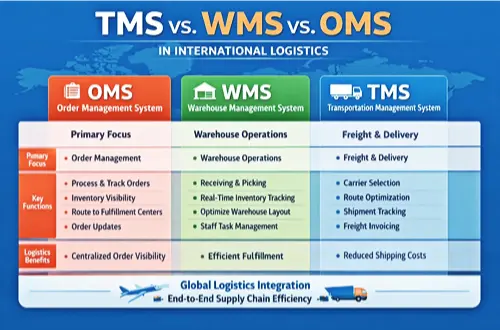
OMS: Central hub for orders from all sales channels; ensures inventory availability across locations; manages order processing, routing, and customer communication from placement to delivery.
WMS: Manages day-to-day warehouse operations; tracks inventory in real time; streamlines receiving, picking, packing, and shipping; optimizes warehouse layout and workflows.
TMS: Manages logistics and transportation; focuses on route optimization, carrier management, freight booking, and delivery tracking; balances speed and cost.
When OMS, WMS, and TMS are integrated?
Enhanced Visibility: Businesses gain a single source of truth for orders, inventory, and shipments.
Streamlined Operations: Automation reduces manual errors and accelerates fulfillment.
Cost Optimization: Better resource allocation lowers transportation and storage costs.
Scalability: Systems adapt easily to new markets, products, and partners.
When a customer places an international order, the OMS captures it, the WMS prepares the items for shipment efficiently, and the TMS ensures it reaches the customer on time, while providing real-time tracking updates.
At Chinadivision, we integrate OMS, WMS, and TMS within our international order fulfillment services, giving B2B clients confidence that their products will be handled efficiently from warehouse to doorstep, regardless of destination.
For international order fulfillment providers like Chinadivision, this integration ensures that B2B clients benefit from faster deliveries, reduced logistics costs, and seamless global expansion.
Why this matters for international shipping?
Complex networks: International fulfillment involves cross-border customs, multiple carriers, and varied service levels. TMS helps optimize international routes and carrier mix; OMS ensures multi-channel order handling; WMS keeps inventory accuracy across warehouses in different countries.
Compliance and documentation: A well-integrated system suite supports accurate packing lists, commercial invoices, HS codes, and other required documents, reducing clearance delays.
Transit reliability: Real-time tracking across modes (air, sea, land) and proactive exception management minimize disruptions and keep customers informed.
The Strategic Benefits of Seamless Integration
Enhanced Global Visibility
Integrating TMS, OMS, WMS, and ERP systems provides end-to-end visibility into the entire international logistics process, from order placement to cross-border delivery. This visibility enables stakeholders to track shipments across oceans and borders, monitor inventory levels across multiple countries, and analyze performance metrics in real-time—empowering them to make informed decisions and proactively address customs delays or port congestion.
Streamlined Cross-Border Operations
By automating data exchange between systems, seamless integration eliminates manual data entry and reduces the risk of errors that cause customs rejections or shipping delays. This streamlines operations, improves accuracy, and accelerates order processing and fulfillment, leading to faster international delivery times and improved customer satisfaction across global markets.
Optimal Resource Utilization
Integration enables better coordination and utilization of resources—transportation assets, international warehouse space, and inventory positioned strategically around the globe. By synchronizing data across systems, businesses can optimize route planning, inventory replenishment, and resource allocation, minimizing international shipping costs and maximizing efficiency across complex supply chains.
Scalability for Global Growth
Integrated systems are more adaptable to changing international business requirements and scale seamlessly as operations expand across borders. With a unified data model and standardized processes, businesses can easily add new products, expand into new markets, or onboard new international partners without disrupting existing operations.
Frequently Asked Questions (FAQ)
Can I integrate my existing Shopify or Amazon store with your systems?
Yes. Professional fulfillment providers like Chinadivision offer plug-and-play integrations. Your Order Management System will automatically sync orders to our WMS for immediate processing.
Can Chinadivision handle multi-channel orders from different platforms?
Yes. Our OMS consolidates orders from ecommerce stores, marketplaces, and apps, providing unified visibility and processing.
How does integration of OMS, WMS, and TMS reduce shipping errors?
Real-time synchronization across these systems ensures accurate order data, precise inventory tracking, and optimized routing, minimizing the risk of delays, mis-shipments, or stockouts.
Can I track international shipments in real time?
Absolutely. Our TMS provides live updates on every shipment, including customs status, carrier location, and expected delivery time.
If you’re seeking reliable international order fulfillment and freight forwarding with robust OMS, WMS, and TMS capabilities, Chinadivision is prepared to design a scalable solution tailored to your business.
By leveraging TMS, WMS, and OMS systems, businesses can significantly improve their shipping operations, ensuring timely and accurate delivery of customer orders. For B2B users looking to optimize their international order fulfillment processes, partnering with an experienced service provider like Chinadivision is the key to success.


About the Author: Limi

Limi is a content marketing expert at ChinaDivision, helping businesses and e-commerce sellers navigate the complexities of international shipping by providing actionable tips and comprehensive guides on logistics, shipping, and cargo transportation.