

How to Calculate Dimensional Weight and Reduce Shipping Costs
For cross-border e-commerce sellers and B2B merchants managing international order fulfillment, few things hurt profit margins more than unexpected "extra weight charges" that show up on your final shipping invoice. What Is Volumetric Weight, And Why Does It Dominate Your Fulfillment Costs?
Table of Contents
- Volumetric Weight: Why Your Lightweight Products Cost More to Ship Internationally
- What Is Volumetric Weight?
- Actual Weight vs Volumetric Weight: What Is the Difference?
- How to Calculate Volumetric Weight
- How Warehousing and Fulfillment Services Help Reduce Volumetric Weight
- Expert Packaging Optimization Tips to Lower Volumetric Weight
- Frequently Asked Questions (Volumetric Weight & Fulfillment)
Volumetric weight (also called dimensional weight) can significantly impact international shipping costs, especially for lightweight and bulky products. This guide explains how carriers calculate volumetric weight, the difference between actual weight and chargeable weight, how to calculate dimensional weight, and how professional fulfillment providers like ChinaDivision help businesses reduce unnecessary shipping expenses through optimized packaging, warehousing, and global fulfillment solutions.
Volumetric Weight: Why Your Lightweight Products Cost More to Ship Internationally
Many eCommerce sellers are surprised when a small shipment costs more than expected because carriers do not always charge based on the actual weight of a package.
A box containing pillows, clothing, plastic products, electronics accessories, or furniture components may only weigh 5 kg, but the carrier may charge based on 15 kg or more.
The reason is Volumetric Weight.
For international order fulfillment, understanding volumetric weight is essential because shipping costs are often determined by the amount of space your products occupy rather than their physical weight.
As a global order fulfillment and warehousing provider, ChinaDivision helps businesses optimize packaging, calculate shipping costs accurately, and reduce unnecessary dimensional weight charges before products leave the warehouse.
What Is Volumetric Weight?
At its core, Volumetric Weight is a billing logic designed by logistics providers to account for the limited space that light but bulky goods occupy in aircraft, trucks and delivery vehicles.
Your shipment will be weighed in two ways: actual weight and volumetric weight. Shipping costs depend on the larger of these two values. If you are sending a shipment that is bulky but lightweight, we will use the volumetric weight for calculation, instead of the far smaller actual weight of the goods.
Instead of charging only based on actual weight, carriers compare:
- Actual weight
- Volumetric weight (also called dimensional weight)
The higher value becomes the chargeable weight.
Actual Weight vs Volumetric Weight: What Is the Difference?
Understanding the difference between actual weight and volumetric weight helps sellers predict international shipping expenses.
Actual Weight: The true mass of the item when placed on a physical scale, measured in kilograms or pounds.
Volumetric Weight: A calculated number that represents the total spatial volume a package occupies relative to its density.
|
Comparison |
Actual Weight |
Volumetric Weight |
|---|---|---|
|
Definition |
Physical weight measured by a scale |
Weight calculated based on package size |
|
Measurement |
Kilograms (kg) |
Cubic dimensions converted into kg |
|
Applies to |
Dense products |
Large lightweight products |
|
Example Products |
Metal parts, books, machinery |
Clothing, cushions, toys |
|
Main Cost Factor |
Product weight |
Space occupied during transportation |
Carriers use volumetric weight because transportation capacity is limited. A lightweight but oversized package occupies the same aircraft or truck space as heavier cargo.
How to Calculate Volumetric Weight
The formula depends on the transportation method and carrier.
Calculate Volumetric Weight for Air Freight
The standard formula:
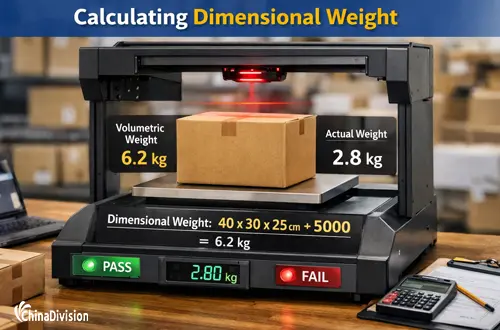
Length (cm) × Width (cm) × Height (cm) ÷ Volumetric Divisor
What Is the Standard Volumetric Weight Divisor?
Different carriers use different dimensional weight formulas.
|
Shipping Method |
Common Divisor |
|---|---|
|
International Air Freight |
6000 |
|
Express Couriers |
5000 |
|
Road Freight |
3000–4000 |
|
Some Economy Services |
Carrier specific |
How Warehousing and Fulfillment Services Help Reduce Volumetric Weight
Professional fulfillment providers can reduce dimensional weight costs before shipment through warehouse optimization.
At ChinaDivision fulfillment centers, businesses benefit from:
1. Professional Packaging Optimization
Warehouse teams analyze:
- Product size
- Protection requirements
- Shipping method
and select packaging that minimizes unnecessary volume.
2. Repacking and Consolidation Services
Instead of shipping multiple oversized boxes, fulfillment warehouses can:
- Combine orders
- Remove excessive packaging
- Optimize carton sizes
This reduces:
- Volumetric weight
- Shipping costs
- Warehouse handling expenses
3. Product Bundling Optimization
For businesses selling multiple products, warehouse teams can create optimized shipping combinations.
Expert Packaging Optimization Tips to Lower Volumetric Weight

Based on Chinadivision’s international fulfillment and warehousing operational data, these actionable tips reduce average volumetric weight by 10%–30% for most light-bulky product lines.
1. Match Box Size Precisely to Product Dimensions
Oversized cartons create empty voids that drastically inflate volume without adding actual weight. Use custom-sized cartons that fit products tightly to eliminate wasted space, the top cause of unnecessary dimensional weight surcharges.
2. Replace Bulky Protective Materials
Thick foam and layered bubble wrap expand package volume significantly. Switch to lightweight air cushions, crumpled kraft paper, and thin shock-absorbent padding to maintain safety while minimizing volumetric size.
3. Disassemble Modular Products
Furniture parts, electronic brackets, and modular machinery components should be disassembled before packaging. This eliminates irregular protruding shapes and reduces overall package volume greatly.
4. Strip Redundant Retail Packaging
Most retail products come with oversized original packaging, gift boxes, and redundant liners. Remove non-essential packaging in professional warehouses to cut volume without damaging product quality.
5. Use PE Mailing Bags for Soft Non-Fragile Goods
For apparel, fabrics, and soft textiles, replace rigid cardboard boxes with flexible PE mailing bags. Bags fit product contours perfectly and avoid the fixed dimensional limits of cartons, lowering volumetric weight effectively.
6. Avoid Unnecessary Double Packaging
Double boxing is a major hidden volume waste. Use high-strength single-layer cartons with targeted cushioning instead. If double packaging is mandatory for fragile goods, select outer boxes with minimal gap margins.
7. Consolidate Small Shipments via Professional Warehousing
Scattered small parcels generate far higher combined volumetric weight than consolidated bulk shipments. Chinadivision’s overseas warehousing and batch fulfillment service merges multiple small orders into optimized unified shipments to reduce overall dimensional weight costs.
Frequently Asked Questions (Volumetric Weight & Fulfillment)
Can professional warehousing reduce volumetric weight charges?
Yes. Standardized packaging, order consolidation, and professional volume optimization in dedicated warehouses can reduce dimensional weight costs by 10%–30% long-term.
Which products are most affected by volumetric weight billing?
Light and low-density products including apparel, textiles, cushions, plastic goods, and disassembled furniture face the highest dimensional weight surcharges.
How can I accurately calculate shipping costs in advance?
Use a professional volumetric weight calculator to input package dimensions and weight, matching the correct carrier divisor to obtain accurate chargeable weight and shipping budget data.
Authoritative Industry Reference Resources
Verify standard volumetric weight calculation rules via leading global logistics industry official pages:
- DHL Official Chargeable Weight Calculation Guide – Air, road, and rail volumetric weight divisor standards


About the Author: Limi

Limi is a content marketing expert at ChinaDivision, helping businesses and e-commerce sellers navigate the complexities of international shipping by providing actionable tips and comprehensive guides on logistics, shipping, and cargo transportation.