

US CPSC eFiling Requirements Explained: What Data Is Required to Avoid Customs Holds in 2026?
If your products are regulated by the U.S. Consumer Product Safety Commission (CPSC), missing electronic filing data can stop your shipment at customs—even if your products already passed safety testing. Starting July 8, 2026, importers must submit product safety certificate information electronically through U.S. Customs for hundreds of CPSC-regulated products. In this guide, you'll learn which products are affected, what data is required, how the CPSC Product Registry simplifies repeat shipments, and how international fulfillment providers like ChinaDivision help businesses stay compliant while avoiding customs delays.
Table of Contents
- What Is CPSC eFiling & Why It Matters for Importers
- CPSC eFiling Requirements
- What Data Is Required for CPSC eFiling?
- GCC vs CPC: Know Which Certificate Your Product Needs
- Where Should CPSC Data Be Added?
- Step-by-Step Pre-July 2026 Compliance Preparation Checklist
- Consequences of Non-Compliance
- Frequently Asked Questions (CPSC eFiling & Logistics Compliance)
What Is CPSC eFiling & Why It Matters for Importers
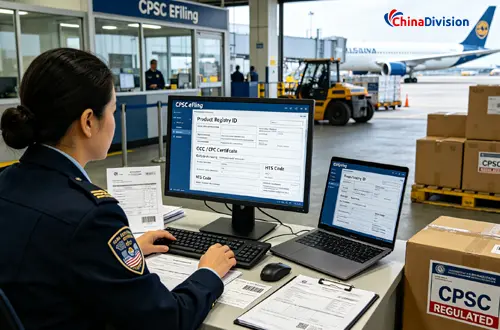
Starting July 8, 2026, the U.S. Consumer Product Safety Commission (CPSC) enforces mandatory electronic filing for all regulated consumer products entering U.S. borders. No longer acceptable: paper certificates attached to shipments or on-request documentation.
From a professional international order fulfillment and warehousing logistics perspective, we’ve seen countless B2B sellers face sudden customs holds, clearance delays, and unexpected fees simply because they submitted incomplete or mismatched CPSC eFiling data.
CPSC eFiling is the mandatory electronic submission of product safety certificate data via the U.S. ACE (Automated Commercial Environment) system at the time of customs entry. Administered by the Consumer Product Safety Commission, this process replaces traditional paper-based GCC/CPC documentation.
Previously, importers only needed physical certificates available for inspection. The new 2026 rule requires safety data to be electronically transmitted before customs clearance. Missing data results in automatic shipment holds or refusal of entry.
CPSC eFiling Requirements
| Item | Requirement |
|---|---|
| Effective date | July 8, 2026 |
| Agency | Consumer Product Safety Commission (CPSC) |
| Filing method | Electronic filing through ACE |
| Products covered | Approximately 600 flagged HTS codes |
| Minimum shipment value | None |
| Certificates | GCC or CPC |
| Responsible party | Importer of Record |
| Consequence | Customs hold, review or refusal |
Key impacts:
- No value threshold: even low-value shipments must comply
- Mandatory at customs entry—not after shipment
- Missing data = shipment CPSC flagged, delayed, or rejected
For B2B sellers and e-commerce brands, this means compliance is no longer optional—it must be built into your fulfillment workflow.
What Products Are Regulated?
All finished CPSC Product categories under ~600 flagged HTS codes, including toys, children’s goods, apparel, furniture, batteries, jewelry, mattresses, strollers, and carpets. Raw materials and component parts are generally exempt.
What Data Is Required for CPSC eFiling?
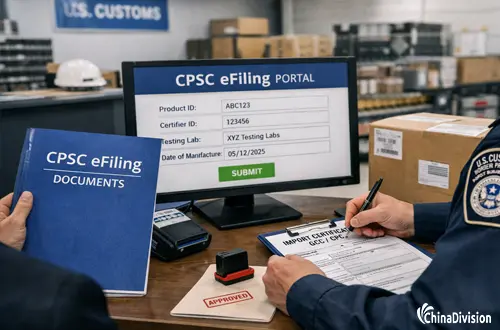
There are three ways to submit CPSC data. The most important one is the full data set.
Option 1: Full Certificate Data (7 Required Elements)
- Product ID / SKU
- Applicable CPSC rule citation (e.g., 16 CFR part 1250)
- Date of manufacture
- Place of manufacture
- Date of most recent product safety test
- Testing laboratory name & contact information
- Records keeper contact information
Option 2: CPSC Product Registry (Recommended for Scale)
The CPSC Product Registry is the official time-saving solution for recurring B2B shipments. Register each SKU once online, then use only three identifiers on every future invoice:
- Product ID
- Certifier ID
- Version ID
This method drastically reduces manual errors, speeds up customs processing, and is officially recommended by the Consumer Product Safety Commission for high-volume importers.
Why this matters:
- Reduces manual work
- Speeds up customs clearance
- Ideal for repeat shipments
Option 3: Upload Full Certificate (Fallback)
You can submit:
- GCC or CPC document (PDF or physical copy)
However:
- Slower
- Less scalable
- Higher risk of delays
GCC vs CPC: Know Which Certificate Your Product Needs
All CPSC eFiling data ties back to one of two core compliance certificates. Mixing these up is a top reason for CPSC flagged customs delays.
| Certificate Type | Full Name | Applicable Products | Key Requirements |
|---|---|---|---|
| GCC | General Certificate of Compliance | General adult consumer goods regulated by CPSC | Self-certified compliance with applicable safety standards |
| CPC | Children’s Product Certificate | Products for children aged 12 and under | Mandatory third-party lab testing by CPSC-accepted facilities |
Where Should CPSC Data Be Added?
Your commercial invoice is the key document.
You must include CPSC data in:
- Invoice “Remarks” section
- OR attached addendum sheet
Important:
- Each SKU must have its own CPSC data
- Multi-product shipments require multiple entries
Step-by-Step Pre-July 2026 Compliance Preparation Checklist
- Verify HTS codes: Cross-check all SKUs against the official CPSC flagged HTS list
- Confirm certificate type: Assign GCC or CPC per product category
- Register SKUs: Create a CPSC Product Registry account for repeat shipments
- Update invoice templates: Reserve remarks space or create addendum sheets
- Align suppliers: Collect manufacturing dates, lab test records, and factory info in advance
- Validate POA status: Ensure brokers have valid POA for high-value entries
Consequences of Non-Compliance
| Issue | Result |
|---|---|
| Missing CPSC data | Shipment held or refused |
| Incorrect VAT or HTS code | Customs delay or penalty |
| Incomplete certificate | Broker liability and importer fines |
Frequently Asked Questions (CPSC eFiling & Logistics Compliance)
Q1: Does CPSC eFiling apply to low-value shipments under $2,500?
Yes. There is no value exemption. All CPSC-regulated products require eFiling. Low-value shipments lose informal consolidated clearance eligibility and require separate formal entries with additional entry fees.
Q2: What is the fastest CPSC eFiling method for bulk repeated shipments?
CPSC Product Registry 3-ID referencing is the fastest and most error-proof method. Register each SKU once, then only list Product ID, Certifier ID, and Version ID on future invoices.
Q3: Can my freight forwarder or broker complete CPSC eFiling for me?
Brokers transmit data via the ACE system but cannot create or certify compliance data. The importer owns full responsibility for accurate GCC/CPC information.
Q4: Do I need eFiling if my HTS code is not CPSC flagged?
eFiling is not mandatory, but you must still retain valid GCC/CPC records for random CPSC audits.
Q5: Do I need to update registry data for new manufacturing batches?
Yes. Manufacturing dates, test dates, or factory changes require updated certificates and revised registry version data to avoid clearance rejection.
Q6: Are raw materials and component parts subject to CPSC eFiling?
No. The rule only applies to finished consumer-ready CPSC Product items.
CPSC eFiling is becoming a mandatory part of importing regulated consumer products into the U.S. Preparing accurate product certificates, maintaining consistent documentation, and integrating compliance into your fulfillment workflow can significantly reduce customs delays and operational risks. By combining supplier management, quality control, warehousing, customs documentation, and international shipping into one streamlined process, ChinaDivision helps eCommerce sellers and B2B businesses achieve compliant, efficient, and scalable U.S. order fulfillment.
Industry Authoritative Reference Links
eFiling – CPSC’s Modern Approach for Filing Certificate Data


About the Author: Limi

Limi is a content marketing expert at ChinaDivision, helping businesses and e-commerce sellers navigate the complexities of international shipping by providing actionable tips and comprehensive guides on logistics, shipping, and cargo transportation.