

EU VAT & Air Freight Clearance: How to Avoid Double Taxation
When shipping goods to the EU by air, mismatched EU VAT declarations and air freight clearance procedures can lead to costly double taxation, non-deductible VAT, and even customs seizures. This guide—written from the perspective of a professional international order fulfillment and warehousing logistics service provider—explains how to align VAT numbers, customs documentation, and clearance methods to ensure compliance, reduce tax risk, and optimize cash flow.
Table of Contents
- What Is EU VAT in Import Logistics?
- Why VAT-Air Freight Mismatch Happens
- Understanding EU VAT and Air Freight Clearance
- Common Scenarios Leading to Double Taxation
- Matching Solutions to Avoid Double Taxation
- Prepaid VAT vs VAT Deferred Clearance
- Frequently Asked Questions (EU VAT & Air Freight Clearance)
What Is EU VAT in Import Logistics?
EU VAT (Value-Added Tax) is a consumption tax applied when goods enter the EU.
Two key stages:
- Import VAT (at customs)
Paid or deferred during Air Freight Clearance - Sales VAT (after sale)
Declared during periodic VAT filings
If properly structured, import VAT is deductible—but only when documentation and tax ownership align.
Why VAT-Air Freight Mismatch Happens
Many cross-border sellers unknowingly trigger double taxation because their VAT number used for customs clearance differs from the one used for quarterly tax declarations.
Common causes include:
- Using third-party freight forwarders’ VAT numbers for clearance.
- Failing to apply VAT deferral policies.
- Inconsistent ownership between shipment documents and VAT holders.
Pain Point: Sellers often pay import VAT at customs and again during tax filing—effectively paying twice for the same goods.
Understanding EU VAT and Air Freight Clearance
|
Term |
Definition |
Key Impact |
|---|---|---|
|
EU VAT (Value-Added Tax) |
A consumption tax applied to goods imported into EU member states. |
Must be declared with a valid VAT number to qualify for deduction eligibility. |
|
Air Freight Clearance |
The customs process for goods arriving by air, including tariff assessment and VAT calculation. |
Requires accurate shipping documents and consistent VAT number matching to avoid tax issues. |
|
C88 Import Document |
An official customs document confirming duties and import VAT payments. |
Provides proof required for VAT deduction during quarterly tax returns. |
Insight: The VAT number on the C88 document, commercial invoice, and air freight manifest must match exactly to qualify for VAT deduction.
Common Scenarios Leading to Double Taxation
|
Scenario |
Cause |
Result |
|---|---|---|
|
Third-party VAT usage |
Freight forwarder’s VAT number is used for customs clearance |
Seller cannot deduct import VAT and may need to pay tax again during VAT declaration |
|
Missing VAT deferral |
No deferred VAT application or approval before import clearance |
Import VAT must be paid immediately at customs, creating cash flow pressure and missing deduction records |
|
Ownership mismatch |
Goods owner is different from the VAT holder |
Customs and tax authorities may treat the shipment and VAT declaration as separate transactions |
Double taxation is not caused by policy loopholes, but 100% derived from non-standard manual matching of clearance and VAT declaration. Combined with a large number of actual fulfillment cases, we summarize three core causes of non-deductible VAT and duplicate taxation:
1 Inconsistent VAT Subjects Between Clearance and Declaration
This is the #1 cause of double taxation. Many sellers rely on third-party forwarders or overseas warehouse service providers for clearance, using the third party’s EU VAT number for air freight declaration. The prepaid import VAT is recorded under the third-party tax account, while the enterprise’s own VAT account has no valid payment vouchers. During quarterly declaration, the enterprise cannot deduct import VAT and is forced to pay full sales VAT again, resulting in double taxation for the same batch of goods.
2 Unused VAT Deferral Policy & Incomplete Tax Vouchers
Most small and medium-sized sellers are unfamiliar with EU local deferral policies and still adopt traditional prepaid modes. Without standardized retention of C88 tax certificates and clearance documents, they fail to complete legal VAT deduction, resulting in invalid prepaid taxes and repeated tax supplementation by tax authorities.
3 Mismatched Goods Ownership and VAT Holder Information
In air freight LCL shipments and multi-batch consolidated declarations, the master waybill, sub-waybill, commercial invoice, and customs tax documents often have inconsistent goods owners and VAT taxpayers. The separation of the tax payment document holder and the tax declaration subject makes all import VAT ineligible for deduction.
Pro Tip: Always ensure the consignee name and VAT number on the air freight manifest match your company’s registered VAT.
Matching Solutions to Avoid Double Taxation
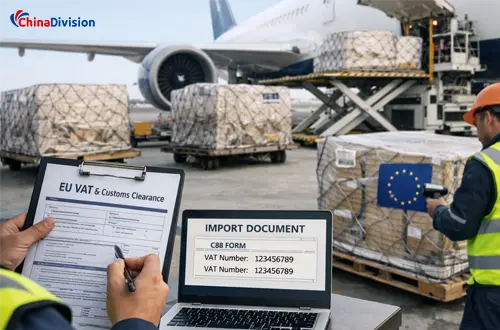
All goods imported into the EU via air freight must comply with unified EU import tax supervision rules. A valid local EU VAT number is a mandatory document for Air Freight Clearance, used by customs to calculate import duties and import Value-Added Tax.
Solution 1: Clearance with Your Own VAT Number
This is the most recommended universal solution for long-term EU cross-border operation enterprises, suitable for most conventional air freight import scenarios.
- Operation Standard: Register a valid local EU VAT number in the destination country; uniformly fill in the enterprise’s own name and independent VAT number for the air freight manifest, consignee information, and commercial invoice.
- Compliance Logic: After customs clearance and tax payment, the customs broker issues a standard C88 import tax payment certificate. The VAT number on the certificate is completely consistent with the enterprise’s declaration subject.
- Deduction Effect: The C88 voucher can be directly uploaded for quarterly tax declaration, and all prepaid import Value-Added Tax can be fully deducted legally, zero double taxation risk.
Advantages:
- Full VAT deductibility.
- Transparent compliance record.
- Simplified audit trail.
Solution 2: VAT Deferred Clearance
For enterprises with stable EU business volumes and complete tax qualifications, VAT deferred clearance is an advanced optimization solution, which not only avoids double taxation but also greatly reduces capital pressure.
- Core Advantages: No need to pay import VAT in advance during Air Freight Clearance; customs only collects import duties. Import VAT is uniformly accounted for, declared, and deducted in the quarterly tax cycle.
- Operation Requirements: Apply for deferred VAT qualification from the local EU tax bureau in advance; mark the deferred application in the air freight booking and customs declaration links, and bind all documents to the enterprise’s independent VAT number.
- Applicable Value: Fundamentally eliminate double taxation risks caused by prepaid tax voucher mismatch, and solve the problem of large capital occupation of bulk air freight goods.
Requirements:
- Apply for VAT deferral qualification with local tax authorities.
- Indicate “VAT deferred” on air freight booking and customs declaration.
- Link deferred VAT to your own VAT number.
| Benefit | Description |
|---|---|
| Cash Flow Optimization | No upfront VAT payment during customs clearance. |
| Compliance Assurance | Eliminates the risk of duplicate VAT collection and improves tax compliance. |
| Financial Flexibility | Ideal for high-volume air freight operations by reducing upfront tax pressure. |
Prepaid VAT vs VAT Deferred Clearance
Help enterprises quickly select a suitable mode based on business scale and capital status:
| Comparison Dimension | Prepaid VAT Clearance | VAT Deferred Clearance |
|---|---|---|
| Double Taxation Risk | Medium-High (easy to create VAT document mismatches) | Zero (no advance VAT collection during customs clearance) |
| Capital Occupation | High (requires one-time full VAT payment at import) | Low (VAT is settled through quarterly tax reporting) |
| Qualification Threshold | Low (available for most VAT-registered enterprises) | High (requires approval or qualification from local tax authorities) |
| VAT Deduction Difficulty | High (requires strict consistency between customs and tax documents) | Low (simplifies VAT reporting and matching processes) |
| Suitable Business | Small-batch, irregular EU air freight shipments | Stable bulk EU air freight operations and long-term inventory sellers |
Frequently Asked Questions (EU VAT & Air Freight Clearance)
Can I use a forwarder’s VAT number for long-term EU air freight clearance?
Not recommended. Long-term borrowing of third-party VAT numbers will lead to inconsistent taxpayers and declaration subjects, resulting in permanent non-deductible import VAT and double taxation. It will also trigger EU tax audit risks.
Will LCL air freight merged declaration cause VAT double taxation?
Yes. Merging multiple batches of goods into a single third-party VAT declaration will cause the actual goods owner to have no valid tax payment vouchers, unable to complete deduction, and eventually face double taxation. Each batch of LCL goods needs independent VAT binding.
Which EU countries support air freight VAT deferral policies?
Mainstream EU countries such as Germany, France, Italy, Spain, and the Netherlands all support VAT deferred clearance for qualified import enterprises, which is the mainstream compliant optimization method for current EU cross-border logistics.
Recommended Industry Resources


About the Author: Limi

Limi is a content marketing expert at ChinaDivision, helping businesses and e-commerce sellers navigate the complexities of international shipping by providing actionable tips and comprehensive guides on logistics, shipping, and cargo transportation.