

Overseas Warehouse vs Domestic Warehouse: Which One Maximizes Your B2B Fulfillment Profit?
For cross-border e-commerce brands and B2B enterprises, scaling internationally introduces a major structural dilemma: Where should your inventory live? Choosing between overseas warehouses and domestic warehouses directly impacts shipping costs, delivery speed, inventory turnover, and customer experience.
Table of Contents
- Part 1: Domestic Warehouses
- Part 2: Moving Closer to the Consumer: Overseas Warehousing
- Comparison: Domestic vs. Overseas Warehousing
- Professional Fulfillment Strategy: Who Should Choose Which Warehouse?
- How Chinadivision Helps Businesses Choose the Right Model
- Frequently Asked Questions (FAQ)
- Recommended Industry Resources
As an international order fulfillment and warehousing service provider, we see brands struggle with this exact question every day. Storing inventory in the wrong location can lead to long transit delays, expensive last-mile delivery fees, or high upfront overhead costs that drain your active working capital.
This guide provides an insider's look at the financial and operational realities of domestic warehouses versus overseas warehouses, helping you choose the ideal strategy for your global supply chain.
Part 1: Domestic Warehouses
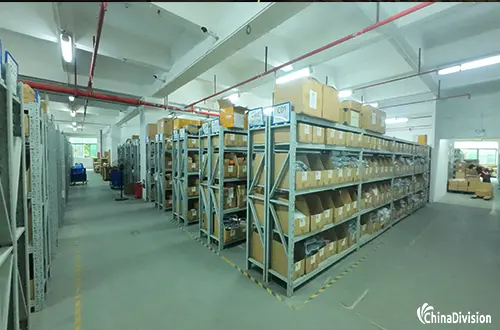
A domestic warehouse is a storage facility located in the seller's home country or the country where products are sourced and manufactured. For many cross-border sellers sourcing products from China, domestic warehouses are commonly used as the first stage of global fulfillment. Domestic warehouses are often connected with fulfillment systems such as WMS (Warehouse Management Systems) to manage inventory levels and order processing. Products are stored locally, then shipped internationally after receiving customer orders.
Choosing a domestic fulfillment strategy means keeping your inventory within the country of origin (such as China) before it is dispatched globally. To build this network efficiently, you must first understand the primary options available.
What are the types of domestic warehouses?
Domestic infrastructure generally falls into four distinct categories, each designed for a specific volume, regulatory requirement, or budget:
- Public Warehouses: These are third-party owned multi-tenant spaces where you pay only for the exact pallet positions, shelf space, or square footage you occupy. They are perfect for seasonal businesses or scaling brands that want zero upfront capital investment.
- Private Warehouses: These are proprietary, brand-owned facilities. While they offer complete operational control and custom branding layouts, they require massive capital investments, long-term commercial leases, and specialized warehouse management software (WMS) implementation.
- Bonded Warehouses: Government-regulated facilities where imported or manufactured goods can be stored, manipulated, or undergo deep kitting before duties and import taxes are officially assessed. This offers an incredible cash-flow advantage for B2B enterprises managing complex duty regulations.
- Non-Bonded Warehouses: Standard storage facilities where all applicable domestic duties and taxes have already been paid on the inventory. These are ideal for domestic distribution or goods destined for immediate, low-tariff export channels.
What are the characteristics and advantages of domestic warehouses?
Operating out of a domestic hub offers distinct structural benefits for cross-border brands:
- Centralized Inventory Control: Storing your full product catalog in a central domestic hub prevents your inventory from being split across multiple isolated global locations.
- Maximum Packaging & Kitting Flexibility: It is significantly more cost-effective to perform complex custom kitting, subscription box assembly, and personalized branding close to your manufacturing source, where labor and packaging materials are readily available.
- Minimized Capital Risk: If a particular product line fails to sell in a specific foreign market, your stock isn't trapped overseas. It remains at the central hub, ready to be routed to alternative, higher-demand global channels.
Part 2: Moving Closer to the Consumer: Overseas Warehousing
An overseas fulfillment strategy involves exporting bulk freight via ocean or air and storing it inside specialized regional distribution centers located within your target destination countries (such as the US, UK, or Europe).
What are some common types of overseas warehouses?
Just like domestic setups, overseas hubs are categorized by how they handle your inventory:
- Overseas 3PL Hubs (Shared Distribution Centers): Multi-tenant centers located in destination markets that integrate directly with your online storefronts (Shopify, Amazon, etc.) to pick, pack, and ship local orders on demand.
- FBA/Platform Warehouses: Dedicated fulfillment hubs tied strictly to a specific online marketplace (such as Amazon FBA). They offer fast shipping badges but enforce strict, costly seasonal storage penalties.
What are the advantages and disadvantages of overseas warehousing services?
The Advantages:
- Lightning-Fast Last-Mile Delivery: By positioning stock within the destination country, you can offer 1-to-3 day domestic ground shipping, matching the delivery speeds that modern consumers expect.
- Slash International Shipping Costs per Order: Shipping single items individually across borders via international air mail is incredibly expensive. Bulk freight ocean shipping to an overseas hub drastically lowers your per-unit transit costs.
- Simplified Domestic Returns: Local returns centers process, grade, and restock returned items within the destination country, eliminating the need to ship single returns back across the ocean.
The Disadvantages:
- Higher Warehousing Carrying Costs: Monthly storage fees, labor rates, and pick-and-pack charges are significantly higher in Western consumer markets compared to domestic manufacturing hubs.
- The Risk of Overstocking & Dead Stock: If you miscalculate consumer demand and ship slow-moving inventory to an overseas hub, your margins will be hit by high storage fees and potential product liquidation costs.
Comparison: Domestic vs. Overseas Warehousing
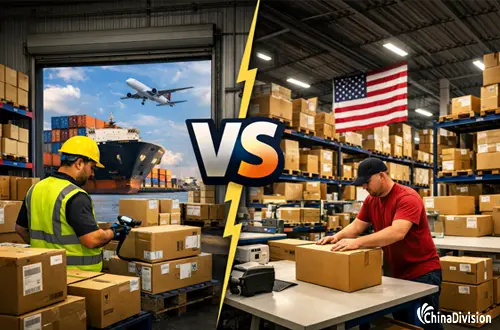
To help your B2B supply chain team make an objective data-driven choice, here is how the two fulfillment frameworks compare across core operational metrics:
| Operational Metric | Domestic Warehouses (Origin Hub) | Overseas Warehouses (Destination Hub) |
|---|---|---|
| Upfront Capital Risk | Low: Minimal commitment; easy to scale space up or down dynamically. | High: Requires bulk upfront freight shipping and split inventory placement. |
| Last-Mile Shipping Speed | Slower: Usually takes 7 to 14 business days via global e-packet or express mail. | Very Fast: Typically takes 1 to 3 days using local domestic couriers. |
| Per-Unit Storage Overhead | Highly cost-effective; lower monthly pallet and bin holding costs. | Significantly more expensive; higher real estate and local labor rates. |
| Custom Kitting & Quality Control | Excellent: Easy to audit, repackage, and adjust items close to the factory floor. | Limited: High local labor costs make deep customization expensive. |
| Best Suited For | High-SKU brands, lightweight goods, or testing new market demand. | High-volume winning products, heavy items, and established global brands. |
Professional Fulfillment Strategy: Who Should Choose Which Warehouse?
Choose Domestic Warehouses If You:
- Are testing new products or entering new overseas markets
- Operate fast-updating trending products with unstable sales volume
- Have limited cash flow and want to avoid overstock risks
- Maintain low and scattered cross-border order volume
Choose Overseas Warehouses If You:
- Have stable best-selling products with continuous repeat orders
- Need to improve platform weight and customer satisfaction urgently
- Want to reduce long-term cross-border single-piece logistics costs
- Focus on long-term localized brand operation in target markets
Best Advanced Solution: Hybrid Domestic + Overseas Fulfillment
As a professional fulfillment provider, we recommend hybrid warehouse matching for 90% of scaling B2B brands:
Store new products, trial products, and low-volume goods in domestic bonded/non-bonded warehouses to control risks; stock stable bestsellers in overseas distribution centers to guarantee delivery speed and customer experience. This model balances cost, risk, and market competitiveness perfectly.
How Chinadivision Helps Businesses Choose the Right Model
As a professional international order fulfillment and warehousing service provider, Chinadivision offers hybrid solutions combining domestic and overseas warehousing advantages:
Flexible Warehousing Network
- Multiple warehouse locations across China and overseas markets for optimized distribution.
Customs Clearance Expertise
- Streamlined bonded and non-bonded warehouse operations to minimize delays.
Real-Time Inventory Management
- Advanced WMS integration for visibility across all warehouse locations.
Cost Optimization
- Strategic placement of goods to reduce shipping and storage costs.
Frequently Asked Questions (FAQs)
Are bonded warehouses always better than non‑bonded warehouses?
No. Bonded warehouses are powerful when you need duty deferral or plan to re‑export goods, but they add compliance complexity. Non‑bonded warehouses are simpler for direct sale into a market where customs clearance happens once on bulk import. The right choice depends on your tax strategy, product type, and planned flows.
Should we invest in private warehouses or rely on public warehouses and 3PLs?
Most growing brands benefit from public warehouses and third‑party distribution centers because they avoid fixed costs and allow quick scaling. Private warehouses make sense for very high, stable volumes or specialized handling. ChinaDivision operates public warehousing solutions tailored for international sellers, giving you pro‑level operations without asset ownership.
Can one provider manage both domestic and overseas warehouses for us?
Yes. One of the key benefits of working with an international fulfillment provider like ChinaDivision is unified management of domestic warehouses, overseas warehouses, distribution centers, and freight. You get one operational interface and one data view instead of juggling multiple local partners.
Do I need to register for VAT/GST if I use an overseas warehouse?
Yes. Storing inventory in most countries creates a tax nexus requiring VAT/GST registration. A professional 3PL can handle this registration and filing on your behalf. ChinaDivision assists clients with IOSS (EU), UK VAT, and US sales tax compliance.
What happens if my overseas warehouse runs out of stock?
Maintain a safety stock buffer (typically 2–3 weeks) and establish an emergency air freight protocol for replenishment. Your WMS should trigger automatic reorder alerts when inventory hits the reorder point.
Recommended Industry Resources
Shopify – International Warehouses and Global Ecommerce Fulfillment Guide


About the Author: Limi

Limi is a content marketing expert at ChinaDivision, helping businesses and e-commerce sellers navigate the complexities of international shipping by providing actionable tips and comprehensive guides on logistics, shipping, and cargo transportation.