

Quality Control in Warehousing: Ensuring Accuracy, Efficiency, and Customer Trust
Effective warehousing quality control is the backbone of international order fulfillment. From receiving goods to shipping them out, every step requires precision to prevent costly errors, inventory backlogs, and dissatisfied customers.
Table of Contents
- Why Warehousing Quality Control Is a Business Problem
- What Is Quality Control in Warehousing?
- Key Steps in a Warehouse Quality Control Process
- Master Checklist: What are the Key Steps in a Warehouse Quality Control Process?
- Methods and Tools for Modern Warehousing Quality Control
- Warehouse Quality Control vs Quality Assurance
- Common Quality Problems Faced by E-commerce Sellers
- Chinadivision’s Approach to Warehousing Quality Control
- Frequently Asked Questions
- Quality Control Is the Foundation of Reliable Global Fulfillment
- Recommended Industry Resources
If your products arrive damaged, wrong, or late, your customers don’t blame the warehouse—they blame your brand. Warehousing Quality Control is the discipline that keeps your inventory accurate, your orders error-free, and your supply chain reliable. This article explains Quality Control in Warehousing from the perspective of a professional international order fulfillment and logistics provider like ChinaDivision, with practical steps, examples, and tools you can use to prevent problems before they reach the customer.
Why Warehousing Quality Control Is a Business Problem, Not Just a “Warehouse” Problem
Quality control in warehousing is often treated as a back‑office operation, but in reality it directly impacts:
- Customer satisfaction and reviews
- Return rates and support costs
- Channel relationships (Amazon, retailers, distributors)
- Cash flow and inventory accuracy
When you outsource fulfillment internationally, the warehouse becomes an extension of your brand. Quality Assurance and Quality Control systems determine whether that extension protects or damages your reputation.
What Is Quality Control in Warehousing?
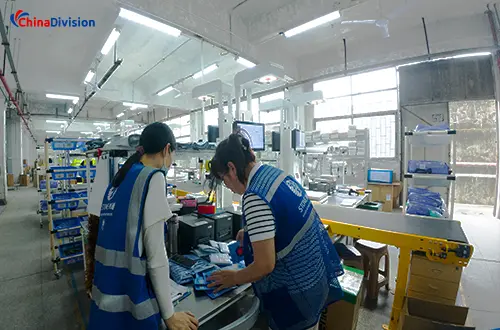
Quality Control (QC) in warehousing refers to the systematic process of inspecting, verifying, and monitoring products and warehouse operations to ensure accuracy, safety, and compliance.
Unlike traditional product inspection performed during manufacturing, warehouse quality control focuses on maintaining product integrity throughout:
- Receiving
- Storage
- Inventory management
- Order picking
- Packaging
- Shipping
- Returns processing
The goal is not only to identify problems but also to prevent them before they impact customers.
Key Steps in a Warehouse Quality Control Process
| Stage | What Happens | QC Focus |
|---|---|---|
| Receiving | Goods arrive at the warehouse | Verify purchase orders, inspect product condition, confirm quantities |
| Shelving | Items placed in storage | Ensure correct placement, update WMS, handle special storage needs |
| Storage | Goods remain in inventory | Monitor temperature/humidity, apply FIFO, check shelf integrity |
| Picking | Items selected for orders | Barcode/RFID verification, SKU accuracy, quantity checks |
| Packing & Shipping | Orders prepared for dispatch | Scan labels, check packaging integrity, ensure carrier compliance |
Master Checklist: What are the Key Steps in a Warehouse Quality Control Process?
Achieving near-zero error rates requires establishing physical and digital checkpoints at five critical stages of the warehousing lifecycle:
1. The Receiving Checkpoint (Inbound IQC)
Quality control begins at the loading dock. Before signing the carrier’s proof of delivery, receiving teams must:
- Cross-verify the physical cargo counts against the Purchase Order (PO) and packing slip.
- Inspect outer carton integrity for water damage, crushing, or tampering.
- Spot-check individual units to confirm SKU barcode readability (such as UPC or FNSKU labels).
2. Putaway & Shelving
Once received, inventory must be guided to its optimal location:
- Ensure specialized items (like organic cosmetics, electronics, or hazardous goods) are placed in designated temperature-controlled or certified storage zones.
- Immediately update the WMS location map via handheld scans to prevent "lost inventory" and pick delays.
3. Active Storage Auditing
Inventory cannot simply sit on a shelf unmonitored:
- Inspect racking structures and pallet stability regularly.
- Deploy strict First-In, First-Out (FIFO) or First-Expired, First-Out (FEFO) protocols to ensure older inventory or perishable goods are rotated to the front of the picking lines.
4. Precision Picking
Picking is the most active stage of warehousing, making it highly susceptible to human error:
- Require warehouse pickers to physically scan the shelf location barcode and the product SKU barcode using handheld RF terminals.
- Configure the WMS to block the picker from proceeding if the wrong color, size, or model is selected.
5. Outbound Packing & Carrier Handoff
The packaging bench is your final line of defense before a package leaves the building:
- Verify item counts against the final shipping invoice.
- Inspect packaging materials to ensure they are robust enough to survive international transit.
- Scan the final shipping carrier label to guarantee the shipping address matches the customer's portal profile exactly.
Methods and Tools for Modern Warehousing Quality Control
Digital SOPs, Checklists, and Workflows
Digital Standard Operating Procedures and mobile checklists:
- Reduce variation between shifts and locations.
- Make training faster and more consistent.
- Provide evidence of QC activities for audits and retailer compliance.
Root Cause Analysis and Quality Analytics
When errors occur, you need to understand why:
- Pareto charts reveal the most common sources of problems (e.g., a specific SKU, supplier, or process step).
- Cause‑and‑effect (fishbone) diagrams help map the deeper reasons (training, tools, layout, data quality).
- Trend tracking shows whether fixes are working or if new issues appear.
ChinaDivision shares these insights with clients so brands can see how warehouse QC connects to supplier performance and product design.
Automated Data Systems (WMS/TMS)
A modern WMS and Transportation Management System (TMS) support:
- Real‑time stock visibility and movement tracking.
- Scan‑based verification at each checkpoint.
- Automated shipping rules (service level, carrier, packaging type).
- Performance dashboards (error rate, OTIF, damage claims, return reasons).
For international fulfillment, these systems also integrate with marketplaces (Amazon, Shopify, etc.) and carriers, ensuring data consistency from order placement to delivery.
Warehouse Quality Control vs Quality Assurance: What Is the Difference?
Many businesses confuse Quality Control and Quality Assurance. While both support operational excellence, they focus on different areas.
| Comparison | Quality Control (QC) | Quality Assurance (QA) |
|---|---|---|
| Main Purpose | Detect and correct errors | Prevent errors through improved processes |
| Focus | Product and order inspection | Warehouse systems and workflows |
| Timing | During or after operations | Before problems occur |
| Example | Checking whether the correct SKU is shipped | Creating SOPs to prevent picking mistakes |
| Goal | Reduce defects | Build consistent processes |
Simply put:
- Quality Control asks: "Is this order correct?"
- Quality Assurance asks: "How can we ensure every order is correct?"
The Difference Between Warehouse Quality Assurance and Quality Control
- Quality Assurance (QA) is proactive and process-oriented. It focuses on designing the standard operating procedures (SOPs), training programs, and software integrations that prevent errors from happening in the first place.
- Quality Control (QC) is reactive and product-oriented. It focuses on the physical checkpoints, scans, and manual inspections that detect and isolate errors before inventory moves to the next stage of the pipeline.
Common Quality Problems Faced by E-commerce Sellers
Many sellers experience similar fulfillment challenges when scaling internationally.
| Problem | Root Cause | Solution |
|---|---|---|
| Wrong items shipped | Manual picking errors | Barcode verification |
| Inventory mismatch | Poor tracking systems | WMS integration |
| Damaged products | Incorrect storage or packaging | QC checkpoints |
| Customer complaints | Lack of final inspection | Shipping QC |
| High return rates | Fulfillment mistakes | Reverse logistics control |
Chinadivision’s Approach to Warehousing Quality Control
As a professional international order fulfillment provider, Chinadivision integrates QC at every stage:
- Multi-point inspections during receiving, storage, and shipping.
- RFID and barcode scanning for SKU accuracy.
- Environmental monitoring for sensitive goods.
- Customized QC protocols tailored to client needs.
This ensures that every order meets international standards, reducing returns and boosting customer trust.
Frequently Asked Questions
Why is warehousing quality control so critical for cross-border e-commerce?
With international shipping, returns are incredibly expensive and complex. If a customer receives a defective or incorrect item, the cost of return shipping, duties, and replacement logistics can completely wipe out your profit margin on multiple successful sales. High-quality warehouse QC stops these errors before they leave the country.
Will strict warehouse quality control greatly increase my fulfillment cost?
For most cross-border sellers, the cost of adding full-process QC only accounts for 1-2% of your order value, but it can reduce your return loss and customer complaint cost by 15-25%. It is a net positive return investment for almost all brands.
Quality Control Is the Foundation of Reliable Global Fulfillment
As e-commerce becomes increasingly competitive, fast shipping alone is no longer enough. Customers expect accurate orders, professional packaging, and consistent product quality.
A strong warehouse quality control process helps businesses reduce operational costs, improve customer satisfaction, and build long-term brand trust.
By partnering with Chinadivision, global brands gain access to professional warehousing, fulfillment technology, and quality management systems designed for international growth. Whether you need China warehouse storage, product inspection, order fulfillment, or global shipping solutions, Chinadivision helps ensure every shipment meets your quality standards.
Recommended Industry Resources


About the Author: Limi

Limi is a content marketing expert at ChinaDivision, helping businesses and e-commerce sellers navigate the complexities of international shipping by providing actionable tips and comprehensive guides on logistics, shipping, and cargo transportation.