

How to Forecast Inventory Demand: A Practical Replenishment Planning Guide
Table of Contents
- What Is Inventory Demand?
- Demand Forecasting vs. Inventory Forecasting: What Is the Difference?
- How to Forecast Inventory Demand in 6 Steps?
- Which Inventory Demand Forecasting Formula Should You Use?
- How Do Seasonality, Trends, and Promotions Affect Inventory Demand?
- How Do You Forecast Demand Across Multiple Channels and Warehouses?
- How Do You Measure Forecast Accuracy?
- How Often Should You Review and Update Inventory Forecasts?
- What Is the Difference Between Inventory Management, Inventory Planning, and Inventory Control?
- What Are the Most Common Inventory Demand Forecasting Mistakes?
- How Can a 3PL Improve Inventory Demand Forecasting?
- How ChinaDivision Supports Inventory Demand Forecasting and Fulfillment
- FAQ: Inventory Demand Forecasting for International Warehousing and Fulfillment
- Choose ChinaDivision for Demand-Driven Ecommerce Fulfillment
To forecast inventory demand, estimate future customer demand by SKU, sales channel, and location using historical sales, seasonality, promotions, market trends, and planned business changes. Then translate that demand forecast into an inventory plan by calculating available stock, supplier lead time, safety stock, and reorder points.
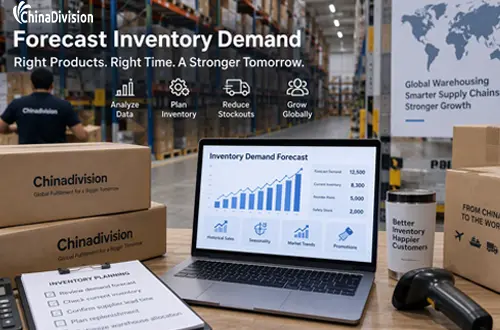
Demand forecasting predicts what customers are expected to buy. Inventory forecasting determines how much stock to hold, where to hold it, and when to reorder. The distinction matters because a good sales forecast does not automatically become a good purchase order unless lead time, current stock, in-transit stock, and safety stock are included.
What Is Inventory Demand?
Inventory demand is the quantity of goods customers are expected to purchase over a defined period. It is the primary driver behind how much stock a business orders, stores, and distributes.
Inventory demand is not the same as:
- Historical sales.
- Customer orders already received.
- Supplier purchase orders.
- Warehouse stock on hand.
- Marketing targets.
- Revenue forecasts.
Historical sales can approximate demand only when stock was available throughout the period. If a product was out of stock, sales data understates true demand.
This distinction is central to replenishment planning: demand tells you what customers may buy; inventory planning tells you what to buy, when, and where.
Demand Forecasting vs. Inventory Forecasting: What Is the Difference?
Demand forecasting predicts how many units customers will buy. Inventory forecasting converts that prediction into a stock plan: how much to hold, where to store it, and when to reorder.
| Comparison | Demand Forecasting | Inventory Forecasting |
|---|---|---|
| Core question | "How many units will customers buy?" | "How much stock do we need, where, and when?" |
| Main inputs | Sales history, promotions, seasonality, trends, and marketing plans | Demand forecast, current stock, in-transit stock, lead time, and safety stock |
| Main output | Expected units by SKU, channel, and period | Purchase orders, replenishment quantities, and allocation plans |
| Typical owner | Commercial, sales, marketing, or planning team | Planning, procurement, supply chain, or operations team |
| Main risk if wrong | Missed revenue targets or overestimated sales | Stockouts, excess inventory, tied-up cash, or fulfillment delays |
| Relationship to warehouse | Provides an expected sales signal | Determines inbound inventory requirements and stock positioning |
Demand planning starts with a sales forecast but also uses actual sales, inventory levels, and supplier lead times to determine inventory needs.
How to Forecast Inventory Demand in 6 Steps?
A practical inventory demand forecasting process starts with clean data, builds a baseline forecast, adjusts for business conditions, accounts for supply chain uncertainty, and improves through regular performance reviews.
1. Collect and validate historical data
Gather sales by SKU, inventory availability, promotions, returns, current stock, and purchase orders. Check that all teams use consistent reporting periods and definitions.
2. Establish a baseline forecast
Calculate average sales over a relevant historical period and identify trends, seasonality, and unusual sales spikes.
3. Adjust for upcoming business activity
Account for planned promotions, price changes, new product launches, geographic expansion, and changes in customer demand.
4. Calculate replenishment requirements
Compare forecast demand with usable inventory and confirmed inbound stock. Include supplier, transportation, customs, and receiving lead times.
5. Allocate inventory by channel and location
Decide how much stock to reserve for each sales channel, warehouse, and target market without counting the same units twice.
6. Compare forecasts with actual results
Review forecast errors, stockouts, excess stock, supplier delays, and fulfillment performance. Update assumptions and repeat the process.
Which Inventory Demand Forecasting Formula Should You Use?
The right formula depends on how much data you have, how stable demand is, and whether your primary objective is predicting sales or deciding when to reorder.
1. Basic Inventory Demand Forecasting Formula
For products with relatively stable sales, start with average historical demand and adjust for expected changes.
Forecast Demand=Baseline Demand*Adjustment Factor
2. Average Daily Demand Formula
Calculate average daily demand over a suitable historical period:
Average Daily Demand= Units Sold/Days in Period
3. Lead Time Demand Formula
Lead time demand estimates how many units customers may purchase while replenishment is in progress.
Lead Time Demand= Average Daily Demand*Lead Time in Days
4. Reorder Point Formula
The reorder point (ROP) indicates when to initiate replenishment.
ROP=Lead Time Demand+Safety Stock
5. Inventory Replenishment Formula
Once you have a forecast, calculate how much stock you need to order.
Net Replenishment Need=Target Stock - Usable On-Hand Stock - Confirmed Inbound Stock + Uncovered Backorders
How Do Seasonality, Trends, and Promotions Affect Inventory Demand?
Seasonality, trends, and promotions can create demand spikes that a simple average forecast will miss. The goal is to separate recurring patterns from one-time events and planned commercial actions.
Seasonality
Seasonality is a repeating pattern tied to time, such as:
- Holiday shopping.
- Back-to-school demand.
- Summer travel products.
- Winter apparel.
- Festival-related categories.
- Tax-season or New Year wellness products.
Use at least two full cycles of history where possible. A single strong season may be an outlier, not a reliable pattern.
Trends
Trends reflect longer-term movement in demand:
- Growing category demand.
- Declining product interest.
- New customer segments.
- Market expansion.
- Competitive changes.
- Consumer-preference shifts.
A trend adjustment should not be based on one strong month. Look for sustained movement across several periods.
Promotions
Promotions can create demand that is real but not repeatable at the same level without the promotion.
Separate:
- Baseline demand.
- Promotional uplift.
- Cannibalization from other SKUs.
- Post-promotion demand dip.
- Pull-forward demand from future periods.
For example, if a promotion sells 1,000 units in one week but normal weekly demand is 300 units, do not automatically assume future weekly demand is 1,000 units. Ask whether the promotion pulled forward future purchases or attracted new customers.
How Do You Forecast Demand Across Multiple Channels and Warehouses?
Forecast demand separately by channel and warehouse, then reconcile the results into a total inventory plan. A single global forecast cannot reliably guide purchase orders or stock allocation.
Channel-Level Forecasting
| Channel | Demand Pattern | Planning Consideration |
|---|---|---|
| Shopify or DTC | Influenced by marketing, email, subscriptions, and promotions | Forecast from traffic, conversion, and campaign calendar |
| Amazon | Influenced by Buy Box, advertising, reviews, and FBA constraints | Forecast separately and account for marketplace rules |
| TikTok Shop | Can spike rapidly from creators or viral content | Use short review cycles and flexible replenishment |
| Wholesale | Often larger, less frequent, and contract-based | Forecast from purchase orders and customer commitments |
| Retail | May require replenishment lead times and minimum presentation stock | Plan by store or distribution center |
| B2B marketplace | Can combine repeat demand with irregular large orders | Separate recurring demand from one-off orders |
Warehouse-Level Forecasting
A total demand forecast of 10,000 units does not tell you where to put them.
Ask:
- Which warehouse is closest to demand?
- Which channel will fulfill from which location?
- What are the shipping cost and delivery-time differences?
- How much safety stock belongs in each location?
- What is the transfer cost if one warehouse runs short?
- Can the destination warehouse receive and process inventory quickly enough?
How Do You Measure Forecast Accuracy?
Measure forecast accuracy by comparing forecasted units with actual demand at the same SKU, channel, location, and period. Use more than one metric, because a single accuracy percentage can hide important errors.
Common Forecast Accuracy Metrics
| Metric | What It Measures | Best Use | Limitation |
|---|---|---|---|
| Forecast error | Difference between actual and forecast demand | Basic variance review | Can offset over- and under-forecasting |
| MAPE | Average percentage error | Easy-to-understand SKU-level accuracy | Can distort results when demand is low or zero |
| WMAPE | Absolute error weighted by actual volume | Business-impact view across many SKUs | High-volume SKUs dominate the result |
| Forecast bias | Whether forecasts are consistently too high or too low | Detects systematic planning errors | Does not show magnitude alone |
| Forecast value added | Whether your process beats a simple baseline | Tests whether forecasting effort adds value | Requires consistent baseline definition |
MAPE measures average percentage error, while WMAPE weights errors by actual demand volume, giving greater importance to high-volume items.
How Often Should You Review and Update Inventory Forecasts?
Review forecasts on a fixed cadence—often weekly for fast-moving ecommerce SKUs and monthly for the full planning cycle. Update more frequently around promotions, product launches, supplier delays, and peak season.
| Review Frequency | Best For | What to Review |
|---|---|---|
| Daily | Viral products, launches, peak season | Orders, stockouts, marketplace restrictions, urgent replenishment |
| Weekly | Fast-moving DTC and marketplace SKUs | Sales versus forecast, stock cover, reorder triggers |
| Monthly | Full assortment and replenishment plan | Forecast accuracy, bias, supplier lead times, purchase plan |
| Quarterly | Category and budget planning | Seasonality, product portfolio, channel strategy |
| Annually | Annual demand and financial planning | Long-term trends, assortment, supplier strategy |
Demand planning benefits from frequent updates using real-time sales, orders, inventory, and lead-time information.
What Is the Difference Between Inventory Management, Inventory Planning, and Inventory Control?
Inventory management tracks and controls existing stock. Inventory planning uses demand, stock, and supply information to decide future purchasing and allocation. Inventory control is the operational discipline that keeps physical stock aligned with system records.
| Function | Main Focus | Typical Activities |
|---|---|---|
| Inventory management | Current stock and its movement | Track quantities, locations, receipts, shipments, returns, and adjustments |
| Inventory planning | Future inventory needs | Forecast demand, calculate replenishment, plan purchases and allocation |
| Inventory control | Accuracy of physical versus system stock | Receiving checks, barcode scanning, cycle counts, stock adjustments |
| Demand planning | Expected customer demand | Forecast sales, promotions, seasonality, and market trends |
Inventory management commonly focuses on monitoring stock location, quantity, dimensions, and weight. Inventory planning looks across past, present, and future demand to determine what to order and when.
What Are the Most Common Inventory Demand Forecasting Mistakes?
The most common forecasting mistakes are using sales as demand, ignoring lead-time variability, forecasting only at company level, treating promotions as normal demand, and failing to include warehouse and channel constraints.
| Mistake | What Happens | Better Approach |
|---|---|---|
| Using sales history without stockout adjustment | Demand is understated | Estimate lost sales during unavailable periods |
| Forecasting only total revenue | SKU-level purchasing becomes guesswork | Forecast by SKU, channel, and location |
| Ignoring supplier lead time | Orders arrive too late | Include lead time and lead-time variability |
| Using one safety-stock rule for all SKUs | Low-margin products become overstocked; key SKUs stock out | Set service levels by product importance |
| Treating promotion sales as baseline | Future inventory is overbought | Separate promotional and baseline demand |
| Ignoring MOQ and carton packs | Purchase plan cannot be executed | Convert forecast into supplier-compliant order quantities |
| Not including in-transit stock | Duplicate orders are placed | Track open purchase orders by expected receipt date |
| Ignoring marketplace constraints | FBA or marketplace stockouts occur | Forecast marketplace inventory separately |
| No forecast accuracy review | The same errors repeat | Measure WMAPE, bias, and forecast value added |
| No cross-functional input | Marketing, sales, and operations conflict | Hold a regular forecast-review meeting |
How Can a 3PL Improve Inventory Demand Forecasting?
A 3PL improves forecasting execution by providing accurate inventory visibility, receiving data, fulfillment velocity, channel-level stock status, and operational constraints—but it does not replace the brand’s commercial forecast.
What a Fulfillment Partner Can Provide
| Fulfillment Data | How It Improves Forecasting |
|---|---|
| Real-time inventory by SKU and warehouse | Shows true available stock |
| Open-order reservations | Prevents double-counting available inventory |
| Receiving dates and discrepancies | Improves supplier lead-time assumptions |
| Fulfillment velocity by channel | Supports channel-level demand forecasts |
| Returns and restock data | Helps calculate net demand |
| Aged inventory and expiry data | Supports markdown, transfer, or disposal planning |
| Warehouse capacity constraints | Prevents unrealistic inbound plans |
| Marketplace prep status | Helps avoid FBA or marketplace stockouts |
What the Brand Must Own
- Commercial sales targets.
- Marketing calendar and promotional plans.
- Product roadmap.
- Pricing decisions.
- Supplier negotiations.
- Purchase-order approval.
- Financial planning and margin targets.
- Final demand forecast accountability.
How ChinaDivision Supports Inventory Demand Forecasting and Fulfillment
ChinaDivision helps ecommerce brands, B2B sellers, and marketplace operators connect inventory visibility, inbound receiving, warehouse operations, and multichannel fulfillment—so a demand forecast can become an executable replenishment plan.
Inventory Visibility and Receiving
ChinaDivision can support:
- SKU-level inventory visibility.
- Warehouse receiving and count verification.
- ASN coordination.
- Lot, batch, and expiry-date workflows where applicable.
- Inventory status controls for available, reserved, damaged, quarantined, and recalled stock.
- Cycle-count and discrepancy reporting.
Demand and Replenishment Support
We can help operationalize:
- Sales and inventory data for planning reviews.
- Channel-level stock visibility.
- Inbound shipment tracking.
- Reorder-point and safety-stock workflows.
- Replenishment alerts and aged-inventory reporting.
- Multi-warehouse allocation planning.
Fulfillment Execution
ChinaDivision can support:
- Shopify, marketplace, B2B, and DTC order fulfillment.
- Amazon FBA preparation and replenishment.
- Pick-and-pack, kitting, bundling, and branded packaging.
- B2B carton, case, and pallet fulfillment.
- Multi-carrier shipping coordination.
- Returns receipt, inspection, restock, and disposition.
FAQ: Inventory Demand Forecasting for International Warehousing and Fulfillment
Can I forecast inventory demand without software?
Yes, especially for a small SKU count. Use a controlled spreadsheet with clear formulas, historical sales, promotions, lead times, and inventory balances. As SKU count, channels, and warehouses grow, planning software can reduce manual errors and improve repeatability.
How do I forecast a new product with no sales history?
Use comparable products, category demand, planned marketing activity, preorders, crowdfunding data, and a staged replenishment plan. Avoid committing a large first order based only on an optimistic sales target.
Why did we stock out even though our forecast was accurate?
Common causes include supplier delay, longer freight or customs time, inaccurate available-inventory data, marketplace stock constraints, unrecorded reservations, or a warehouse receiving delay. Forecast accuracy alone does not guarantee fulfillment availability.
How do I forecast inventory across Amazon, Shopify, and wholesale?
Forecast each channel separately, then reconcile total demand. Amazon, DTC, wholesale, and retail channels often have different demand patterns, lead times, stock rules, and fulfillment constraints.
Choose ChinaDivision for Demand-Driven Ecommerce Fulfillment
Forecasting inventory demand is not just a spreadsheet exercise. It is a supply-chain process that connects customer demand, supplier lead times, purchase orders, freight, customs, warehouse receiving, and order fulfillment.
ChinaDivision helps B2B brands, ecommerce sellers, and marketplace operators build that connection. From supplier consolidation, inbound receiving, inventory visibility, lot and expiry workflows, and replenishment support to DTC fulfillment, Amazon FBA preparation, B2B distribution, and returns management, we help turn inventory plans into sellable stock and reliable customer delivery.


About the Author: Limi

Limi is a content marketing expert at ChinaDivision, helping businesses and e-commerce sellers navigate the complexities of international shipping by providing actionable tips and comprehensive guides on logistics, shipping, and cargo transportation.