

How to Reduce Shipping Costs for Crowdfunding Campaigns
The short answer to slashing your logistics expenses is simple: You must optimize your product and packaging dimensions for volumetric weight, collect shipping fees post-campaign via a pledge manager, and partner with a specialized crowdfunding fulfillment provider to leverage pre-negotiated volume discounts.
Table of Contents
- Understanding Crowdfunding Shipping Costs
- Designing for Logistics to Lower Crowdfunding Expenses
- Engineering Your Packaging for Maximum Savings
- Navigating Platform-Specific Shipping Challenges
- Use bulk cargo transportation and regional fulfillment
- Misconception: Secondary customs clearance ≠ Automatic fines
- Choose the right shipping method (not the fastest)
- Protecting Your Margins with Deferrals and Tax Strategies
- Why Top Creators Outsource to Specialized 3PLs
- Why Choose Chinadivision for Your Crowdfunding Shipping?
- Crowdfunding Fulfillment FAQ
For creators on platforms like Kickstarter and Indiegogo, bringing a product to life is only half the battle. The real challenge begins when thousands of packages need to cross international borders. Underestimating your Shipping Costs is one of the most common reasons a successful campaign can still lose money. A small miscalculation of just 20% can entirely wipe out your profit margin.
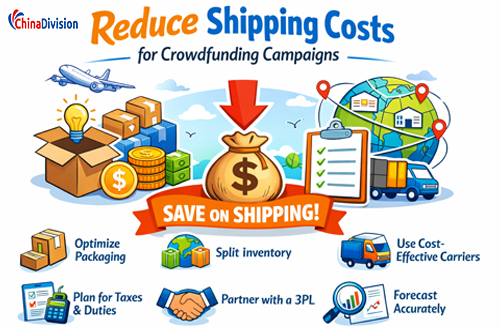
To protect your bottom line, you need to transition from a creative mindset to a logistical one. This guide breaks down exactly how to control your global shipping expenses from the perspective of an international order fulfillment specialist.
Understanding Crowdfunding Shipping Costs
For creators launching projects on Kickstarter Crowdfunding or Indiegogo Crowdfunding, shipping is often the largest hidden expense — and the number one reason campaigns run into budget issues after funding. Crowdfunding shipping cost includes far more than just postage; it is made up of multiple layers:
- Carrier Base Fees: Calculated by weight, transit distance, and service level.
- Dimensional Weight Pricing: The industry standard where carriers bill based on package volume versus actual weight—whichever is higher.
- Packaging Materials & Labor: The cost of boxes, mailers, inserts, and the specialized warehouse labor required to pack them.
- Customs Duties, VAT, and Import Taxes: Border clearance fees that vary drastically by the destination country.
- Last-Mile Surcharges: Additional fees for residential delivery, fuel fluctuations, or remote areas.
- Risk Reserves: The hidden costs of processing returns, handling lost parcels, and sending out re-shipments.
For Kickstarter crowdfunding and Indiegogo crowdfunding projects, underestimating these factors is one of the most common reasons campaigns lose profitability after funding. A miscalculation of even 15–20% can eliminate your margin entirely.
Designing for Logistics to Lower Crowdfunding Expenses
Your product's physical design determines your Crowdfunding Shipping Cost far more than your final choice of courier. Because logistics networks charge based on billable weight, a lightweight but bulky item can cost significantly more to transport than a heavy, compact one.
Practical Design Adjustments
- Eliminate Dead Space: Design your product components to nest together neatly, reducing empty internal volume.
- Ditch Oversized Boxes: Avoid massive exterior packaging meant solely for a "premium retail feel."
- Embrace Modular Configurations: Use foldable or detachable parts that allow the item to ship completely flat.
- Audit Accessories: Reconsider non-essential add-ons that push your package into a higher dimensional tier.
Engineering Your Packaging for Maximum Savings
Packaging is the fastest, most controllable way to trim your international shipping fees. A beautifully designed box is great—until it triples your Kickstarter shipping cost. Experienced creators often say: "Design for logistics first, branding second." Shipping carriers charge based on billable weight, which is either actual weight or dimensional weight (size-based calculation)—whichever is higher. That means a lightweight but bulky product can cost more to ship than a heavier, compact one.
- Swap Boxes for Mailers: Whenever possible, replace rigid boxes with padded bubble mailers. They drop both the physical weight and the volume calculation.
- Use Free or Subsidized Materials: Leverage raw packaging boxes provided by your manufacturers or standard carrier boxes provided by your 3PL.
- Minimize Internal Fillers: Excessive packing peanuts or air pillows expand your outer box dimensions and trigger higher volumetric rates.
Logistics Balance Rule: Never cut packaging quality so aggressively that your damage and return rates spike. A damaged reward costs twice as much to replace and hurts your brand reputation.
Navigating Platform-Specific Shipping Challenges
Whether you are running a Kickstarter Crowdfunding project or an Indiegogo Crowdfunding campaign, each platform presents unique logistics hurdles that impact your bottom line.
Managing Your Kickstarter Shipping Cost
Once your campaign concludes successfully, Kickstarter Fulfillment demands rapid, accurate execution to maintain backer trust. Your core focus must be balancing your package dimensions.
For instance, shipping a laptop from an export hub like China to the USA naturally costs more than shipping a smartphone—not just because of physical weight, but because the dimensional weight of the laptop box triggers higher pricing tiers. Ensuring your final box dimensions tightly hug your product is paramount.
Optimizing Your Indiegogo Shipping Cost
For creators managing an Indiegogo Shipping strategy, the platform’s layout allows for extended, rolling fulfillment timelines (especially through Indiegogo InDemand). This format gives you extra room to aggregate your orders for bulk cargo transportation, securing deep volume discounts from carriers that single-packet shippers cannot access.
Use bulk cargo transportation and regional fulfillment
For larger Kickstarter crowdfunding and Indiegogo crowdfunding campaigns, bulk cargo transportation combined with regional warehousing is one of the most effective cost-saving strategies.
Why it works:
- Ship inventory in bulk from China to key regions (US, EU, AU)
- Reduce per-unit international shipping fees
- Avoid repeated cross-border shipments
- Enable faster last-mile delivery
Benefits:
- Lower crowdfunding shipping cost per order
- Reduced customs complexity
- Improved backer satisfaction
This model is especially effective when paired with a fulfillment partner like Chinadivision, which offers global warehousing and distribution.
Choose the right shipping method (not the fastest)
Speed is one of the biggest cost drivers in international shipping.
Smart crowdfunding fulfillment strategy:
- Offer tiered shipping options (economy vs express)
- Default to cost-efficient shipping methods
- Use expedited shipping only when necessary
Most backers prefer lower shipping costs over faster delivery, especially for Kickstarter shipping and Indiegogo shipping.
Realistic Shipping Cost Benchmarks for Crowdfunding Campaigns
A healthy crowdfunding campaign usually spends:
| Campaign Type | Typical Shipping Cost Ratio |
|---|---|
| Simple domestic campaigns | 8%–12% |
| International campaigns | 10%–15% |
| Complex global campaigns | 15%–25% |
If your estimated Crowdfunding Shipping Cost is far below these ranges, you may be underestimating expenses.
Protecting Your Margins with Deferrals and Tax Strategies
1. Charge Shipping Separately (Always)
Offering "free shipping" or locking in a flat shipping fee during the live campaign is a major financial risk. Fuel surcharges spike, carrier rates fluctuate, and global supply chain disruptions happen.
Instead, always collect shipping fees after your campaign concludes using a dedicated pledge manager. This allows you to input real backer addresses, calculate exact physical weights, and apply real-time, region-specific pricing.
2. Plan for Taxes, Duties, and Incoterms Early
When shipping internationally, you must decide how duties are handled:
- DDP (Delivered Duty Paid): You, the creator, pay all import taxes and customs clearance fees upfront. This increases your upfront budget by 15–25% but ensures a seamless delivery experience for your backers.
- DDU/DAP (Delivered Duty Unpaid): The backer must pay local taxes at their local post office to claim their package. This lowers your initial cost but frequently results in angry backers, high abandonment rates, and costly return shipments.
3. Apply for Export Tax Rebates
If your product is manufactured in China, you can qualify for an export tax rebate (the refund or exemption of VAT and consumption taxes paid during production). Navigating international customs paperwork independently is highly complex, but an experienced fulfillment center based directly in China can manage this process on your behalf, dropping your overall structural costs.
Why Top Creators Outsource to Specialized 3PLs
Trying to pick, pack, and label thousands of international packages from a garage or local warehouse is an operational bottleneck. Partnering with a dedicated third-party logistics provider unlocks immediate cost advantages:
- Deeply Discounted Bulk Rates: 3PLs process millions of packages a year, granting you access to commercial shipping rates you cannot secure on your own.
- Automated Fulfillment Ecosystems: Seamless software integrations pull backer data directly from Kickstarter, Indiegogo, or your pledge manager, eliminating manual data entry errors.
- Crowdfunding Expertise: Dedicated 3PLs understand how to manage massive, sudden spikes in order volume without processing delays.
Why Choose Chinadivision for Your Crowdfunding Shipping?
As a leading international order fulfillment service provider, Chinadivision specializes in supporting creators and brands launching projects on Kickstarter Crowdfunding and Indiegogo Crowdfunding. We understand exactly how to reduce crowdfunding shipping costs while keeping your operations smooth.
What we offer:
- Competitive rates through bulk cargo transportation and global carrier partnerships
- Kickstarter fulfillment and Indiegogo fulfillment tailored for volume spikes
- Warehousing in China, US, EU, and more to split inventory and cut international shipping fees
- Full customs support, tax calculation, and DDP delivery options
- Automated tracking and integration with major pledge managers
- End-to-end solutions to lower your crowdfunding shipping cost and protect your margins
We take care of logistics, so you can focus on building your product and growing your community.
For global campaigns, working with an established provider like Chinadivision bridges the gap between your manufacturing base and your worldwide audience. By leveraging Chinadivision's specialized Kickstarter Fulfillment and Indiegogo Fulfillment services, you benefit from secure warehousing right next to manufacturing hubs, direct access to optimized international lines, friction-free customs clearance, and expert tax rebate handling. This keeps your per-unit costs low and frees you up to focus entirely on building your community.
Crowdfunding Fulfillment FAQ
How can a fulfillment partner reduce my crowdfunding shipping cost?
A professional partner like Chinadivision leverages bulk shipping rates, optimized logistics routes, and regional warehouses to significantly reduce per-order international shipping fees.
Is bulk cargo transportation better than direct shipping?
Yes, for medium to large campaigns. Shipping inventory in bulk to regional warehouses lowers costs and improves delivery speed compared to individual international shipments.
Should I choose DDP or DDU for crowdfunding shipping?
DDP is generally recommended for better customer experience, especially in Kickstarter and Indiegogo campaigns, as it avoids unexpected charges for backers.
When should I start planning fulfillment?
Ideally before launching your campaign. Early planning ensures accurate Kickstarter shipping cost and Indiegogo shipping cost estimation.
Can Chinadivision handle global crowdfunding fulfillment?
Yes. Chinadivision specializes in crowdfunding fulfillment, offering end-to-end solutions including warehousing, bulk cargo transportation, picking and packing, and global last-mile delivery.
What’s the difference between Kickstarter Fulfillment and Indiegogo Fulfillment?
Kickstarter campaigns often have larger backer bases, while Indiegogo campaigns may require more flexible logistics. Both benefit from professional fulfillment partners.
How can I reduce bulk cargo transportation costs?
By consolidating shipments, using regional warehouses, and leveraging negotiated carrier rates.
Should I charge shipping separately?
Yes. Charging after the campaign via pledge managers ensures accuracy and protects margins.
If you are preparing for Kickstarter fulfillment or Indiegogo fulfillment, working with an experienced international order fulfillment partner like Chinadivision can help you control costs, improve delivery performance, and scale your campaign globally with confidence.


About the Author: Limi

Limi is a content marketing expert at ChinaDivision, helping businesses and e-commerce sellers navigate the complexities of international shipping by providing actionable tips and comprehensive guides on logistics, shipping, and cargo transportation.