

Negotiable vs Non-Negotiable Bill of Lading: Key Differences
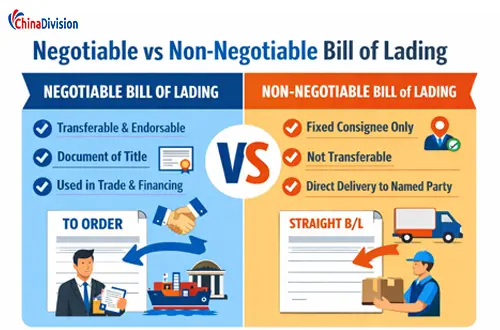
A negotiable bill of lading (also called Order Bill of Lading) is transferable, acts as proof of ownership, and supports trade finance. A non-negotiable bill of lading (including Straight Bill of Lading and Named Bill of Lading) is fixed to one consignee, cannot transfer ownership, and is used for confirmed payments or trusted shipments. Below we explain everything you need to know for international shipping, warehousing, and order fulfillment.
Table of Contents
- What Is a Bill of Lading in International Shipping?
- What Is a Negotiable Bill of Lading?
- What Is a Non-Negotiable Bill of Lading?
- Key Comparison: Negotiable vs Non-Negotiable Bill of Lading
- Original vs Non-Negotiable: Clear Up Confusion
- How to Choose the Right One for Your Fulfillment
- Why B2B Businesses Choose Chinadivision for Global Fulfillment
- Frequently Asked Questions
- Recommended Sources and Industry References
What Is a Bill of Lading in International Shipping?
A Bill of Lading (B/L or BOL) is one of the most important documents in global logistics and international order fulfillment. It serves three major purposes:
- Receipt of Goods — confirms the carrier received the cargo
- Contract of Carriage — outlines transportation terms between shipper and carrier
- Document of Title — in some cases, proves ownership of the cargo
In cross-border fulfillment operations, bills of lading are commonly used for:
- Ocean freight shipments
- FCL and LCL container transportation
- Amazon FBA shipping
- Wholesale and B2B cargo distribution
- International dropshipping fulfillment
- Customs documentation
- Trade finance and Letters of Credit (L/C)
What Is a Negotiable Bill of Lading?
A negotiable bill of lading is a legal document that serves as a contract of carriage, receipt of goods, and most importantly, a document of title. It is almost always issued as an Order Bill of Lading, marked with phrases like “to order” or “to order of [party], meaning ownership can be reassigned by endorsement (signing the back) and delivery of the original document.
Core Features
- ✅ Transferable ownership: You can sell, assign, or pledge goods while they are still in transit — ideal for commodity trading or multi-party transactions.
- ✅ Proof of title: Whoever holds the properly endorsed original bill legally owns the cargo and is the only one authorized to collect it at destination.
- ✅ Trade finance ready: Used with Letters of Credit; banks hold the bill until payment is secured, reducing risk for both buyer and seller.
- ✅ Must present original: Carriers will NOT release goods unless the original, endorsed negotiable bill is surrendered.
Common Use Cases
- International sales with payment terms like L/C or documentary collection
- Reselling goods while they are still on the water
- Using cargo as collateral for loans or financing
- Complex supply chains with multiple buyers or intermediaries
Important note: While called “negotiable,” legally it is transferable title, not negotiable currency — you cannot pass better rights than you hold, so endorsements must be valid and documented.
What Is a Non-Negotiable Bill of Lading?
A non-negotiable bill of lading is fixed to one named consignee — it cannot be transferred, sold, or pledged. It is also known as Straight Bill of Lading or Named Bill of Lading, because the receiver is explicitly written out and cannot be changed after issuance. It is NOT a document of title, only proof of shipment and delivery contract.
Core Features
- ❌ Not transferable: Even if signed over, it has no legal effect; only the named party can receive goods.
- ❌ Not proof of ownership: Only shows who must receive the cargo, not who owns it.
- ✅ Simpler delivery: Often allows release without original document (express release / telex release) once identity is verified.
- ✅ Lower risk when payment is secure: Great when trust is established or payment is already made.
Common Use Cases
- Pre-paid orders or confirmed sales
- Intra-company transfers, moving stock between your own warehouses or branches
- Simple shipments without banks or third parties involved
- Sea waybills also fall under this category — same rules apply
Key Comparison: Negotiable vs Non-Negotiable Bill of Lading
| Aspect | Negotiable / Order Bill of Lading | Non-Negotiable / Straight / Named Bill of Lading |
|---|---|---|
| Transferability | ✅ Fully transferable via endorsement | ❌ Fixed; cannot change consignee |
| Document of Title | ✅ Yes — holder = owner | ❌ No — only delivery instruction |
| Release Rule | Must surrender original endorsed bill | Deliver only to named party; ID enough |
| Best For | Trade finance, L/C, resale in transit | Pre-paid, trusted partners, internal moves |
| Risk Level | Medium (secure but needs document control) | Lowest — clear, fixed delivery |
| Common Labels | “To order”, “To order of shipper/bank” | “Consigned to: [Company Name]”, “Non-negotiable” |
- Ownership transfer:
Negotiable bill of lading allows transfer via endorsement; non-negotiable does not. - Document of title:
Negotiable B/L acts as a title document; straight bill of lading does not. - Cargo release requirements:
Negotiable requires original endorsed document; non-negotiable often allows release without original (depending on carrier and agreement). - Risk level:
Negotiable offers more control for sellers and banks; non-negotiable is simpler but assumes trust between parties. - Fulfillment efficiency:
Non-negotiable B/L supports faster, streamlined delivery; negotiable B/L adds administrative steps.
Original vs Non-Negotiable: Clear Up Confusion
Many people mix these terms — they describe different things:
- Original Bill of Lading: Refers to the signed, official copy issued by the carrier. Both types come as originals; you always receive 1–3 signed originals.
- Negotiable / Non-Negotiable: Refers to function and ownership rights, not whether it is original or copy.
Critical Legal Difference
- Original Negotiable Bill: Whoever holds and endorses it owns the goods. Carrier releases only to that holder.
- Original Non-Negotiable Bill: Even if someone else holds it, goods go only to the named consignee. Ownership never changes via the document.
Digital & Future Trends
Modern fulfillment uses electronic Bill of Lading (eB/L) and digital signatures. These replace paper originals but keep the same rules: negotiable eB/L still transfers rights; non-negotiable remains fixed. This speeds up release, cuts lost-document risks, and works seamlessly with international warehousing and cross-border fulfillment systems.
How to Choose the Right One for Your Fulfillment
From an international order fulfillment perspective, choosing correctly affects speed, cost, security, and warehouse handover:
Choose Negotiable / Order Bill of Lading if you:
- Work with new partners or use Letters of Credit
- May sell goods before arrival
- Need bank financing or credit terms
- Want full control until payment is confirmed
Choose Non-Negotiable / Straight / Named Bill of Lading if you:
- Already received payment or work with trusted buyers
- Ship between your own factories, warehouses, or branches
- Want faster release, less paperwork, no risk of lost originals
- Ship under simple terms (e.g. Ex Works, FOB with payment upfront)
Pro tip: When using our Chinadivision fulfillment network, we match your document type with our warehouse processes — negotiable bills require document verification before release; non-negotiable allow faster clearance and direct handover.
Why B2B Businesses Choose Chinadivision for Global Fulfillment
As an experienced international order fulfillment service provider, Chinadivision bridges the gap between China-based sourcing and global delivery.
Key advantages include:
- End-to-end fulfillment: From inventory storage to last-mile delivery.
- Expertise in shipping documentation: Including negotiable and non-negotiable bills of lading.
- Flexible shipping solutions: Sea freight, air freight, and hybrid logistics.
- Scalable operations: Supporting startups to enterprise-level global distribution.
- Reduced shipping risk: Through optimized B/L selection and compliance management.
For businesses dealing with complex ownership structures or multi-party transactions, our team ensures your documentation aligns with your financial and logistics strategy.
Frequently Asked Questions
What is the difference between Straight Bill of Lading and Named Bill of Lading?
They are almost identical — both are non-negotiable, name one fixed consignee, and cannot transfer ownership. “Straight” emphasizes direct delivery; “Named” emphasizes the specific receiver. In practice, they are used interchangeably.
Can I switch from negotiable to non-negotiable after issue?
No — once issued, type cannot be changed. If you no longer need transferability, you may arrange express release or telex release to speed delivery, but legal status remains as issued.
Can goods be released without an original bill of lading?
Sometimes. For straight B/L shipments, carriers may allow telex release or electronic release depending on destination regulations and carrier policy.
What happens if I lose an original negotiable bill?
You face delays, extra costs (indemnity bonds), and risk of cargo being claimed by others. With Chinadivision, we guide you through recovery or help you use secure digital options to avoid this risk.
Which one is better for Amazon or cross-border e-commerce fulfillment?
Non-negotiable / Straight Bill of Lading is usually better — you have pre-agreed buyers or fulfillment centers, payment is confirmed, and you want fast handover to our overseas warehouses without waiting for paper documents.
Do you handle document preparation and compliance?
Yes — as your international order fulfillment partner, we prepare, verify, and manage all bills of lading, customs papers, and transport documents to ensure full compliance with export/import rules in China, Southeast Asia, Europe, and the US.
Recommended Sources and Industry References
For additional information about international shipping documentation and cargo transportation practices, businesses can refer to:


About the Author: Limi

Limi is a content marketing expert at ChinaDivision, helping businesses and e-commerce sellers navigate the complexities of international shipping by providing actionable tips and comprehensive guides on logistics, shipping, and cargo transportation.