

How Many Pallets Can a 20-ft and a 40-ft Container Hold?
When planning international shipments, space optimization directly impacts your bottom line. As a professional international order fulfillment service provider, one of the most frequent questions we receive from global B2B clients is: How many pallets can a 20-ft and a 40-ft container hold?
Table of Contents
- Key Pallet Sizes: Standard Pallets vs Euro-pallets
- How Many Pallets Fit in a 20-foot Container?
- How Many Pallets Fit in a 40-foot Container?
- Pallet Capacity in 40ft Reefer Containers
- Important Reefer Loading Considerations
- How Many Boxes Fit On a Pallet?
- Standard Pallets vs Euro-Pallets: Which Is Better?
- FCL vs LCL: Which Shipping Method Is Better for Palletized Cargo?
- Professional tips to maximize container pallet efficiency
- Frequently Asked Questions (B2B Users)
- Why businesses choose Chinadivision for international order fulfillment
In short, a standard 20-foot container can hold 10 to 11 single-stacked pallets, while a standard 40-foot container can hold 20 to 24 single-stacked pallets. The exact number depends entirely on the dimensions of the shipping pallets used and your chosen loading technique.
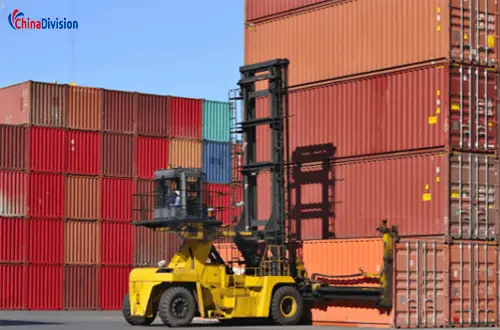
Understanding how to maximize your shipping container space is essential for cost-effective supply chain management. Let’s break down the details of container pallets layout, dimensions, and expert loading strategy.
Key Pallet Sizes: Standard Pallets vs Euro-pallets
Before counting, clarify the two most widely used sizes globally — this directly changes how many container pallets you can load:
- Standard pallets (US/GMA): 48 in × 40 in (1,219 mm × 1,016 mm) — widely used in North America, Asia, and global trade.
- Euro-pallets: 47.2 in × 31.5 in (1,200 mm × 800 mm) — standard across Europe, more compact, fits slightly more per container.
Always confirm pallet dimensions first; mixing sizes or non-standard pallets will reduce total capacity and increase planning risk. Choosing the right type of standard pallets depends heavily on your destination market, your fulfillment center requirements, and the handling equipment used at the final destination.
How Many Pallets Fit in a 20-foot Container?
A 20 ft container can hold 10 standard pallets or 11 Euro‑pallets.
20 ft Container Internal Dimensions
Length: 19’4” (5.89 m) | Width: 7’9” (2.36 m) | Height: 7’10” (2.39 m) | Volume: ~33 m³
The 20-foot container is a cornerstone of global logistics. Freight forwarders and exporters often prefer it for smaller Full Container Load (FCL) shipments or for routes where container rollover risk is higher due to port congestion. It allows businesses to ship a pallet quickly and securely, offering faster turnaround times and lower upfront capital investment.
Exact Pallet Capacity
- Standard pallets: 10 pallets, single stacked, arranged two across × five deep.
- Euro-pallets: 11 pallets, optimized layout fits one extra due to narrower width.
Practical Notes
- Ideal for smaller shipments, high-frequency routes, or when you need faster transit and lower minimum costs.
- Very common for FCL orders under 28,000 kg gross weight — perfect for exporters, manufacturers, and distributors.
- Loading tip: Align long side along length; avoid overhang, which causes damage and carrier refusal.
How Many Pallets Fit in a 40-foot Container?
A 40 ft container can hold 20–21 standard pallets or 23–24 Euro‑pallets, depending on loading technique.
40 ft Container Internal Dimensions
Length: 39’5” (12.03 m) | Width: 7’9” (2.35 m) | Height: 7’10” (2.39 m) | Volume: ~67.7 m³ | Tare weight: ~3,750 kg
The larger footprint of a 40-foot container makes it the preferred option for high-volume international shipping. A 40 ft container helps reduce freight cost per pallet because transportation expenses are spread across more cargo units.
Exact Pallet Capacity
- Standard pallets: 20 pallets standard; up to 21 pallets with optimized pinwheel or staggered loading.
- Euro-pallets: 23 pallets standard; up to 24 pallets with tight, efficient arrangement.
Best Use Cases: Smaller FCL shipments, routes with congestion risk, or urgent deliveries requiring faster turnaround.
This is the most popular shipping container size for bulk international orders — nearly double the space of a 20-foot container, excellent value for volume shipments.
Pallet Capacity in 40ft Reefer Containers
Refrigerated containers (reefers) are essential for temperature-sensitive goods, but they present unique space challenges. The pallet capacity in a 40ft reefer container is slightly smaller than a standard dry 40-footer due to the added insulation that narrows the interior walls. Capacity is reduced by 1–2 pallets vs dry containers:
- Standard pallets: 20 pallets only; no extra space for optimization.
- Euro-pallets: 22–23 pallets maximum; must leave clear airflow gaps around walls and between rows to maintain temperature control.
Best Use Cases: Bulk shipments, cost‑efficient long‑haul freight, and consolidated orders.
Critical rule: Even if you fit more, weight limits apply — heavy goods often reach payload limits before space is full. Always calculate volume and weight.
Important Reefer Loading Considerations
When loading reefer containers:
- Airflow space must be maintained
- Pallets cannot fully block ventilation channels
- Cargo weight distribution becomes more critical
- Payload limits may be reached faster
This is especially important for:
- Food products
- Cosmetics
- Pharmaceuticals
- Temperature-sensitive ecommerce inventory
How Many Boxes Fit On a Pallet?
No fixed number — depends on box size, stacking strength, and stability. But here are the industry standards that make loading easy and efficient:
For Standard Pallets (48” × 40”)
- Common box: 16” × 12” (406 × 305 mm) — fits perfectly, no waste.
- Bulk goods: 20” × 16” (508 × 406 mm) — ideal for lighter, larger items.
- Rule: Never let boxes overhang; keep height ≤ 1.2–1.5m for safe transport.
For Euro-pallets (1200 × 800 mm)
- Best fit: 600 × 400 mm — exactly 4 per layer, fully aligned, zero wasted space.
- Half-size: 800 × 600 mm — also widely used.
Pro tip: Design packaging to match these dimensions, and you will load 10–15% more per shipment while reducing damage claims.
Optimizing your box layouts onto container pallets
There is no single set number of boxes or crates that fit onto a pallet. Because retail freight dimensions vary wildly, professional fulfillment centers use different modular box sizes and stacking arrangements to stabilize shipments.
While ocean carriers do not mandate specific carton sizes, they strictly require a proper fit for warehouse safety and structural stability. Cartons should ideally be modular sub-multiples of a pallet’s length and width to eliminate wasted space and, most importantly, never overhang the pallet edge.
Standard Pallets vs Euro-Pallets: Which Is Better?
Standard Pallets
Advantages:
- Common in the U.S.
- Compatible with Amazon FBA
- Widely accepted by North American warehouses
Disadvantages:
- Wider dimensions reduce container efficiency
Euro-Pallets
Advantages:
- Better space optimization
- Higher pallet quantity per container
- Common across European logistics networks
Disadvantages:
- Less common in North America
For international freight forwarding, choosing between standard pallets and Euro-pallets often depends on the final delivery destination.
FCL vs LCL: Which Shipping Method Is Better for Palletized Cargo?
FCL (Full Container Load)
Best for:
- Large shipments
- Stable inventory demand
- Lower per-unit freight cost
- Faster transit handling
LCL (Less than Container Load)
Best for:
- Small businesses
- Test orders
- Low inventory volume
- Flexible shipping schedules
For growing ecommerce brands, many companies begin with LCL shipping before transitioning to full 20-foot container or 40-foot container shipments as order volume increases.
Professional tips to maximize container pallet efficiency
From a fulfillment and freight forwarding perspective, optimizing container pallets goes beyond simple counting:
- Use pinwheel or interlocking loading patterns to increase pallet count
- Consider double-stacking if cargo is strong and regulations allow
- Balance weight distribution to avoid container imbalance penalties
- Align packaging design with pallet dimensions early in production
- Evaluate FCL vs LCL depending on shipment volume and urgency
Working with an experienced international order fulfillment provider ensures these optimizations are implemented correctly.
Frequently Asked Questions (B2B Users)
Which is better — 20 ft or 40 ft container for my order?
Choose 20-foot if your cargo is under 15–18 tons or <30 m³. Choose 40-foot for volumes above that — cost per cubic meter is 25–35% lower. We analyze your order volume and weight to recommend the most cost-effective option.
Can I mix standard pallets and Euro-pallets in one container?
Possible but not recommended — it creates gaps, wastes space, and complicates loading. We advise using one consistent pallet type per shipment.
Do you handle LCL shipments if I don’t fill a full container?
Yes! We consolidate your goods with others to cut costs, and we still optimize pallet arrangement so you pay only for the space you use.
How do you ensure no damage during loading and transit?
Our team follows strict procedures: weight balance, secure strapping, airflow gaps for reefers, and professional packing. We also offer cargo insurance and inspection services.
What if my goods are irregular, heavy, or temperature-controlled?
We have special solutions: flat racks, open tops, reefers, and custom loading plans. We calculate exactly how much fits and ensure compliance with all safety rules.
Is double stacking pallets allowed in containers?
Yes, if the cargo is durable and properly secured. However, it depends on product type, packaging strength, and shipping regulations.
Should I use standard pallets or Euro-pallets for international shipping?
Euro-pallets are generally more space-efficient for container shipping, especially in a 40 ft container. However, compatibility with destination warehouses should also be considered.
Why businesses choose Chinadivision for international order fulfillment
For B2B companies sourcing from China or Asia, managing palletization, container loading, and global shipping can be complex. Chinadivision provides end-to-end solutions that simplify the process:
- Optimized palletization and container loading plans
- Integrated warehousing, pick and pack, and labeling
- Competitive international freight forwarding for both FCL and LCL
- Real-time inventory and shipment tracking
- Expertise in handling standard pallets, Euro-pallets, and mixed cargo
By combining fulfillment and logistics, Chinadivision helps businesses reduce shipping costs, improve delivery times, and scale globally with confidence.


About the Author: Limi

Limi is a content marketing expert at ChinaDivision, helping businesses and e-commerce sellers navigate the complexities of international shipping by providing actionable tips and comprehensive guides on logistics, shipping, and cargo transportation.