

EMS vs. FedEx: Definitive International Fulfillment Comparison
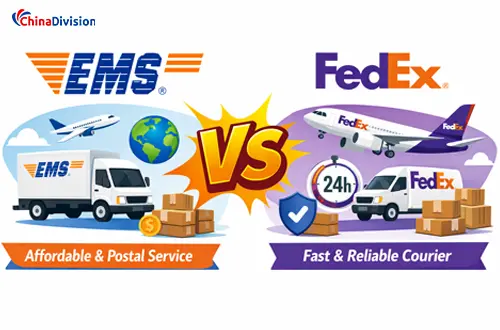
EMS (Express Mail Service) is cost-effective, flexible, and works through global postal networks, ideal for budget shipping and less time-sensitive orders. FedEx is a premium private carrier, offering fast, reliable FedEx Delivery, advanced FedEx Tracking, and better customs support, perfect for urgent, high-value, or B2B shipments. The right choice depends on your product, budget, and delivery needs — and professional fulfillment partners can help you pick and optimize both.
Table of Contents
Neither service is universally superior. The optimal choice depends heavily on your product type, target market, shipping volume, and customer service expectations. As a professional international order fulfillment service provider, Chinadivision manages multi-channel logistics to help businesses balance these variables. Below is a comprehensive, professional breakdown of how Express Mail Service and FedEx Delivery compare.
Understanding EMS and FedEx
What Is EMS?
EMS stands for Express Mail Service, an international express delivery service coordinated by the Universal Postal Union (UPU) and operated by national postal carriers in every country — such as China Post EMS, USPS, or Japan Post. It integrates directly into domestic mail systems, making final delivery widely accessible.
- Transit time: 5–15 business days (China → US: 5–15; China → Europe: 7–14; Asia: 3–7 days)
- Cost: Low to moderate; much cheaper than private couriers; price per kg drops with heavier weight
- Max weight: Typically up to 30kg
- Tracking: EMS Tracking provides key updates (accepted, dispatched, customs, delivered), but updates are less frequent and detailed
- Customs: Simpler documentation, fewer formalities, slower clearance in some regions
- Best for: Medium-value goods ($20–$80), non-urgent orders, items restricted by private carriers (cosmetics, batteries, sensitive goods)
What Is FedEx?
FedEx is a global private logistics giant, owning its own aircraft, hubs, and last-mile network, covering 220+ countries and territories. It offers tiered services to match speed and budget:
- FedEx International Priority: 1–3 days (fastest)
- FedEx International Economy: 3–7 days
- Domestic / Ground / Same-day options
FedEx Delivery is consistent, fast, and fully controlled end-to-end.
- Transit time: 1–5 business days globally; next-day available on key routes
- Cost: Higher; priced by actual or dimensional weight; premium service = premium rate
- Max weight: Higher limits, supports heavy/bulky shipments
- Tracking: FedEx Tracking is real-time, GPS-enabled, with delivery windows, alerts, and full integration into e-commerce and WMS systems
- Customs: Dedicated brokerage teams, faster clearance, duty/tax calculation, full compliance support
- Best for: High-value goods, urgent orders, B2B/wholesale, premium customer experience, guaranteed delivery dates
EMS vs FedEx: Full Comparison Table
| Factor | EMS | FedEx |
|---|---|---|
| Speed | 5–15 days; slower in peak seasons | 1–7 days; reliable, consistent |
| Cost | Lowest option, great for 2–10kg | Higher; premium speed & service |
| Tracking | Basic EMS Tracking, periodic updates | Advanced FedEx Tracking, real-time, full visibility |
| Customs | Simple docs, fewer fees, slower clearance | Fast clearance, professional support, more paperwork |
| Restrictions | More flexible; accepts many restricted items | Strict regulations; bans more products |
| Reliability | Good; ~85–90% on-time | Excellent; ~95%+ on-time delivery |
| Global Reach | Covers all postal destinations; remote areas | 220+ markets; strong in developed regions |
| Insurance | Basic included; extra available | Comprehensive coverage options |
Detailed Comparison: What Matters Most to Your Business
Shipping Speed
Shipping speed directly impacts customer satisfaction, refund rates, and conversion performance. EMS is faster than standard postal mail but slower than premium couriers. Transit time may fluctuate because EMS relies on local postal systems for final delivery.
| Destination (From China) | EMS Delivery Speed | FedEx Delivery Speed |
|---|---|---|
| United States | 5–15 Business Days | 1–5 Business Days |
| Europe | 7–14 Business Days | 2–5 Business Days |
| Asia-Pacific (Regional) | 3–7 Business Days | 1–3 Business Days |
- EMS Delivery: Slower, but acceptable for standard shipping. Best if customers are willing to wait 1–2 weeks.
- FedEx Delivery: Fastest available; critical for time-sensitive, holiday, or B2B orders.
- Verdict: Choose FedEx if speed is your priority; EMS works fine for standard delivery.
Shipping Cost
Shipping cost directly affects ecommerce margins. EMS is generally more economical than private express couriers. FedEx also commonly uses dimensional weight pricing, meaning large lightweight cartons may cost more than expected.
- EMS: EMS generally charges based on actual gross weight up to standard limits (typically 30 kg per package). Far cheaper — example from China: 1kg ≈ $25–30; 5kg ≈ $65–75; 10kg ≈ $110–130. Perfect for free-shipping offers and margin-sensitive goods.
- FedEx: Starts at ~$20–50/kg; large/light packages cost more due to dimensional weight rules. The formula calculates billable weight based on package volume: Dimensional Weight (kg) = Length*Width*Height (cm)/5000
- Verdict: EMS wins for cost-efficiency; FedEx is worth paying for when value or speed justifies it.
Tracking & Visibility
Modern ecommerce customers expect accurate shipment visibility. Still, EMS Tracking is usually adequate for standard ecommerce fulfillment. FedEx Tracking is significantly more advanced.
- EMS Tracking: Shows milestones, but gaps exist, and location updates are rare.
- FedEx Tracking: Every step recorded; predictive ETA, proof of delivery, API integration for your store.
- Verdict: FedEx delivers better transparency — reduces customer inquiries and complaints.
Customs & Compliance
Customs processing is one of the biggest challenges in international ecommerce. EMS parcels are usually processed through postal customs channels. EMS may work better for simpler consumer shipments. FedEx has dedicated customs brokerage teams. FedEx usually clears customs faster and more professionally, especially for commercial cargo.
- EMS: Postal customs = fewer forms, less likely to trigger extra fees, but processing can take longer.
- FedEx: Dedicated brokers, pre-clearing, duty payment options, and compliance checks — great for high-volume or regulated goods.
- Verdict: EMS = simpler; FedEx = faster and more professional.
Product & Weight Rules
This is an area many ecommerce sellers overlook. EMS sometimes accepts products that private couriers may restrict. For specialized ecommerce products, EMS may occasionally provide more flexibility. FedEx generally enforces stricter compliance standards.
- EMS: More flexible — ships cosmetics, electronics with batteries, food, and items private couriers reject.
- FedEx: Strict on batteries, liquids, powders, and dangerous goods; limited exceptions.
- Verdict: EMS is your choice for specialty or restricted products.
Reliability & Support
Delivery reliability directly impacts: customer reviews, refund rates, chargebacks, repeat purchases.
- EMS: Good, but depends on local post; delays possible during holidays or peak seasons.
- FedEx: Industry-leading consistency, guaranteed service levels, and dedicated support for business accounts.
- Verdict: FedEx for mission-critical shipments; EMS for standard, low-risk orders.
When to Choose Which?
When Should Ecommerce Sellers Use EMS?
- You need to cut shipping costs or offer free shipping
- Goods are medium-value ($20–$80) and not urgent
- Shipping sensitive/restricted items (cosmetics, batteries, supplements)
- Delivering to remote or less-developed destinations
- Volume is moderate, and budget matters more than speed
EMS is commonly used for:
- eBay sellers
- AliExpress sellers
- small Shopify stores
- cross-border marketplace fulfillment
When Should Businesses Use FedEx?
- You ship high-value goods (electronics, luxury, industrial parts)
- Orders are time-sensitive or require guaranteed delivery
- Serving B2B buyers, wholesalers, or premium customers
- You want full visibility, professional tracking, and fast customs
- Your business relies on reliability and brand experience
FedEx is the better choice for several high-performance logistics scenarios.
EMS vs FedEx: Which Is Better?
The better choice depends on your shipping priorities.
| Priority | Better Option |
|---|---|
| Lowest Shipping Cost | EMS |
| Fastest Delivery | FedEx |
| Best Tracking | FedEx |
| Simple Customs Process | EMS |
| High-Value Shipments | FedEx |
| Standard Ecommerce Shipping | EMS |
| Urgent B2B Orders | FedEx |
| Premium Customer Experience | FedEx |
For many international ecommerce companies, the smartest strategy is using both:
- EMS for economical standard shipping
- FedEx for urgent or premium orders
How a Professional Fulfillment Partner Helps You Choose
Working with an international order fulfillment service like ChinaDivision removes all the complexity. We don’t just ship — we optimize your logistics:
Best carrier selection
We compare EMS and FedEx in real time, choosing the best balance of speed, cost, and rules for every order
Negotiated rates
We secure discounted pricing on both services — cheaper than booking directly
Customs expertise
Smooth clearance for both channels, reduced risk of hold-ups
Unified tracking
Whether you use EMS Tracking or FedEx Tracking, you and your customers get one simple view
Hybrid strategies
Mix EMS for standard orders and FedEx for express/B2B — all managed from one platform
With 10+ years of experience, warehouses across major regions, and partnerships with all major carriers, ChinaDivision ensures your shipping is always efficient, reliable, and cost-effective — so you can focus on growing sales, not logistics.
Frequently Asked Questions (B2B Focus)
Can I use both EMS and FedEx for my business?
Yes. Most B2B sellers use EMS for budget, standard orders and FedEx for express, urgent, or premium orders. A fulfillment provider manages both seamlessly, giving customers exactly the service they choose.
Which is better for bulk/wholesale shipments?
FedEx is preferred for B2B wholesale — faster, more secure, better documentation, and guaranteed delivery. EMS works well only if delivery time is flexible and cost is the main priority.
Is EMS faster than FedEx?
No. FedEx is generally much faster than EMS for international deliveries. FedEx can often deliver within 1–5 business days, while EMS usually takes 5–15 business days.
Is EMS cheaper than FedEx?
Yes. EMS is usually more affordable for standard international ecommerce shipments, especially for medium-weight parcels.
Can you integrate with my store or ERP system?
Yes. ChinaDivision connects Shopify, WooCommerce, Amazon, and most ERPs, syncing orders and providing unified EMS Tracking and FedEx Tracking links automatically.
Ready to optimize your carrier strategy? ChinaDivision's international order fulfillment services integrate EMS, FedEx, and 20+ additional carriers into a single, intelligent logistics platform. Whether you need cost-efficient postal solutions for high-volume ecommerce or premium express delivery for B2B clients, we configure the right mix for your business.
Why choose us?
Official partner of FedEx, China Post / EMS, and all major carriers
Global warehouses, same-day processing, 99.96% accuracy
Full customs, packaging, labeling, and returns management
Dedicated account managers for B2B clients
Lower shipping costs and faster delivery than direct booking
Contact ChinaDivision today for a free shipping analysis and discover how professional international freight forwarding can reduce your logistics costs while improving delivery performance.
Recommended Resources


About the Author: Limi

Limi is a content marketing expert at ChinaDivision, helping businesses and e-commerce sellers navigate the complexities of international shipping by providing actionable tips and comprehensive guides on logistics, shipping, and cargo transportation.