

How to Ship Liquids Internationally: Packaging, Rules & Costs
Liquid shipping is where e-commerce fulfillment gets unforgiving: one broken bottle can destroy an entire parcel — and everything packed around it. In our warehouse operations, liquids are the single highest-risk product category for damage claims, yet also one of the fastest-growing (beauty, wellness, beverage, and home-care brands expanding internationally). This guide covers the exact packing protocol, what each major carrier allows, and when your product crosses the line into dangerous goods territory.
Table of Contents
- Can You Ship Liquids Internationally at All?
- How to Pack Liquids for International Shipping: The 5-Step Protocol
- USPS vs. UPS vs. FedEx: Which Carriers Accept Liquids?
- Dangerous Goods Classification: When Your Liquid Needs an MSDS
- Shipping Liquids for E-Commerce: The Fulfillment Angle
- How Much Does It Cost to Ship Liquids Internationally?
- FAQs About Shipping Liquids Internationally
- Industry Resources
Can You Ship Liquids Internationally at All?
Yes — but with a hard divide between two categories:
| Category | Examples | International Shipping |
|---|---|---|
| Non-hazardous liquids | Water, juice, shampoo, lotion, honey, non-alcoholic beverages, water-based cosmetics | ✅ Widely permitted with secure packaging |
| Regulated / dangerous goods liquids | Perfume, essential oils, nail polish remover, paint, solvents, alcohol, aerosols, corrosive cleaners | ⚠️ Only via carriers/licensed forwarders with SDS/MSDS, DG labeling, and applicable quantity limits |
The biggest mistake is treating every liquid as an ordinary parcel. A liquid that is easy to ship domestically may be restricted or prohibited when sent internationally. The dividing line is the product's chemical properties — specifically flash point, corrosivity, and alcohol content — not how "everyday" the product feels. Perfume feels like a beauty product; to an airline, it's a flammable liquid in IATA Dangerous Goods Class 3.
Quotable takeaway:Non-hazardous liquids ship internationally with good packaging; anything flammable, corrosive, alcoholic, or pressurized is dangerous goods requiring an MSDS and specialized handling — the product's chemistry, not its retail category, decides which lane it takes.
How to Pack Liquids for International Shipping: The 5-Step Protocol
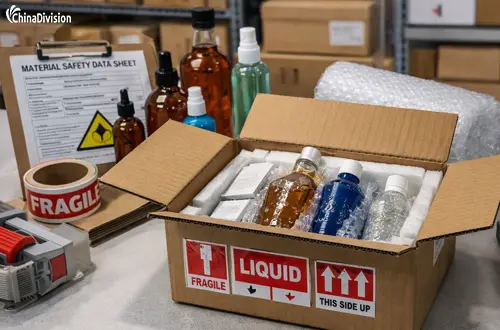
Proper packaging is the difference between a delivered order and a damage claim. We recommend a minimum of three layers for any liquid shipment, plus labeling:
Step 1 — Original Container with Headspace
Use leak-proof bottles and jars, and leave 5–10% empty space at the top. Liquids expand with altitude-related pressure changes and temperature swings — a full, sealed bottle on a hot tarmac or in an unpressurized cargo hold can crack or burst. Seal caps with strong tape. If the factory's original container is flimsy, repackage into sturdier bottles before shipping.
Step 2 — Waterproof Secondary Layer
Place each container in a sealable waterproof bag (or vacuum-seal it). This contains any leak at the source and protects every other item in the box — and, on a pallet, every other customer's cargo too.
Step 3 — Rigid Outer Box with Cushioning
Stand bottles upright in a double-wall corrugated box, separated by dividers. Fill every void with bubble wrap or foam pellets so nothing shifts in transit — movement, not pressure, is what breaks bottles. Add absorbent pads or paper towels between containers as a final leak backstop. Seal all seams with multiple layers of tape.
Step 4 — Label Everything
Apply "Fragile," "Liquid," and "This Side Up" arrows to the exterior. Add "Flammable" or "Perishable" labels where applicable. Shipping labels go on top. For temperature-sensitive liquids (probiotics, natural cosmetics, beverages), include gel packs and insulated liners — and verify the lane's transit time won't exceed the cooling window.
Step 5 — Verify Carrier Rules Before Sealing
Each carrier has its own liquid requirements (detailed below). And note: this protocol covers non-hazardous liquids only. If your product is flammable or you're unsure of its classification, hand it to a professional logistics agent with dangerous goods capability rather than improvising.
Quotable takeaway:Triple-layer packing — vented original container, waterproof bag, void-free rigid box — plus correct labels, is the baseline for shipping liquids internationally; anything less is a damage claim waiting to happen.
USPS vs. UPS vs. FedEx: Which Carriers Accept Liquids?
| Requirement | USPS | UPS | FedEx |
|---|---|---|---|
| Non-hazardous liquids | ✅ Accepted; containers over 4 oz must be triple-packed with absorbent material between layers (metal containers exempt) | ✅ Accepted; leak-proof containers + absorbent wrap recommended | ✅ Accepted; screw-cap leak-proof bottles, tape-sealed, upright |
| Flammable liquids (perfume, essential oils, solvents) | ❌ Prohibited | ⚠️ May be accepted through UPS dangerous goods services, subject to classification, packaging, and destination requirements | ⚠️ May be accepted through FedEx dangerous goods services, subject to classification, packaging, and destination requirements |
| Alcohol | ❌ Prohibited in USPS mail | ⚠️ Requires applicable licenses and a UPS shipping agreement; international restrictions may apply | ⚠️ Available only to approved, licensed shippers under applicable FedEx alcohol-shipping requirements |
| Labeling | Product information and applicable markings; follow USPS requirements for the specific liquid | Directional markings and required dangerous goods labels when applicable | Required dangerous goods labels and markings for applicable hazardous liquids |
| Glass containers by air | ⚠️ Subject to applicable packaging and service restrictions | ⚠️ Requires appropriate protective packaging; acceptance depends on the commodity and service | ⚠️ Wrap with suitable shock-absorbing material and use protective outer packaging |
Key distinctions most shippers miss:
- USPS is the most restrictive — no alcohol, no flammables (including most perfumes and alcohol-based nail products), and strict triple-packaging rules above 4 oz.
- UPS and FedEx accept a far wider range, including Class 3 flammables, but only through their formal dangerous goods programs — which means DG training certification, correct UN packaging, and surcharge fees.
- International ≠ domestic. Even where UPS/FedEx permit alcohol domestically with permits, most destination countries prohibit or tightly license small-volume alcohol imports — check destination customs law.
- Glass + air freight = avoid. Pressure changes and handling make glass the leading breakage cause; use plastic or aluminum where the product allows.
Quotable takeaway:USPS prohibits flammable liquids and alcohol entirely; UPS and FedEx accept them only as declared dangerous goods with MSDS documentation, UN-compliant packaging, and DG surcharges — and destination-country law can still forbid entry.
Dangerous Goods Classification: When Your Liquid Needs an MSDS
An SDS/MSDS may be required or strongly recommended when the liquid could be classified as dangerous goods, but an SDS is not automatically required for every ordinary liquid shipment. The exact requirement depends on the product, carrier, transport mode, destination, and applicable regulations.
An SDS generally helps logistics providers determine information such as:
- Chemical composition
- Flash point
- Physical and chemical properties
- Hazard classification
- Transport information
- UN number, when applicable
- Packing group, when applicable
- Handling and storage precautions
For example, perfume, nail-polish remover, paint, solvents, and some cleaning products can require substantially more scrutiny than ordinary shampoo or bottled water. FedEx specifically identifies products such as nail polish, nail polish remover, paint, perfume, solvents, and some aerosols as products that may fall under dangerous-goods requirements.
A better way to handle SDS requests
Instead of asking only"Do I need an MSDS?", provide your fulfillment provider with:
- Product name
- Product ingredients or composition
- SDS, if available
- Container size
- Number of units
- Origin country
- Destination country
- Preferred shipping method
This gives the logistics provider enough information to determine whether additional dangerous-goods review is necessary.
An MSDS (Material Safety Data Sheet) documents a substance's hazards and safe-handling requirements — and carriers or customs will demand it before accepting regulated liquids. Getting the classification right upfront prevents rejection, return, or destruction at the border.
| MSDS Requirement | Examples |
|---|---|
| Not required | Bottled water, juice, soft drinks, honey, shampoo, and lotion (harmless, non-flammable) |
| May be required (carrier-dependent) | Essential oils, fragrances, and cleaning products |
| Required for applicable regulated shipments | Wines and spirits, acetone-based nail polish remover, paints and solvents, flammable chemicals, aerosols, corrosive cleaners, and lithium-ion battery electrolyte |
Practical rules of thumb:
- Alcohol content is the fastest tripwire. Beverages and tinctures above roughly 24–70% ABV fall into DG territory; perfumes with high alcohol content are Class 3 flammables regardless of bottle size.
- Aerosols are always DG — pressurized containers (IATA Class 2) face strict quantity-per-package limits and many carriers refuse them in international small parcels entirely.
- Corrosives (Class 8) — drain cleaners, acids, some industrial liquids — need specialized packaging and routing.
- When in doubt, get the MSDS from your manufacturer before booking. "I didn't know it was flammable" is not a defense customs accepts — misdeclared dangerous goods can mean fines, seizure, and loss of carrier accounts.
Quotable takeaway:If a liquid is flammable, pressurized, corrosive, or high-alcohol, it needs an MSDS and dangerous goods handling; misdeclaring it as ordinary cargo risks fines, seizure, and termination of your carrier accounts.
Shipping Liquids for E-Commerce: The Fulfillment Angle
A practical fulfillment workflow is:
Product review → SDS/classification → Destination screening → Packaging test → Carrier/service selection → Customs setup → Warehouse SOP → Order fulfillment → Exception monitoring
This is particularly important when selling through Shopify, Amazon, WooCommerce, eBay, or crowdfunding campaigns because a single product may generate orders across multiple countries.
For brands shipping liquids direct-to-consumer at scale, packaging rules are only half the battle. The operational layer matters just as much:
- Carrier selection per SKU: route non-hazardous liquids via postal/express networks; segregate DG SKUs into a dedicated dangerous goods workflow with the few carriers and lanes that accept them.
- Insulated fulfillment windows: temperature-sensitive products need expedited lanes and gel-pack protocols validated against actual transit times — a 72-hour lane with a 48-hour cold pack fails.
- Damage-rate monitoring: track breakage per SKU and per lane. In our experience, most chronic liquid damage traces back to two causes: inadequate void fill and glass containers on air lanes. Both are fixable and both show up immediately in the data.
- Customs declarations: describe liquids accurately ("non-alcoholic skincare serum," not "cosmetics") with correct HS codes. Vague descriptions of liquid shipments are a red flag that triggers inspection holds.
Quotable takeaway:Scaling liquid e-commerce fulfillment requires segregating dangerous-goods SKUs into dedicated workflows, validating cold-chain against real transit times, and declaring liquids precisely at customs.
How Much Does It Cost to Ship Liquids Internationally?
International liquid shipping costs depend on destination, actual and dimensional weight, package dimensions, liquid type, packaging requirements, service level, and whether dangerous-goods or special handling applies.
The liquid itself does not automatically make shipping expensive. In many cases,packaging dimensions and chargeable weight have a bigger impact on the final parcel rate.
For e-commerce sellers, calculate the total fulfillment cost rather than looking only at the carrier transportation charge:
Total liquid fulfillment cost = Product handling + Packaging + Pick & Pack + Transportation + Special handling + Customs-related costs + Potential returns
For example, a glass bottle may require more protective packaging than a lightweight plastic bottle. That increases both material consumption and package dimensions.
This is why liquid sellers should test thefinal packed SKU, rather than estimating shipping costs from the liquid's net weight alone.
FAQs About Shipping Liquids Internationally
Can I ship shampoo and lotion internationally?
Often yes, provided the products are classified as non-hazardous and the carrier and destination country allow them. They should still be packaged with leak protection, cushioning, and appropriate outer packaging.
Can I ship perfume internationally?
It depends on the carrier and destination, but alcohol-based perfume can be regulated as a flammable liquid. USPS, for example, prohibits alcohol-containing perfume in international mail.
Can I ship alcohol internationally?
Potentially, but alcohol is a highly regulated commodity. Appropriate licenses, carrier agreements, customs documents, and destination-country permissions may be required. FedEx and UPS both impose specific requirements on alcohol shipments.
Do liquids always require an MSDS?
No. An SDS/MSDS is particularly useful when the product may be classified as hazardous or dangerous goods, but ordinary non-hazardous liquids do not automatically require one for every shipment.
Industry Resources
USPS Publication 52: Hazardous, Restricted, and Perishable Mail
USPS: Flammable and Combustible Liquids
USPS: International perfume restrictions
Everything You Need to Know About Shipping Liquids Internationally


About the Author: Limi

Limi is a content marketing expert at ChinaDivision, helping businesses and e-commerce sellers navigate the complexities of international shipping by providing actionable tips and comprehensive guides on logistics, shipping, and cargo transportation.