

Step-by-Step Guide to Tire Shipping and Packaging
Shipping tires safely, cost‑effectively, and compliantly is straightforward when you follow standardized packaging, labeling, and carrier selection rules. Whether you ship tires loose or mounted on rims, domestically or across borders, correct preparation prevents damage, reduces fees, and ensures smooth customs clearance. Below is a complete professional guide — with international standards, comparisons, and expert advice from ChinaDivision, your trusted global fulfillment partner.
Table of Contents
- Why tire shipping needs a careful process
- Two Main Scenarios: Tires Only vs. Tires With Rims
- Step‑by‑Step Packaging Instructions
- Choose the Right Shipping Method
- Best Practices to Save Cost & Avoid Issues
- Common Tire Shipping Mistakes to Avoid
- Why Automotive Businesses Outsource Tire Fulfillment
- Why Choose Chinadivision for Tire Shipping and Fulfillment?
- Frequently Asked Questions (FAQ)
Why tire shipping needs a careful process
At first glance, tires may seem easy to transport because they are durable products. However, tire shipments create several logistics challenges that can significantly affect shipping costs and customer satisfaction.
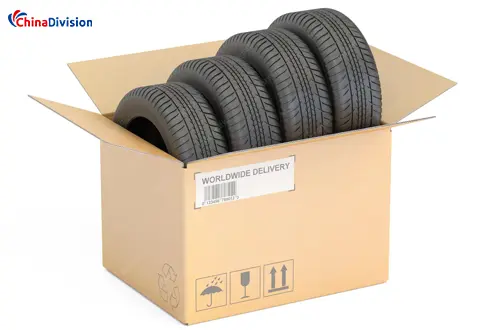
Tire shipping is more complex than shipping many other auto parts because tires are bulky, irregular in shape, and easily affected by packaging quality and carrier handling. If the shipment is going abroad, customs documentation, transit time, and carrier selection become even more important.
Common challenges include:
- Large dimensional size
- Irregular package shape
- High freight costs
- Potential wheel or rim damage
- Customs clearance requirements
- Carrier surcharges for oversized shipments
For ecommerce sellers, tire distributors, wholesalers, and automotive brands, poor packaging can result in damaged products, delivery delays, and expensive returns.
Proper tire shipping procedures help reduce these risks while ensuring products arrive in excellent condition.
Two Main Scenarios: Tires Only vs. Tires With Rims
The method changes completely depending on whether rims are attached. Here is the core difference:
| Type | Packaging Need | Weight | Cost | Risk Level |
|---|---|---|---|---|
| Tires Only | Minimal; No Box Needed | Lighter | 💲 Lowest | Low |
| With Rims / Wheels | Full Protection; Padding + Rigid Layers | Heavier | 💲💲 Medium | High (Cosmetic Damage Risk) |
International Note: Cross‑border requires extra care — compliant packing, accurate value declaration, and correct documentation to avoid customs holds.
Step‑by‑Step Packaging Instructions
| Packaging Method | Protection Level | Cost | Best Application |
|---|---|---|---|
| Stretch Wrap Only | Basic | Low | Tires Without Rims |
| Stretch Wrap + Cardboard | Medium | Low-Medium | Standard Wheel Assemblies |
| Bubble Wrap + Cardboard Discs | High | Medium | Alloy Wheels |
| Custom Wheel Packaging | Maximum | High | Premium Wheels |
Scenario 1: Shipping Tires Without Rims
Best for: bulk shipments, replacement tires, cost‑saving shipping.
- Clean & Inspect
- Remove dirt, grease, or debris. Check for existing damage; document photos if needed.
- Deflate Slightly
- Reduce pressure to ~15–20 PSI. Prevents sidewall damage, lowers volume, and reduces dimensional weight charges.
- Wrap Securely
- Use heavy‑duty stretch wrap / shrink wrap — 3–5 layers
- Covers tread and sidewalls; keeps clean and protected
- Bundle 1–2 tires together (cheaper than single shipments)
- Optional: add cardboard discs on flat sides for extra protection.
- Label Correctly
- Place label on flat tread area — avoid curved sidewalls
- Dual labeling: main label + backup sticker inside wrap
- Mark: “TIRES – NO COMMERCIAL VALUE” if samples; include HS code 4011/4012 for customs.
- Final Check
- No loose ends; package firm and stable.
Scenario 2: Shipping Tires With Rims / Wheels
Best for: full sets, high‑value wheels, finished assemblies. High risk of scratches or bending.
- Prepare Components
- Remove loose parts: center caps, bolts, valves
- Deflate slightly (~15 PSI)
- Clean rim and tire thoroughly
- Protect Sensitive Areas
- Cut 2 cardboard circles matching rim diameter
- Wrap full wheel in bubble wrap — extra layers on spokes and edges
- Place cardboard discs front + back to shield painted/chrome surfaces.
- Secure Assembly
- Wrap entire unit tightly in stretch wrap
- Tape all edges; use H‑tape method for strength
- Optional for international: place in heavy‑duty corrugated box; fill gaps with foam/air pillows.
- Label & Mark
- Apply label to flat side
- Mark: “FRAGILE – WHEELS”; weight + dimensions clearly shown
- Insurance Mandatory
- High‑value goods → insure for full replacement value.
Choose the Right Shipping Method
Select based on quantity, urgency, destination, and budget.
| Method | Best For | Transit Time | Cost | Notes |
|---|---|---|---|---|
| Express (DHL / FedEx / UPS) | 1–4 Tires; Urgent Shipments | 3–7 Days | 💲💲💲 | Door-to-Door Service, Full Tracking, Customs Support |
| Air Freight | 4–20 Tires; Fast Delivery | 5–12 Days | 💲💲 | Airport-to-Airport or Door-to-Door Options |
| Rail Freight (China–EU) | 4–40 Tires | 12–20 Days | 💲💲 | Lower Cost Than Air Freight; Stable Transit Schedule |
| Sea Freight LCL | More Than 10 Tires; Non-Urgent Shipments | 25–45 Days | 💲 | Lowest Cost Option; Ideal for Bulk Orders |
| Postal / Special Line | Small Batches; Budget-Conscious Shipments | 7–20 Days | 💲 | Economy Service; Suitable for Samples and Test Orders |
ChinaDivision Recommendation:
- 1–4 pcs → Express / Special Line
- 5–20 pcs → Air / Rail
- 20+ pcs → Sea LCL / Full Container
International Shipping Rules
- HS Code: 4011 (new tires) / 4012 (used/retreaded)
- Documentation: Commercial invoice, packing list, certificate of origin
- Value Declaration: declare actual cost; mark clearly “AUTO PARTS – TIRES”
- Restrictions: Some countries limit used tires; confirm before shipping.
Best Practices to Save Cost & Avoid Issues
- Optimize Size → Cut Fees
- Deflate → smaller volume → lower DIM weight
- Bundle 2 together → 1 shipment instead of 2
- Avoid over‑packaging → extra weight = extra cost.
- Label Smart
- Dual labels = no risk if one is damaged
- Write HS code + country of origin clearly
- For bulk: mark cartons sequentially 1/4, 2/4….
- Avoid Surcharges
- Check carrier rules: some charge extra for “non‑standard” shapes
- Professional packing reduces “irregular package” fees by 90%
- Insurance Always
- Tires/wheels are high‑value; 0.5–1% of value covers full loss/damage
- Use a Professional Fulfillment Partner
- We handle all rules, docs, and carrier negotiations
- Up to 60% cheaper than direct booking
- Zero mistakes in international compliance
Common Tire Shipping Mistakes to Avoid
Using Insufficient Packaging
Inadequate protection often leads to wheel scratches and cosmetic damage.
Ignoring Dimensional Weight
Large tires frequently incur dimensional-weight charges that exceed actual weight costs.
Applying Labels Incorrectly
Poor label placement can create delays and increase the risk of lost shipments.
Choosing the Wrong Carrier
Not all carriers specialize in oversized automotive products.
Neglecting Customs Requirements
Missing documentation is one of the leading causes of international shipping delays.
Why Automotive Businesses Outsource Tire Fulfillment
As order volume grows, managing tire storage, packaging, and shipping internally becomes increasingly difficult.
Professional fulfillment providers offer:
- Warehouse storage
- Inventory management
- Pick and pack services
- Carrier rate optimization
- International shipping expertise
- Customs documentation support
- Returns processing
Outsourcing allows automotive businesses to focus on sales and growth rather than logistics operations.
Why Choose Chinadivision for Tire Shipping and Fulfillment?
For tire distributors, automotive brands, and ecommerce sellers, successful logistics requires more than simply moving products from one location to another.
Chinadivision provides a complete fulfillment solution that includes:
- Tire warehousing and storage
- Professional pick and pack operations
- Wheel and tire packaging services
- Global shipping management
- Freight forwarding solutions
- Customs documentation assistance
- Ecommerce platform integrations
- B2B and wholesale fulfillment
- Returns management services
Whether you sell through Shopify, Amazon, eBay, Walmart Marketplace, or your own online store, Chinadivision helps reduce logistics complexity while improving shipping performance worldwide.
Frequently Asked Questions (B2B Focus)
Q1: Do I need a box to ship tires?
A: No — for loose tires, stretch wrap only is accepted by all major carriers. With rims, cardboard + wrap is enough; boxing optional but safer internationally.
Q2: What documents do I need for export?
A: Commercial invoice, packing list, certificate of origin. We prepare and validate all automatically.
Q3: Can I ship used tires internationally?
A: Many countries restrict or ban used tires. We verify destination rules before shipping to prevent seizure.
Q4: How do you calculate shipping cost?
A: Based on actual weight OR volumetric weight — whichever is higher. We optimize packaging to minimize this.
Q5: Can you store and ship tires in bulk?
A: Yes — our warehouses have dedicated heavy‑goods storage; we pick, pack, and ship by order.
Source Recommendations
FedEx Shipping Guide – Automotive Parts: https://www.fedex.com/en-us/shipping/how-to-ship-automotive.html


About the Author: Limi

Limi is a content marketing expert at ChinaDivision, helping businesses and e-commerce sellers navigate the complexities of international shipping by providing actionable tips and comprehensive guides on logistics, shipping, and cargo transportation.