

Ecommerce Product Fulfillment: Complete Guide for International Sellers
Ecommerce product fulfillment is the end-to-end process of receiving, storing, picking, packing, and shipping online orders to customers—encompassing inventory management, order processing, and returns handling. For B2B sellers and e-commerce businesses operating internationally, professional fulfillment services like ChinaDivision's can reduce shipping costs by 25–40% and cut delivery times in half through strategic inventory distribution, while eliminating the operational burden that diverts focus from growth activities like marketing and product development.
Table of Contents
- What Is Ecommerce Product Fulfillment?
- The Five Critical Steps of Ecommerce Product Fulfillment
- How Ecommerce Product Fulfillment Differs from Traditional Fulfillment
- The Four Core Ecommerce Product Fulfillment Models
- Ecommerce Product Fulfillment for Different Platforms
- Frequently Asked Questions: International Ecommerce Product Fulfillment
- Ready to Optimize Your Ecommerce Product Fulfillment?
What Is Ecommerce Product Fulfillment?
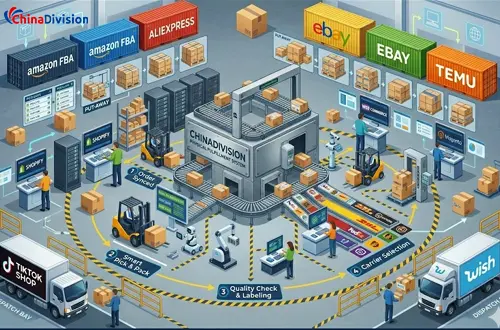
Ecommerce fulfillment refers to the complete operational chain that transforms a digital order into a delivered package. Unlike traditional retail fulfillment—which ships bulk pallets to distribution centers—ecommerce product fulfillment handles individual orders shipped directly to consumers, demanding faster turnaround times (typically 24–48 hours), seamless platform integrations, and constant customer communication.
As a professional international order fulfillment service provider, ChinaDivision manages this entire process for B2B sellers sourcing from global manufacturing hubs, ensuring that products move from factory to customer with maximum efficiency and accuracy.
The Five Critical Steps of Ecommerce Product Fulfillment
| Step | Description | Key Metric |
|---|---|---|
| 1. Inventory Receiving & Storage | Goods arrive at the fulfillment center, are counted, inspected, and placed in optimized warehouse locations. | 99.5%+ receiving accuracy |
| 2. Order Processing & Integration | Orders automatically sync from sales platforms (Shopify, WooCommerce, Amazon) to the WMS. | Real-time synchronization |
| 3. Pick, Pack & Quality Verification | Items are retrieved, packed with appropriate materials, and verified for accuracy. | 99.5%+ pick accuracy |
| 4. Shipping & Carrier Optimization | Packages are routed through the most cost-effective carrier based on destination, weight, and speed requirements. | 25–40% cost reduction via zone optimization |
| 5. Returns Management & Recovery | Returned items are inspected, restocked if sellable, and inventory updated. | <24-hour restocking for sellable goods |
How Ecommerce Product Fulfillment Differs from Traditional Fulfillment
Understanding the distinctions between ecommerce fulfillment and traditional retail fulfillment is essential for B2B sellers evaluating their logistics strategy.
| Factor | Traditional Retail Fulfillment | Ecommerce Product Fulfillment |
|---|---|---|
| Order Size | Bulk pallets (hundreds/thousands of units) | Individual orders (1–10 units typical) |
| Shipping Speed | Weekly or bi-weekly schedules | 24–48 hour processing; 2–5 day delivery |
| Customer Communication | Minimal direct contact | Automated confirmations, tracking, delivery updates |
| Platform Integration | ERP-focused; minimal sales channel connectivity | Real-time sync with Shopify, WooCommerce, Amazon, eBay |
| Returns Handling | Bulk returns to suppliers | Individual customer returns with fast restocking |
| Inventory Visibility | Periodic counts; batch updates | Real-time tracking across all sales channels |
The shift from pallet-based to piece-picking operations fundamentally changes warehouse design, technology requirements, and labor management. B2B sellers transitioning to direct-to-consumer models must adapt their product fulfillment infrastructure accordingly—or partner with specialists who have already optimized for ecommerce complexity.
The Four Core Ecommerce Product Fulfillment Models
B2B sellers can choose from four primary fulfillment approaches, each with distinct trade-offs in control, cost, and scalability.
Model Comparison Overview
| Model | Control Level | Capital Investment | Best For | Key Risk |
|---|---|---|---|---|
| In-House Fulfillment | Maximum | High (facilities, equipment, WMS) | Small operations (<20–30 orders/day) with specialized products | Scalability limits; operational distraction |
| Third-Party Logistics (3PL) | Moderate | Low (pay-per-use) | Growing sellers (30+ orders/day) seeking expertise without capital outlay | Provider dependency; requires vetting |
| Dropshipping | Minimal | Very Low | Testing markets; avoiding inventory risk | Quality control loss; shipping speed uncertainty |
| Hybrid Fulfillment | Strategic | Moderate | Established sellers combining international sourcing with domestic speed | Coordination complexity |
In-House Fulfillment: Maximum Control, Limited Scale
In-house ecommerce fulfillment means managing all operations internally—receiving inventory, storing goods, processing orders, packing shipments, and coordinating carrier pickups. This model works well for very small operations (under 20–30 daily orders) or businesses with highly specialized products requiring unique handling protocols.
When to Consider In-House:
- Order volume remains below 30 per day
- Products require proprietary packaging or assembly
- Margin structure cannot absorb 3PL fees
- Founders have logistics expertise and available space
Critical Limitation: The transition point arrives when fulfillment consumes 2–3 hours daily. Beyond this threshold, in-house operations typically suffer from rising error rates, inflated shipping costs (due to lack of carrier volume discounts), and customer complaints that damage brand reputation.
Third-Party Logistics (3PL): Scale Without Capital Investment
Outsourcing ecommerce product fulfillment to a 3PL provider transfers warehousing, order processing, packing, and shipping to specialists who leverage economies of scale, established carrier relationships, and operational expertise. This eliminates capital investment in facilities, equipment, and warehouse management systems while providing immediate access to professional-grade infrastructure.
3PL Advantages for International Sellers:
- Negotiated carrier rates typically 20–40% below small-volume pricing
- Multi-channel inventory synchronization preventing overselling
- Peak season staffing without recruitment burden
- Geographic distribution reducing shipping zones and costs
- Compliance expertise for international shipping regulations
ChinaDivision specializes in international product fulfillment, bridging the gap between overseas manufacturing (particularly China-based sourcing) and end-customer delivery across North America, Europe, and Asia-Pacific markets.
Dropshipping: Inventory-Free Fulfillment
Dropshipping eliminates inventory holding by having suppliers ship directly to customers upon order receipt. While this minimizes upfront capital requirements, it surrenders control over ecommerce fulfillment speed, packaging quality, and overall customer experience.
Dropshipping Suitability:
- Market testing for unproven products
- Extremely limited startup capital
- Digital products or print-on-demand goods
- Supplementary product lines outside core inventory
Critical Caution: For B2B sellers building brand reputation, inconsistent delivery times and generic packaging from dropship suppliers can erode customer trust. Most successful sellers transition to held inventory or hybrid models once product-market fit is established.
Hybrid Fulfillment: The Strategic Advantage
Hybrid ecommerce fulfillment combines multiple approaches strategically. The most effective configuration pairs international sourcing (typically from China) with domestic fulfillment centers—stocking fast-moving products in local warehouses for 2–4 day delivery while shipping slower-moving items directly from overseas to optimize inventory carrying costs.
Hybrid Model Structure:
| Inventory Location | Product Type | Delivery Speed | Cost Structure |
|---|---|---|---|
| Domestic Warehouse | Fast-moving SKUs; high-demand items | 2–4 days | Higher storage; lower shipping |
| International Hub | Slow-moving SKUs; bulky items; test products | 7–15 days | Lower storage; higher shipping |
| Direct from Supplier | Dropship-only items; made-to-order | 10–20 days | Minimal inventory risk |
This model delivers the cost advantages of overseas manufacturing with the competitive delivery speed that modern consumers expect—making it ideal for growing B2B sellers scaling internationally.
Ecommerce Product Fulfillment for Different Platforms
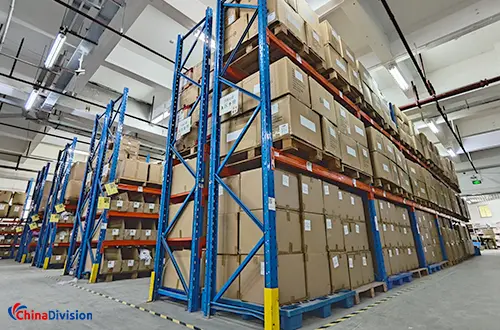
Platform-specific requirements significantly impact your ecommerce product fulfillment strategy and provider selection.
Shopify Product Fulfillment Integration
Shopify sellers benefit from a robust ecosystem of fulfillment integrations. Third-party fulfillment apps in the Shopify App Store sync inventory automatically, forward orders to fulfillment centers in real-time, and push tracking information back to customers—creating a seamless merchant and buyer experience.
Shopify Fulfillment Considerations:
- Native Shopify Fulfillment Network availability varies by region
- Third-party apps offer broader geographic coverage
- Hybrid approaches (domestic + international inventory) work particularly well for Shopify stores with global customer bases
- Automated tax and duty calculations essential for international orders
ChinaDivision's Shopify integration enables automatic order import, real-time inventory updates, and tracking synchronization—allowing sellers to maintain their storefront while we handle the operational complexity.
WooCommerce Fulfillment Integration
WooCommerce's open-source architecture provides exceptional flexibility but requires more technical configuration than Shopify. Fulfillment providers offer WooCommerce plugins handling order synchronization, inventory updates, and tracking data transmission.
WooCommerce Fulfillment Advantages:
- Complete data control through self-hosted infrastructure
- Extensive customization of fulfillment workflows
- Direct database integration for advanced reporting
- No platform-imposed fulfillment restrictions
The trade-off is higher technical overhead. B2B sellers without development resources should prioritize providers offering dedicated WooCommerce integration support and clear documentation.
Multi-Channel Selling and Centralized Fulfillment
Selling across multiple platforms—Shopify, Amazon, eBay, Etsy, and social commerce channels—creates significant inventory synchronization challenges. Without proper integration, products may appear available on multiple channels while existing only once in your warehouse, leading to overselling and fulfillment failures.
The Centralized Inventory Solution:
Professional ecommerce fulfillment systems act as the single source of truth for inventory. When an item sells on any channel, the system immediately decrements available inventory across all platforms. This prevents overselling while maximizing sales opportunities across every touchpoint.
| Challenge Without Centralization | Solution With Professional Fulfillment |
|---|---|
| Overselling across channels | Real-time inventory sync across all platforms |
| Manual stock updates | Automated decrementing on every sale |
| Channel-specific reporting | Unified analytics across all sales channels |
| Separate shipping processes | Single pick-pack-ship workflow for all orders |
Frequently Asked Questions: International Ecommerce Product Fulfillment
Q: At what order volume should I switch from in-house fulfillment to a 3PL?
A: The transition threshold is typically 30–50 orders daily or when fulfillment consumes 2–3 hours of your time. However, international sellers may benefit from earlier transition due to the complexity of customs documentation, multi-carrier optimization, and cross-border compliance that 3PLs handle routinely.
Q: How does the hybrid fulfillment model reduce my overall costs?
A: Hybrid models optimize the inventory cost-speed trade-off. Fast-moving SKUs stored domestically reduce shipping costs by 25–40% through zone optimization, while slower items shipped directly from China minimize inventory carrying costs. The net effect is lower total fulfillment cost per order compared to single-location strategies.
Q: What platform integrations are essential for multi-channel sellers?
A: At minimum, your fulfillment provider should offer real-time integration with Shopify, WooCommerce, Amazon, and eBay. For B2B sellers, EDI capability and API access for custom integrations are also critical. ChinaDivision supports 50+ platform integrations with automatic inventory synchronization.
Q: How do I prevent overselling across multiple sales channels?
A: Professional fulfillment systems act as a centralized inventory source. When an order processes on any channel, available inventory decrements across all platforms immediately. ChinaDivision's WMS provides this synchronization with <5-second update latency.
Q: What are the hidden costs I should watch for in fulfillment contracts?
A: Common hidden fees include dimensional weight surcharges, long-term storage penalties, account maintenance fees, minimum monthly charges, returns processing fees, and packaging material markups. ChinaDivision operates on fully transparent pricing with no hidden charges.
Q: How quickly can I scale fulfillment during peak seasons?
A: Professional providers with elastic infrastructure can scale 3–5x within days. ChinaDivision maintains surge staffing protocols and pre-positioned inventory strategies, ensuring holiday volume doesn't compromise delivery speed or accuracy.
Q: How does geographic inventory distribution affect my shipping costs?
A: Shipping costs are zone-based—increasing with distance from origin. Single-location fulfillment forces distant customers into expensive zones. Multi-hub distribution places inventory closer to customers, reducing average zone and cutting costs 25–40%.
Ready to Optimize Your Ecommerce Product Fulfillment?
Your ecommerce product fulfillment strategy directly determines your ability to compete in global markets. Rather than navigating the complexity of international logistics, customs compliance, and multi-channel inventory management alone, partner with ChinaDivision—where international sourcing expertise meets professional fulfillment infrastructure.
From optimized ecommerce fulfillment processes to hybrid inventory strategies that balance cost and speed, we provide the operational foundation that allows B2B sellers to focus on what they do best: building products and growing their business.
Contact ChinaDivision today for a free fulfillment assessment and discover how professional international product fulfillment accelerates your global expansion.
recommended resources:
Shopify Fulfillment Network documentation: Shopify Help Center — Fulfillment options and dropshipping services
Incoterms guidelines: ICC — Incoterms® rules


About the Author: Limi

Limi is a content marketing expert at ChinaDivision, helping businesses and e-commerce sellers navigate the complexities of international shipping by providing actionable tips and comprehensive guides on logistics, shipping, and cargo transportation.